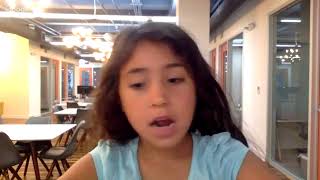
Michael Strong works through estimation with six-year-old Alana using her real question: how many hairs are on a classmate's head. They group hairs into clumps of ten, then fifty and a hundred, to multiply their way to an answer. Alana's learning a practical skill while solving a problem she actually cares about.
Chapters
Well, what are you doing this morning?
I'm at Nova right now. I was just working on some Make stuff.
What is the Make stuff you're working on?
So I'm working on like posters and videos.
What are the posters and videos for?
The Make project that me and some of my jiu-jitsu friends are doing.
I see. And can you say why you're doing it?
To raise money for families and kids who don't have enough money for jiu-jitsu, I think.
Excellent, excellent. Well, that's exciting. Do you remember what we were talking about last week?
Actually, not really, no.
That's okay. We were talking about estimation. Do you remember what estimation is? Eh. Okay. Um, we were trying to figure out how to estimate the number of hairs on Logan's head.
Oh yeah.
Now you remember it?
Yeah. I did not do that. I, like, I don't know why, but like—
That's totally fine. So do you want to keep thinking about that or do you want to think about something else?
We can keep thinking about that.
Okay. So one of the things— well, let me give you what I remember we got to and see if it sounds familiar, okay? So one of the problems is he's got so many hairs on his head, if you just counted them one by one, you'd probably get lost in terms of—
Oh yeah, I'd probably get lost because I would probably count them again and like—
Exactly. So you had an idea for how to, how to not to get lost. Do you remember that?
I have. Yeah, I remember my idea.
What was your idea?
So, so I would like put either a braid or a ponytail on each of 10 hairs on his head.
That's exactly right.
I don't count them again, and what, and however many 10s there are is our answer, because like if there is 2 tens, I mean like actually 10 tens, that would be 100 hairs.
That's exactly right, and you were actually figuring out how to multiply by 10. Um, so it sounds like you already know 10 tens is 100. Um, I want to do just a little bit more of multiplication by 10. How many— suppose you had, um, 15 clumps of hair and each clump was 10 hairs. How many hairs would that be?
15.
15 times 10. So each clump has 10 hairs and you have 15 of these clumps. It's 10 times 15. So let's go back. So 10 times 2 is how many?
20, I think.
And 10 times 3?
30.
10 times 5?
50.
10 times 9?
90.
10 times 10?
100?
Let's try 10 times 11.
10 times 11?
Mm-hmm.
21?
No. So what is— what is— so 10 times 10, one way to think about it, well, 10 times 10 is already 100. You've got that one. So 11 is the same as 10 plus 1, right? So suppose you have 10 times 10 over here, and my— I don't have enough fingers, so you just have to say 10 times 10 over here, and you have 1 more 10 over here. If you have 100 over here and you have 1 more 10, what is 100 plus 10?
100 plus 10 is 110.
Exactly. And so 11 times 10 is 110. Does that make sense?
Uh, kind of.
Okay, so 10 times 10 is 100. 11 times 10 is 110 because it's just 1 more 10 than 100. How about 12 times 10?
12 times 10? 102?
120.
Oh, 120.
So you mean every, you know, beyond 100, if you have 2 more tins, you don't have 2 more ones. If you had 100 plus 2, that would be 102. But if you have 120 more, that is 2 tins, then you have 120. Is it starting to make sense?
Kind of.
Okay, so this is hard math. We're getting— but I'm just— the reason I'm doing this, going back to Logan's head, hair is is I bet he's got more than 10 clumps of hair. If you start braiding clumps of 10, I bet he's got more than 10 clumps of hair on his head. So I think we're going to have to get to bigger numbers than 100. So is this an experiment you think you could actually carry out, or is it too hard?
Maybe I could do it. I'll try.
Okay, um, or maybe somebody who's easier, who would sit still longer, like your mom or dad?
I could do my mom.
Okay, did she— can you braid her hair?
What did you say?
Can you braid your mom's hair?
Braid? I don't know how to braid. All I know how to do is like a bun and a ponytail.
Okay, I bet you're old enough that you could learn how to braid. It could actually be that 10 hairs is too small to form a braid. I bet most people like braids that are bigger than that. So suppose— let's look at it a different way. Suppose we were braiding— how about this? Suppose we were braiding 100 hairs at a time. So that's a thicker braid, but then we can count a lot more hair a lot more quickly. So suppose we were braiding 100 hairs at a time, then how many, how many hairs would 2 braids be?
100 hairs at a time?
Yeah, 100. If each braid is 100 hairs and we have 2 braids, how many, how many hairs is that?
200.
And if we have 3 braids at 100 hairs each?
300.
7?
700.
9?
900.
10?
1,000?
Yep, that's exactly right. So now I'm beginning to wonder, I'm just trying to guess, I wonder if I 1,000 hairs is— because I know we have more than 100 hairs. I just think, you know, you think about how tiny hairs are, and it seems like 100 would not be enough on a whole head. 1,000, maybe we're getting closer. So if we could— if you could do a braid of 100 hairs each, which might be hard, but then it would only be 10 of those to get to 1,000, and then we could actually count somebody's hair. On their head. Or maybe if 100 hairs in a braid is too much, how about we do 50 hairs in a braid?
Excuse me?
I'm thinking if 100 hairs in a braid is too many, maybe that's too big a clump of hair, maybe we do 50 hairs in a braid.
50, that would be kind of a good idea.
Okay, so if it's 50 hairs in a braid, how many hairs would 2 braids be?
If we had 50 in like one braid?
Yeah.
Like how many 50s?
Wait, if you have 2 braids and each braid has 50 hairs, how many hairs do we have?
100.
Yep. And how about if we have 4 braids, each of which has 50?
4 braids of 5?
Yep, of 50.
All I've got to is 200 with 1 4.
200. 200 is correct. 200 is correct. So what we're doing is by— we're looking at different ways to solve this problem. Estimating how many hairs on a head, I think, is a pretty hard problem. You know, just part of it is, you know, we'd have to go into somebody's head and see how many hairs are in a little tiny space. And then I love your idea of we braid them together, you know, we braid some clump of them together, and then we count the braids. And I bet actually that you'll really love braiding. I think braiding is kind of cool. Have you seen anybody braid anybody's hair? Do you know what it's like?
I've seen my mom mostly braid my hair, my hair, her hair, or my brother's hair.
Does it take very long for her to braid your hair?
I would say not too long.
Okay, of course he's not counting the hairs. It will go a lot more slowly if you're counting the hairs in the clumps of 50 or 100. So I think it would be— how about, how about for now let's just think of you doing one braid of a certain number of hairs, maybe 10, maybe 20, maybe 50, and then part of it is you need to learn to braid, and then we also see if this really is a good way to count hairs. Does that sound like a good project?
Mm-hmm.
Okay.
And it also sounds like an experiment, because I like— I can like braid somebody's hair in like 50s or 10s or 100s.
Exactly, exactly. So it's an estimation experiment, and you get to learn how to braid in the process. Sound good? Mm-hmm. Okay, well, I'll let you continue on your Make project, which is a wonderful project. And we will talk next week, okay?