Socratic educator Michael Strong with father Ryan Nohea Garcia
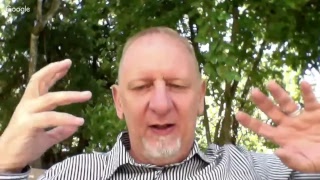
Educator Michael Strong uses Socratic questions with father Ryan Nohea Garcia and his two children to explore how Alana learns to read from her father's unpublished book "The Second ABCs," and what her baby brother Logan understands about language and his own name.
Chapters
Anna, can you hear me?
Well, we didn't hear. I had to turn up the volume. Oh, loud and clear.
How are you? Good, good.
How are you?
I'm well, thank you very much for asking. I'm— you see this big— we have a great big yard with lots of nature and trees. Wow. Do you like nature?
Yeah.
You like trees and grass?
Yeah.
What do you like best about nature?
That we can find animals.
Ooh, what are your favorite animals to find?
Giraffes.
Have you ever found a giraffe? Yes.
No.
Not yet.
Because they don't have a yard yet.
Oh, okay. How about frogs? Have you ever found frogs?
No.
We found frogs in Hawaii.
Oh yeah.
Yeah. Yeah. How about beetles? You like beetles?
Yeah. Um, one time I think I saw one in San Diego.
A beetle. How about cats?
Um, I think cats, but I don't have one.
Well, it's probably good not to touch strange pets. Sometimes animals can bite you and give you diseases and things. You got to be careful which ones.
Yeah.
So my son, when I was— I had a son who was your age once. I have a son, he was your age. One time he got bit by a squirrel. He tried to reach his hand out and pet a squirrel and it bit his finger. And we had to take him to the hospital. That sounds scary?
It doesn't sound scary.
But you don't want to get bit by a squirrel, do you?
Yeah, I don't want to get bit by a squirrel.
Okay.
Every time one of my friends and me try to catch one, they always run away, but they do not bite us.
Good, I'm glad they don't bite you. They're not supposed to bite you. They're supposed to run away. That's what good squirrels do. They run. And do you have any pets at home at all or any animals at home at all? Even fish?
I don't have any animals at my home, but I have a toy dinosaur though.
A toy dinosaur?
Yeah.
And Logan.
And Logan, is Logan your pet?
Yeah.
Yeah, I think you love your baby brother. You love your baby brother?
Yeah, I do.
I thought you did. So your daddy wrote a book, The Second ABCs. Is that what it's called?
The Second Birth to the ABCs.
You know it by heart? Do you remember it?
The what?
You remember it? The Second Birth to the ABCs?
What is it about?
It's about reading.
Can you say a little bit more? Can you say the first couple of lines? What are the first couple of lines? Daddy, what are you doing?
Daddy, what are you doing?
I'm reading, dear one.
What is reading?
Reading is a human technology that helps us learn by revealing the thoughts and information expressed in writing.
What's the next one?
Why do you read?
Why do you read, Daddy?
Well, we'd probably be better if we had that book in front of us, but it's not published yet.
Got it, got it. Well, so what do you like about reading, Alana?
That we can learn. Anything.
And do you know how letters relate to words? How do you go from a letter like an A or a B or a C to a word? Is it magic?
Letters have sounds, sounds form words, words form sentences, which express thoughts. All you have to do is learn how to like songs The two California lights in the west.
Wow, that sounds really complicated. Is that complicated? Is it hard to read?
No.
Well, Logan doesn't know how to read, does he?
He does not.
Why does Alana know how to read but not Logan?
Um, because that was my first, and Daddy and Mommy teach to me first.
Taught me.
Taught me first.
I see. So could you teach other people how to read?
Um, one day.
Do you think you could teach Logan how to read?
Yeah. And we can have it every night.
Logan is learning how to read.
Yeah.
How can you tell? I don't know. Does Logan listen to you when you read to him?
Yeah.
Sit still. You think Logan understands what you say?
Yeah.
How can you tell?
I don't know.
If a dog is barking, do you understand what a dog is saying when the dog barks?
No.
Can you understand Logan when he's making sounds right now?
Sometimes.
Sometimes.
But when I hear him, he seems just— I don't understand Logan.
Yeah.
Oh, what did he say? What's he saying right now? Can you translate? Yeah, what did Logan just say?
Uh, what?
Speak loud.
Okay, so I don't know what he's saying right now.
Oh, you don't know what he's saying right now?
Yeah, well, Alana does a great job in truth translating for Logan. Um, sometimes she states the obvious, like he'll knock over his cup of water and she'll say, he's not thirsty. But other times she's very helpful. They're forming a close bond. And Logan has a very serious face and serious look. But the times where he's not looking serious at all and when he looks really just relaxed and happy is when he's with his sister or chasing his sister or following his sister or watching his sister.
Got it. So Alana, I have another question for you. Are you ready for another question?
Yeah.
Okay, what if— I'm going to try, I want you to imagine something, okay? What if when you talk to Logan, you sound almost just like he sounds to you? So when you say, "Hi Logan, how are you?" Logan hears, "Blah blah blah blah blah." Is that possible?
That's funny.
Do you think that might be the case though?
Yeah.
So maybe Logan is just hearing, you know, your mom and dad and you talking all the time, and he just thinks all these people, "Mum, mum, mum, mum, mum." Yeah. Maybe so. So in which case, maybe he doesn't understand you, but you think sometimes he does.
Yeah.
Do you think that just like sometimes you understand him, sometimes he understands you?
Yeah.
So give me one word you think he understands. Uh, I'll let you think about it. I'm asking you really hard questions.
What does Logan understand?
So while Alana's thinking, and I love how hard you think, Alana, you are really a hard thinker. I see your eyes, you start thinking and thinking and thinking. It's wonderful, it's wonderful. So I'm gonna just comment and add. What's interesting to me is the way she does have a model of Logan's mind. And so when I did the hypothetical of what if he was hearing her just as blah blah blah, she got it immediately, she thought it was funny. And now I'm trying to get her to think about you know, what might be the case in terms of what Logan understands and when. And I would say it's beginning to model other human beings' minds in your own mind is a very sophisticated process. Again, Alana is doing great for her age. We're kind of stretching her a little bit in terms of how far to go in terms of really figuring out what Logan understands, what he doesn't understand, And then likewise, what she understands of him and vice versa. In a funny way, it's a very, very, um, early version of, you know, when you and I were reading and talking about Plato. Are we understanding Plato? Do I understand Plato the same way you do? Do you understand Plato the same way I do? What's going on with Plato? You know, a lot of it sounds very different when— what is Logan saying? But it's still a matter of trying to model and understand other people's minds. And I think Alana is doing a great job.
She's doing a good job. And there's a lot of words that she says, a lot of phrases that she says to Logan that he understands. Like, Alana, when you call Logan, sometimes he'll come to you. Or if you ask him if he's thirsty, you ask him if he wants agua or banana. Or you'll say, Logan, hold my hand, and he'll reach for your hand. There's a lot of things that he understands that that you communicate to him.
So, Alana, I want to check to see what you think. We know what your dad thinks. What I care about is what—
Indeed.
So, Alana, do you think that Logan knows his own name?
Um, yeah, because like, um, let me call— Call Lily or Logan. He like— He like looks to us and then I think he runs back.
Wow! So you're saying that when you call Logan, you think he understands and he responds to it one way or another. Is that correct?
Yeah.
Super! So that's one really important word that Logan understands. How about mom or dad? Does Logan understand the words either mama or daddy?
Well, she understands the word daddy but not mama, but I do. I understand mama. I really love my mom.
Of course you do. So Logan understands daddy?
Yeah.
All right.
Logan says daddy pretty regularly. He says mommy less frequently, much to his loving mother's chagrin.
Got it.
So just since we've got Ryan in again, when— in a way, I use fancy language— Alana is beginning a conscious epistemology. When I ask how does she know that Logan knows his name, and of course she knows that Logan knows his name because he comes and responds when she says his name. So, you know, metacognition is another fancy word, but she's developing an awareness of what she knows and how. And a lot of becoming a really proficient learner is to become really aware of what you know and how you know what you know. And it sounds really, really simple at this level, but I think this is a lot of why Socratic questioning is very powerful, because it develops a constant sort of meta-algorithmic checking. So Alana, one more question and then I'll let you go for the day. What are you guys going to do today? What do you want to do today?
I don't know what we're gonna do today.
What would you like to do?
I'd like to go to the playground.
Playgrounds are very cool. Actually, I said one more question. I want one more. Do you like to think about hard questions, or do you not like to think about hard questions?
I do.
You do? Why do you like to think about hard questions? It's okay, totally okay.
Look at me, look at me.
A lot of times we don't know why we like what we like. That happens with grown-ups too. I love to be outside. I don't know why I love to be outside.
Logan loves to be outside.
I bet you love to be outside too, right?
Yeah.
Well, I better let you guys get started on your day, and hopefully you get to the playground today, okay?
Okay.
I will too. Bye-bye, everybody.
Bye.
Well, thank you very much for your time.
You're welcome. Bye-bye. Hey, Logan says bye.
Yeah, say bye.
Bye-bye.







