Socratic educator Michael Strong with five year old Alana
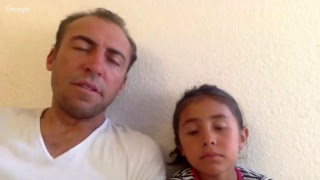
Educator Michael Strong talks with five-year-old Alana about school, robotics, and writing. She describes spider biology, robot cars, and learning to type on Duolingo. Michael emphasizes letting kids lead conversations and finding real audiences for their writing instead of pushing them.
Chapters
Say hi.
Hi.
Hey, Alana, cómo estás?
Bien, cómo estás?
Muy bueno, gracias. So, tell me about school.
It's great.
What do you do at school?
We play at recess for a little while, but After we put our things in the places where it needs to be, and then we go to our meeting.
What do you mean?
We've been talking about like making cupcakes and muffins there.
That sounds like fun. Do you get to eat the cupcakes and muffins?
What?
Do you get to eat the cupcakes and muffins?
I think so.
Oh, you haven't made them yet?
Yeah, I haven't made any yet.
Okay, and do you learn things at school? Yes. What do you learn?
Like what spiders need to survive.
Tell me what, what do spiders need to survive? I don't know about that.
They need water and they need food and they need shelter.
And what counts as shelter for a spider?
So that it doesn't get wet from the rain.
So I think I've seen spider webs in the rain and spiders on spider webs in the rain. Have you seen those?
No.
So what I guess I'm wondering, if spiders are out in the rain, do you think they would die?
No.
What happens to a spider in the rain?
Because if it's in— because if it's in their little like slider, whatever it is, and then it rains, it slides the spider out and then the spider will have to climb up again.
A slider is like a slider, a long string that it's hanging from.
No, it's like its slide or whatever it is.
I know what a slide is at a playground. You like a metal slide that you would slide down to have fun? Do spiders have those kind of slides?
Except, except the top is covered.
So spiders do have slides just like playground slides?
Yeah, but they're really Small. But I've seen one in a song.
You've seen a spider slide in a song? How can you see a slide in a song?
Well, sometimes I see it on the TV when I'm watching that kind of song.
Oh, so you see a song on TV and their spiders actually have slides on this TV show?
Yep.
Okay.
Except the COVID is like maybe this tall.
So did you learn about these slides in school or the slides— you did not learn about that part in school?
I did not learn that part in school.
What did you learn about shelters, about spider shelters at school?
Well, shelter is kind of like shade when it rains, so you can keep it, keep yourself dry.
Okay, did you know what shelter was before they taught you about shelter at school?
Yes.
Okay, so in which case, I would say you did not learn about shelter at school. You already knew about shelter, but maybe you didn't know that spiders needed shelter.
Yep, I didn't know that.
Okay, what else do you learn at school?
That if you have guns, you cannot play with them. Like only pretend guns, but in my school they don't let us use guns. So that's—
Not even pretend guns?
Yeah, not even pretend guns. You know, some of my kids in my class do that.
Kids in your class use pretend guns?
Yep.
Even though they're not supposed to?
Yeah, I know. That's why I never use pretend guns.
I see. So you learned about rules at school, certain rules like no pretend guns, right?
Yeah, and no glass breaking.
No glass breaking?
Yeah, no breaking glass.
Did you used to think that it was okay to break glass?
No.
I didn't think so either. That's why it's funny to me that that's something you learned at school. At school? Because I bet you already knew that.
So what do I— I only know a little bit of that.
Okay, what else might you have learned at school?
Robotics.
Oh, tell me about that. What did you learn about robotics-wise?
I know how to— now I know how to like control robot cars with All I know is that I knew it already. You do it with buttons and wheels.
Did you have these same cars at home, or you had a friend who had them, or where did you find these cars?
In my school, in another class, in robotics.
Okay, so what are you learning about outside of school? Are you learning anything outside of school?
Well, and first I'm going to tell you how I learned about spiders.
Thank you, I appreciate that. Tell me.
So one time we caught a spider and we brought it into the class. I showed everyone. I bet they were really excited to see it because I don't think kids in my class ever seen a spider.
Well, maybe, or maybe they hadn't seen one up close. Even if they saw one far away, maybe you were the first person to tell them, show them a spider up close.
I think so.
I like the fact that you told me first you're going to tell me about how they— you learned about spiders. So it sounds like you brought the spider to school, and then did the teacher tell you about what spider?
No, the spider was in recess. Where you found it? On the playground.
You found it?
Well, some other friends found it too. It was pretty big.
Well, is it dangerous? Was it dangerous to catch?
No, but then we put it in a cage, but then we lost it in the cage because we put so much stuff in it.
Was it a cardboard cage, or what was the cage made out of?
It was made out of glass or plastic.
I see. And how did you know it wasn't a poisonous spider? Do you know about poisonous spiders?
No.
You know what poison is? No. So there are actually some spiders that can bite you and it could even kill you sometimes. So that's poison. Poison is stuff that makes us sick or even dead. And so there are some spiders that are actually dangerous.
I've seen that kind of poison where it makes you dead in one of my dad's Turkish shows.
Oh, okay. Well, that's why you have to be careful with spiders, is because some spiders are actually dangerous. Does that make sense?
Yes.
Okay, I used to play with spiders all the time as a kid, but I remember one time when you— I was your age, I accidentally picked up a spider and it turned out to be very poisonous and dangerous. That was very not a very good thing to do, but I was okay, so you can be lucky. But be careful with spiders, okay?
Okay.
Um, yeah, I would not pick them up with your hands ever.
I, I've heard that mosquitoes have Poison?
Little tiny— so mosquitoes make you itch, right? If they bite you? Do they make you itch if a mosquito bites you?
No, but it did a little.
Well, insofar as it does, I would say it's because there's a little bit of, as it were, poison right around the part of your skin where it itches. So the mosquito put something in you that makes you itch. That's why sometimes mosquito bites itch. Oh. So tell me one more thing you learned either in school or out of school in the past week.
Okay, so one thing I learned is that in the garden, you— there's more rules in the garden.
More rules?
Like be nice to the bugs. Don't step on the flowers.
Are you good at learning about rules?
Yes.
Okay.
I know I can't do that because I watch all flowers.
Are you good at following rules?
Excuse me?
Are you good at following rules?
Yes.
Are all the kids good at following rules?
Yes.
Okay. Um, so how about what was the most the most fun you had all week last week?
When I was in robotics and in the garden.
Okay. Well, um—
The funnest part about the garden is because she gave us journals.
Okay. And tell me what's good about a journal.
That you can read, put science in it.
And what, why do you like to put science in a journal? What makes that fun?
So that you can learn, and when you bring it home, your family can see what you've learned so far.
That sounds wonderful. That sounds wonderful. I was going to talk to your dad for a little bit. Is it okay if your dad and I talk some?
Yes.
I'm so glad you're having a good time at school, and I'm so glad that you love the garden and your products.
Hey, Michael.
Hey, Ryan. How are you doing?
We're good.
We're good. So you were going to update me on a few things that— about her overall education and how she's doing. Yeah.
I mean, at the risk of sounding like a broken record where I constantly praise her, she's doing great. She's really taking time to think about what she's learning at school and put it in a journal. She's been very brave at school making friends and being nice to others. Her teacher said that she handled a couple of difficult social instances very well and that overall she has good social skills. At jiu-jitsu, she's been really brave and tough and even did a class with the older kids because her father took her to class.
2 classes with the older kids.
Yeah, 2 classes total, and she did very well there. It's really Amazing. And we're really proud of her, and we're always looking for things that we can do to help her get more out of all the things she's already doing. So thinking about more journaling, thinking about doing book reports rather than just reading books and just throwing books at her, and having her actually write things down. What do you think, and what, what should we be looking at?
That's great. Well, first, I am impressed by, I would say, how conscious and articulate she is. In a lot of ways, I always like to get into a child's head with respect to their experience, because often their experience of, say, school or anything might be different than what we expect it to be. So it was wonderful to hear her articulation of her experience at school—what matters, what doesn't, what counts as learning, what doesn't. Again, I love the fact that she says, you know, first I'm going to tell you about— I think she's very articulate and conscious about her own experience and remarkably reflective for a 5-year-old. I think it's great that she's reading, and I would not be the least bit concerned about her reading and not reporting back at them. It sounded like you were trying to have conversations, and she's not eager to have conversations about her books. Oh, no, she is.
I may have misstated in my text message. After she reads, we generally talk about it. In fact, today she broached a good question. I think I was making Logan some food, and she asked if, like, in a certain famous English storybook whose name I can't recall, but it's about a toy bunny that comes to life if you love it enough. Yeah. We read it at a doctor's office recently. She asked that if it's possible for her favorite toys to actually come to life if they— if she loves it enough. I said, well, that's a good question, based upon a book that she'd read. And we did talk about that, how it's not literally true, but fiction is still awesome and has many advantages. And that one of my favorite fictional, I guess, characters growing up was Calvin and Hobbes. And so we made a pact to start reading more comics.
Well, no, I think that's wonderful. I think spontaneous conversation or I always like— one of my favorite expressions about writing is that a writer should want to write the way that a cow needs to be milked. And I grew up on a dairy farm, and cows really want to be milked twice a day when their udders are full. So I think, you know, in general, rather than pushing anyone to write, children or anyone, I like to have the ideas just so full and so out there that there's sort of an eagerness to write. That said, it does sound— let me check with Alana. Alana, do you like to write? Yes. Tell me what you like to write.
I like to write about what I did in my school and what I've learned.
That's wonderful. Do you know how to keyboard using the type on a computer? Can you type on a computer with your fingers?
Yes. Yeah, she's learning, and she's learning through Duolingo. Perhaps the most challenging part for her, and the only part that she can't do completely unassisted in Duolingo, is when she has to translate something either in English or write it in Spanish. She had to learn where the keys are, and she's pretty good. Her hunt and peck is getting better and better, and she is learning about keyboards that way.
There are some cool keyboarding games that are entirely— they really are sort of you know, video games where they're graded so you learn how to put your fingers in the right place and type in a certain way. I would say she's old enough that it's probably worth getting her to the point where instead of hunt and peck, she should learn the keyboard. And where I was going to go with that is, again, I like writing to be natural and spontaneous, so I love the fact she's excited about her science journal so that she can bring it home and share it with you. The thing about the stories is since you're already home and she's already talking with you, there's not a natural motivation necessarily for her to write. But what I'm thinking about keyboarding is I could see Alana within the next year learning how to keyboard and having her own little blog on the internet. And I think that it would be pretty amazing to have a 5-year-old blogger. To kind of accompany these interviews. So, you know, not something that needs to be done right away, but one of the things I do at my school is I want writing to be real, and writing is real when you have an audience. I think for a lot of people, texting each other is real, you know, commenting on social media is real, you know, not all young people email, but emailing can be real, or setting up, you know, a blog where you're writing for a public, even if the public is 2 people, 3 people, 5 people. The reason to write is to communicate things that you can't necessarily communicate in a spoken manner, and the more authentic it is, the better. And I think she might get very excited after she— and I say after she learns to keyboard, just because before keyboarding, the hunting and pecking, you know, is difficult. And there's no rush. Again, she is so far ahead of the game in so many respects. If it takes her 3 months— Yeah, voice-to-text could be great. I don't know how good it is. Is it pretty accurate these days?
I never use it on my laptop, but I assume there's a way to do it, and she may be using a tablet or an iPad, just considering how much cheaper they are than laptops. Well, there are cheap laptops. We could probably get a Chromebook for her.
You know what? My inclination is that even though voice-to-text may well be the future. I actually thought when I was in high school in the late 1970s that typing would become obsolete because we'd all be just voice-to-texting way back then. It turns out, right, I suspect that keyboarding is going to be valuable for a while. And again, since she's already so far ahead, I would say maybe get her some fun keyboarding games. You know, you may have to show her where to put her fingers. I mean, her fingers are a little bit small, but there are keyboards that are small enough. It'll be fine. And yeah, get her started keyboarding, and then she'll be really empowered to, you know, use computers as writing tools and write, I suspect, longer and longer pieces over the years. That sounds good.
That's a good idea. So we have to learn to type now. Duolingo plus typing. Sounds good.
Just to check in, are you playing games still, either checkers or chess or What's the card game?
Set. Set. So we have not played very many games lately. We have played some checkers on an iPad, and that's been due to her parents not prioritizing that and mostly being run ragged by their 20-month-old, who is not so conducive to board games at this point. Or puzzles. Or— anything else with small pieces. But we do need to get back to it. And the last time we played checkers, I noticed a huge difference in how— in her strategy and in her foresight. Yeah, actually made me think that I should start teaching her how to play chess, at the risk of, you know, maybe going a little fast, but definitely making progress.
Yeah, my sense is that she is so advanced, um, rather than kind of emphasize anything that's the least bit schooly or homeworky at all, I would say go ahead and take opportunities to accelerate the play, the cognitive play factors, because I would say she does love to use her mind, and it really is wonderful. And you're doing so well, you know, all of you are doing so well in terms of that. I would say let's just keep having her develop and develop that extraordinary awareness and intellect. You said she's— I suspect she's a bit more advanced than some of her peers.
Yeah, Alana sets a pretty— I mean, even acknowledging my bias, she really is— she displays extreme emotional endurance everywhere she goes alongside physical endurance that just grows by the day through her martial arts. But I can count on her being, you know, calm, cool, and collected everywhere we go, which is more than you can say for most other Homo sapiens. Myself included.
So Alana, what do you think about when your dad says things like this about you? I think it's great. Is it great because your dad is great, because it's true, because you're great, or all of the above?
It's 'cause about everything.
All of the above.
Okay, fair enough. Well, I think that's probably enough for today. I am delighted to be catching up again. Sorry it was later in the day today. No, it's okay. Um, I hope you guys have a wonderful week and hope to talk next week. Right.
Actually, I do have to share one more story. Um, during one of her boxing classes, uh, a fellow team member was supposed to do some push-ups because he didn't win the game, and he wasn't. So Lana tapped him on the shoulder, said, very nice, push-ups, showed a little leadership. And I joked to her coach and said, she's not being bossy, she's leaning in. And he looked at me and says, well, Alana says what she wants. And he just with a big smile.
No, Dad, Dad. Hold on.
That was right. That's right. And either way, I'm proud of it. Alana's got guts and she speaks up. She says her mind and nobody puts her in a corner.
And she's willing to interrupt her dad to correct the record from time to time.
Absolutely. I have to stay, I have to be on my game.
There we go. Okay, have a wonderful week.
Have a wonderful week.
Okay, hasta luego.
Bye.







