Socratic educator Michael Strong with five year old Alana
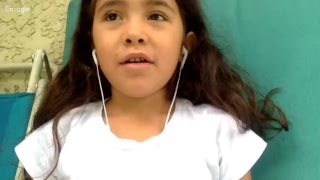
Michael Strong asks five-year-old Alana what the mind is, how time works, and whether clocks make time real. She figures out that the sun marks day and night, and that time would exist even without clocks to measure it.
Chapters
Good. How are you?
I'm very well. You always seem so bright and alert when I talk to you.
I'm all right, but why?
Well, I think you have a very active mind.
I think so too.
So what is, what is your mind?
Your brain?
Okay. Do you think with your brain?
It could be your brain, if it's the mind.
Sometimes we talk about the brain being the physical part and the mind being the thinking part, but it's kind of tricky actually. You know, is it— how does the brain connect to the mind? That's a really hard question. Did you think— did you know there are questions that are hard even for grown-ups?
Really?
Yeah, there are a lot of questions that grown-ups really don't know the answer to.
Are there?
Yep. I want to check in on time. What does time mean? What do you think time is?
Time? I don't know.
Do you ever use the word time?
Yes.
How do you use the word time?
Like, what is the time right now in Hawaii?
Okay, what does that mean? Go ahead.
That means like the time in Hawaii, like that, like it's like the time on the clock.
Well, I'm sure that's right. I also— do you know how many hours different time Hawaii time is from California time?
Really?
It's a different time, right, than California?
Yeah, it's a different time.
Do you know how many hours different?
No.
Okay, because I bet sometimes— I know you are 2 hours earlier than me. I'm in Texas. And you're in California, so it's 11 o'clock here and it's about 9 o'clock there. So you— I've been— I've probably been awake for longer than you have been awake because it's later here. And if you have friends in California or family in Cali— I mean, in Hawaii, in Hawaii it's going to be even earlier. I bet right now if you called people in Hawaii, it would be pretty early in the morning.
It would be pretty dark.
Yep, exactly. So, um, what does the sun have to do with time and light and dark?
Excuse me?
What is the sun? You said it would be dark in Hawaii. Um, at different times of the day, is it sometimes light and sometimes dark?
Yeah, so I know it's gonna be like pretty dark at nighttime, but when the sun rises up, probably it's gonna be daylight.
Okay. Do you think that the sun is what makes time happen? No. Why not?
Because it's not the clock.
Okay. Does the clock make time happen?
Yes.
So if we stopped all the clocks, would time quit happening?
Yes, it would.
So presumably we all grow older over time, right? I'm getting older, you're getting older, your mom and dad are getting older, Logan's getting older.
My whole family is getting older.
Exactly. So do we all get older no matter what?
Yes, we all get older no matter what.
Well, how about we stop all the clocks on Earth, and if clocks are what make time happen, we just stop the clocks and then we don't get older?
Yeah, that's what I was trying to say. Like, when we stop the clocks, the time will stop too.
It sounds like if we want people to stay young, it's very, very simple. We just have to stop those clocks.
That actually cannot happen.
Why not?
Because there's no magic real in this world.
There's no magic what?
There's no magic real. Like, the magic isn't real. It's fake.
And so stopping the clocks in order to stop time would be a form of magic?
No, it wouldn't.
So, okay, well, I'm still trying to understand, um, if the clocks are what make us older or something else makes us older.
It's just our bodies.
So even if we stopped all the clocks, you think our bodies would keep getting older?
No, our bodies would just keep— or just do it by itself.
Okay, so it sounds like the clocks do not really— do not really make time happen. That is, we would get older as time passes even without clocks.
Yeah. Actually, the clock doesn't make us get older.
It doesn't?
It doesn't. Our body just do it itself.
Okay. So do you think that— suppose somebody had never seen a clock in their life, would there still be such a thing as time?
Yes.
Okay. So every day is a new day, right? The sun rises, every day is a new day. And even with clocks, people would still see a sunrise every day and they'd have a brand new day and they'd get older day by day. So is time basically just what makes us older, or is getting older what makes time, or what is time without clocks?
What is time without clocks? Hmm. If we didn't have clocks, we didn't know any of the time.
Okay, even with sunrise and sunset?
Yes, even at lunchtime or breakfast.
Could we, could we say that we still have morning and evening? Nope. Without clocks, we would not have morning?
We would not even know anything, like even at lunch, snack time, daylight, nighttime.
So I would think that if the sun rises, that I know it's morning even if I never ever saw a clock. Can I call it morning just when the sun rises? Whatever.
Yes. At nighttime, but not in the evening, but not, but not like late at night, not for breakfast, not for bedtime.
So are you saying that we can use sunrise and sunset to figure out morning and evening, but other than that we need a clock to figure out time?
That's what I was trying to say.
Okay, that's what I was checking on. So some places, I think this is the original thing, noon is when the sun is straight up in the sky. So, you know, can you imagine figuring out more or less when the sun is straight up in the sky?
Yes.
So what if we said, okay, we don't have any clocks, So I'm imagining a world where we lost all the clocks. All the clocks just vanished. And, you know, we're figuring out how do we live our lives. And we say, okay, sun comes up in the morning, we're calling that morning. Sun goes down, we call that evening. And then sun in the middle of the day is straight up in the sky, we call that noon, lunchtime. Does that work?
Yes.
So I would say that I'm trying to persuade you we could actually figure out a lot of things with time even without clocks.
Good.
Because you've given me morning, you've given me evening, and now it looks like you're giving me noon, straight up lunchtime. How about— how about this gets more complicated. At night, sometimes the moon moves across the sky, right? Yeah. Have you ever watched the moon go across the sky at night?
No, I didn't.
Okay.
Have you?
I have, actually, and thank you for asking. I love it when you ask good questions. Way back, you know, human beings long ago, we had not yet invented clocks, and things like the movements of the sun and the moon and the stars helped us think about time. Does that make sense?
Yes.
Okay. Well, I think that this has been a really interesting conversation, and I'm inclined to let you go have another fantastic weekend day. Anything you want to say before we take off for today?
There's one more question in my head.
Go for it.
Why does the moon fly across the universe sometimes?
That's a great question. I love the fact that you have such great questions. So what we believe is that the moon goes around the Earth. The moon goes around the Earth.
And the Earth goes around the sun and all the other planets.
Exactly.
The sun just stays where it is.
Yep. But when you see the moon moving across the sky— and you should ask your mom and dad to— on some nights, some nights you can't see it, some nights the moon is— you can't see it, but other nights you can. And on a night you can see the moon, you should— and it moves very slowly, so if you stare at it, it doesn't look like it's moving. But if you look at it and then look at it an hour later, it will be in a different place. Because it moves very slowly. Oh. But then you can start to watch the moon move across the sky at night. And I think it's really beautiful and really marvelous. So is it time for Ilana to start studying the moon?
Yes.
Okay. Thank you so much for asking such great questions and for having such great thoughts.
You're welcome.
What are you going to do for fun today?
I don't know, I'll see.
Okay, okay, give my best to your family and we'll talk next week, okay?
Okay.
Bye-bye, Alana.
Bye, Michael Strong.







