Students Hate School. Michael Strong Has A Socratic Solution. | The Show | Dad Saves America
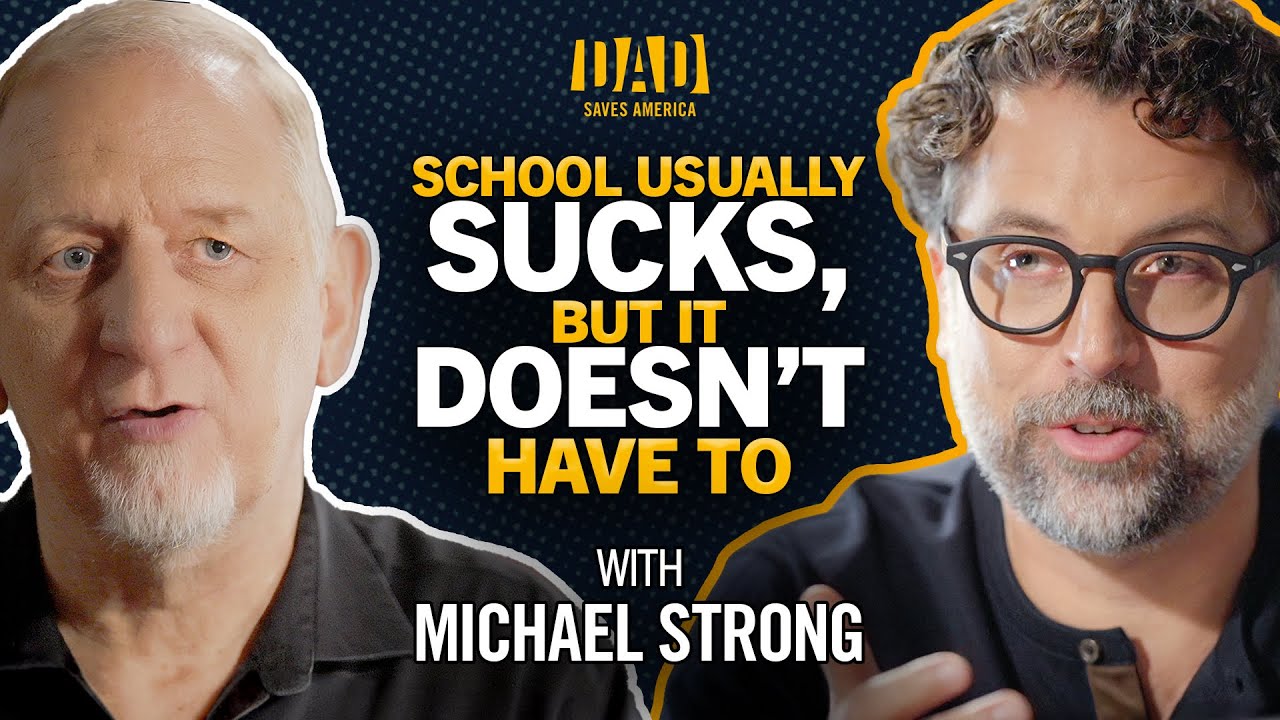
Education innovator Michael Strong argues schools kill curiosity by ignoring Socratic dialogue and real-world skills like sales and relationship-building. He points to the Talmudic tradition as proof that teaching kids to argue and think critically works, and proposes peer-learning communities where teachers are optional and children pursue their own genius.
Chapters
One of the most significant decisions we make for our kids is where they go to school, which is why radically rethinking education is a major theme here at Dad Saves America. And while traditional public schools, like boot camps, may provide order and direction, they often achieve it at the expense of our children's natural curiosity and creativity. Studies have found that kids between the ages of 14 months and 5 years ask an average of 107 questions an hour. But once kids reached elementary school, that number drops to around 1 to 2.5 questions an hour, and it falls to practically zero by 5th grade. In other words, the longer you're in traditional public school, the faster your curiosity dies. Does it have to be this way? Shouldn't the point of education be to foster creativity and independent thought, so that our kids can develop the tools they need to navigate a rapidly changing world, and ultimately build a better future? Well, my good friend Michael Strong is truly one of America's pioneers of curiosity-focused education. As one of our nation's most experienced education innovators, he believes that every child has genius in them, and the fundamental way to cultivate that genius is encouraging them to ask questions.
When I ask somebody else questions, I'm trying to understand the world. But even more, when we interact with people, you know, if we can ask good questions, if we can actively work to form a mental model of what other human beings think and understand, we're learning in some ways. One of the most valuable forms of knowledge.
Michael has built successful education programs in both public and private schools alike. His achievements include creating the 36th best public high school in the nation, according to Newsweek. A serial education entrepreneur, he now leads the Socratic Experience, a virtual school that educates children through interactive peer learning. Michael grounds his approach to education in the Socratic method, which so enthralled him as a student that he left Harvard University to pursue Socratic studies at the less prestigious St. John's College. His book, The Habit of Thought: From Socratic Seminars to Socratic Practice, is used by educators and students alike to cultivate curiosity and a mindset of lifelong learning in our kids. And what could be a better goal for kids' education than that?
Michael Strong, I— we've known each other how long?
Almost 20 years, 15, something like that.
It's been a long time.
Yeah.
You know, when we first moved to Austin, you were the person I knew that was really radical on education. And so that's why I'm really excited to have you in this conversation because as a dad, I feel like one of the most important things we do is engage our kids' education and make choices with our spouse about what education is going to look like for our kids.
Big time.
You know, I really want to start with a bit about your personal story. First thing, I was surprised by is, given what you do, is that your mom was a high school dropout.
Is that right?
Tell me about that.
Yeah, jumping ahead, I love learning and I hate school. So, but, um, yeah, my mother was a high school dropout. My dad was an elevator repairman. I often say the best thing about my own education was that I grew up in northern Minnesota with bad TV reception. It's, you know, rabbit ears and a fuzzy screen. And, you know, often we'd have to kind of move the rabbit ears to even get a faint signal. As a consequence, I became a reader. I was reading 200-page books every night by 6th grade. And I would say reading, and to this day as an educator, reading, if you have a kid who's a reader, it's not the only path, but reading is so valuable. You know, people think science is important. Yes, science is important. If you can't read the biology textbook, you're not going to get biology. Actually, the other thing going to the fatherhood piece is that although my father was uneducated, he had a certificate in electronics that allowed him to get into elevators. I remember when I was 4 or 5, him trying to explain electronics to me. So volts, ohms, amps, and I just remember being so confused but really wanting to understand my dad. But I see the 2 most important parts of my own education as my dad explaining electronics to me when I was little, becoming a big reader, and then finally I also had an hour-and-a-half bus ride each way to school as a kid. So 3 hours on a bus every day, and I had a friend with whom we played chess, and we didn't have magnetic chessboards, And so on the bus, we'd get halfway through the game and go for a bump and a oof. So we learned to play chess in our heads. So the other thing is I did a lot of mental chess on these 3-hour bus rides, and I think that was way more valuable than anything. So when I say school is bullshit, which I do, it's not that learning is bullshit. I think high-end intellectual, using one's mind, learning to read, to think, to understand things, super important. But that's not what most of school is. I was great at memorize and forget tests, you know, go in, Load it into the brain, get the A, leave, done.
You know, you said that being a reader was a huge part of your childhood and getting to learn things, but can we go back to your mom for a sec?
Sure, absolutely.
She didn't actually graduate high school. So did that have an impact on your family life?
I was born in 1960, which I think was the peak period for teenage marriages. But yeah, she was, uh, she must have been 15 when I was conceived. My father was 17. You know, teenagers, and that's what you did, got married and They were very young when I was a kid, but you don't notice it as a kid. So yeah, I didn't have anything to compare it with. Actually, one of the most interesting aspects, I think, was that later on when I went to Harvard, only 20 years later did my mother discover that it was hard to get into Harvard. And my father probably never knew. From my family's perspective, I was going to college somewhere back East. So what was actually great about this is I feel as if so many children have this heaviness about expectations, whereas, you know, I escaped into reading and intellectual life. And, you know, I come from kind of lower middle class family where people are just doing jobs and working. And so, you know, geeky kid, it was actually great not to have any expectations.
You were born into a teenage, you know, teenage parents, and along the way you get into Harvard. Yeah. So how did that happen? And why would it be the case, or how was it the case, that your parents just thought like, oh, he just went to a school back East?
2 things. First, I think a lot of educated people who are so anxious about education are completely unaware of how the bubbles that other people live in. So living in my bubble, you know, my kind of lower working-class bubble, people care if you can make a good living. So that includes plumber, electrician, you know, real estate agent, that kind of thing. So on the one hand, there's this, you know, complete lack of awareness of the outside world that I think A lot of, you know, part of this gets into when people talk even about news, they have no idea. Most people are focused on their local community, their friends, their families. They kind of tune out all this stuff. But with respect to education, it's relevant because in my own case, I think the schooling is not, you know, was not relevant to me, but the learning was. And so that's why I have such a passion for real learning, real understanding, and seeing school as almost this epiphenomenon around learning. I think most people who are well-educated have a lot of ego invested and their education. And so I went to Harvard, I did this and this, my test scores, yada yada yada. Whereas, you know, not quite, but almost my family was almost embarrassed that, you know, okay, Michael went off and did that, okay, but, you know, can he make a living?
Yeah, he went to Harvard, but he doesn't know how to weld.
There we go.
And, you know, so I don't know how he's keeping himself fed.
There we go, exactly, that kind of thing.
Yeah, there's this quote I came across from John Taylor Gatto that you remind me of, which is— and I have it written down— which is, when you take the free will out of education, that turns it into schooling.
Absolutely.
Absolutely.
Maybe because of my upbringing, I'm a big fan of 19th century upbringing. Abe Lincoln learning in a log cabin, reading the Bible and the Constitution and whatnot in a log cabin. And before schooling, before mass schooling, it was normal for people to educate themselves to an extraordinary degree. So when I hear that Godot quotation, I think of all of the people, and many of them, by the way, started working at 12, 13. So Ben Franklin started working around 12, Andrew Carnegie, John Muir, you know, all of these people, Thomas Edison, started their, as it were, professional lives at 12 or 13, did not have schooling. Clearly Franklin, Carnegie, Edison—
They did all right.
Did all right. Really well educated. Yeah. Way better education than we have. But it's, yeah, free will. If you want to learn something, you can't stop yourself.
You got into Harvard, but what happened after?
So before I left for Harvard, I discovered St. John's College, Santa Fe and Annapolis, where for 4 years you read and discuss classic texts, the great books. I visited, I loved it. I was going to drop out of my senior year of high school and go to St. John's, but then I had good test scores and my college counselor said, look, you can go to Harvard and study Greek and Plato and French and Newton and all this stuff. So I said, okay, and I go to Harvard, but it was famous people talking at me, and I hate being talked at. One of my analogies there is suppose you're at a party and somebody walks up to you and starts lecturing you. John, Plato, blah, blah, blah, blah. You think, what a jerk. Who else can I talk to? Teaching is rude. And that's my attitude, whether it's a high school teacher or a Harvard professor. Even when I go to conferences, I don't go to lectures. I come down for lunch. I go for the cocktail hour, but I skip almost all the talks because I hate being lectured at. So yeah, Harvard was a bunch of people talking at me. I left and went to St. John's in Santa Fe, I describe it as, after my wife, one of the great loves of my life, because for 4 years we're reading, thinking, and talking about ideas. I love thinking and talking about ideas. Again, really one of the most fun things you can do. And I found that kids do as well.
I get why you didn't like Harvard.
Right.
Right? You've got people lecturing at you. You've got smarty pants. It's like, at this point, you could watch that on YouTube if it was today.
Exactly.
4 years of talking through reading the great works. You can do that on your own, right? I can just go home and start reading Homer. Like, what about St. John's made that a place to do that instead of literally taking books out of the library?
Well, the good news is actually you can, but you do need people to talk to, and it's about developing independent thought. So I don't tell John Popola what to think about Plato or Kant or whatever. You read it, and what do you think and why? And of course you defend your opinion with the text, but I am radically committed to thinking for myself, so I really want to come to my own understanding, and so respecting Except for intellectual autonomy, that's the biggest thing. So one thing they talk about at St. John's is that the tutor, they call them tutors rather than professors, is simply the best student in the classroom. And actually a radical thing they do there is that every tutor, regardless of academic background, must teach every subject. So if you come in with a PhD in physics, you have to teach Greek. If you come in with a PhD in music, you have to teach science, you know, Newton, whatever it is. And as a consequence, it's radically democratic intellectually. I was, by senior year, because I'm fairly good at math and science, I was more capable than the tutor teaching the class, but that was okay because we're kind of a learning club. We're trying to figure this out together. We all learn by emulating, by models, and if you've never seen adult learners learning, how do you ever learn to learn? Whereas a teacher or professor is all about, I am the authority, and John, you need to, you know, this is what it is. You know, it's— again, you can see how much I resist it.
You know, that's such an interesting— I never really think I've— I don't think I've ever really thought about it that way. If I'm hearing you correctly, it's like Like, we think you learn by being told the information, and yet maybe we learn by seeing other people actually learn.
And even, you know, I specialize in working through very difficult texts, and when I'm working with a child, you know, I have a series of children from age 4 and up, but I'll— when I'm working through a paragraph or a poem, well, the way I work through it is I look at, you know, one word at a time and one sentence at a time. I talk to them in real time about how I'm thinking through it. And I would say a lot of my art is Not just asking questions, but also talking them through how I'm thinking about things as I'm thinking about it. When I'm looking at a hard math problem with kids, you know, well, what I would do here is I'm thinking about breaking it into this and that, what I know and what I don't know. They call it metacognition in the literature on cognitive science, but all it means is modeling thinking, modeling learning, and talking about it. There's a whole thing about, in traditional cultures, people learned by apprenticeship. And now we know, yeah, apprenticeship might be great for plumbing or whatever, but no apprenticeship in how to learn how to learn.
I remember my dad and my mom and I were going around to colleges, and, you know, you speak to— I don't know if it's the admissions officer or maybe to some professors. I asked like, well, what kind of job do you think I would get if I come out of this program? And the professor said, we don't teach you how to get jobs. We teach you how to think. And simultaneously, I look back on that and think it's actually a good idea.
Right.
Notionally, Right. I don't think that's what they're doing.
Yeah, no, no, no, it is the liberal arts idea. So give you a concrete example. One of the tutors at St. John's said, and I love this, it's actually my mental model, is that the ideal St. John's language exam is one where you don't know what language you're going to be examined in. So there's a test on Friday, maybe it's Swahili, Mandarin, Polish, whatever. You're given a passage, you're given a lexicon or dictionary, and you need to figure it out. I kind of extend that to, okay, there's a test on Friday, And a science. You don't know what science it is. Might be a paper in chemistry, physiology, you know, physics, whatever it is. You're given some resources, you figure it out. This may sound esoteric, but this is what entrepreneurs do. Entrepreneurs, you know, you have a new software package, you just figure it out. Life is about figuring it out. And so I'm very big on let's put them in situations and have them figure it out.
So life is not sitting being lectured at for 45 minutes until a bell rings?
I'm sure today they would drug me. ADHD. I'm one of these people with 50 browser tabs open and 20 projects and my attention's all over the place. It would kill me to be in school. I mean, I think for any adult, especially any adult in kind of an entrepreneurial or creative lifestyle, imagine sitting through school. Or if you really want to be sympathetic, go and sit yourself in a classroom and suffer. And I promise you, you will suffer. It will be painful. And kind of riff on this, I would say our most creative and entrepreneurial kids are being destroyed by the system. You know, there's a whole literature on how a lot of the great creators, a lot of the entrepreneurs hated school, dropped out as soon as they could because it's completely misaligned with those kinds of personalities.
What is public school, which is 95% of kids, and why does it look the way it looks? I've heard that, you know, school today isn't even what it was 30 years ago. So what is it now? Where has it— and how did we get to where it is now?
So I would say it's extremely bureaucratic. I'll do a quick version of how it got there because public school is a religion in the United States. There's this sort of halo around it. And I don't like to be a mean person, but I am often kind of cracking the halo because I think it's become a bureaucratic monstrosity, a lot of top-down, rule-heavy sort of system. One way to think about it is, in the late 1990s, Microsoft had a quasi-monopoly. People were concerned about a monopoly operating system. Public schools have a larger market share than Microsoft ever had, and it's subsidized by the government and forced— children are forced to go to it or something like it most of the time. And as a consequence, the human— I think this goes to everything great. You and I were talking about this. Everything great is human-to-human, bottom-up. And every child is unique. As an educator, I try to personalize an education for a child. It is impossible to personalize perfectly because I'm a great believer there are 7 billion different kinds of genius. How do— our job as parents and educators is how to identify and develop that child's genius. Where school is top-down, this is 7th grade science, this is 10th grade history, there are standards and it's imposed. So if your child happens to be a brilliant video producer or a brilliant coder or whatever, a brilliant salesperson, the school system cannot and does not acknowledge that. All the school system knows is, did they perform well by this metric within these boxes behaviorally and so forth? And kind of going back to the history, so even 100 years ago, public schools were often one-room schoolhouses. They were much more flexible. One of the great entrepreneurs Entered high school and graduated one year later because in a one-room schoolhouse, hey, you know, John's doing great, let's graduate him. There was that kind of human-to-human discretion. Over the course of the 20th century, school consolidation happened. So we went from over 200,000 districts in the US early in the 20th century to fewer than 20,000 school districts. So just in terms of local control, dramatic reduction in local control over the 20th century.
That's a really interesting point that I don't think most people even realize. It really destabilizes the idea that we're told, oh, well, schools are locally controlled, and you have the local school board, and it's your neighbor that's sitting in the school board making sure that school's serving your kids' interests. But when you talk about such a dramatic consolidation, I mean, we never hear about this. We hear about corporate consolidation all the time. Amazon's going to own the world.
Yeah.
Meanwhile, what the institutions that are raising our kids are These are more powerful monopolies than any company that's ever existed in the United States.
By the way, I think the public schools that work best are, say, small rural districts. Occasionally you find a small suburban or urban district, but small enough districts that things can be personalized. So I created a charter school in Angel Fire, New Mexico, a town of 1,000, maybe 1,500. There, if a kid got in trouble— so Johnny's in trouble— I could call up the the justice, the judge, and I could call up the chief of police, and we could figure out, okay, when do we crack down on him? When do we cut him some slack? It was incredibly personal. Whereas in a large bureaucracy, you know, these are the rules. You know, you've seen these things where—
Yeah.
A kid has a paper gun, and, you know, a 3rd-grade kid brings a paper gun to school and is, you know, kicked out and is regarded as criminal. Or these, you know, children are being wrestled and put in handcuffs for these tiny things. It's an insane bureaucracy. I'll give you one other story. In New York City schools, you've heard of the rubber rooms where they have incompetent teachers, some of them accused of sexually assaulting children, and they are, because of union rules, in these rubber rooms for decades continuing to earn money. And again, it's not— there are heroic teachers, heroic, absolutely.
Sure.
But as a system, it's a large impersonal bureaucratic mess where the combination of top-down government and union rules have made it so that often great teachers struggle against the tide, whereas poor teachers are rewarded. Compliance. It's a compliance system.
You know, I went and I was looking at these John Taylor Gatto quotes, and I've got another one.
Yeah.
It's a little long, but I'm gonna read it 'cause I wanna get your reaction to it. I've noticed a fascinating phenomenon in my 30 years of teaching. Schools and schooling are increasingly irrelevant to the great enterprises of the planet. No one believes anymore that scientists are trained in science classes, or politicians in civics classes, or poets in English classes. The truth is that schools don't really teach anything except how to obey orders. This is a great mystery to me because thousands of humane, caring people work in schools as teachers, aides, and administrators, but the abstract logic of the institution overwhelms their individual contributions. So how can that be? How can individuals be good and the system be rotten?
So, a good question. First of all, John Taylor Gatto essential reading. His 7 Lessons of a Schoolteacher got him New York State Teacher of the Year. Absolutely essential reading for anyone in education. And so that quotation is one of my lodestars.
Absolutely.
Going back into how the system can be, when you think about it, you've got— first of all, we all know we don't want to work for 2 bosses or 3 bosses. Everybody in a school system is working for the school district governed by the school board. They also have state Department of Education rules. They also have federal Department of Education rules. And these rules are not always consistent. So to start with, we have 3 different bureaucracies all imposing compliance. Going back to the school district level, a superintendent— once I knew a wonderful superintendent, and he said the worst part of the job is he had to hang out with other superintendents. And part of it is, you know, they're politicians in charge of bureaucracies. How do you become Maintain tenure as a superintendent of a school district, you avoid as many controversies as possible, and you basically keep the, keep the school board members happy while not making any waves. And so you become an expert in being a politician enforcing compliance and not doing anything too different. There are superintendents that try to do little innovations, but it's so risky. They're by nature necessarily risk-averse. And you can go down the ranks. So Which principles win? Well, compliance is number one. Doing well by kids is number 3, 4, 5, 6. And again, even teachers— there's a joke that the teachers of the year are the ones that break all the rules. If your job is to teach this curriculum in this manner, in this timeline, it's all about compliance. And everything great— again, everything great in human history is by creative and entrepreneurial people who have broken rules, who've decided to do what they believe is right or interesting, often with with little evidence, often with social pressure against them. That's the whole story of innovation. So you can look at school as an anti-innovation machine and yet, going back to Gato's point, everything valuable is created by innovators. So it filters out anybody who would want to do something differently.
Is there something you can say to that parent who, when they see what you're doing, they see, oh, my son or daughter, but especially my son is— because Because boys struggle in school more than girls.
Right.
But I don't know about this crazy other school where they're letting them do whatever they want.
So the parents that I respect the most who have made this leap, they saw the light leave in their child's eyes. 3rd grade might be okay. Younger grades are kind of okay. 4th grade, 5th grade, 6th grade, 7th grade. At some point, for a large percentage of children, they disengage. So I'll give you a data point. Gallup shows that 2/3 of American high school students are disengaged from school. And you could think, okay, they're not learning. No, no, it's much worse than that. If they're disengaged from learning, imagine being bored for 6 to 7 hours a day every day, and it's worse than that. Yale has a study: 75% of high school students are unhappy at school. So you've got somewhere between two-thirds and three-quarters of kids who are disengaged and unhappy. Let's go back to the CDC data. The leading indicator of adolescent dysfunction is the combination of disconnect from family and disconnect from school. So now we've got two-thirds to three-quarters of kids who are bored and unhappy and disengaged. disconnected from their schooling experience. What happens? Well, they seem unrelated, but substance abuse, anxiety, depression, you know, and so forth— that all these adolescent dysfunctions are much more likely to happen if your kid is bored and disengaged. So, you know, when a parent sees that their child is not happy at school, a lot of parents will say, well, suck it up. I wouldn't be so glib about the suck it up part because there could be very serious issues if you allow them to continue to be Miserable and unhappy in school. People, you know, again, I'm very big on— we evolved in hunter-gatherer societies where especially young boys at 12 or 13, they're out hunting and fishing and, you know, exploring and fighting and things. And if you cage them— go to Rat Park. They put rats in a cage and gave them cocaine and they became addicted to cocaine. But then they let them go in a park where they could be free to roam and hello, they're no longer interested in cocaine. And, you know, in a certain sense, it's common sense. And yet we have this whole There's a whole apparatus around, yeah, substance abuse, mental illness, and yes, it's important and needed, but I think a lot of it is due to caging young people. If we put young people in cages that are radically unnatural, and especially young men, we're going to get all of this dysfunction. And then we blame the young men, we send them to therapy and so forth, whatever. Whereas meanwhile, if we help them be happy and fulfilled, all of this other negative— all these negative behaviors are much less likely to take place.
I want to talk a little bit about the gender differences within— in terms of both what is the way that learning and sort of engagement with school or studying differs between genders in your experience, and also the way the traditional school deals with the genders.
Well, let's go back to school is about compliance. And yeah, in terms of gender differences, especially young men, I go back to traditional cultures where young men— I think of a proud— we'll do Indigenous culture— a proud brave, the young potential leader of the community. They want to be audacious. They want to take risks. They want to demonstrate their manliness. I'd mentioned earlier this case of Seagram. He was a young man I worked with in Alaska, a Native American. And at the age of— in 7th grade, maybe 13 years old. He was 6'2, a huge young man, and I was having a hard time engaging him. And so finally I asked Seagram, what do you care about? What do you like? And he said, fighting. It turns out that, you know, after school he'd go in the, you know, parking lot and beat the crap out of other kids. You know, they wanted to show what they could do. But I thought, wow, in a traditional culture, the tribe would be so proud of this strong, powerful, proud young man. They would celebrate him. They would nurture him. Here he was locked all day in an ugly room with fluorescent lights. He was controlled by a fearful older female teacher who, in a traditional tribe, there's no way she would be giving him detentions all day. I mean, so this is my mental model for a lot of boys. This also includes, I think, you know, boys who get into trouble over wide shorts. We have a system where the young men are designed to be the brave, strong, young brave and compete for that, you know, title, and we are humiliating them every day for 6 hours a day, boring and humiliating them. And you just think, what would this do to a society? So again, when we see You know, school-to-prison pipeline or all of the dysfunctions of adolescent young men in our society, I think, well, we're asking for it. We deliberately created this system where we humiliate them all day. What were you thinking? And of course nobody's aware of that.
You know, so as the father of a son, one of the things that's so funny to hear Siegrum's story is I had found out after the fact, of course, that my son had started a bit of a fight club. One of the things about that school experience at that moment for him that he was lucky to have is he had a teacher who just got boys. He understood, and it was a Montessori school, so he understood, and as he explained it to me, that they need to be run like puppies. But the way boys on average, and obviously some girls, these are on averages we're talking about, right?
Right.
Are treated with all that energy and that physicality is that they— that that's a problem. You need to sit down and shut up. You need to be medicated.
Is that on purpose? Young, especially middle school boys, have amazing amounts of energy, just physical energy like you wouldn't believe. And so, yeah, caging them and making them comply is the wrong thing. The best, as it were, way to address behavior I ever had was I was at a Montessori school where we had a garden out back, and then, you know, certain boys would get out of hand. Go dig a hole in the garden. And they would go dig a hole in the garden. Like a puppy dog.
Exactly, exactly.
And yeah, after an hour of getting hot and sweaty, they'd come in and they were calm and relaxed. But you can imagine that incredible physicality, again, forced to sit in a desk and do as they're told, shut up, and all of that. The wrong, wrong, wrong thing. And our society, you know, the teachers don't have the discretion. The principals often don't have the discretion. Everything is about compliance. Bureaucracies are inhumane. Most parents and most educators, if they had the autonomy and agency to address real issues directly as human beings, they'd almost always do the right thing.
The last thing I want to ask you about before we start to get your positive vision, because you have such a bold positive vision for how education works. We do have private schools, but my observation is a lot of private schools, including for example Catholic schools, which I do think in general perform better than the public schools. I went to 12 years of Catholic school and the most interesting thing to me about Catholic schools is They quite intentionally placed themselves in disadvantaged communities because of the mission of the church. So my high school was a couple blocks from the prison, and at least 25% of the class, of the kids in class, were on some manner of financial assistance by the church in one way or another. Now you can love or hate Catholics or Catholic school, but it was a blue ribbon school.
Yeah.
You know, high graduation rates, High success rates, but I was still sitting. It was boring. Most of it was boring. Why is that? Why are the private schools kind of like public school?
I've led in-service trainings in hundreds of schools across the US— public, private, parochial— and at one point I was leading one in a Catholic school, and I was talking about we have a right and obligation to talk about morality and to talk about what's better and what's worse. And I gave the example of I had once seen a some older boys take the backpack of a younger boy and put it in traffic, getting the younger boy to run out into traffic at risk of being killed. And I told the older boys, stop that, you guys. And I said, we have, you know, as an example of we have a right and an obligation to help young people learn to do what's right. The older nuns teaching the Catholic school were like, yeah, go, go, go. The younger people, younger teachers at the Catholic school who had been educated, who had been education majors at university, had been taught a form of relativism where they thought, well, it's not our job to teach morals. This is at a Catholic school. So, you know, I think this is where there's this, again, an operating system where the curriculum, the assessments, the textbooks, the teacher training, all of this is dominated by the public schools so that even those teachers at a Catholic school have been trained to be relativists, who are taught that they need to teach this curriculum. You know, it's interesting. The last 30 years, there's been attention on character education, grit, and whatnot. It's insane, but what they do is they do lessons on grit, or lessons— you know, lessons are the wrong thing. You need interpersonal relationships where, you know, we talk to each other about what's right and wrong, and we get on each other's cases about what's right and wrong. We impose norms. We don't teach lessons. So this whole paradigm of teaching lessons and everything It drives me crazy when I see the lessons on character. I think these people have no idea. You know, in real community, it's that somebody says, dude, don't do that. You know?
It's like aliens coming down, having seen a lost civilization and reading the books of it and saying, we're going to recreate this civilization by worksheets on what it means to not be evil.
That's exactly right. That's exactly right.
I've heard this notion that the school system reflects a factory, that it's the factory model, and that is often— and critics of public school often say, well, this is because this was all built in the industrial age to prepare kids to be in a factory.
Is that true? Going way back, Thomas Jefferson— so often people think of, you know, Jefferson said we needed an educated population for a republic. Totally agree. His version of school was that there would be a parent-supported, tuition-supported essentially private schools in each community with scholarships for the poorer kids. Then Horace Mann in the 1830s went to Prussia and saw the Prussian top-down kind of military-style conformity. And that was the state-driven education system that was first developed in Massachusetts, then spread across the US. So even before we get to the factory system, I would say there's a Prussian top-down state control. Then you add the kind of efficiency experts. And by the way, The Soviet Union was very big on Ford and efficiency and Taylorism and all of that. So I see it as you've got the Prussian system then on steroids with Taylorism and efficiency. And that's when you get the school consolidation movement. It's all about metrics and all of this. And we lost the individual, the idiosyncratic, the radically human as we have these layers of statism followed by Taylorism and ultimately grinding down through union rules and whatnot.
What is Taylorism?
20th century efficiency expert. You know, Charlie Chaplin did these things about, oh, every stopwatch and do everything in a factory more efficiently. There's this notion that we should optimize, and for some factories, absolutely, it's been amazing. Factories today are incredibly efficient, but human beings are not Widgets. And so applying the same sort of efficiency mechanisms to human beings— again, think as a parent, um, you don't want your parent in your child in the widget manufacturing system to make sure Johnny is standard in every way. No, you want somebody, educators, to recognize the absolute idiosyncratic brilliance of your child's moral, intellectual, spiritual, and so forth, physical characteristics. And so the whole thing of efficiency is misaligned with the amazing subjectiveness of human beings.
In this conversation, you know, we've talked a lot about all these problems with the way that the sort of public school system, the traditional system, and the things that look like it— how did you start to change that with the things you were doing?
Yeah, I come out of St. John's. I love intellectual dialogue. I went to graduate school at the University of Chicago. While I was there, Mortimer Adler, who's famous for How to Read a Book, which is a great piece, famous for advocating for the great books, also created the Paideia Proposal. And the idea was kind of the ancient Greek style of learning for the modern world. A key part of that was Socratic seminar to get kids to think and talk about ideas. Paideia in Greek means enculturation. And so the whole vision is one is enculturated in the virtues and ideals of one's civilization. When I went into Chicago Public Schools, this is inner-city Chicago Public Schools, And I started asking these kids questions about stories they'd read. They were on fire. It was so much fun. And so the first thing is, with no training as a teacher, no formal background in education at all, nothing but 4 years of talking about ideas at St. John's, I go into a classroom, I start asking kids about what they think about something, and wow, they're just so excited and so much fun. So I got into it by means of training teachers in Chicago and leading Socratic seminars. That led to a full-time job as a Socratic teacher trainer in Alaska in public schools. We were on soft money, so after a couple of years, the grant money ran out. And parents loved what we were doing so much, they asked me to create a private school. And so I became an accidental education entrepreneur because parents loved what we were doing.
And this is in Alaska?
In Alaska. That led then to basically 30 years of creating schools all based on the Socratic dialogue, including I worked in a Montessori school in San Antonio where I Socratized the program and was working in a high school program. I created a school for highly gifted children in South Florida. I created Montessori middle schools for a multi-campus Montessori organization in the San Francisco Bay Area. I created a high school, a charter high school in Angel Fire, New Mexico, that was ranked the 36th best public high school in the U.S.
after 3 How could you create a Socratic high school within the public school system?
Yeah, it was a charter school, and the way charters work is that a group of parents or educators or sometimes another entity apply for a charter, and different states have different approaches. But once one is awarded a charter, then— and the charter stipulates this is the curriculum, this is the finances, basically it's a business proposition. with an educational proposal attached to it. And if one is granted the charter, then a relatively autonomous group of parents and educators or whatever can create a school. So that's what we did in Angel Fire, New Mexico, Moreno Valley High School. And yeah, when I went there— northern New Mexico is one of the least academic regions of the US— it was possible to help these people become much more intellectual. And already I love the life of the mind, but a lot of people think of intellectual as stuffy. For me, it's just you know Plato, Socrates think and talk about ideas. Hey John, what do you think about this? Make it really natural and fun. So when I talk about intellectual dialogue, it's not stuffy and pretentious. It's what is true? What is good? What is justice? What is love? Do you care about if your friend betrays you? I can go into any classroom in America and get a conversation going. Hey, do you mind if your friend betrays you? Of course they mind. So for me, talking about ideas is about fundamental human universals. And when I read a text, whether it's Toni Morrison or Plato, with a group of kids, my job as an educator is always to connect it to these totally personal issues. You know, another example, Plato asks, should you bring your friend to justice if they've done something unjust? That sounds very abstract, abstract. But I would ask a group of kids, Suppose your friend commits DUI. Do you tell the police that your friend killed somebody after committing a DUI? That's a scary thing. Nobody wants to betray their friends. On the other hand, whoa, that's heavy. So, it's really— once one realizes that the life of the mind is really reflection on moral issues, and I think that reflection on moral issues is fundamental to the human condition. I think in societies around the world, groups of human beings, they would hear the elders talking about moral issues. The young people would listen to this and they'd be embedded in a culture of moral reflection. So one of the travesties of the modern world is that there are experts who tell us what to do. And meanwhile, I often say the moral education of our adolescents is pop culture. School is the sterile, bureaucratic, meaningless sort of thing, and they get their moral information from—
Movies.
from video games, from porn, from social media.
It's a great bunch of moral sources.
It's catastrophic. Adolescence in the United States is a catastrophe because teachers believe they cannot teach morals. Again, character education is a joke. Meanwhile, where do they have these conversations? Online. And if they're lucky, they'll be positive communities. But there are a lot of I mean, 4chan as a moral education? Oh my gosh.
Help me understand. So Socratic is Socrates, the Greek philosopher. What does that mean? Like, what does Socrates have to do with teaching?
Sadly, philosophy has become an academic subject. What Socrates did is he would go to the marketplace in ancient Athens and say, John, what do you believe truth is? What is justice? What is justice? Do you think it's just to do right by your friend, or is it just to bring your friend to justice? That sort of very basic human question: what do you think and why? You know, one way of thinking about Socratic is, why do you believe what you believe? Which can be very disruptive. Socrates was put to death for corrupting youth and not believing in the gods of Athens. The corrupting the youth was that young people saw Socrates talking to these respected members of the community asking them what they thought was the true, the good, and the beautiful. They often got stuck and confused. It turns out it's really hard to come to a coherent account of these things.
Yeah.
And he would— Socrates would embarrass wealthy and powerful people in Athens. And so the young people, you know, hey, let's ask people these questions. And it was regarded as corrupting the youth. So there is the corrosive aspect of Socratic inquiry, corrosive to traditional culture and traditional belief. On the other hand, I see it as ground zero of the innovation of Western civilization. Most cultures around the world are highly conformist, highly hierarchical. Confucianism, you know, looking at Chinese culture, is all about respect your elders, respect your community, conform, conform, conform, conform. Western culture, ground zero, Socrates, what do you think and why? Including listening to beliefs that disagree with those of your community. Again, all innovation starts with somebody thinking for themselves, having a different thought than what is accepted. And if we don't allow— this is why I'm passionate about freedom of speech— if we don't allow and support independent thought, we will not continue to be an innovative society.
So how does that manifest in a school? And I'm asking this as somebody who's already bought in because my son goes to Acton Academy where no adults on campus, of which there are only 3 or 4 for the entire K through 12, yeah, are allowed to answer questions. It is an actual hard rule of acting. So it is, it's like, you know, like your schools, it's radically Socratic. Somebody hears that and they think you're crazy.
So what do you mean?
Like, are you even a teacher if all you're doing is asking questions?
I prefer guide. At St. John's, it's tutor. So I'll No, you're not a teacher. Again, I regard teaching as a rude activity, an insulting activity to an individual's sense of self. Right now, you can learn anything online. You could always learn anything through books. I've read books. That's how I learn. But what people don't realize is in order to care about things, somebody needs to care about what you think. So again, loving your child's mind. The way we do it is a group of 15. and the guide ask questions. We typically read a text together. Yesterday, I taught a class. I have a virtual school, The Socratic Experience, where we teach by means of the Socratic process. So we had read Thomas More's Utopia, and we were asking— one of the places, one of his passages is he wants simple rules in utopia. He doesn't like complex legal rules. So I asked, why might it be beneficial to have simple rules. So first of all, they are reading texts. So they read Thomas More's Utopia, but then why? If you just heard he cares about simple rules, so memorize and forget, more simple rules, blah, blah, blah, gone, done, go home. But I think it's worth thinking why we might care as a society if the legal rules are simple or not. And people, the students themselves, well, if the rules are complicated, I might not know if I'm breaking the law or or not. And then they start talking about, yeah, but we need lots of laws. But, you know, what do you do if you cross the state and you don't know the laws? All of that reflection, I would say, is the essence of learning. Getting kids to really begin to think through the complexity of legal systems is absolutely essential to their education. But they will care more about these legal systems if not only am I asking questions, but more importantly, if their peers are having opinions. And in a physical room, one of the things that's most important to how I lead discussions is watching eye contact. You know, you'll see they care. Kids are incredibly peer pressured. They care about what other kids think. It's the most important thing on earth. But if you can take that peer pressure instead of, you know, smoking and drinking and whatnot to, oh, my friend thinks that, they think that, but I think this, you know, and you can see the social dynamic kind of moving. And they're loving each other's minds. They're caring about what each other thinks. They do have their own opinions. And gradually Eventually they become more capable at just arguing their opinions. A key point for me is very often when 2 friends disagree with each other because there's this buddy thing, but you think that and I think that. Another thing is the social hierarchies. When I go into a public school and I want to disrupt things, I absolutely need to capture the attention of the socially dominant kids. So if the cool jock and his girlfriend are sneering, this is so stupid, No way will I win this class over. I've absolutely got to get them to buy in, and then the geeks can come in and be respected. So there's this whole peer dynamic undergoing— underlying this that's absolutely essential.
How do you, as a Socratic guide, how do you know that those kids are progressing?
The system's metric of success are test scores. My— the metric of success that it's explicit for me in my school is lifelong happiness and well-being of the child.
It's a hard thing to measure, Michael. Absolutely.
But part of that, going back to if 2/3 of the students are disengaged and 3/4 are unhappy for years at a time, how can you argue that that is on a path to happiness and well-being? Especially if social dysfunction— literally, I have an article, Are Public Schools Causing an Epidemic of Mental Illness? And it's because you put them in a cage For 4, 5, 6 years, depending on when the disengagement starts. You cage them up for years and you think that's good for them? So number one for me is engagement. And it sounds simple, but are the kids engaged? And then if all the activity is intellectual, it's not like they're engaged in YouTube channel. Here we are talking about, are simple laws better than complex laws? And the kids are tracking. We actually have technology. I'm using something called Immersion Neuro, which it can track physiologically engagement in real time. Before this, I was doing this intuitively. I still do it intuitively, but now you can actually track engagement. And so if they're engaged in an intellectual conversation for hours at a time, then the next piece is getting them to engage the text. We also use SAT verbal gains as a metric of this. But for me, the engagement is primary. The technological metric is secondary. The SAT scores are secondary because if they're not engaged, nothing's happening. And my competitor, as it were, doesn't care about engagement or is failing dramatically at engagement. But just one other thing that's relevant to this, and I think this is something parents can do, in the back of my head is always, would I hire this person?
Mm-hmm.
And that may sound like a strange metric of sorts, but the number one thing is somebody who is articulate, engaged, on the ball, Well, you know, hey, that's, that's like a first threshold for hiring. Somebody who's tuned out, who has a bad attitude and so forth, forget it. And again, this years of habituation— um, Goddard was great on this— years of being taught to be passive and dependent and often rude and unhappy, that is not good hiring. This is actually a good time to talk about just how bad schooling is. So it's normal in our society to think that Adolescent rebellion is a thing. Teenage rebellion. Of course, teenagers are going to rebel. Kind of, sort of. But the way I look at it is in traditional cultures, again, that's that energy of going off and hunting your first deer. And when we take that energy of, I'm a proud young man who's going to go out and hunt my first deer, and we shut them up and say, you have to sit down and do what you're told for 7 hours a day for 7 years, what do they do? They become rebellious. And so even going into the history of education in the United States, only a majority of students started going to high school in the 1930s. In the '40s, we have World War II slowed things down. '50s, Rebel Without a Cause. If you look at the whole history of adolescent rebellion, the term adolescent was coined in the 20th century. A teenager was coined in the 20th century. In the 19th century and before, we did not have a concept. Again, at 12, 13, Andrew Carnegie Ben Franklin, all these people, they are out there working. If you're working, you're not rebelling, you're getting stuff done. So the whole notion that teenagers are by nature rebellious is an artifact of our sick system. So when I talk about engagement as metric, would I hire you as a metric, kind of, are you a normal healthy human being as a metric instead of are you a caged rat who's kind of biting off your own tail because you're so miserable? This is a valid metric for education as far as I'm concerned. And any parent ought to be able Is my kid about to bite off his own tail because he's so miserable, or is he a healthy, happy, engaged human being? Hello.
So, you know, one of the things I think about— it's so funny that you're putting it this way— as far as, you know, would I hire this student, you know, as a metric for success, is for me personally, I started essentially like a second educational journey because I got interested in economics in 2007 and '08 with the financial crisis. And I had this long bus commute, kind of like you were talking, like Like your long commute. And I started to teach myself about economics through podcasts, through books, through mostly audiobooks. And it's got me thinking about the weirdness of dividing your life into, well, I'm in school from K through college or K through 12. And then I'm not anymore. And then it's done. And now I guess I keep learning, but we don't even talk about that anymore. That's not education anymore. That's not learning. That's not school. You know, we have phrases like the school of life or the school of hard knocks, but the notion that education is only in this early period itself is weird. And then even weirder is we think that we're educating and preparing kids to be adults, yet to go back to the John Taylor Gatto quote, What we're doing here bears no resemblance to the rest of your life.
Well, just responsiveness. You know, you know, I asked you to do something. You know, I'll be really banal: being on time. And if you're not on time, letting us know you're not going to be on time. You know, there's there's a whole layer of very, and part of this is when I first started working in Alaska, one of the donors. To the grant funding that supported us was ready for Alaska's youth ready for work. It represented 25% of the private sector workforce. Again, many people think Socratic philosophy over here, work preparation there. But the reason they supported our work is very basic things like paying attention, you know, not becoming defensive when we're having a conversation, listening to what people said. And Jeff Weiner, the head of LinkedIn— now he's chairman, was CEO— said the number one skills gap in the 21st century country, the soft skills gap. And soft skills, what does that mean? You know, all kinds of normal behaviors for adult professionals. You know, did you show up on time? Would you listen to what I'm saying? Do you ask questions if you don't know?
Yeah.
You know, you're basically responsible. Do you take initiative? So basic. Learn to adhere to the norms, professional norms. Be alert, responsive. And yeah, would I hire you? At the end of the day, yeah, that person is, you know, asking questions, thinking, taking initiative. Polite, respectful. Again, we're not talking old-fashioned military, we're talking basic decency. So Montessori talks about multi-age groups. Sounds weird and technical. All traditional societies, the 17-year-olds see what the 21-year-olds are doing. The 15-year-olds see what the 17-year-olds are doing. You know, they model their behavior on people a little bit older. So when we lock everybody in these, you know, these are all the 7th graders and you don't get to see what the 18-year-olds are doing, they— it doesn't work. One other thing on this. So I'm big on bringing in role models to the classroom, just in entrepreneurship. I love to bring in entrepreneurs to the classroom. A 21-year-old entrepreneur has so much more impact on a 17-year-old than does a 40-year-old. A 40-year-old entrepreneur, you're a dinosaur.
You're irrelevant.
You don't matter anymore.
Yeah.
And again, kids copy this whole thing of peer pressure. If you can get them to model on the right kind of peers, all of a sudden, magically, everything goes up. One of the things that I can do because I have schools that's harder for parents to do is to curate great peer communities. And so if you can, I would say the number one thing parents need to do is be super attentive of the peer communities. One of the things that outrages me is people complain about homeschools. Oh, you know, they're protective. Like, you should be protective. You don't want your kids around the wrong behaviors. The number one influence on substance abuse, violence, teen pregnancy is peers who do these things will get other peers to do these things. Conversely, A peer who's coding for fun, who's entrepreneurial for fun, you know, who's, you know, being kind for fun, you know, you know, whatever it is. If you have peers who do the right behaviors, including reading and talking about ideas, voilà, magically that's what your kid will do. Ralph Waldo Emerson said, I pay the schoolmaster to teach my child, but it's the boys who do the teaching.
You know, you've just opened up this door to this incredibly important thing. It is no other place in our life That we organize ourselves on the basis of our birthday. Our workplace has a wide range of ages. Most workplaces do. The people that work with me, I don't even know their age. I don't even care what their age is.
And to push that a little bit more, because this goes back to would I hire this person, when you look at whether or not a person might be a good fit for a role, do you ever think about what grade did they get in 7th grade science? It's just, it's outrageously stupid. No one would think of that. And yet we act as As if the grade you get in 7th grade science matters. Not one bit. You know, if you want to be a PhD in math, okay, you should do well in math all the way along. But for 90% of jobs, hey, do you show up, take responsibility, do what's there, and you have pretty decent reading, writing, math skills? Done.
We think of education as this information transmission, but then the people who act in ways that we want to be like, we don't think of that I've known very successful people who were diagnosed with learning differences, sometimes couldn't read in high school.
By the education systems, they've been formally diagnosed as a failure. Richard Branson, by the way, is a high school dropout. But I know, say, a real estate agent in Florida who's very successful. I know somebody who has an expat business, who relocates experts, very successful. And yet, they did not do well at school. And so you think, well, what did they do? Well, they learned sales. Somebody who can sell— Yeah, super important. Super important. Steve Jobs, fancy salesman, basically. Somebody who can sell. No, I agree. The sales part really was non-trivial. Most entrepreneurs are partly salespeople. That's how they're effective. And how do you learn to sell? You learn to interact with other people. When I see kids who are really socially adept, who can get their friends to go someplace where none of the friends wanted to go, it's like, wow.
I read that Steve Jobs once said that he would give up all of his technology if he could spend one day with Socrates. Why do you think that is?
Well, I think he and a lot of people who've been successful as entrepreneurs realize curiosity, thinking for yourself, asking questions— one way I think about it actually is that when I ask somebody else questions, I'm trying to understand the world. I am actively trying to make sense of their world. And if you think about it, something that is fairly sophisticated actually is understanding the niches in a marketplace. And of course, you could research it online, but it takes curiosity to know what do I ask Google if— in order to get information about a marketplace. But even more, when we interact with people, getting to know the world of Of the travel expert or the, you know, customer service representative or with whomever we're talking, if we can ask good questions, if we can actively work to form a mental model of what other human beings think and understand, whether it's personal, interpersonal, or Google, we're learning. In some ways, one of the most valuable forms of knowledge. We never use most of what we learned in high school, but if we can understand the mental models of other human beings in society, and it's by means of asking endless questions. Well, why this and why that? Why this and why that? Again, I love science and technology. For the people that go into that, asking why, why, why in science is great. But the vast majority of people have jobs that really, after a certain level of technical fluency, is about interpersonal relationships. And so understanding human beings is absolutely essential.
That's one of the most interesting things about how dysfunctional traditional education In my mind, because, you know, I'm 44 years old. I've been in the workforce now for over 20 years and worked in big companies at Viacom and started companies and run organizations. It's all about people. It's all about relationships, you know, trying to sell an idea. And yet, like, that process, that process, that pitching process, that communications process, It's just sort of not really part of most of education.
No, completely invisible in education. I often joke that learning to write a good cold call email has been more important than my formal education. Might be a little bit of an exaggeration, but not a lot. Because if you can write— and I've met a lot of people, ultimately John Mackey was through cold call emails, you know? You learn. And one way I think about that is what is the mental model of this other person? So whether it's somebody in your organization or a famous rich person you want to reach out to, understanding them. And it sounds so obvious. Of course you try to understand them, their interests, their motivations, and so forth. That's sales. Sales is building a bond with the customer. You know, the best salespeople have this— one of my pet peeves about both K-12 and academia is they despise sales. It's this sort of sleazy used car salesman thing. No, no, no. Great sales is building rapport with people you want to relate to, and you discover how to build that rapport. And once you've built that rapport, then you kind of build bridges. And then if you want to do business or whatever, you have an opportunity to do so. It's not just, again, top-down lecturing. It's let's build a relationship and go from there. So these sorts of— there's the math and science world, there's the literature creative world, and the sales and entrepreneurship world. Completely neglected by education.
As a parent, I can sort of understand in this conversation how a Socratic dialogue fosters, you could say, softer skills, but what about these things that everybody likes to tout? STEM. Science, technology, and math, and I'm forgetting the E. Engineering.
Right, right.
You know, how do you be Socratic Sure.
So first of all, mathemata, the Greek root for math, means that which is teachable. And so actually, I do think that math— you know, there is a Socratic role in math, and we can get to that in a minute, but a lot of math is more teachable. And it's funny because most people think math is the hard subject. It's that which can be taught, whereas most other things are absorbed socially, including verbal reasoning And a lot of that is absorbed socially via verbal interactions, real-time interactions. But the way I see what I do is most kids are alienated from academic work, intellectual work. Normal— and I'm sympathetic, I happen to be a geeky intellectual. Again, I ran away and read books when I was a teenager instead of going out and doing some of the things kids do. But normal kids, yeah, want to run and play. And so how do we go from this natural, vigorous sort of thing that we evolved for over millions of years to actually learning modern skills. Part of it is first we need a relationship to a positive relationship where we can show our initiative and energy to intellectual matter. Jewish culture has been amazing. I think 20% of Nobel laureates are Jews, whereas 2%, 1% of the population are Jewish in the US. So tiny. But a lot of it is, for 1,000 years, 2,000 years, Jewish culture consists of arguing about texts. If you're a young boy in a Jewish culture or a girl, you're reading and arguing about the Talmud. I once had a rabbi come and—
I mean, isn't the Talmud itself basically parallel? It's just layer upon layer of critique, isn't it?
Absolutely. So I once had a rabbi come visit one of my classes and he said, this is what we do in Talmudic school. You think and talk and argue about texts forever. And oh, by the way, then you become absolute intellectual and entrepreneurial rock stars. So I think it's hard to exaggerate the importance of Having the life of the mind be part of who you are. And maybe that is, vis-à-vis the kind of hunting-gathering lifestyle, a little bit unnatural. But there are subcultures like Jews, like the Socratic subcultures I create, where it becomes natural to think, talk, and argue about ideas. And then, you know, some kids love math already, but part of this is if you're using your mind, then yeah, math is a different sort of thing. And I'm interested in helping people who naturally love math. I love math. So let's accelerate where you love it. That may involve some teaching of math for sure, also learning how to learn math. But I think that for most students, they first need to care. And once they care, then if they're interested in learning math, anybody I think can learn a lot of math. But they have to care. My picture of education is not, oh, we need a better pedagogy or better textbook. No, it's that 2/3 to 3/4 of them are tuned So, why is math class not working? Maybe it's because they're tuned out. You know, Beavis and Butt-Head. Anytime somebody wants to think about education, right, remember Beavis and Butt-Head. You know, that's what's actually going on.
Well, my first job was actually at MTV Animation, the creator, the home to Beavis and Butt-Head. So, I have a special connection to being the most tuned-out manifestation of high school gone wrong ever.
There we go.
Another way I feel like maybe to say what you're saying is, or the way I'm hearing what you're saying is, you know, people just won't learn what they don't want to learn.
Hello, yes, that's the biggest thing. And this is something where parents can come in. I think parents who love learning— so this is, I'm very interested in unschooling where parents just let kids do whatever they want to do. But an unschooling family where intellectual life is part of the norm, kids often spontaneously become intellectual and they're rock stars. John Deming is the father of Laura Deming, who got into MIT at 14. She was unschooled. She did what she wanted. What did she want to do? She studied math for 2 hours a day, played piano for 2 hours a day, and read for 2 hours a day. No traditional schooling at all. But hey, you know, and talk to her dad. Her dad is super entrepreneurial, super intellectual, So after, you know, a few hours of basically doing this, they go out and have fun and talk. But for families where maybe that's not part of the culture, I want to create a sort of deliberate focus on, yeah, let's stimulate excitement. Just, you know, a little thing. There's so many kids where one of my pieces of advice to parents is, do you have Popular Mechanics or Popular Science in the home? You know, all these boys who want to build things and do things— kid loves Lego, hates Pretty common profile. Well, are you immersing him in just the cool world of gadgets and engineering so he's kind of— and then that's how you go from loving Legos and hating school to, oh, by the way, I want to build things. How do I do this engineering? Materials science? What's that? Expose them to the cool, rich world, and then they're much more likely to become involved.
I've always been a geek, and I've always loved computers, but one of the things about Like playing with software, which almost every kid now does, at least, you know, in the United States, is, you know, software is this sort of complicated tool. Even the simplest is complicated. And the only way I've ever seen that anybody really learns software is that they have an objective in mind. They have a thing they want to do with the software.
Yeah.
They don't simply open the manual. Nobody's He's like, all right, textbook for Final Cut Pro video editing software version 10. It's like, I want to make a video. How do I get the video into the software? How do I shorten the clip? How do I add music? How do I get it out and put it on YouTube?
Yeah.
And then over time it's like, okay, well, how do I add text? And then, well, how do I get the background to be a different color?
Mostly what school teaches kids is that learning is boring. Now, you know, that, that's the primary lesson we're being taught. The medium is the message, school is boring, that's what we're learning. So I knew a kid who, as a 10th grader, he had taught himself how to code via Minecraft. He was head of a software division of a startup in San Francisco while going to school, and he was managing Columbia University computer science graduates who were below him because he'd learned on his own. So, you know, even when you get to STEM, when you talk coding, I've known so many many adolescent coders. Yesterday I was actually on the phone with a guy in Rwanda. Rwanda is trying to become more entrepreneurial, like how can we get the software industry going there? I told him when I worked in Palo Alto, the 12 and 13-year-old boys were all coding. Why do they code? Not because it's taught in school, but because that's the cool thing to do when you're in Palo Alto and a 12-year-old boy.
It's cool and it's fun.
Exactly. And so, you know, sadly the mental model for a lot of people, and this includes many developing countries, is, oh, they need good education and then they need to go to college and, you know, meanwhile you're 24 and you don't know how to do anything. Like, no, create a subculture where it's cool and fun to code and voilà, by the time they're 14, 15, 16, they're rock stars.
For the parent that heard this, our conversation around tech and STEM and coding, and maybe thought, I don't feel like I heard why I shouldn't be worried that if I send my kid to your school he's not going to get math.
So I would say Basically, there are 2 kinds of learning that are important. One is Socratic, the other is problem solving. And so we're going to acknowledge very explicitly lots and lots of practice problem solving is complementary to Socratic. Socratic gets them thinking and their minds open, and at the end of the day, you need to learn problem solving. So we have a whole strand that's focused on, yeah, how do we solve interesting complex problem solving? And it's years. When you talk about coding, trying to get to a solution.
Right.
People need years of figuring out how to solve problems they care about and that are more challenging. But I would say the combination of big picture Socratic verbal reasoning and years of how do we solve it— problem solving is complementary to Socratic.
Are teachers necessary?
Super great question. So one of my great mental models for this is Lancaster Schools. So Joseph Lancaster was an 18-year-old kid in 1800, working-class He designed a system of students teaching students teaching students. As a consequence, he was able to get teacher-student ratios of one to one hundred, one to five hundred, one to a thousand. This system spread around the world. It was in Brazil among Native Americans, the Russians. It was a global system, India. And in essence, the rise of public education killed it. People complained that it was simplistic. But it was low cost. The working class of Britain could afford it because students teaching students teaching students. When I talk about self-taught coders, most self-taught coders are not entirely self-taught. They've discovered peer communities where other people are out there, just like you were saying, figuring things out, you know, solving problems together. So they ask a question on the forum.
How do I get this object to respond with the right variables?
Totally. So actually, my vision Our mission is to create low-cost curated peer learning communities so that in essence teachers are not necessary.
What if I'm a kid that doesn't like this intellectual stuff that you're talking about? I want to be physical. I want to be out there.
So this goes back to the one-size-fits-all top-down school. There are a lot of kids where I think it's completely inappropriate for them to take, you know, 8th grade science, 10th grade history. It's a waste of their time. You know, if you want to have a test, There's this notion, oh, we need education for citizenry. Give you a specific metric. Fewer than 25% of Americans can name the 3 branches of government. And it's required that this be taught in 7th grade or in middle school and high school for decades. So we've got a system where people think we have to teach this to kids. We do teach this to kids. We put them in cages so they so-called learn And as adults, fewer than a quarter of Americans remember it. So this whole argument, we can't let them go off and be welders or learn to build stuff or be designers because we've got to teach them this stuff— absolutely ridiculous. If you want to test, have this minimal test. I'd rather let them go ahead and be welders from the age of 12 onward and give them a test on the 3 branches of government. And if they pass it, they get whatever goodie. But the notion we have to cage them for years But I guess, is the—
is the— this stuff you're talking about something akin to shared understanding or culture, or in the case of government knowledge, which is obviously abysmal, civics?
So first of all, I'm pretty radical in terms of let parents choose, and I think on balance, parents choosing will result in a much better system. I think the vast majority of parents certainly want their kids to be able to read and write reasonably well. I think in a 100% parent-driven system, the kids on balance would read and write much better than they do today. They would also want a certain level of math, but that could be basic finance. I mean, the vast majority of kids don't know personal finance, and I think most parents would want their kids to be able to understand that credit card interest is pretty high and this is what you need. So basic finance is probably the most math most kids need. And they get a better job of that in a parent system. In terms of civics, I'm happy to have a test. Let's use the test that immigrants need to come into the US and you could have some kind of test. And so in order to get— if we're talking policy, in order to get the $13,000 per pupil, maybe your kid needs to pass the same test immigrants need to do. But that could be done. A motivated kid could learn this in a week. That's the thing, the scale of time, the money and time spent on this with ineffectiveness and active damaging is incredible. So I want people who think we need this to specify exactly what the benchmarks are, and let's go to those benchmarks and not have a massive expensive bureaucracy that's destroying kids' lives while pretending to do something it's not.
What is your advice for me as a dad and for the parents that are watching? If I have the means, or if I could have the means, meaning that, you know, if I prioritized being engaged on this, what should I do?
Your job is to identify and develop your child's particular genius. That's pretty abstract, but if they have great skills, and by great skills, reading, writing, math. On the reading and writing side, if they're reading a lot, first, if a child is a reader, 80% of the education job is done. So if your child is reading books, leave them alone. Let them read. It's simple, super simple. When I think of what happens in school classrooms versus kids sitting down and reading for fun, forget the school classrooms. It's actively reducing things. And with respect to writing, most kids who are avid readers, writing at some point comes naturally. They're so verbally thoughtful and articulate, easy game. With math, grade level or above, but the number one thing in terms of even developing math is not to introduce anxiety. Something that I'm very big on is, you know, kids— attention is love. They want love from their parents, they want attention from their parents. And anytime you're doing any kind of learning activity— hey, let's do some math— or have a tutor who's doing math with them, or whatever the source of the math is, it has to be positive, has to be joyful, it has to be fun. If there's this tone of, oh, You're losing. The number one message the child gets is, my parent is anxious, I'm bad, you know, and that is so damaging. So I would— and part of this goes into loving your child's genius. So suppose you have a child who's amazingly creative or amazingly warm interpersonally or really funny, you know, humor is a skill, you know, whatever it is, and you're forcing the math and you're anxious about the math. I'm very aware of the kinds of talent in the world. There are people that make a living as film producers, you know, and maybe they'll, you know—
Ridiculous.
There we go. And so a lot of this is love your kid and support them becoming amazing. And once one realizes there are jobs in sales and creativity and entrepreneurship, the academic strand, I love it personally, but it's only a strand. Recognize one way I think of education is that the subset of human beings who happen to be good at school Somehow got the power and authority to impose this. Talk about decolonizing the school system. I see the people who are good at school as forcing it on the rest of us, and it's been a brutal, horrible thing. And so we need to liberate ourselves from those people who said this is the only path and realize there's so many other paths. But open your eyes and see in terms of your child's genius. Could he or she be a salesperson or a plumber or an engineer or a designer? And so forth. And if those are the paths, what are the minimum skills they need? And maybe it's high-level reading, writing, math, but it almost certainly doesn't include the 7th grade textbook. So part of this too, in terms of part of what I'm talking about, is getting the courage and confidence to realize that most of what's happening at school is not necessarily relevant. So go and look at the textbook and see, do I need this? Do I care about this? Really take a look at what they're doing to your kids. in school and make an honest assessment of, will my kid need this 10, 15 years from now? And other than math skills, other than reading skills, other than writing skills, almost certainly not. In which case, pull your kid out, make sure the reading, writing, math, and the healthy culture, healthy attitudes, support of their genius is happening, and they'll be fine.
There's this knowledge that the homeschoolers have had for a long time that is starting to now get out there because of COVID and because of seeing what the school day looks like when your kid is staying at home, and that is that there's only about 90 minutes productively in a school— in any school day, just about.
Right.
And yet we send our kids there from like 8 to 3, and so the conclusion seems to be that it's basically very expensive babysitting. What does the parent that is in a situation where that's That is frankly absolutely necessary. What if I'm not in the position to just pull my kid from school?
So I'd say 2 things, and certainly the first one is love your child and give them confidence. That is, people again talk about character, but going back to earlier, the 2 major causes or correlates with adolescent dysfunction are lack of connection to school and parents. So the number one thing a parent can do is stay connected. If there's a bond of love and trust, give your child as much of that because you may be the path out. That sort of sense of, I can do it. A lot of people who have succeeded, and if church and religion can be part of that, go ahead and make that be part of it. But that kind of healthy human identity. So if the school is giving them kind of negative messages, you're overpowering that. The other thing is peer culture, other social relationships. Think of your child and who they're surrounded by and do whatever it takes to make sure they're surrounded by more positive people than negative people. There's an expression where the average of the 5 people we spend the most time around— totally true. If I'm around people who wake up and do yoga at 6 AM, that's what I do. If I'm around people that have beer at 7, that's what I do. And we're all like that. And so be absolutely monomaniac about who is my child surrounded with, because that's the real education they're getting. And so if you can't escape the school system, this love and confidence, the positive social network, and you'll avoid most of the problems that cause, I think, severe disasters with children from, as it were, deprived environments.
Michael, thank you for this really stimulating conversation. I think we covered a lot of ground, and I hope the dads and the families that watch are inspired to, you know, do what you're suggesting.
Thank you. And my number one message is trust your own intuition about what's good for your child over the experts. I'm furious at the way the experts have talked down to parents. I think we need to create a movement where parents talk to each other, feel their intuition, learn on their own, and kind of feel the strength to say, no, I believe this is right for my child. Even if the experts want them to do this other thing.
Hear, hear. Thanks a lot.
All right.
I hope you enjoyed this conversation with Michael Strong. Be sure to check out his book, The Habit of Thought: From Socratic Seminars to Socratic Practice. We'll post a link below. I think the biggest takeaway is that as dads, we should do everything in our power to encourage and cultivate our children's unique and innate curiosity, and that includes caring carefully considering the schools we send them to and being open to non-traditional choices. I'm fortunate to count Michael as a friend, and my wife and I live this belief. Our teenage son attends a radically Socratic school where the adults, of which there are only a few, aren't even permitted to answer questions at all, only ask them. And as parents, we even had to sign a contract agreeing that we wouldn't help him either. It hasn't always been easy for us or for him, but we've seen the transformation in our son firsthand. But I'm curious to hear from you. Let us know what you think down below, and I look forward to engaging with you in the comments. If this has been valuable to you, please share it with your friends. And the best way you can help is to like, subscribe, and hit that notification bell. At Dad Saves America, we believe that dads are heroes that play an essential role in confronting the challenges we all face together. And now we leave you with a dad out there doing something awesome.
Are you all ready for school?
Tomorrow!
'Cause I am!







