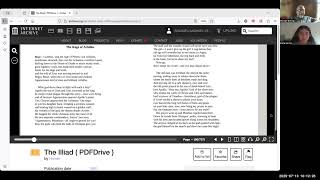
Speaker A and Ilana read the opening of Homer's Iliad, tracing Achilles' rage at Agamemnon and Apollo's plague. Ilana connects the epic's anger to her own experiences, from sibling fights to grief over loss, finding both familiar and foreign ground in the ancient text.
Chapters
Yeah, I actually wanted to just look at the Eliot a little bit. I know you read most of it on your own, but I thought it might be fun to just discuss a little bit. So I've got a different translation, not the Wilson, and I thought I'd just see how you are understanding the first part of it, because obviously we won't be able to read very much. Um, right, I'm looking for my Zoom. There's my Zoom, so I'll share it and we can just read the first little bit. Um, okay, and maybe I'll start. I'll, I'll read the first bit because it's hard to read and think, and so if I read it, then you can be thinking and understanding, then I'll ask a little bit. So, the rage of Achilles. Rage. Goddess, sing the rage of Peleus' son Achilles, murderous, doomed, that cost the Achaeans countless losses, hurling down to the house of death so many sturdy souls, great fighter souls, but made their bodies carrion. Feasts for the dogs and birds, and the will of Zeus was moving toward its end. Begin, Muse, when the two first broke and clashed, Agamemnon, lord of men, and brilliant Achilles. So just first start with, um, you know, how does that land for you? What do you think of it? Like it? Not like it? What's interesting? What calls your attention? What are you getting out of that?
Uh, I like it, and I guess the main point of that clause— I'm not sure if that's what you call it— would be to— an inference that Agamemnon and Achilles are going to fight. And then also maybe foreshadowing that Achilles does something that costs the Achaeans countless losses and puts that in a little detail. But I like it because it's a really interesting and captivating first.
Got it. Um, and just to go to the rage, would you say rage is something that you've experienced, or are you not the kind of person who ever has rage?
Um, I guess, uh, depends on your perspective, because I've gotten like angry or mad at people, but not in like this context, like war, wanting to kill someone or something. So maybe not this type of rage, but frustration maybe, or anger, but not entirely this.
What kinds of things have made you angry?
Um, well, the littler things are like when my brother is annoying me, or maybe he's not listening. Or bigger things like, um, someone at or outside my home, like maybe at my gym, or maybe when I was in school, was bullying someone or not being nice, that made me a little angry. That's, yeah, those are examples.
Got it. So then my question is, given that you've had perhaps little, and you say a little bit angry, do you think you can actually understand the rage of Achilles, or is it too alien? To what extent do you think that you can, you as a human being, can relate to the rage of Achilles?
Um, I think I could understand parts of it, like, um, when he's angry that Agamemnon wouldn't give or wanted to take Briseis. Um, in that part of the story, like, I've had things— maybe, maybe my brother wanted to take things from me. That's a smaller scale, but that's sort of like it. But then other parts where maybe Patroclus dies, I couldn't really relate to that because I haven't had anyone close to me pass yet. So yeah, I think I could look at it like that.
[Speaker:CB] Okay. Actually, I meant to scroll down rather than turn the page. Let's just get one more stanza and then we'll run out of time. What god drove them to fight with such a fury? Apollo, the son of Zeus and Leto. Incensed at the king, he swept a fatal plague through the army. Men were dying, and all because Agamemnon spurned Apollo's priest. Yes, Chryses approached the Achaeans' fast ships to win his daughter back, bringing a priceless ransom and bearing high in hand, wound on a golden staff, the wreaths of the god, the distant deadly archer. He begged the whole Achaean army, but most of all the two supreme commanders, Atreus' two sons, Agamemnon, Menelaus, all Argives geared for war. May the gods who hold the halls of Olympus give you Priam's city to plunder, then safe passage home. Just set my daughter free, my dear one, here. Accept these gifts, this ransom. Honor the god who strikes from worlds away, the son of Zeus, Apollo. So what are you getting from that stanza?
That I'm assuming, well, First, I know that— or another emotion besides rage is that the priest, he misses his daughter and maybe he's sad or grieving, so he's begging the army and Menelaus and Agamemnon for her back. I already know what happens next. They won't give her back, and then the plague comes. Well, actually, just in that stanza, if you didn't know anything, I guess I could assume that they don't give the priest's daughter back because they is because of the plague that Apollo unleashed onto the army. So there's some more foreshadowing there, and where you can kind of tell what happens, which I think is interesting. But overall, that made sense.
Got it. And I realize that, you know, because there is a lot of this where it's one thing to approach a text raw, the first time trying to figure it out, trying to make sense of it and so forth. It's very different as, because you've read most of the book, you're already familiar with plot lines and both are valuable. You know, the Greeks would typically listen to these many, many times. You know, they were kind of sung or spoken at large gatherings and people would listen to them for, I think it was 8 hours at a time, something like that. Um, but they hear them many times, so they're very familiar with it. Um, but a question I have, we're kind of running out of time today. We're gonna try to keep these short. But a question I have was, I thought it might be nice for you and I to actually read something together, uh, in a substantial way. And since you already started the Iliad, I assume you know what the Odyssey is?
Yes, I know what the Odyssey is.
Have you, um, ever looked at the Odyssey at all?
I haven't read the original translated text, but I've heard lots of different retellings and little clips and things like that.
So one possibility is to read the Odyssey together. And what I'm thinking is maybe next, next time we're together, maybe just start very slowly like we did today, but then read a chapter at a time separate and then come back and discuss it seminar style. How's that sound?
That sounds great. That's a great idea.
Okay, in which case, um, I will recommend a translation to your father, and, um, you know, you and he can get it, and then we can start next week just with the first few stanzas. Okay.
All right, that sounds great.
All right, thank you. Have a great week, Ilana. Bye-bye.