Ep 191: Building a High-Performance Culture with Clear Expectations - Insights from Michael Erath
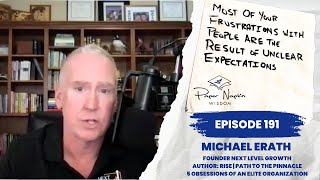
Michael Erath talks about building a high-performance culture through clear expectations. He shares his career shift from manufacturing to coaching and how those experiences shaped his approach to leadership and holding people accountable.
Chapters
Michael, welcome to Paper Napkin Wisdom. I'm really excited to be sitting down with you today.
Yeah, Govind, appreciate it. Really appreciate the invitation and a little.
Bit of a small world. I'll just pull it in right away that Jim Small, a member of your team, was with us a few years ago. So it's exciting that we're bringing you on now too.
Yeah, that's great.
So your paper napkin is really interesting and I'm going to read it out and it is. Most of your frustrations with people are the result of unclear expectations. Why did you share that with me?
I think it's something that as I've transitioned from a career of having my own manufacturing business and into more of a coaching career, it's something that became very clear to me early on and something I see across every industry, every size organization. And in many cases it doesn't matter how mature the organization and or the team are, there I think are oftentimes we default to thinking people understand what we expect of them and then we're constantly frustrated with them by not meeting those expectations. But when we flip it around and ask them, they don't actually understand as clearly as we think they do what's expected of them.
One of the things I think is really interesting about this is the result of unclear expectations. You didn't specify just with them. Does that mean it could work both ways too?
Absolutely.
Right?
Absolutely. I think sometimes you could be from a team member role, you could be promoted into a role and you have expectations of what you need from your boss to help elevate you into that role and coach and mentor you that you don't communicate and then you're frustrated that you're not getting it. But you know, so there. It's absolutely, I think a two way street.
Yeah. I think it was really to me what jumped out right away was the fact that you, you left expectations open and it made me think that it was mutual in your, in your interpretation. So. So, you know, I think I've been guilty of this in the past. I'll go to a conference, I'll spend a sleepless night writing a new manifesto about some idea or product or we're going deeper into how we could solve some problem, come in all excited, lay out the course of what I want, drop effectively a bomb off. That's really clear in my head and then I leave the team to deal with the shrapnel. Is that the kind of thing that you're talking about?
That often happens for sure. I also think that. And where A lot of this comes from is, and I mean, I think this works with outside vendors. I think this works with, you know, things you procure for your business, capital investments. But especially where I see this show up is between leaders and organizations and the team members that they lead. And you know, when, when, when I work with companies or work with teams to help them break down issues, I often find that underlying their actual issues are either some sort of a broken process or a person not performing to the expectation that you have for them. And when we dig deeper into the individual performance issues and the expectations, I find that most organizations don't have a system in place to clarify expectations. Well, there's a great Edwards Deming quote that every system is perfectly designed, designed to get the results it gets. And so if you're having people issues, people aren't sure what to expect of one another. Communication's not great. You already have a perfectly designed system. It's just designed to get you those results you don't want. And so that's where I think you've got to start to look at the underlying system of how we communicate expectations. And it really goes back to starting with the onboarding process.
So let's sort of scale this back a little bit. And you know, you said that you understood this in coming out of your career in manufacturing. And then as you moved into coaching, you saw this. So is, you know, how did you first, what was your world like before you learned this lesson? How did you come about it?
So, yeah, and so actually this was something I was more a victim of as a self inflicted wound in my, in the prior stage of my career. So a little bit on my, on my background. So I grew up in a family manufacturing business. Through high school and college we were, we had a manufacturing business in Virginia that manufactured hardwood veneer for the furniture industry. So when I took that over, I was in my, I was about 27 when I took it over. We were about an $8 million business. 100% of our, our business was domestic, supplying furniture manufacturers up and down the East Coast. Over a period of about 15 years, I grew that business to around 45 million. We had to, we transitioned to an international business. We had offices on six continents. We were shipping about 200 containers a year, I'm sorry, a month between logs and veneer. But one of the things that was part of the whole growth strategy was I wanted to vertically integrate the business. And so I brought on a partner, set up a separate entity under the same umbrella. And the entity that he ran was a timber merchandising company. So we went from going to sawmills and loggers and buying the highest grade logs to produce veneer to we actually started managing timber ourselves. And we would merchandise everything we didn't want. We would keep the best logs to produce into the veneer that we sold. And so symbiotically that worked, really. And this business partner and I became best friends. We vacationed together with our families. I became his son's godfather. We got really, really close. And in 2008, when the financial market started to unravel and we went into the Great Recession, I found out that not only had he embezzled half a million dollars in 18 months, but he was committing bank fraud through the entity that he was was governing. So at that time, if you remember, businesses that were in trouble were essentially throwing the keys at the bank and letting the attorneys fight it out. When we found out what was happening, we brought in a private investigator, kind of verified what my CFO had uncovered and at the same time went to our lender and went to the U.S. attorney's office. So kind of the path that went down took about four years, but he ended up being indicted on two felony counts. He served two years in federal prison. The bank immediately froze all of our accounts to figure out what was going on. So I had a situation where my father had passed. We had transitioned my mother out of the business. I had bought her shares, but she was hung on our bank guarantee. And so we had about a $6 million open term note that was. Now she was at risk. So I went to the special assets group and negotiated with them a Runway to take the business through an orderly liquidation because had it gone to auction, there would have recovered nothing. And with a few very fortunate events along the way, we were able. It took about 18 months, but to get the bank made whole and got the creditors made whole. And my wife kind of took the attitude we would take the haircut, but we wanted to live to fight another day and keep our credit intact. So we got through that, moved to Ohio, started a new business in the same industry where we outsourced our manufacturing. We kept a few key employees and just essentially restarted from scratch. As I was growing that business, I had been a member of YPO and EO throughout this time and had been kind of implementing a lot of my own bits and pieces of different things I had read and studied. But it was, it was very cobbled together, not very complete. And so I at the time had red traction and started self implementing eos. And I appreciated the holistic nature of it and that it was easy to digest. And so that became something I got very interested in understanding more about the systemization of business as I was going through that process. That then led to me about five years later in 2015, one of my colleagues in EO in Ohio and asked me if I could help their team kind of self implement eos. And so I kind of de facto became their coach, not really intending that to happen. And I really fell in love with that type of work and realized that the things I had experienced through the last years of my career and things I had endured and overcome really equipped me to facilitate, coach and mentor with some unique abilities that not a lot of people had, based on the experiences I had been through. And so 2015 was when I exited the business, the second business that I had started and initially started working as an EOS implementer and then eventually left EOS and started building next level growth. And it was really through that process when I started working with lots of other companies and started helping people break down issues and understand what was really affecting their performance, that I started realizing that even like for example, with the accountability chart in eos and the way that works for anybody that's familiar with still doesn't do a great job of really clarifying what's expected of people. And so those were some things that we started to evolve. And we've created what we refer to as a next level accountability chart. It's got different components to it, really clarifies expectations of people and creates, creates measurable outcomes that people need to achieve in order to be successful in their role. So they know whether or not they're winning. There's no questions to it. And then it allows us to coach and mentor people in those areas. And so it was really through that that I started realizing that one of the underlying issues affecting performance and leading to frustrations is simply the fact that lots of people get onboarded into a job and don't really understand what's expected of them. And even more so how what they do connects to a bigger picture within the organization.
I think there's a lot of wisdom what you shared right there, Michael, and I want to thank you for that. But I think we have to go back. We have to go back and connect some of these dots here. I want to get to the system designed to clarify expectations. Because now you've talked about this twice, right? You've brought it up twice. So I want to get back to that. But before we do that, you said something, you just sort of dropped it real quickly. That the things that you'd overcome had equipped you with skills that were beneficial as a coach.
Right.
As a. As a. As a. As a supporter of other organizations equipped you with skills. It's incredible how much the challenge, how much the struggle, how much the endurance, sometimes surviving that, sometimes not surviving. But either way, learning from those challenges can equip you with a set of skills that are really quite surprising. Is that kind of what you were hinting at there, that you got some skills through this challenge that you otherwise hadn't expected to pick up along the way?
I think so. I mean, in a sense. So it's both, I think, some technical skills as well as some emotional skills. I think when I talk to entrepreneurs and when we start kind of sharing our stories, what I tend to find is the more vulnerable I can be and how I share what I went through, the more it actually resonates. Because what I tend to find is most entrepreneurs have either been through something in some way, shape or form similar. In some cases, they're actually going through something, or they're fearful that the time will come when they will. And so it creates a bit of a quick connection. If you think about it, people don't really connect and get close. When we're talking about all the social things that you do at the country club or whatever, it's when you really kind of share the hard things, that's where people find common ground that they connect on. So I've found that. But also it. You know, for 18 months, I was meeting with the Special Assets Group every two weeks at our bank. And my father had a background in finance. I did not, but I was very involved financially in things with the business. But some of the financial things that I learned going through that process, things to be mindful of, things to stay ahead of in the business, just lots of various things that I think were taught to me or that I learned through that, through that whole process.
Yeah. And I think that one of the things that I wonder about that it taught you is a little bit about this accountability and expectations thing, because it's very rare that entrepreneurs, CEOs, founders, are put in a position where they have to be accountable to someone else.
Right.
And isn't it true that when you were showing up every two weeks, the Special Assets Group, you were. You had to be transparent and accountable to them? You had to, you had to actually volunteer to be that level of accountable, because if you weren't, you wouldn't have rebuilt their Trust, you wouldn't have been, first of all, you wouldn't have been even given the opportunity, but you would have, you know, they could have closed you down at any point, right. If anything went wrong in those two week meetings, right. They had that over.
So. And that was. You're right. And that was essentially the feeling going into every one of these. Is this the stakes were that high? Yeah, exactly.
That must have been really tough to, to learn to be that accountable. And I think that for some people it's a lesson in humility, but another piece is just a lesson. It's an opportunity. And you talked about this, you learned some emotional skills. And I wonder, I wonder, I wonder how much came from just that volunteered accountability every two weeks that you had to learn that skill.
Right. And you know, I hadn't really connected these dots until hearing you, you ask it or mention it that way. But so as an example, I mentioned I was second generation in this business, right. So I wasn't in the family business. I grew up in it. I didn't build it, my father did. And my father was born in 27 in Chicago. He grew up the tail end of the Great Depression, right. And so grew up very poor. And really through a lot of grit and determination and good decision making and some fortunate breaks through a different vehicle in a different circumstance. He learned a lot of those disciplines and those were things that, the way I grew up as a second generation in the business, I didn't learn those naturally growing up. And it really kind of took at sort of the midpoint of my, of my life in my late 30s going through this to, to really learn those things.
What a really incredible opportunity because most. One person who was in, you know, surrounded mostly by generational businesses used to tell me that the first generation sees opportunity in everything. You know, they, they think with the first generation of growing a large, you know, and I mean like a business that goes to the 20 to 50 million minimum category. These entrepreneurs, these founders see things as opportunity, are very risk, you know, are very managing risk, but are willing to take the risk because they're willing to build. They see the growth opportunity and they want to capture the growth opportunity. They're more open minded to those things. The second generation, his point to me back then was they want to protect the wealth, right. As opposed to grow it. And that's a different mindset. But you ended up having the opportunity to bridge the two and then learn this volunteered accountability on top of it, which is really interesting skill dynamic to add to it, which is fascinating. And I think that's the emotional skills, some of the emotional skills that you're talking about. Am I right?
Sure. Right, right. Because I think it's. I have. I think. I think naturally I'm more of an empathetic person. But having been through these experiences, when I'm talking to an entrepreneur who's highly frustrated, who's having challenges and sleepless nights, and there are things that they're afraid of, there's a very authentic empathy, I think, that I'm able to extend because I know exactly what that feels like. I've been there. And it allows me, in those cases to kind of walk that journey with them as opposed to having to try to figure out what they're really going through.
Yeah, that's. That's powerful. So.
So.
The other thing that you talked about, and I think you said it.
Very subtly.
You talked about accountability, but you didn't really talk forcibly about holding people accountable, but more making sure that people know that they're winning, which the converse is also true. If the people know that they're winning, they know that they're not winning, which, you know, sort of puts the accountability on them. They're accountable because they know. Is that. Was that a slip? Am I missing or am I connecting something that you're not trying to say there?
No, I think you're absolutely right. Accountability and high performing, highly accountable cultures do not have to be browbeating, you know, disciplinary cultures at all. And I think, in fact, the inverse is often true. But like I said earlier, I think it goes back to most organizations, I think, have a very poor onboarding process or one that's very inconsistently followed. And I kind of, tongue in cheek, ask. I always ask my clients this. And when I have the opportunity to talk to or speak to team members within companies, I ask as well. But if I were to go back and ask the last 20 employees that your company onboarded, if they went through a great onboarding experience or if they felt like they got waterboarded, what would they say? And everybody kind of laughs. And yeah, we waterboard our employees. We don't onboard them well. And the problem is that when you think about retention of employees, a well onboarded employee will stay much longer, they'll perform better, faster. And when you relate this back to expectations, if you and I were going to work together, whether I'm an outside vendor or it's me coming into your organization as an employee, if we take time in the very beginning to have a dialogue around expectations in both directions, but if you're really clear with me on what's expected of me. And this kind of gets into this idea of, of a next level accountability chart. And so if, if, if anybody in your audience has an accountability chart, if it's kind of the pure EOS form or if, if, if they just have an org chart. The way I like to approach this is that every seat on your accountability chart should have three components that you define. And they're simple and they're short. But the first is a clearly defined mission. And that's a one sentence high level statement that is for a person in that role, the consistent, deliverable that they have to accomplish or achieve in order to be successful. And oftentimes it's, they're very obvious but they also create clarity. And so once you know the mission for a role, and I'm happy to share some examples if you're interested but once you understand the mission for a role and so like I'll take a CEO for example. So let's say, and this is another exercise I like to do is to ask teams to imagine they're a board of directors and they're going to start hiring a new executive team, starting with the CEO. What would that mission be? How would we articulate it if this, if, if a candidate came in and said well, what's my mission in this company as the CEO? It may be something as simple and obvious as grow the enterprise value by guiding the long term strategy and culture or something to that effect. When you look at it, it's on surface it's pretty obvious. But how many CEOs are working for organizations where they're not growing the enterprise value, they're not being held accountable to that, they're not making decisions through the lens of how does this grow, grow enterprise value. So it becomes clarifying. And then I think what's really powerful.
About it is it's simple, right? It's a simple measure that you can apply. And I often say this, that you know, the, the, the mission of, of every pro sports team is obvious and simple. It's a win, right? They, they want to win and, and then they, you know, muddle about with a bunch of tactics that some deploy more successfully and consistently than others and some lose when it comes to how they onboard retain practice and so on and so forth. So I think, I think the mission becomes this permanent simple element that you can really understand and put everything through that makes a lot of sense. What's the second?
Yeah, so the second component of it is what we have branded as A most critical outcome. And so there's. I was watching a recent interview with Joe Polish and Harvey McKay, and Harvey made a statement that I think is universally true and a little bit direct, but that things in life pay off on results, not effort. And I think it's very true. Doesn't mean we don't reward effort and when we see momentum, but at the end of the day, it's about results. And so the idea with the most critical outcome is it really answers two questions. Number one, if we're going to look at an outcome, not leading indicators, but an actual deliverable outcome that would prove success in the achieving of a mission, what would that be? So probably a more common example, if you think about companies, and you've probably worked with several yourself, where we've got a sales manager in place or we've got a chief revenue officer, we're missing our revenue goals. We tolerate mediocrity, they're trying hard, whatever the case may be. There's lots of excuses and lots of storytelling. So one of the things I look at is for a sales leader, a mission is typically something like consistently grow, lead conversion to meet or exceed revenue goals, or revenue budget, whatever that may be. That's a finite number. It's easy. That's. That's a really obvious statement. But if you and I agree, if, if you came to work for me as our chief revenue officer and we agree that that's your mission, then it becomes much easier to one, you're going to want to hold yourself accountable to it, but I can hold you accountable to it as well, because we've already agreed to that. There's no gray area, no argument. The most critical outcome would simply be revenue dollars to budget every year. That's what it is. And if you're meeting or exceeding that, you're winning. If you're not, you're not winning. And we need to figure out how to get you coached up, or if you can't get there, get you coached out and bring in the next one. Just like a professional outcome.
Just to be clear, Michael is quantitative.
And measured 100% quantitative. It is often, especially in an executive team, it's typically a lagging indicator because it's an outcome and it has a handful of key drivers, which are the daily and weekly metrics you want to be tracking. But same thing for a director of operations. It might be net operating income, percentage to budget. I want them to go get us the percentage of net operating income and manage expenses accordingly. And so what you start to do is if you think about that most critical outcome in each role. What is the outcome? Not the inputs that prove success and their mission. That logic can filter down to a frontline employee, whether it's a tradesman in the field, a manufacturing company person on the floor. Everybody that you hire has a mission. There's a reason you hire them and there's something you can measure to prove success.
And if there isn't, well then why are they there?
Right? Why are they there? Right.
I mean, if people are struggling with this and saying, oh, I don't have a mission for this person.
Right, well, exactly.
That's the issue.
Right. And so we used this in the second manufacturing business I had and it was really powerful. You know, Jim Collins in Good to Great talks about in the flywheel concept, he says that many of the good to great companies achieve spectacular results in very unspectacular industries. And he says they did it because they built a fabulous economic engine. And that was kind of the three word phrase that really stuck to me. And when I start looking at most critical outcomes, the companies I work with or that we work with at next level growth, who have done this really well, truly build a financial engine in the business. Because the frontline team members, their most critical outcomes drive the most critical outcome of the person to whom they report. And that logic flows all the way up through the organization. So if the CEO's most critical outcome is enterprise value to goal or return on invested capital or EBITDA dollars, whatever your value measure is going to be, if the entire organization is built on a system of most critical outcomes, that all are how that person in that role contributes to driving the one above them. You essentially have an entire company that is focused on outcomes that drive value in the business, which at the end of the day is what we want, whether we want to sell the business or not, if we make it more valuable that everybody wins, yeah, it makes.
A lot of sense. So, mission most critical outcome and what's the third element?
So before I go into the third, just quickly, there's a second question that the most critical outcome helps to answer. And I think this is something was more of an epiphany for me as, as, as we were developing this over the last few years is that most of the things that people invest in with their businesses they consider through a lens of return on investment, right? So if we're going to go invest capital in a new piece of equipment or a new software product, we can talk in terms of ROI to make a decision. At the same time, Most organizations in the service based economy that we've kind of become in the U.S. most organization's largest expense is the fully burdened human capital investment they make in their people. I have yet to meet anyone who can explain to me if I pick one person off of your, your census of employees and ask you prove to me you're getting ROI for Jim being the person in that role, they can't tell me if you successfully get to the right most critical outcome. It will also prove return on investment for the individual people in the seat. So for example, back to the sales. The chief revenue officer, if I'm paying a chief revenue officer who's consistently meeting or exceeding our budgets every year for our revenue goals, I'm absolutely getting ROI on the person that I've got in that role. And so it starts to allow you to think about actually you're making capital investments in these people. Right. And so are you looking at it the same way?
Yeah, it's really interesting. You know, one of the things that sort of flipping back again, a little cobblestone that we stepped on on the way was your father built the business in the depression era. And you know, that generation I find is the term my mother used to always use is mean with money. They're really tough. They got the most out of everything. A great example, this is my, my wife's grandmother would always, when we buying cucumbers, buy the basket, you know, sneak an extra couple cucumbers into the basket. Right. Say you have to shove it, you have to fill it right up. And my wife couldn't do it. So she'd always buy two and then stuff one and then bring it to her. Right. Because she wasn't that, that didn't come naturally to her.
Right.
But, but that, that frugalness and that ability to be able to prove, prove value. Just not think value, but prove value sort of comes out in that being mean with money and being frugal and being smart about what you're doing and getting a return on investment on every seat.
Right.
I like, I like that. Proving value, right?
Yeah, I love that story.
So number three, are we on to number three now?
Yes, exactly. I appreciate that. So the, the third component, the final component is what I call obsessions. And so if you think obsessions.
Obsessions. Okay.
Yes. Mission, most critical outcome and obsessions. And so one of. So our whole model is around what we call the five obsessions of elite organizations. I'm actually nearing the completion of a manuscript. I've got a book that'll Be coming out early next year by that same title. And one of those five obsessions is a culture of performance. And so I believe that to really perform at a high level, into a high standard, you have to almost be obsessed about a certain few things in your role and treat them that way. And so the idea with obsessions think about buckets of responsibility. So let's go back to our sales chief revenue officer or sales manager. In my company, with. With a sales manager in place, I really wanted them to obsess about three things every single day. The first was I wanted them to obsess about leading, managing, retaining, and holding their team accountable. So when I break that one down right, leadership is the mentorship, the coaching, the relationship building with the sales staff. The management is more the tactical, executing, doing the things they're supposed to be doing and doing them right. The reason I like to consider retention when I say lead, manage, retain, and hold my team accountable is I think most people go to work for a company, but when they quit, they quit their boss. And so if you have teams within an organization that struggle to retain talented employees, you almost always have a leadership issue. And so I need them to focus on retention. And then lastly, holding the team accountable. I think, and if you have hired right and you've got clear expectations, most people will hold themselves accountable. But I find that leaders who aren't willing to have tough conversations and hold people accountable when they're not holding themselves accountable, those teams always underperform. So to me, that's one of the three obsessions. And I think anybody who leads a team, that has to be one of one of the things they obsess about every day, which is a lot about looking out and up and leading the team, versus always looking down and into the team. The second one, I think at an executive level, I want this person focused on our strategy and the plans to achieve that strategy. So I'll usually start with a phrase and then people customize this if they agree with the logic. But a second obsession to me for a sales manager, chief revenue officer might be to own the sales strategy, plan and outcomes. And so the reason I phrase it like that, I think each of these obsessions needs to have a verb because they're actions that I need them to stay focused on. And when I say own the sales strategy, what I mean by that is this person should have the aptitude to create our sales strategy, to analyze it if there are areas where it's not working, to adjust it. So they really need to fully own the sales strategy. And if they get stuck, the rest of the team's there to help them. But ideally, this is the tip of the spear for our sales strategy. They need to own the plans as to how we're executing on that strategy, and they own the outcomes of that strategy. And so to me, that kind of encapsulates the strategic aspect of their role in leading our sales organization. Third obsession, and typically the final one is I'll say something around, like, owning our sales playbook and execution. Right. And one of the things. And you probably see this too, but when I go into organizations and I start digging around with the sales team, very few sales teams have team members who are all doing it the same way. Right. It's. It's chaos. They're all kind of making it up as they go. There's not a. There's not a best practice system for how we sell what we do and sell the value. So I'll ask, like, can I see your sales playbook? And it's almost always, oh, it's kind of in our heads, or, you know, we used to have one, and it's buried on the Z drive in the server, and nobody knows where it is. And so I think that role really has to own how we run the plays as salespeople and how well we're executing that. And so I feel like if a chief revenue officer or a sales manager shows up on a daily basis focused on leading, managing, retaining, holding their team accountable, owning the sales strategy plan and outcomes, and owning the sales playbook and its execution, I just need them to focus on those three things. And if they're doing those three things well and let everything else be noise, they will almost always lead a very successful sales team.
Yeah, I think it's really powerful. And so we don't lose it. I want to go back to the system design to clarify expectations. Are these elements are the mission most critical outcome sessions along with the onboarding process. Sorry, not the three things we talked about as being these three statements that you had as part of it.
Would you.
Which were. Which were the obsessions.
Is.
Is that part of the system designed to clarify expectations?
Yes. So if. If I were to show you what our accountability chart looks like, those statements I read to you, the mission, the most critical outcome, and the three obsessions. That's what's in the box for the sales manager. And it's simple enough that I believe they should be able to memorize, that they should be able to keep it top of mind every day. And when we talk about setting Expectations in the interview process or the onboarding process. These are things I want to talk through and I want to kind of break down what they look like. And what that does is if I'm being onboarded into a new role and I sit down and as part of that, I'm having a conversation with the person I'm going to report to. And we talk through these things, you in essence, create a de facto agreement because we had a dialogue about them. And so I am much more likely to hold myself accountable. But I'm also. If you're the person I'm reporting to. And so let's say you're the CEO, I come into this role and I can't find our sales playbooks or I feel like they're incomplete. Like we're going to have that conversation and figure it out pretty quickly so that we can get those things in place. Because the entire team's going to benefit by having it. And so you're actually. By giving me these key areas to focus on, you're giving me direction from day one, that this is what's most important, this is what's primary for me and my focus. And so it's kind of guiding me to put the building blocks in place, if they don't already exist, to make sure that the team members that I support have everything they need to perform to a high level.
Yeah, I love it. And you know, if you're of the school that believes in scorecards for. As supportive tools for coaching your team, all of this stuff can live on a score, part scorecard really easily.
And typically what I find is because the most critical outcomes at higher levels in the organization are more lagging, I tend to see them more on monthly scorecards and the key drivers of each of them. And we could talk about, you know, sales team driving, revenue dollars. We could come up with three or four key drivers right now that belong on the daily and weekly scoreboards or scorecards. Right. That as long as we're keeping those activities on track and meeting our expectations on a daily and weekly basis, we're almost guaranteed to hit the revenue goal.
Yeah, yeah. And I think that's. It's so. It's so simple the way you've organized this and articulated it. Really profound. I know our time is up, but there's something that is new with Paper Napkin and I mentioned this when we started. Michael. We're closing every episode with a shout out. So let me ask you now, just on whatever basis that you'd like, who would you like to shout out today.
You know who comes to mind today is Cameron Herold. He's been a friend going back to about 2015 or so. When I first was getting started with Eos, and when he and I started talking and I was able to share my story with him and my background, he made a statement to me that at the time, I had just transitioned into coaching, so I was a little bit fearful even hearing it. But he said. He said, you've got a lot more to offer than just this. He said, you need to do your own thing. And it took me a little while to execute that or to actually take action, but it just resonated with me. And for him to get to know me and knowing what he's accomplished, for him to say that to me, that was something I needed to hear. That helped me step out into as part of why we call our company Next Level Growth, kind of. He's the one who kind of pushed me to challenge myself to go to a next level. Powerful.
Thank you, Michael. And thank you for joining me today, Govind.
I really appreciate the time. All right, thank you.
More from Michael

Take Your Business Growth Next Level with Michael Erath #entrepreneurship #businessgrowth