$150k Out of a STORAGE UNIT & Pet Waste is KING! 👑 | Zero Turn
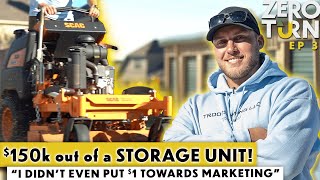
A Zero Turn interview (YouTube) with Sam, owner-operator of Troops Mowing, describing his transition from tech sales to running a lawn-care business out of a storage unit. The conversation covers how he found customers (neighbors, Google Maps), minimal early marketing, equipment and shop setup, services offered (lawn mowing, property cleanups, retaining walls, pet-waste removal), pricing strategy (per-cut by frequency), staffing/training approach, use of Jobber CRM, and his short-term growth goals for 2022.
Questions this video answers
December 25, 2021.
Within about two months.
A 21-inch push mower folded into his wife's Ford Focus (plus an electric weed eater and leaf blower).
Jobber.
$20 per service.
Chapters
Hey, everybody. Welcome back to another episode of Zero Turn. Today we're here with Sam, owner operator of Troops Mowing. We're going to hear about how he left his sales life behind and went to the gray outdoors to follow his passion of lawn care and landscaping.
How's it going, Sam?
Good, how are you?
Can you tell me a little bit about how you started Troops Mowing? What were you doing beforehand?
Yeah, so I was, I was essentially a director of sales for a tech startup here in Austin, Texas, and I was mowing a few of my neighbor's lawns just for fun, just something I enjoy doing. And to make a long story short, somebody came up to me and said God spoke to them and told me that I should be doing my lawn care company full time. And after some meditation and prayer, I believe that she was right. And so I started it full time. And he replaced my income probably within about two months. And yeah, I didn't really put a dollar towards marketing.
So how did you go about finding your first few custom.
A lot of neighbors, right? So my wife and I, we bought our house at a 21 inch push mower and an electric weed eater and leaf blower. And I was mowing my neighbor's yard and I just decided to put my company, company up on Google Maps and I got a call and so I didn't even have a truck at the time. So I folded my 21 inch push mower into my wife's Ford Focus and I had an electric weed eater. And it's kind of really just how it got started.
So what kind of jobs are you scheduling on a day to day basis? Is it mostly mowing or do you focus on like property cleanups nowadays?
When we were in the big swing of things in the, in the peak season, we're mowing Monday through Thursday and we would save Fridays to make up for those rain days. And if a rainy didn't happen, we would then kind of just knock on doors and schedule some property cleanups. Now that we're heading into the winter, I'm really just kind of focusing on upselling the current customers that I've had. So we're doing retaining walls kind of around flower beds and the trees in their front yards and just kind of more property cleanups. But it really, if you just had to pick one service that we do all the time, it's lawn mowing.
How long did you work in sales before you jumped over into lawn care?
I like to say I was in sales my whole life because I've always been Just a little hustler. But professionally, I was in sales probably two years before going full time in long term.
I think it's interesting that you mentioned upselling your customers. What would you say to somebody that's just getting started out, trying to get over that, like, closing hurdle?
Whether you're sending an email or talking to anybody in person, you just can't be afraid to ask, right? And I think when people hear sales, they. It's like kind of like slimy. Like nobody likes the word sales. And I don't like to be sold myself. So really like the technique that I use. I just like to build rapport with people. Just kind of be slightly sarcastic and just kind of just have that playful banter. And that way when I do ask for the business, it almost seems like we're friends at that point, it's harder for them to tell me no. And if they tell me no, I ask them, is it a price thing? What can I do to turn this into a yes? Like, I would love to earn your business and really just kind of go off of their answer and really just kind of see if we might even be a good fit. Right? Because every single person that gives me a call might not be a perfect fit for me. And just for advice for anybody else, just don't be afraid to talk to people.
Right?
That's all it is, right? Just talking to somebody, building that rapport with them, and then just asking them, can I have your business?
So I'm sure you missed miss your days working out of the van, but do you want to tell us a little bit about your truck setup and what you got going on here?
I mean, the truck is just a truck. We kind of carry. Like I do the pet waste removal, so we carry a bucket to put all that in and just kind of the pet waste removal tools. But yeah, this is the bread and butter right here. So you just got a commercial blower and stick edger, string trimmer. Right now we're on our backup 30 inch. So it's a residential model, but our commercial grade needs to get fixed. But yeah, so really just, you know, we work with a 36 inch stand down and a 30 inch push mower. And that kind of just takes care of all of our properties for us pretty quick.
So when you guys are doing maintenance, do you send it into the shop for it or do you do any of the maintenance?
I can show you the maintenance that I do. It's pretty janky. But really I just have a good relationship with my dealer and I'LL take it in, and I'll get it fixed as soon as possible.
Cool.
I feel like I kind of cut the line a little bit, but that's why it's good to be good with people. Right.
So this is your shop space.
Yeah.
Do you want to tell us a little bit about your organization, how you got things going on?
Yeah. So really just kind of just chose the most affordable option closest to my house.
Yeah.
Really just try to just keep it as organized as possible. I mean, I have limited space. We don't have enough space in between the storage units to, like, back up the trailer with our truck. So we have to download the equipment, pick up the trailer, wheel it in, and that's why we're looking for a new spot here. Come, you know, March of next year and really grow into that space. It really works for the size of business that I'm working with right now.
Have you always worked out of a storage unit or did you work from your home for a bit of time?
I worked from my home for about a week, and then my wife was like, get a storage unit. Gotcha. I mean, she's so supportive. So I'm somewhat joking, but really just more efficient for me to kind of work out of here. I feel like I'm not taking up the space in my house.
Obviously, you can't just fill up your storage unit with debris. What's your strategy when you're trying to get rid of that sort of stuff?
We actually have a pretty awesome. I call it a park, but really just a community spot. And the dumpsters are completely free. We don't bag our clippings. And the level of landscaping jobs we have might just be a bag or two of weeds and debris. So if we have a few bags, we'll just go put it in those free dumpsters. Yeah. So we haven't had to worry about dumping fees or anything like that yet.
With retaining walls. I had a customer who. She's an older lady and just basically like my grandma. Right. At this point, we built that relationship to where I. I would call her family. And she asked me if I did retaining walls, and I told her, yeah, but really, I've never done it. So I told her, I said, you know, if you're willing to let me learn on your property, if you just pay for the materials, I'm not going to make a markup on it. It didn't turn out great, but I've learned from that. And then I probably had, you know, seven or eight retaining walls since then, and every Single one has turned out amazing. So really just, just kind of dipping my feet in, diving head first, asking somebody if they're willing to allow me to make mistakes without them paying a huge profit for me in the company. So really just hands on and learning from your own mistakes. Because I make mistakes frequently, so just learning from those mistakes is key.
You haven't had to put a lot into marketing just to get rolling, have you done a few things. I heard that you're on Google. I saw your website, it looks amazing.
Thank you. Really just having the logo on my truck has been, I would say probably the most pivotal thing I ever could have done for my company. I think just the white against like that steel color just pops and I always see people's heads turn right. So to me, to me it's working. So outside of having like the logo on my trucks, I've done door hangers and stuff like that. But really I think what helps me out is, you know, Mike always says like marketing and sales. So whenever I get those inbound calls, I rely on the sales skills that I picked up to really just kind of close that business.
Thanks for watching the episode so far. If you haven't already get your tickets for Landscape Summit, it's going to be January 13th, 14th and 15th. Either click the link in the description down below or go to landscapebusinesscourse.com conference.
So here at this property, what kind of goes into pricing a property of this size?
So really the first thing I do is I pull up an address and I kind of measure their square footage. With the software online, I kind of know about down to like every 50 square feet, how long it takes me to mow a thousand square feet. So with that I'll just kind of run some calculations and if that price comes out lower than my minimum, I'll just charge them the minimum. If that price comes out higher than the minimum, I charge them, you know, within like $2.50 of that price. So this one, this is actually the very first week we did a bi weekly service on this property was weekly. So for this it took us maybe like 17 minutes. And we charge. This would be $55 per cut plus sales tax every two weeks.
Gotcha. Yep.
So I think this customer, they want us to stay on throughout the entire, the entire year at bi weekly. And then if they choose to happen to go down to monthly, that price per cut increases, but ultimately saves them month. Right. So we kind of look at it as like a bulk discount. So if you want Weekly, this is 45 per cut, bi weekly, just $55 per cut. And then probably monthly we'll probably kick that up to 70 just to, you know, make sure bills are paid throughout the winter.
What were some of the kinks along.
The way really initially, the prices, I had them all wrong. I didn't really know what to, what to charge for the first few lawns. And I was being generous. I think they were my neighbors, right. So first few lawns, they're pretty off. And then I realized if I want to actually have a company out of this, when I went full time, I was like, I got to figure out like the man hour rate and kind of figure that out. So, you know, right now just if I'm solo, I'm making about like $80 per man hour. After like the variable costs and all that. With two of us, we're probably sitting around like 150 every two hours. So every hour, 150 every hour for two people?
Yeah. So working out the kinks, it really just took some time. But once I figured out how long it took me to mow a thousand square feet, I really was able to dial in prices at that point.
So my ideal customer really truthfully would probably be like a veteran, like an older veteran who just is always trying to help me out and they want to help out a younger veteran. So that would be my ideal customer. But really anybody who is either too busy to mow their own lawn and anybody who's maybe too old to mow their own lawn. So like the busy professional and then the retired just kickback person is my ideal customer.
Do you want to introduce yourself just because now you're hopping on the scene?
Sure.
Well, my name is Dylan Warner. I'm Sam's brother in law. I help him on the scene side until the spring hits. When the spring rush hits and I'll be doing that full time with him. What are you guys thinking about for like 2022?
So 2022, I think initially my goal is to have him in a truck with another employee. And I think, you know, right when spring rush hits, we're gonna already have a full route for a two man crew. So I'm gonna have him and an employee on the two man crew and then I'll have a truck and just kind of build up routes, go to estimates, do the sales process. You know, God willing, if this grows to million dollar company, multimillion dollar company, he's going to probably be more like an operations manager, just kind of continue growing the business. I'll probably be like in The CEO role, just, you know, managing everything. And yeah, I couldn't be more thankful to have him on board because, like, really, it's hard to find trustworthy people.
Right.
He's one of the hardest working people I know, so I'm very lucky to have him on board.
Were you dreaming for the stars right away or were you like, maybe is this something that I could do part time?
I would say I'm a dreamer. Probably like unrealistically a dreamer. So realistically, I thought I was going to be like a million dollar company day two. So really my dreams have always been big and, you know, reality set in a little bit and it obviously takes time to grow and I have good help. Yeah. The aspirations was to provide for my family. As soon as I started going full time was to provide for my family, you know, really just kind of create a company I'm proud of. Right. And create a company that, you know, maybe one day I could pass on to my family, God willing. And really that was just my biggest motivational factor.
So which one of you guys came up with the pet services idea? That's genius.
It was me. I was just tired of walking through dog poop, so I figured I'd make money off of it.
Yeah, that's smart. I like how you framed it as a service that you're offering because on Augusta, we're always emailing customers ahead of time, please pick up after your pets. Please pick up after them. I know it's a huge problem in the industry in general. What was your thought process behind that? You offer it as like a service?
To answer that question, I. First, I probably should touch on how we bill the customers. So we have all their cards on file. So as soon as we're done with the. With the service, we charge their card. I used to charge like an excessive pet waste fee, but something just didn't sit right with me. Charging their card for something they might not have been expecting. I think that like ruined the trust with the customers. If I was a customer, I wouldn't like that either. So really I just decided to offer it as a service. And right now it's $20 per service and sometimes it takes me five minutes and we have a five gallon bucket and other times last week or two weeks ago, this yard filled up about five gallons.
Oh, man.
So going forward, I could probably fine tune it a little bit where like one dog is X amount of dollars, two dogs is whatever. But yeah, it's really, it's a really good, just revenue. Revenue driver. But I'm always looking for ways where I can, you know, increase my revenue with little added work.
Right.
So it's nothing, nothing much to go pick up dog poop. I mean, I have two dogs myself, so I know the g.
How do.
You keep track of your schedule? Do you have an app for it or do you use Google?
I use Jobber for our software and that's been probably the most helpful tool that I've had since having this company. Even since the very first customer I've had, I had Yardbook and then I transitioned into Jobber so that my customers can have like a more user friendly experience. But managing all of my customers is definitely. I give credit to the CRM on that. It's really just me kind of going in there, pressing a few buttons and then I have all that information. So I can't take full credit.
So have you already felt the fatigue of trying to manage your customers, trying to manage the mowing, try and manage employees? How have you dealt with that kind of stress?
There's days like with anything, right? I think if you have, if you have a director of sales, there's days where you're like, I'm tired of selling, or there's days here like, I'm tired of mowing. You know, I get in my Bible in the morning and I think that really just helps me out throughout the day with my mental headspace. And then I kind of feed off of talking to people if they're nice, right? So I feed off of that. So really just kind of just managing the whole day is take each day one day at a time and understand that I have a reset button in the morning. So I think that understanding that in the morning everything resets, it kind of just takes that pressure off of you where, you know, it doesn't seem like compounding every single day.
Hey everybody, hope you're enjoying this episode of Zero Turn. If you haven't already, check out lawn care bookkeeper.com we can handle your payroll and do quarterly bookkeeping. Check us out@longcarebookkeeper.com. make knowing your numbers easy.
As far as like truck experience goes, having the trailer set up, has that caused any issues out here? I mean, you guys are out in Texas, so is it mostly suburbs like this or are you getting into more dense areas as you go towards Austin?
So really it's more spread open like this. I mean, if I was in downtown Austin, we'd be trailerless all day, all night. I really do think I'm gonna get into the ramp rack sport next year. Really Just kind of cut down on, like, the tires. You'd have to get brakes. I mean, this doesn't really need brakes for that light of a trailer. But, you know, registration, I mean, that's crazy, right? You get a $3,000 trailer. You're paying a couple hundred just to register. So we'll cut down on that. I think we'll have one. They'll probably be on a trailer to set up next next year so that the whole trailer training doesn't have to happen.
Austin is an incredibly fast, growing place. Have you felt the pressures of competition, or is it more of, like, a camaraderie amongst landscapers? Because just us driving around, we saw, like, five different other guys.
Yeah, it's super cool, actually. I was just. Just cutting this lawn. I had a compact competition. You could say, give me a call. And really, I subcontract stuff out to him. He subcontracts it out to me. And there's so much business to be had. I really don't feel any competition. It's really just. I want to say a brotherhood, but it's not really, you know, brotherhood. But we're all friendly, right? We. I hand off business if I can't do it that day, and vice versa. So really, it's. If anything else, it's, you know, marketing, I guess, like, referral basis. People give me business and vice versa. So, yeah, really not a whole lot of competition. I got a good group of guys around here that I trust, and they trust me. So.
In this sort of area, what kind of climate effects do you have to take into consideration? Like, obviously, a rain day puts a big damper on things. Does winter really slow it down for you guys?
I really forecast January and February to be the slower months, and probably beginning of March can be thrown in there, too. One of the bigger environmental factors that we need to worry about is. Would be the rain. It doesn't rain a whole lot, but the ground here is, like just limestone and clay, right? So if it rains a little bit, it's gonna sit on top instead of just soaking in the soil. So in Washington, you guys can probably have a tsunami and be out there in two hours. But here, you know, just kind of sits on top, and it almost just kicks out like, a half of a day if it rains for an hour or two.
You've had employees in the past. What was your kind of training strategy? Are you thinking you might switch things up with this new crew that you're.
Gonna bring on really, a big part? Why?
He's.
He's on your part time right now is he's just gonna get a hang of everything. He's already rock solid on the mower, he's gonna get rock solid on the Weed Eater and just everything in general. So really all I have complete trust in him, you know, next year to train as he sees fit. I don't want to micromanage anybody. I don't want nobody micromanaging me. So as long as quality is there and really, however he wants to train, he can train. How I train my previous employees is I would put them on the Weed Eater first for, you know, a week or however long it took them to really just get comfortable with it because really, weed eating, I don't know, it's like everybody's, you know, Achilles heel. But so once they got comfortable with it and they just feel like they could, you know, master that, we move them to the blower. Really not much to the blower.
Right.
Just turn it on and walk. And then we kind of put them on the push mower and then the stand down. And, you know, once they're. Once they feel comfortable with everything, I would put them on a whole lawn by themselves. A lawn or two, and they can just kind of put it all together. And once they kind of comfortable with everything, they're just ready to rock and roll.
Yeah.
This off season going into next is like, it's going to be like a feel like a company, you know, morning meetings, whatever.
Just. Yeah.
Really build that culture.
Try to build it so it's a little bit more like official feeling. So that way they feel more invested.
They feel like they have a job instead of just helping some guy out.
Yeah. What have you done to do that? Like what? So morning meetings is like one. Obviously you guys have the shirts and the hoodies and stuff. Yeah. Is there anything else, like mindset wise, like culture wise that you're trying to think of incorporated?
Mike's been. I don't know him personally, but just watching his videos, he's been a huge help. Really. Just kind of I want to build that culture. I want to invest in these people. And, you know, one of the. One of the main pillars of this business is, you know, I want to honor God before I mow the lawns. Right. Like, I think this is from God and I want to kind of give back to them. So if somebody wants to be a Christian, like, let's do a Bible study. If they don't want to be a Christian, I'm not going to force anything, any beliefs on you, but just kind of the core beliefs. As a, as a Christian, you want to be kind to people, and I'll be kind to my employees. Right. I want God to show it through me to my employees, to my customers, and really just help them with their professional development, personal growth.
Yeah, I think that's, like, such a great place to get started when growing businesses. When you're coming from, like, a place of, like, family in a place of, like, growing up individuals, I think just like, only good things are gonna follow. So.
Yeah.
If you're interested in joining on a future episode, check out the link down below and you could be next on Zero Turn.









