3 Ways to Mow Lawns Faster and MORE EFFICIENTLY! ⏩Double Profits
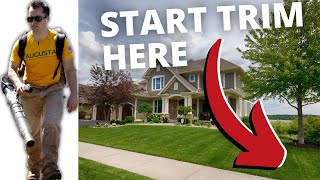
Mike Andes shows how to mow lawns faster and cut costs. Start at a corner and trim counterclockwise to keep moving without stopping, push clippings inward instead of toward fences and windows, and switch your edging direction to stay in rhythm and avoid redoing work.
Chapters
Hey everyone, It's Mike Andes, landscapebusinesscourse.com and today I'm going to show you three different ways that you can become more efficient and more profitable when you're mowing lawns. These are going to be tactical tips that you can use on the next lawn that you mow to make more money and do it faster, make it look better and be more profitable. Number one is trim counterclockwise. Alright, Now I'm going to show you what maybe a traditional type looking property might look like. Okay, so we got this bad drawing, but we got a house, a driveway. You know, this is the sidewalk and this is the lawn. All right, we're going to just pretend for this drawing that this area here is all fenced. Okay? This is like a fenced lawn here. And you know, let's assume no gate just for the sake of simplicity. Sidewalk here, house, driveway. All right. Everyone always wonders, well, where should I start trimming the lawn? Where should I start using the weed whacker, the line trimmer, whatever you want to call it, you should start right here. There is no better way than starting right here. The reason for that is because I am going to want to work counterclockwise around this property with the trimmer. And there's a reason for that. But I'm going to start here and I'm going to go here all the way along the fence, along this fence and come back along this fence. I'm going to edge along here and I'm going to go around the house and at the end of the day I'm going to end up right back here where I started. But the entire time I'm going one direction, the I way. The reason this is so important is because I don't have to stop, alright? What I don't want to do is trim this area and then trim this area and then trim this area, then trim this area. All of those areas in between. All this walking in between spots is wasted time. I don't want to edge along here and then walk back to here and then edge along here and then come over here and edge this and then kind of come over here and then finish this off and then walk all the way to the backyard. Stick with one area and keep going. You don't have to ever stop. Literally if you start here and you are doing a horizontal edge, you can literally go all along the fence without stopping. And then along here you can just flip it vertically and go do a vertical edge along the concrete, then flip back to horizontal around the house. For example. But the bottom line is you don't want to stop. You don't want to ever have to have breaking points in your rhythm when it comes to trimming. Now the next thing is, why do we do it counterclockwise? Alright? So counterclockwise, why is this important? This is very important. Because if you don't do it counterclockwise and your line trimmer spins.
Counterclockwise, you're gonna end up having a bunch of clippings either being thrown into the house, the fence, or onto the sidewalk or into flower beds. So let me explain. If I'm starting here, let's assume that this is the fence and I'm starting trimming here. This is what this looks like, okay? We have a fence right here and we have all the grass that I am trimming now with my line trimmer. This is my line trimmer, okay? It's like this to be my line trimmer. The next second it's turning counter clockwise, alright? So it is going in this direction. So what that means is, is that when it hit, if I'm moving this direction with my weed whacker, I'm traveling in this direction. What is going to happen is when it hits new grass, grass that's sticking up, it's going to kick it back into the lawn, okay? It's going to kick it this direction. When it hits that weed whacker head, it's going to meet it on this side of this as this is rotating, it's going to hit right here and it's going to kick out this direction. If I was going the opposite way, if I was going down, what is going to happen is. Now let me erase this.
Now what's going to happen if I am going clockwise on this property and I'm going down and now my direction is switched. What's going to happen is the grass, the new grass that I'm trimming is going to meet the line trimmer right here and it's going to kick it into the fence. So if you're trimming up against a white vinyl fence or a cedar wooden fence or anything, even a flower bed, you do not want to be going this direction. You always want it so that the clippings are being pushed back into the lawn. Whether you bag your clippings or you mulch the clippings, you want all of the clippings that you get from your trimming and your edging to be thrown into the middle of the lawn. You do not want them thrown onto a flower bed, onto A fence. You know, worse yet, this is another house here. And now we're talking about windows being over here that you could potentially crack. But if, let's say, for example, that this is a flower bed, if we are doing this operation, we're not going to get a whole bunch of grass clippings all inside the flower bed. And then what we're going to have to do at the end of the job is blow them all back. And guess what? Now they're on top of the lawn. Lawn. After we've mowed and it looks horrible, you want all the clippings and the debris going into the middle of the lawn onto the grass. And then you either mulch them or you bag them, but you do not want them in the flower beds, on sidewalks and patios. Again, remember, if I am edging along this direction and I'm doing a horizontal cut, this should all be going, kicking into the lawn at all times. And it will, as long as I'm going counter clockwise and the line trim is spitting the clippings back into the lawn. Okay? So number one, the number one way that you can make more money, make more efficient, be more efficient on a mowing route and a mowing lawn is trim the lawn counterclockwise. The next thing.
Next thing is the order of operations. In other words, when do you trim, when do you mow, when do you blow? It should always follow the same pattern. The same thing. When I showed up at this property here, and immediately, my first thing was, where do I start? And I immediately knew where it was. It was in the bottom right hand corner and I was going to work counterclockwise, right? The same thing goes for when it comes to mowing a lawn. You should always, always, always, with very little exception. And I'll explain what the exception might be. You should always do the same order of operations. You should trim the lawn, then you should mow the lawn, and then you should blow off all the walkways and the sidewalks, et cetera. It should always follow the sequence, okay? The reason for that is because if you mess this up, if you do mowing first, okay, which you should never do. If you do that, what's going to happen? You're going to mow the lawn and then you're going to go along the edges that we just showed with that diagram and you're going to kick all the grass back onto the lawn. Or let's say you do wrong and trim the clippings wrong. It goes on the sidewalk or under the flower beds. Now you're going to end up blowing them all back on top of the lawn again. The goal is to trim, get all the that debris, the clippings, all the rest of it kicked into the lawn, and then mulch or bag the clippings when you're mowing again. That way the clippings and the debris that we get from edging and trimming along the fence and flower beds and all the rest of it doesn't end up on top of the lawn after we've mowed. If we mow, whether it be bagging or mulching or whatever and then we trim, there's a good chance there's going to be debris. Now sitting on top of the freshly cut grass, it will look horrible. Horrible. Or you're going to spend a whole bunch of time extra blowing a whole bunch of stuff off when you could have just done it first, the trimming and then mowed the lawn and had it sucked up or mulched it before. Now, there's one time where you might actually do a fourth step, and that is you might actually blow here as well. Now, you would do this if you have a really overgrown lawn with edges that are overgrown. You know, when you're going along that fence line, it's like a foot tall and then you know, you edge all along the concrete, but there's like 6 inches overlapping and a whole bunch of mud and all the rest of it you really want to blow off before you mow. Because again, the goal is to get everything, all the debris, as much as possible onto the lawn and then mow it or mulch the clippings. What you don't want to do is trim it, you mow it and then you blow it off. But because you trimmed and it was so overgrown the edges, now you're blowing all this debris and junk. All this stuff that was overgrown over the edges is now being thrown back on top of a freshly cut lawn. You don't want that. You want to get as much trimming and all as much junk onto the lawn as possible. If you're doing a recurring weekly visit, it's very likely that you can trim and go straight to blowing without worrying about having to blow off the sidewalks before you even mow. Alright, let's clean up. It looks so much better because there's not clipping that's sitting on top of the the lawn after you have mowed. Do not mow before you trim. Trim. Get all the clippings in the middle of the lawn using the counterclockwise method of getting all the trimmings back into the grass. Mow the lawn, whether it be bagging or mulch, then blow things off. If it's really overgrown and the edges are really, really crazy, you want to blow off your sidewalks and things before you mow. So that when you mow you get it all sucked up. All the clippings either mold or bagged. Third thing. Alright, so in this sequence that we're doing, we're gonna trim, mow and blow in that sequence. Let's draw our diagram again here of our lawn. Here's our lawn that we did. Our house driveway. Okay. Beautiful. There it is. I want you to refuel and restock before starting. Okay? So I pull up and here's my truck. I'm not gonna try driving a truck cause it would be catastrophic. There's our truck. Okay. We pull up here, we already know we're starting right here. Okay. So first things first, this is actually a really bad place to park. Why would I park here when I know I'm starting here? I'm gonna have to walk what, maybe 50ft to get over to the point where I'm starting. Maybe 100ft. I want to park right next to where I'm going to start weed whacking. Why? Because I'm going to end weed whacking there. Because again, I'm going to go up here, over here, around the house and I'm going to end up right back here again. Why would I want to then have to walk back to the truck again? Park your truck as close to the point where you're starting the weed whacking. Park there. That is the best place to park. Because guess what? When I get my mower, I'm going to start there and I'm going to go around the same pattern and end here as well. So park your truck here, not here. Let's just assume I'm parking there because I didn't listen to the first two steps of this video. And so there's my truck. I want you to refuel and restock before you start. It's super, super inefficient. If I walk over here, I'm trimming my edge. I did watch the first couple parts of the video. I'm trimming. Yeah, let's go. And then right here I run out of line. I run out of weed whacker line and I have to refill the spool on the trimmer. Now I have to go walk all the way over here, gotta re spool the line, walk all the way back and start Again, all of this is wasted time. All this walking back and forth every time you stop trimming when you're doing a line, we want to do this in one solid swoop. You should never have to turn off the edger. We did a video last week where I was doing edging, and literally it was in one fail swoop, never stopped. And the reason for that is you want to get extra line. Get an extra 20ft of line, cut it off, put it in your pocket. Maybe have a pocket knife, maybe you don't, I don't really care, but have it in your pocket. So if you run out of line here, you simply pull it out and then you keep going, pull out that line, refill the line trimmer and keep going. Same thing for fuel. Check your fuel before you leave the truck. It takes all of two seconds to look at the fuel and see how much fuel is left. Because the last thing you want to do is be over here and the fuel run out on your line trimmer, on your blower, on your mower, and on a lawn like this, it's not a big deal. Maybe you waste 40 seconds walking back and forth. That adds up over the course of a week or two. But imagine if you're in a big property, maybe this is a few acres, and now you've got to walk three or four minutes just to get back to the truck to fuel up. Then walk three or four minutes back with the fuel can. If you have a mower, a big zero turn, for example, it's dead. It's dead in the water. And you've got to walk back, walk back with the fuel can, fill it up, take the gas can back and then come back to the mower. Very, very inefficient. Make sure you're fueling up and restocking at the truck. Same thing goes for if you need to bag clippings. Why would I leave the bin that I'm going to haul my clippings? Why would I leave that in the truck here? Why not? When I get my first mower, when I get my start mowing, and if I'm bagging clippings and I'm going to start mowing, let's say right, right here, I've finished my line trimming and now I'm going to mow right, and I'm going to go back like this, and I already know I'm going to go then back like this, Boom, boom, boom, boom, boom, come around and then keep going. Why wouldn't I take a bin with me? Because I'm going to go start over here with my mower. Why would I take a bin with me and then drop it like right here, knowing that I'm going to bag all the front area and probably need the bin right here instead of you doing all this and all of a sudden right here, you've just found out you ran, your bag is full on the mower and you need to go get the bin and the bin is over here. So what do you do? You stop the mower, you turn it off, you hop off, you walk all the way back to the truck, you get the bin, you come back here walking again. All that's 30, 40 seconds. Bigger the property, the bigger the waste it is when it comes to if you're not restocking and refueling. I've seen people on a big commercial property or walk a quarter mile because they forgot they ran out of line, or walk a quarter mile because they ran out of gas in their two cycle engine for their trimmer, or on a big zero turn in the middle of a massive field, having to walk 10 minutes to go get gas because they ran out of fuel. These are things you gotta think about. And this takes a little bit of planning, it takes a little bit of experience. But using these three tips, you're gonna make more money, be more profitable on P4P as well as make sure you get more lawns in a day, which at the end of the day leads to more money and happier customers. Because they're not gonna have cool clipping sitting on their lawn. They're not going to have you dragging a bin of debris across their lawn. You're going to have it on the mower, you're going to take it here, drop it here, pre. Think about how you're going to do this lawn. Have a strategy for every single lawn and you absolutely will get 20 to 30% more efficient on your mowing route. I'm Mike Andes, landscapebusinesscourse.com We'll see you next video.









