Biden's out, the Olympics are in. - Episode 070
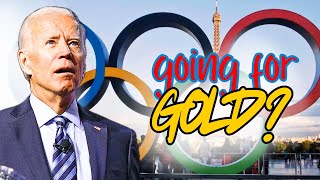
YouTube conversational episode (Mike Andes + co-host) reacting to contemporary news. Major threads: 1) Politics — hosts discuss Joe Biden dropping out, party maneuvering to install Kamala Harris, voter reactions (possible defections to RFK/independents), and a forecast that Trump will win November; hosts debate how money and elites shape outcomes. 2) Paris 2024 Olympics — hosts review cost estimates and overruns (headline estimate €8.9B vs. original €6.8B), note additional infrastructure outlays (~€4.9B for river + metro often excluded), cite IOC-commissioned economic projections (€6.7–11.1B over ~17 years) and public exposure (€3–5B), and debate whether the Games deliver adequate ROI and cultural value. Additional segments cover Olympics anecdotes, a Team USA medal-count bet (Tokyo baseline: 113 total, 39 gold), sports-finance notes (Celtics sale ~€/$5B asking, player pay vs. team equity), and personal-finance/productivity advice (income percentiles, millionaire stats, screen-time/productivity tactics).
Chapters
Right before I clicked record, Mike said, let's talk about Biden dropping out. So. Welcome back. Another episode C Suite Unfiltered Biden has dropped out of the race. He is no longer the Democratic candidate for the presidential race. Your thoughts?
Anyone's better than they could have chose Anybody. Yeah, just in terms of, like, he's just old, like. Yeah. Look, the guy's done a lot in terms of service, whether or not people agree or disagree with him. He spent his whole life kind of doing that. So I'm glad he's going out with some sort of cognitive ability to have a victory lap like he should. Like, honestly, regardless of whether or not you agree with him or not, there's people that have, in their minds, benefited from him. And so I think he needs to enjoy that. And he shouldn't be a pawn. Like, he has been basically being pushed around to do things that he physically isn't really capable of. So I'm happy that he's. He's moving on, I think. It's obviously a lot of political stuff going on with the way that they're setting up the Democratic Party. I would prefer there be a more Democratic way of picking a candidate, but, you know, it is what it is.
At time of recording, we have still not seen proof of life.
Do you believe? Do you believe?
And like, I know it's funny. I'm not trying to.
There's a video of him getting on Air Force One.
Was there?
Yeah.
Okay. Yeah, I feel like I haven't seen that yet. But that's the thing people are saying, like, he's probably dead.
Well, I thought was he might be. It was a matter of, like, literally just a post that had, like, no signage or a letterhead from the White House, just his name. And everyone just takes it for, like, what it is when he dropped out of the race because everyone just knew, like, it should. It should have happened.
Yeah.
So.
You know, I don't know.
Yeah. Yeah. I appreciate you saying that because we did. We did. We obviously got a couple of comments.
Oh, we did.
I didn't look at the last couple of comments. Do.
Would you.
Would you like to know what someone said about. About you?
Specifically about me?
Yeah.
For what they.
Politically.
Oh, politically, yeah. What did I say?
You become a little bit of a fence sitter is what they said. But they said because you're, you know, high profile, you big businesses, maybe you can't, you know, maybe you feel like you can't share as honestly as you would otherwise. But I feel like you made a Pretty clear statement at the beginning that like it's good that Joe Biden is no longer going to run for president. President. Yeah.
Yeah. I think I, I think if anyone that's objective has to, has to realize that. I would also say that if there was a candidate that was younger than Trump, I would feel much more confident about it because he's 78. Right. I will say yesterday, breaking the Internet. Do you see this? Bryson?
Oh, that was awesome.
He plays good. Go.
Dude, that was awesome. Dude, that was awesome.
That was a great video.
Did you watch the whole thing?
Probably like 6, 60, 70%.
Yeah, I watched that speed. Yeah, I watched it like half, I'll probably finish it, but I got like halfway through. I was like, this is actually kind.
Of awesome for a 78 year old dude. He plays golf really well. Honestly, like just, he doesn't have great mechanics either. It just, I think he's done it so much, it works pretty easy.
Swing your swing. That's what they say.
But honestly, a 78 year old going to a four year term, I still don't like that.
Yeah. Biden's 81, I think right now.
Yeah. And so I think, I think in four years Trump won't be as bad as Biden in terms of physically, but like at 78, you have a high likelihood of like something like crazy, like a heart attack happening. And he's not like in the picture of health.
Yeah.
Like he, he has, he's overweight and so I don't know, I think from a political standpoint though, and like his demeanor, he's exactly what the country needs from a leadership perspective. From a foreign affairs perspective, I look at it as like you, you have leadership on the world stage and then you have leadership internally. And so if I had to grade Trump, it'd be like you have an A, A minus on global affairs and like geopolitical stuff and then you have like a B minus on the ability to be able to unify the country. And so that would be my grading on him.
So do you feel that? Let's fast forward. Place your bets. Is it, Is Kamala Harris his main opponent? As of right now, she is.
Oh yeah, 100%.
Biden has endorsed her.
Oh yeah. That's the only way for them to get their money in behind her. Yeah, it's, it's all a big money thing. And yeah, what they gave Biden to drop out in terms of money, who knows? But it would have been a lot.
Fair enough.
So, yeah.
Yeah, it's interesting. How do you feel about the people saying that the Democrats are not expressing true democracy because they basically propped up Joe Biden knowing whether you believe it or not, knowing he wasn't fit to run so that they could then institute whoever they wanted into the presidential candidacy seat.
The polls will tell. Yeah. If people leave the Democratic Party because they don't feel like they were. Their voices were heard correctly, that will be the tell tall sign. And so ultimately people vote with their feet.
Yeah.
And so if people really feel that way on the Democratic Party that they were not. Their voice is not being represented because of the way it was done, they will leave the party. Yeah.
I'd push back on you on that though, because there are. There are the Never Trumpers out there, just like there are the Never Bidens.
Yeah, but there's a spectrum. Yes, there are those, but there's going to be the 10, 15% of people that are like left, left of center that voted for Biden. And now because of the. What's all the drama happening? And they feel like this was not fair with Columbia Kamala, they will either switch or go independent or they're going to go rfk.
Right. It's on the ticket.
Yeah.
Which then I think does. Whether the Democrats meant to do this or not could be a strategic play. Hey, any vote not for Trump is a vote for us.
Right.
If they can get poll enough votes or if. If RFK can pull enough votes from Trump and then maybe the def. The detractors from the Democratic Party don't vote for Trump, but they might vote for rfk. That still could be a win for the Democratic Party.
Yeah. But the stuff RFK is saying about the Democratic Party is pretty poisonous. Oh, yeah, He's.
He went hard on Kamala.
Did you see some of those? Yeah, and rightfully so. Cause he was Democratic. Like, if he. If they would have had an actual primary, like done correctly, there's a good shot he'd be in it and I would really enjoy him versus Trump. Yeah. I think that'd be a much better debate. It'd be a much better policy, much better balance. Obviously, he's more left, but he. He started as a Democrat.
Yeah. Did you see that the Kennedy family came out in support of Kamala and the Democratic.
Really? Yeah.
It's like, you know, you know, these American institutions are. They're different now. They're not what they used to be. Right. Back. Back in, you know, like the Roaring twenties Industrial Revolution. Right. You had like the Rockefellers, you had JP Morgan Chase, you had the Kennedys. Right. Like all These big families. Well, now it's like, who are the American families? I guess you would say Trump, the Kardashians, like, like, you know what I mean? They don't, they don't have as much weight in the public eye as they used to. So it was just interesting to say, like, his family, I don't think, like his immediate family, but, but people with the Kennedy name basically turned against him. We're pro Democrats.
Yeah. So, yeah, there's a lot of money involved there, too.
So your, your thoughts on November? The, the ultra early prediction for Mike Andes, what's going to happen in November?
Trump will win.
Yeah.
Yeah, I think it's pretty obvious.
Yeah. All right. I just want to know what, what your thoughts are like. I agree with you.
Outside of him making a massive political mistake, I think he'll win. Yeah. And I do think that what's going on in the Democratic Party will be teetering. The people are left of center and if they go to rfk.
Like, I just think that this, this is, this is the first time I've seen the media portray Trump in a little bit more of a centrist perspective. Obviously it's all spun up, but, like, seeing him on things like Bryson's show, you've, like, whoever is behind him on a public PR perspective is nailing it right now.
Yes.
Yes. He's getting on all these random channels. It's like, what in the world? This is the craziest collaboration ever. Yeah. And like putting them on Logan Paul and all this sort of thing. It's, it's the move. Whoever's doing his PR and social media and like, they are just clicking on all cylinders right now.
Yeah, well, yeah. Logan Paul has millions of subscribers across.
All the younger demographic.
Bryson DeChambeau, I think his YouTube channel is like a quarter of a million, probably on like Instagram and other social media.
Put it all together.
So I saw it pop up in the morning. It had 20,000 views.
Yeah.
And it had been posted like 20 or 30 minutes before. I was like, dude, this is going to blow up. And let's see here, let's see how many views it has right now. Bryson, let's see here. He had on that 4 million and it's not even a day old.
That's insane.
Yeah, dude. And it's an hour long video. It's just going to absolutely crash.
Yeah. And if you don't know what we're talking about. Bryson DeChambeau, pro golfer, had Trump on his YouTube channel to do a breaking 50 challenge. So they're Trying to do a combined kind of scramble golf score of below 50, as well as for every birdie. I think they're donating $10,000 to the wounded, 20,000 to the wounded warrior project, and for an eagle, 20,000 to the wounded Warrior Project. So you can hate Trump as much as you want, but cool YouTube concept and a great charity.
People think I'm sitting on the fence. I just don't. I don't really care about politics.
Yeah.
I care about leadership and I care about economics and that's it. I do not care about who's sitting at the top of the chain because I know they don't really do much besides being a figurehead, but I am interested in the way they lead and in their policies. In terms of the economy.
Yeah, 100%. So, yeah.
Alrighty.
Well, we'll switch it from politics. I know we've been politics heavy. For the people that don't like politics, we have to like.
What's it called? Historical events that happened in the past couple of weeks. Come on now.
Yeah, I made Trump the thumbnail. Someone commented that it was lame. I was like, well, it's just a historical event. It was a big deal.
It'll probably only happen a couple of times in our lifetime. Yeah.
I mean, if there were a huge earthquake, you know, and we wanted to talk about it, we probably looked at the thumbnail.
No, we probably wouldn't talk about it.
Well, yeah, I'm just trying to.
Earthquakes happen every day.
That's fair.
I'm talking the US President gets shot.
At 10 point or something. Half. You know, the. Half the state falls into the ocean.
So wait, so the person that said I was sitting on the fence, but they basically, they're. They're red and they're like, hey, you need to leave me more red kind of thing.
I mean, I can. I can read the comment. Let me find it here.
That's funny. I really. Yeah, I just don't care. Yeah, I just. I just want. I just want the policy to be right and I want them to lead in a way that's going to bring people together.
Yeah.
Being Divisive unfortunately does really well on social media.
Okay.
Whoa. This is a long comment.
Yes. Yeah, yeah.
Don't read the whole thing, just summarize it. That's a huge comment.
Yes.
Seraphin. Wait, I think I know who this is. Give me a second.
I think I know who this is.
You become a bit of a fence sitter. I know you are kind of obligated to, since you're a Business owner. But saying that you would vote for Biden is not logical. But in the context of the last episode, you, I believe you said, I would vote for Biden, and then it was. You followed with an if statement. If X, Y and Z. You did say that on the last part.
Like replace the word Biden with president. Yeah, I would vote for the president. That brings together people internally and protects us externally and has a great economy. Let's go.
Yes. And then they add some more, like, personal retorts, if you will, that we don't need to go into.
Like, about certain policies.
Certain policies. Very specific policies.
Oh. So their approach Trump.
And they said, don't take offense to this. Like, I've been listening to you for years. Your advice is great. Just some concerns.
Okay. Concerns.
They're just sharing your concerns.
Yeah, I really just like, I think people get wrapped up in the characters of the story instead of what the plot is. And so the plot to me just simply depends on will I make more money, will the people I love around me be protected, and will this leader be a good leader in terms of bringing people together? If those things are not checked off, I don't vote for them. If they are checked off, I will vote for them. And if they're. There's some version of gray, I have to choose which one's better.
Yeah. That brings me to another comment. I'm glad I pulled these up. Someone commented, this is interesting. When you're rich, it's easy to not care about politics. Would you agree or disagree with that?
If you looked at my tax bill, you would think otherwise.
Yes, that was my initial thought. I actually think it's the inverse. I would. I would say it's the extremes that the more rich you are, the more you care about politics because it's going to affect your tax bill. It's going to affect how you can move money around in your businesses. Assuming that, you know, you're ultra wealthy, so you probably own businesses and large assets, you are going to ultimately have a big tax bill or have stipulations on how you can move your money around. I think the other extreme is if you are on the unfortunate side of life or, you know, just call it what it is, poor due to your own circumstances are external, you probably care about politics a lot more because you need policies that are going to help you, your family, to survive. So I think the middle actually probably cares the least.
Well, the middle is the ones who should be carrying the most because they're the ones who pay the taxes. Yes.
Exactly.
Let's be honest. Like it's a function of percentage of income the middle class pays most of. Not, not a function, a percentage of the revenue to the government, but as a percentage of their personal income. Yes. The high earner is the one who pays the highest percentage of taxes. Because if you're not making very much money, you're getting a lot of social programs, you're going to get a lot of, of benefits, you're going to pay way less in taxes as a form of, of percentage range. And then if you make tons of money, you're usually making a lot of that money from investments. And you have the money to be able to go get.
Accountants and people and vice to be able to shelter things and do things tax efficiently. It is the people that make between 90,000 and $500,000 a year that are W2 employees and they know investments. They are the ones that pay 30 to 50% of their income to the government. And that 30 to 50% is not reflected in the lower class or the upper class because the upper class is going out and get there. I get rid of all my cash, I want no income. I want to put this all into investments. I want capital gains and then I will sell if the administration cuts capital gains. And so yeah, I would agree like the politics definitely affect the, the, the lower class the most in terms of. And then fortunately because of that, we've gone so much social programs. Right. Because we know we can buy votes. If we just tell people we're going to give them things, we can buy the 30 to 40% bottom. And so that leads to a lot of debt. And that's why we've gotten in the past 40 years in America, we just racked up debt is because we just know we can buy the bottom 30 to 40% of the votes by just giving them more money. And so we have tons of debt, we have lots of inflation and it's got cost of political, you know, that sort of thing happening.
Yeah. And that's where I think you and I, I don't want to speak for you, would probably lean towards not having government funded social programs, but having local nonprofits, churches and organizations that can take over those social programs so they aren't one, a chip to be used by a candidate for office or two, cost less money because any time the government does something, it's going to cost more money.
Yeah, it's like employees, it's like P4P. You can't, you can't lower base pay.
Yeah.
And so once the programs have been instituted like social, Social Security, Medicare, Medicaid, etc. Like you're just not going to be able to take them away. They're entrenched, so. But yeah, I would agree from a fundamental perspective, I think if we did something like that would throw our country in the chaos from a political standpoint. So no one's going to do it. But like, yes, there needs to be a reinstituting of like community stuff and like. Yeah, anyways, that's a whole different topic. Whole different topic. Yeah.
I will say to this comment at face value, the premise is true. If you're rich, it's easy to not care about politics. Like I think net worth.
What I would say it doesn't affect you whether you care or not, but it doesn't affect you as much because you're rich no matter what. Look, if you take 20% or 50% of someone who's making a billion dollars, whoop. You do.
Yeah, that's what I was going to say. I think the premise is correct. Meaning that you have the choice to not care.
Right.
If you have, let's say eight figure plus net worth.
Yeah.
You have the ability to just not care.
Yeah.
Who cares?
And so that person's vote is the equivalent of the person that's making 20,000 a year and their vote can be bought. So what happens is the people who are rich spend a bunch of money trying to convince people to vote their way. That's what happens.
Yeah.
Welcome to capitalism. Whether or not I agree with it or not doesn't matter. That's just the way it works.
The political machine.
Yeah. So that's why Elon goes and spends $45 million a month, is because his vote is the equivalent of an 18 year old out of high school that, you know, also can vote.
Yeah.
So he uses his leverage to convince these people with a whole bunch of money. Yeah, that's what happens.
And social influence and this that the other people actually want to listen to you. It's crazy. Oh, yeah. All right, we are going to switch it up once again, apologize to the people that don't like the politics. But at time of recording, in 48 hours, we're going to have the opening ceremonies in Paris.
Okay. Okay.
So hence the hat. Team usa. I'm a big Team USA guy. I love the Olympics.
It's so arbitrary, but I love it. I'll like stay up late to watch a live event if like if an American's in a gold medal round, I love that.
So that's hilarious.
It's awesome. But I want to talk to finances of the Olympics.
It's not good.
We have not had. We've not had the Olympics since we started the pod. So I figured let's dive into it. So obviously the Olympics are in Paris and this is from the Washington Post. So I'm going to jump around a bunch, try to get right to the numbers. Here's the main quote you need to know. This is from an Oxford University professor who actually studies Olympic cost trends. He said Paris is going a step in the right direction compared to previous Olympics. So that's a good thing. Now the question then becomes, what is their budget, what have they currently spent and how are they in the right direction? According to this Oxford professor, the latest estimates put the Paris Olympics and Paralympics budget for facilities and operations at 8.9 billion euros, or 9.7 billion USD. That would make the Olympics less expensive than London, 16.8 billion, Rio 23.6 billion and Tokyo 13.7 billion, according to a study co authored by this university professor. But Paris has not bucked the trend of running over budget and is not exceptionally cheap that they said right now they the budget for Paris was 6.8 billion euros, so they've already spent 8.9 billion euros. But that 8.9 is still statistically substantially cheaper than the last three Summer Olympics. So what are your initial thoughts on their budget versus their spend versus the trend of previous Olympics?
I think they just got to. I was really interested to see how they cover this. This Olympics, like the last, last couple have been marred by Covid. So you got to give, you got to give them some grace points, but they've got to do some special stuff to make it relevant. I feel like it's fallen out of relevancy a lot. No one cares as much. You watch the highlights and that's kind of it you usually get. So there'll be three to four big stories coming out of this Olympics. It'll be around scandal. It'll be around someone who's like, literally people think is God for about four weeks in terms of like, they're basically perfect. Someone will break a world record that everyone thought was insane. Like, it'll be a couple things, right? But I just don't know if the brand of the Olympics is holding the weight of $7 billion. And so this is why a lot of countries and cities don't want to host the Olympics. It used to be a big deal to make your bid to try to get it to come to you, but I think it's losing that allure.
Yeah. Well, and here's where they, like, they move some money around because, well, technically we weren't spending this on the Olympics. Not included in the Olympics budget is 1.4 billion euros to clean this Sven. Or sign. Oh, the river.
The river.
Sen. Sen. I think it's the Sen. As well as the 3.5 billion euros to extend the metro line and basically get the metro, the subway, up to snuff before the Olympics. So if you say, like, oh, we were doing that for the city. Okay, well, that's an extra 5 billion that you're just not accounting for.
A billion dollars to clean out a river.
Yeah, I guess it was really polluted. There's a lot of funny stories about that. So Macron, the Prime Minister, said that he would swim in the. In the sign or however you say it. Yeah, the river. He would swim in the river to prove that it's, like, safe to swim in. I guess it was, like, highly polluted, kind of like, what's. What's the. Like the rivers that go along New York like, people don't swim in Hudson. The Hudson. Yeah. It's like heavily polluted. Same thing there.
Okay.
So he was like, I'll do it. He hasn't done it yet. The mayor of Paris did the other day, though.
Okay. Yeah.
So this is important stuff.
Oh, man.
So they've spent an extra 5 billion in just city infrastructure cleaning up the river and the metro system. Even if Paris can't shake the Olympic reputation for overspending, officials say the Games won't burden taxpayers with the legacy of debt faced by many other host cities. Organizers have cited 3 billion euros as the amount that would need to come from public funds, and that would be 0.1% of France's gross domestic product. The head of France's national auditor has said that the cost to taxpayers will not fully be known until the Games and could be 3 billion to 5 billion euros. That's a pretty big jump.
So I think the.
The tourists. So have you been to Paris?
It'll lay over there.
Okay. No, like, the tourists attract, like, the tourist. I do believe Paris has enough brand power. Yeah. To really pull because of this. Like, Olympic. There's a lot of iconic symbols. Yeah. That people. It'll reinforce the brand of the Eiffel Tower and the Arch and things like that are, like, iconic. That will bring people to there and bring revenue. Like, if you just think about a business. Okay, are we willing to invest 6 billion, 7, $8 billion in order to receive over the course of next 10 years, $1 billion a year. What's the return on that? Right. So like there has to be someone running some calculus here.
Yeah.
Some basic math, you think? Hope so. Right. And then if that math breaks down, that's when people don't want to have, you know, if you're spending 23 billion, I have a hard time trying to make sense of that, how you're going to get a return on that money. Right. I think on, on 7, 8 billion you might get a return on that.
Yeah. So that's a great point. That's where this article goes for these Olympics. Organizers say that there will be €3 of economic impact for every year of public money spent at the Olympics. That's based on a study commissioned by the IOC, International Olympic Committee and Paris 2024 project, which projected an economic boost between 6.7 billion and 11.1 billion euros in the Paris region over a 17 year timeline generated by tourism.
15 years. We're going to care about these Olympics.
Yeah.
Oh, brother.
So basically they're saying over the course of 17 years you might break even. But they're also saying, the study said they're going to get €3 for every €1 spent in 17 years.
You have to redo the metro, reclaim the river.
Yeah, Right. So that's what it says. Paris organizer organizers this month celebrated that they had set a record with 8.6 million tickets sold. So I don't know if that's for the events because that seems kind of high. I don't know how the, how many people can fit in these events, but either way, they say that sales are up compared to previous.
Well, yeah, because last year they couldn't get anyone in there.
Well, yeah, of course. Right.
Brutal.
Let's see. They built. Yeah. So they, the, the nice thing for Paris is they had most of these structures that the IOC needed to see in order for them to host the Olympics. So that's where they saved the most cost. Whereas, like Rio had to spend so much. Yep, exactly. Whereas Paris had a lot. And obviously now the Olympics isn't really centered in one city. It's pretty much when you host it, you're the host country.
Yeah.
So they didn't have to build a ton. They only had to build. I think it was like under. I think, I think I saw one report that was like under like 800 million in construction. So almost everything else went to like temporary construction, temporary housing, Olympic village, those sort of things.
Yeah. Like, I think the thing that's good about the Olympics is it's a Unifying something for everyone to get around that, like, regardless of you're from Russia or whatever, like, if there's going to be story just going to hit right now, someone from Ukraine and Russia are going to be having a duel or whatever, and they're going to shake hands or hug or something. It's like. Like, I think it's healthy.
Yeah.
Yeah. I think it's healthy. I think as much as we can just realize that we're all humans.
Yeah.
And like, all this political meandering, like, killing people is ridiculous.
Yeah.
That we should just get along and we're better off like that. I think. I think that's healthy.
Yeah.
So I don't care. Like, I just don't care. Like, I just don't. I don't think that most people hate each other. Yeah. I think it's like we've just built all these weird frameworks in our mind and we never actually communicate.
Yeah.
Like, have you ever talked to someone from North Korea?
No. Personally? No.
Have you ever talked to someone that's in Russia when you talk to them?
No.
These are the type of things that, like, I think are important.
Yes.
In order to be. Like, there are enemies. Are they? Or just political enemies? And, like, do we just kill each other and spend billions of dollars for. For economic resources like oil.
Yeah.
Or do we actually hate these people?
Yeah.
So these are the type of things that Olympics. It just shows the humanity of us. I think it brings us together and so, like, spend $7 billion. Sure. Better than $80 billion spent on ammunition.
Yeah. Fair enough. I love the Olympics. I'm very excited. A couple of stories have already come out this week. Since you want the. Since you said there's going to be some noteworthy moments. A horse equestrian, a trainer from Great Britain was seen abusing one of the horses. So big news, big red flag for Great Britain. Nice work over there. Some repressed anger, if you will. And a child. Someone's son from the Canadian women's team was using a drone to spy on another team to get some strategies. Good for them. Yeah. No, not really.
Why?
It's cheating.
Why is that cheating?
You can't use a drone to spy.
Who said that?
I think the ioc. Otherwise it wouldn't be news.
I was like, hey, they're creative. Let's go.
I like that. It's like the kid, though, not like the actual coach. I think it was like a coach's kid. Kid.
Oh, that's so even.
Like a player's kid. Genius.
I was like, you know, hey, as long as not in the rulebook.
Yeah. They probably were like, oh, well, he just looked like a dumb tourist. Yeah. They just said, oh, sorry. Right. He's a Canadian. He'll get away with it.
He didn't.
He didn't. So I will be keeping everyone up to date on the Olympics because I follow them and I enjoy it. And I like to think that we can coexist and we can have fun games where people can compete and show off their talents.
Yeah. Hey, $8 billion, you could do that 10 times for what we sent over to Ukraine in the past couple months. Yeah. For ammunition and blowing people up and killing people.
Yeah.
So I think that if we spent, you know, if we had 10 events for the next, you know, few years, run around Christmas, one around Easter, one around the summer, springtime, whatever you want to do, just bring everyone together, spend that money. Wow.
It's going to be fantastic.
Anyways, my last thing on the Olympics here we. We need someone to hold us accountable in the comments because we make a lot of little bets on the pod.
Dude, you. Okay, wait one second. Disclaimer. You crushed me on a bet. I need to. I need to come clean about. Oh, yeah, you're going to remember once I say, okay, perfect, but I need to stand corrected.
Okay.
Okay, so.
Oh, is it our shorts?
Yeah, dude, we're going to short year a year and a half ago. Oh, yeah, 13 months ago.
So true.
You said Nvidia. I was like, nah, it's too expensive. It's probably doubled or tripled by then. So kudos to you. You're right. I said Disney. I think they're basically break even, maybe up 20%. So you definitely slam dunked on that.
Wait, did I say. Is that flipped? What did I say? Nvidia.
You said Nvidia like it was.
You said Disney.
No, no, I said I was gonna short Nvidia.
Oh, right, right.
And you said you would short Disney.
Okay, that's what I thought.
Both of us were wrong. I was way wrong.
Yes, yes, yes.
You crushed it. So, yeah, I just want to hand up while I was wrong on that.
That's what I thought. Thank you for reminding me.
Now, whether or not historically, in five years, we'll think that's correct. Well, we'll come back to that.
So I would like to make another bet with you. Another bet?
Do we actually bet money?
Last time we always throw out, like, usually either, like lunch. I like a good lunch bet. Or money.
Okay.
You and Liz also owe me money for a bet we made the other day. We it was for a certain metric we were tracking that I won't. I can't share.
Oh, okay. I don't remember.
Anyways, in Tokyo, I bet someone.
I bet someone $1,000 the other day that they beat me at Topgolf. I made sure I got that money. Dude. Nice, dude. Sorry.
No, you're good. All right. Tokyo Summer Olympics. The US Team. I didn't. I verified this number, but I don't remember the exact number, so I think we'll leave a little bit of allure to it. Let's make a bet. Tokyo. Team USA brought home over 100 medals total. Yeah, I did verify this number. We had 39 golds.
Okay. All right.
So over.
Under is. That we're doing here?
Yeah. So I would say pick your total.
Okay.
And then you. I'll give you the honors. Over. Under 39 on gold. So pick your total. Throw out a number.
What was the total last year?
Over 100 in Tokyo.
Okay.
I don't know how many off the top of my head, but I know it was over 100.
Okay. How about we just do this? If they're gonna. If they're gonna do better or worse then four years ago.
Okay.
How about you pick over, under, on, total, I'll pick over, under, on.
Okay.
And then we get the opposite.
But I don't. You don't. I don't even have a metal count for. For total.
I know it was over 100, but was 120. Was 130.
I just.
How about we just do this? Do we think that the total metal count will go up or down compared to the last Olympics? I think the US Is going to lose supremacy. Really? Yeah, unfortunately.
Hold on.
All right. I think we've gotten too soft, and I think other countries are catching up.
I got it.
Okay.
In Tokyo, we brought home 113 total medals.
Okay.
39 of them were gold.
Okay. I'm gonna say that we're gonna do 120 total, but I do think our. Our gold count will go down.
Yeah. I feel like we haven't had a lot of star power.
Yeah.
Like, even, like. Well, just. I'm just saying, like, even in, like, social media, like, I feel like I'm not. We are. We talked about the Olympics a couple months ago on the pod that we just haven't seen a lot about dominance. Yeah. So, like, Katie Ledecky, she's going to win all the women's swimming events. Simone Biles, she's going to win all the women's gymnastics outside of that. And I'm I would say I'm a little bit above a casual Olympics fan. I don't. Apparently, I don't know that many names.
Yeah. Yeah.
So, okay, so you said 120 total.
I'd say 120 total. And then. But then I think that the gold medal count will go down.
Okay.
I think we're. We're good, but we're not. Great.
Okay, I'll do.
Let's go.
I'm gonna go 125.
125. Okay.
And I guess I'll just take the over on gold.
It's like 40 up.
Yeah.
Okay. All right.
I mean, I think I agree with you, but I gotta take the over.
Okay. All right.
But I'm gonna go 125.
Okay.
We're, you know, we haven't been in a, like, western country in a while in the Olympics. Maybe that'll give us some advantage.
Yeah, yeah. There you go. That's true. Yeah.
I'm just saying.
No ac.
That's true. That's true. That is true.
Hey, but the US Is bringing their own AC units. We got this.
Yeah. All right. That is the Olympics. Talk, pray, talk about it on the next couple of pods while it's happening.
Yeah.
Because I enjoy it. All right, now, do you want to go personal finance, or do you want to go to sports finance?
Oh, personal finance. Way better. All right.
Just some interesting stories came out after, you know, the NBA Finals. Okay, I got a cool screenshot, but we'll save it for later.
Just say in one sentence.
Okay, well, this is the tweet.
All right.
You said you want to go personal, but here's the sports finance. The Boston Celtics are selling for around $5 billion. Jason Tatum, their star player, resigned for 13. Excuse me. 314 million over the next five years.
Yeah.
New CEOs typically get 5 to 10% stock insurance over four years. When will franchise players start getting on the cap table?
Oh, yeah, this will start happening.
Interesting question, right?
Yeah, this is not happening.
Like, how. How are. How are the Celtics going to sell for 5 billion and Jason Tatum's gonna get. What would that be, like, 70? No, less than 70 million a year.
I think the equity part is tough in terms actual cap table, because once they leave, you can't keep adding cap. Like, you can't keep giving away percentage of the company until you don't own anything in perpetuity. I think what will be more likely is they get a percentage of, like, sales. It's like, hey, we'll give you a percentage. Or, like, kind of profit sharing. I think that's definitely coming because there's. Because you have, like, literally 10 to 15 names in the NBA that hold all the weight and the brand of the NBA.
Yeah.
And so especially in a sport like the NBA, you could literally have to, like, you have 24 players, like, hey, we're going to go start our own league and literally take the entire viewership of the NBA because it's all so concentrated in those. In that all stars. Yeah.
Yeah. So the owner of the Celtics purchased them in 2002, so he's had them for 22 years.
Let me guess.
How much selling for around 5 billion. Bought it in 2002.
400 million.
Yeah. You're right on the money.
What?
Let's go 3, 360. I'll say that's right on the money. That's pretty darn close. 3, 3, 360 million.
Okay.
He is selling them for an asking price of around 5 billion. That's 11% compounded annually. That beats the S&P 500 during the longest bull market in American history. Oh, and unlike a stock, he got to sit courtside watching a team that now has two championships.
Also interesting, though, that that's a much better return than the S&P 500, to be perfectly honest. Yeah, it's better marginally.
Yeah.
I'm just saying that sounds like a great, like, business move. If you would just put the money in the S&P 500, gone on vacation for the next 25 years, you would have basically got the same amount of.
The last line, Though, unlike a stock, you got to sit core aside, while watching this team bring home two champions.
Hey, dude, if you have 400 million dol. You can buy. You can sit courtside anytime. But.
But it's different if you own it.
That's true.
It's a different experience.
It's a totally different experience.
Like, you and I are Mariners fans.
Yeah.
It'd be cool one day when they win the world series, dude. But if you were part owner.
Oh, yeah.
It'd be completely.
Come on now.
Yeah.
And the whole thing.
I would. Yeah.
You want to be known as the owner, not like the president and the CEO. All right.
We are jumping to personal finance.
Imagine having enough money to go buy a team. Oh, dude, that'd be so sick.
I know.
The biggest flex. Be like, yeah, all your friends. Yeah, come on in. Like, dude, that' be so fun. Just like. Yeah, I'll fly you in. We'll pick you up, we'll go over to the game. We'll have like box seats. Oh, dude, that would be such a flex.
Yeah.
Be so much fun. Everyone would want to be your friend, but I don't know if you want those type of friends. Yeah.
But that would be fun.
Yeah.
Like any business adventure, you're like, hey, yeah, we'll just meet up. We'll have the meeting at the game.
Yeah, dude, that'd be so nice. The owner suite. Yeah, you should always have your own results.
Someone you're trying to, like, help out or like encourage. Like. Yeah, you'll throw out the first pitch. Dude.
Yeah. Let's go. That'd be so awesome.
Sing the national anthem. Just don't do it drunk.
Yeah, There you go.
You know what I'm talking about.
Yes.
Okay.
Okay. From the Home Run Derby. Yeah. That's rough. That was very rough.
That's brutal. Especially right after that weekend.
Yeah, tough. It was a tough one. All right, we're gonna jump to personal finance.
Okay.
This is from George. I think Camel is how you say his name.
Oh, yeah.
He put out this video. It's really good. Can't remember the title of the video off the top of my head, but I have screenshots. It was basically around personal finance. And it was for those who are W2 employees. You know, traditional working employee. How to build wealth over time. Very straightforward video introductory. But some of the numbers were interesting. So average individual income. This is as of last year. This is Dave Ramsey's reporting analytics team. Whatever. Age 25, average individual income is right around 48,000. Age 35, 73,000. And ages 45 to 65 is right around 82,000. These are their reports from last year. Now this is the 50th percentile. So this would be the median, if you will, not the average. The median 25 is 40,000, 35 is 53,000. And then between 45 to 65, it ranges between 55 to 60,000 to the median. Substantially lower than the average. Just want to point that out. Always good to bring in as much information as possible. He is talking about long term wealth investing, creating opportunities for yourself and saving ultimately. This is an interesting statistic. One out of three millionaires never had a six figure household income. So I never knew that. I thought that was very interesting. And then he said 45% of people earning over a hundred thousand a year still live paycheck to paycheck. So there wasn't any major takeaways or any questions I had from that. But I wanted to know if you had any thoughts on some of those figures. Speaking to maybe the employees out there or the folks that are trying to build personal wealth.
Yeah. It's not how much you make is how much you keep. Right. So it's the classic, like in a business perspective it's about profit, not revenue. But.
It is a matter of like, can you get off of the treadmill? Of as I make more, I will spend more. If you can get off that treadmill, you start to compound so fast. And so if you can just establish the baseline and be like, okay, this is now independent of my personal income. This is what I will, how I will live. Then you like, you will just crush personal finance. Like personal finance is how much do I need to make to be happy? And then staying there as you increase your income, revenue, if you're in a business owner. So like if you can do that, you just, you can become rich. Like just laws of physics. Yeah. Okay. Spend stays, same income, go up difference, increase money set aside. Like you'll become rich. Yeah.
The interesting thing now when he uses the term millionaire, he's talking net worth millionaire obviously in this video. But just want to make sure I'm clear with that. That I guarantee if you pulled probably most people from like 20 to 35, kind of our age range would they would not know that 2/3 of millionaires never made 6 figure salaries almost guaranteed. It's people that have just continually stashed and put that money away that I didn't know that. I was actually kind of surprised by that statistic. So yeah, I think it's interesting. I think that you know, there are the people living paycheck to paycheck, but ultimately that's there. As their earning potential goes up, their spending habits also increase. So just be better about that. But it was a good, it was a couple of good statistics in there.
Was like that Tatum contract to go back to that. I think I saw a breakdown of his $60 million he was making per year. And then like after you take out taxes, you take out how much is to pay to his agent. Take out something else.
The players association.
Yeah, exactly. He was basically making like 20 million.
Yeah.
And so the highest paid NBA players making $20 million a year. And so I just believe that you can make $20 million a year as like say for the, for the business owners listening. $20 million a year. You can make that and not pay that much in taxes and like basically do it tax free. If you do it right. Right. It'll just take you 40 years. What's cool is you can do it for 40 years. He can Only play basketball at his level for maybe 10 or 15 years.
Yeah, 15 is pushing it.
Yeah. So, you know, unless you're LeBron.
Yeah.
But like, you know, I think it's just.
It'S all about how you build the wealth too. And so for someone that is an employee, it's like, how can I build this wealth in a tax efficient way? How can I set money aside into 401ks IRAs? Like, those are the people that, if you're just stacking money as an employee, that's what you want to be thinking about is like, get money away from the government as fast as possible. And like, get rid of the money from your personal account so you don't spend it and just invest the high, like the higher percentage of your income you can invest, the better. Right. It's like people that, like, are way too wealthy, say 10% of your income, you live off of. Well, most people can't do that. Okay. But like, if you can just make that percentage go up as a course of time, like, okay, if I take my income and I take how much I spend and I just want the delta become bigger and bigger, like, the mechanics of that will never fail. Yeah, you'll become rich. And so it's just like two things you need to focus on. One, how do I stabilize or reduce my expenses? And two, how do I increase my earning potential? And so, like, the fastest way to increase your earning potential is gain skills. And so literally there's people like in our organization I know have almost doubled their pay over the course of like, 24 months. Why? Gaining skills. And so it's just a matter of how do you gain skills? Well, like, look, listen to books, podcasts, like, gain skills will usually double your income the fastest. And then it's beyond that, it's going to become more of an investing game. Right. And then, like.
I just genuinely believe Most people are 12 to 24 months away from doubling their income if they'd actually put their head down and gain skills.
Yeah. And I think what's interesting that, you know, George points out, he said, as you can see, statistically speaking, the older you get, the higher your earning potential becomes. What you're saying is you can shorten that timeline. It doesn't have to be the older you get, it can be in 24 months. You don't need to just wait around or put in the years at some big corporation and slowly get promoted and increase your earning potential. You can put the skills together and prove that you're worth more, whether it be at the organization you're currently at or potentially, you know, job searching and looking for someone that's willing to pay more for the skills you've acquired. You can shorten that time.
The only reason that 20 years of experience means something is because it's the. The, what we're assuming is that you've over the course of 20 years gained skills. Well, if I can do that in two years, why would you not pay me now for what I'm worth in 20 years? And so it's a matter of can you get into a job where as you improve your skills at an increase and accelerated level, those things are appreciated?
Yeah.
And so if you're not in a job, it's like, well, I can't make more than X no matter what I do. There's no pay for performance, there's no profit sharing, there's no upper mobility. Then it's like gain the skills and then go market yourself. Right. And get another job.
Yeah, yeah. So just an interesting, interesting thought. Let's go from George over at Dave Ramsey. George. Yes. All right. Any not financial advice for the people.
Oh, dude, I'm striking out.
You go ahead while you think it's just.
I'm gonna.
I'm just gonna read this.
Okay.
All right.
Okay.
This is my not financial advice as a quote.
All right.
I am telling you from the bottom of my soul. It is so easy to beat people today. They are so soft.
That's Alex.
They have no work ethic. No one can stick with anything. Everyone's distracted. They're on social media, they're counting their blank notifications because they can't stick with blank. They can't say no.
Yeah.
Alex Hormozi.
Okay. I have tuna on financial advice. Great quote by the way. Love it. So last week I sold out of everything. Personal stocks. Very happy. Because Tesla's down 14.43% since I sold. So I'm happy about that.
Did they have like a Q2 last night?
Was Q2?
Yeah, yeah.
Which they usually drop after that, but they down 14%. Just want to thank you. I appreciate me sending selling all everything off last week in terms of Google. Same thing. Their stock went down last night. Anyways, the second thing was here are some non financial advice on how to get more done. Okay. This is. These are things I've done. No news apps whatsoever. The only way you'll get the. You will get headlines if it's on your YouTube feed. Basically that's my, my theory.
Smart. Or even when you open a new Google tab.
Right. Exactly.
Yep.
Uninstall apps monthly. So every single month doing an audit of all your apps and deleting anything that you didn't use. Like that do not disturb is always on.
I've been doing that more always.
Like it's not. It's always on. So you. The phone will never ring, it'll never ding. You know there we know to push notifications.
Notifications.
The ringer, the thing on the side.
Yes.
Always off. Agreed. 100% of the time already do that on your home screen when you first open up the phone. The main one is only work related apps. There should be no social media. There should be no sort of content related apps on it. If you do those things, I bet you you can get most of your time back including another one making a filter on your email that anything with the word unsubscribe immediately gets archived. If you do these things, you will get at least an hour or two back of your day, guaranteed. And then if you really struggle with screen time on social media, just change your. Your phone screen of grayscale. Yes, I don't really struggle with it. So I turned it back on to color. But when I was testing it I did that to see if it would impact my screen time on social media apps. Like I use my phone for work but I did test it on social media apps and it didn't really affect it because like I only go on to social media if I'm looking for something usually. So that's what it is.
That's smart. I am a proverbial. I never change the home screen on my iPhone.
Okay.
Like the standard apps, I leave it really for me.
But do you use them?
No. So it's the same thing. Like you put your work related apps on the main screen. Yeah, I just leave it as the generic.
But they don't make you any money.
Right. But I'm saying like so I don't, like I don't see Facebook right when I open my phone, I don't see Instagram. I don't see the time wasting apps. Okay. This is how my iPhone set up. I don't need any of this. Does that make sense?
Now my home screen makes me money. I have to swipe.
That's smart to get distracted. I have a. I have a folder on my phone. It's just alcs. So everything I need to use for Augusta so I can just click that and then boom, it's everything. I agree with you on the do not disturb what I've done. For those who maybe aren't going to be as stringent as you. This is my caveat to your non financial advice is I have work focus on. So my work focus is from 7am to 5pm and then I have my sleep focus from 8 to 8pm to 6pm yeah. So that way there's really only a three hour window where I'm getting notifications.
Yeah.
Which isn't a bad thing. That way I can know if a friend texted me, a family member needs something. But yeah, that's what I've done.
I love it.
I love it. I get no push notifications from 7 to 5 and then 8 to 6.
Yeah. The thing you have to get over is the anxiety of what if it's important. Right. So like for example right Now I have 231 voicemails.
Oh my goodness.
Probably with a full voicemail. And honestly if I open this up, some of these are probably important. Like there's my bank, that's probably important.
Play that one out loud.
There's my contractor, probably important. But like there's my lawyer. Like it's a matter of like look, they know that if it's something really urgent they're going to get a hold of me.
Yeah.
And if they voicemail is going to be the thing that keeps them from contacting me, they'll probably figure out a solution.
Yeah.
So like getting over the fact that you're not that important. Like I had to realize. Okay look what like really goes by my desk. Is it gonna like end the world? No. Okay. Everyone can wait. They're usually, they usually figure things out.
Yeah.
And then they know like if they need to get ahold of me, you're gonna text or call me or text or email me and I'll get to you on my time. But if it's urgent you know how to get to me.
Yeah.
It's like contact probably you, Nick or Liz.
On the co pilot side there's like Lindsey that if you contact her like they know how to get to me.
Yeah.
And that's all that matters.
Yeah.
And so I'll probably make a post here pretty soon because August 1st I'm going to go kind of like mode a little bit. Yeah. So no, no like hey, do you have a seconds will ever happen till from now till end of February.
Yeah. I know that's the direction you're going in so I've tried to avoid doing that.
Yeah. But you also, when you bring it forward, you're very concise. We nail it. It's good.
I usually that's my two things.
Oh, man.
Cool.
Right on. I love it. I think that's everything. All right, let's go like and subscribe.









