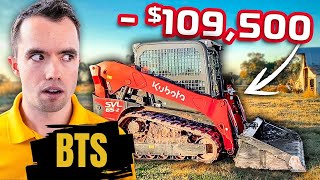
Behind-the-scenes transcript of Mike Andes visiting Freedom Lawn Care to document a business turnaround. Key on-site findings: the company carries roughly over $100k total debt (about $15k credit-card debt) and shows a negative bank balance (~$1,000); the owner reports heavy equipment debt (a ~$70k Kubota) that is underused and a personal/owner-pay issue (owner hasn’t paid himself for months). Production constraints: the crew had >$10k of gear stolen so the episode was filmed on two iPhones. Business details: the landscaping business is ~75% of revenue, lawn care ~5%; the owner expects ~$200k in revenue this year (250k is an optimistic target) and also runs a hunting outfitter and some real-estate projects (buy/hold and a flip). Andes notes the high fixed costs of large equipment (loan ≈ $1,200/mo plus insurance/storage/maintenance raising effective cost to ~$1,800–2,000/mo) and warns about mixing real estate with operating businesses. The owner also reports leadership and employee-management challenges.
Questions this video answers
Over $100,000 total debt.
$15,000 of credit-card debt.
Negative $1,000 (about -$1,000).
> $10,000 worth of gear stolen on American Airlines.
A ~$70,000 Kubota (large piece of equipment).
Chapters
The two cars just didn't go through. They know there's not money.
As of today, my account was negative $1,000. I haven't even made the payment on this thing. Where's this? Where's my check coming from?
It's embarrassing to be a crew member. It's hard to take them seriously. The customer doesn't want you there.
Trying to do things as fast as I can. Hey, you're getting way overpaid for like.
What you're willing to do behind the strip club. This is an absolute nightmare. Please tell me this is a joke.
I'd say I'm in 100 some thousand dollars of debt between equipment that got out of hand real quick. I want to see them go bankrupt. Seems like things have just been really out of hand lately.
We're asking for disaster.
All right, so we're going to be doing behind the scenes of Freedom Lawn Care during the last turnaround show. If you enjoy this, please let me know in the comments. I'm going to give my behind the scenes look of what's happening, what didn't make it into the final edit. And I think it might be educational and a little bit entertaining. So let's go ahead and get started. I'll interject and kind of pause the video throughout. And if you haven't watched the main video, it's on the main channel. Just look up Mike Andy's and you can see here, that's what we're watching it from. Came out yesterday. Today we're going to talk, walk through it and I'm going to add a lot more details of what was really going on while we were shooting. So without any further delay, here we go.
Today we're going to Freedom Lawn Care where there's over $100,000 in debt. $15,000 of that is credit card debt and they have a negative $1,000 bank balance. Five employees haven't paid himself, the owner for four months. Let's go see if we can turn this thing around.
Of course we're gonna have. We're literally going to have.
An advertisement. Like seriously. All right, let's skip this thing and move on with life.
Just see that Kubota over there?
That's a lot of debt sitting over there.
Morning, brother. Good. All of our camera gear didn't come through on the plane. Don't mind our lackluster setup.
You're good.
Cool, man. Good to meet you.
Don't mind my lackluster setup.
So this is true. We had over $10,000 worth of gear stolen on American Airlines. We had a pelican case with a bunch of cameras and microphones and a whole nine yards. All of it was stolen. So. So we literally shot this entire episode on two phones. You'll see right here. Actually in my hand, I'm holding one phone. That's the audio source. And then Terrell, he has the other iPhone and that is our video source. So the entire thing was shot on literally two iPhones.
Actually, we rent this house here. The owner just lets us.
Nice, man. This is the place you want your shop out in the middle of nowhere.
Yeah. So I grew up working on this ranch here. We do lawn maintenance, landscape, Christmas lights. Yeah, I don't come from money. I've built all this by myself. And it's been a been a grind. I'd say I'm in a hundred and some thousand dollars of debt between equipment, schizier and other stuff for revenue this year.
2023. What do you think you're doing? I know the numbers are a little bit hairy.
We're gonna hit 200 000.
Okay. For sure.
250 might be a long shot.
I see the Kubota. Do you guys use that? Quite a bit of landscaping then. And some lawn care. What's kind of SP split in terms of revenue?
75 landscaping.
Got it.
5% lawn care.
What's the team on this each month. Do you guys use it quite often?
Like once a week.
When we're using it, we're using it right. Not, we're not. There's been times where I'm like, holy crap, I'm so thankful we have this thing. It's like, it's just so handy.
Yeah.
And then there's times where I'm like, geez, I haven't even made the payment on this thing. Like it hasn't even paid itself right. For the month.
So it sounds like you bought the seventy thousand dollar piece of equipment. He doesn't use it very often. And it's bunch of debt on the business. The thing about having a big piece of equipment like that, it's not just the actual cost of the loan which is paying like 1200 bucks a month on. It's also the insurance. You have that thing on a a business that is that small. Like 200,000 annual revenue. If you're just doing like small landscaping projects or mowing or landscape, like small stuff softscaping, your insurance is like very, very minimal. You throw that size of piece of equipment now you need bigger trucks. You also need bigger trailers. And all of that leads to more insurance. So there's cost of insurance, there's cost of storage, there's cost of maintenance. And I would. I would venture to assume that piece of equipment's actually costing the business around 18 to 1800 dollars to 2000 dollars per month with everything included.
And then you have other businesses too, right?
Yes, I invest in real estate. I started doing that this year, and then I have a hunting outfitter a couple hours away from here.
Okay.
And I do that. I mean, we're about to start up doing that.
So. So do you, like, take people on tours or.
Yeah, so we take people on guided hunts. I have six employees doing that. Chef, a lodge. So the honey lodge is for my business.
Got it.
So in Kansas, that was my real sale. So I bought two pieces of real estate this year. One was a flip house, and one was the hunting lodge. But that's all buy and hold for my personal business.
Right, Got it.
We're gonna do 250 grand.
So one thing that wasn't mentioned in the episode was that that buy and hold that other deal, he doesn't own very much equity in it. He's doing sweat equity, which means he doesn't put any money into the deal. There's investors, they. They provide the liquidity. And then he does sweat equity, which is like project management, doing the whole rehab and remodel process, all of which takes a whole lot of time away from his businesses, which create together over $500,000 in annual revenue. What? The reason in this episode, I start talking about him actually using the hunting business instead of his law is because it's doing more revenue in a few months out of the year compared to the landscaping and lawn care business, that takes eight, nine months out of the year in terms of attention. And so when you're looking at two different business opportunities like he is, in this case, we have One business doing $200,000 in revenue over the course of eight to nine months. Super unprofitable. And then we have another business, hunting business, doing $250,000 in revenue in a matter of a few months, being very profitable because you don't have all this equipment cost and debt and all the rest of it. I am a little bit concerned, even with the hunting business, that he's investing a whole bunch into real estate, because real estate is a different business. Like, you have a business focus on generating cash flow, because a really good house deal, you might make 3, 4, $500 a month on rent, like, as cash flow on top. I want to pay insurance and maintenance and property management. And all the rest of it. You might make a few hundred dollars a month. A good business. You focus on that. Make thousands of dollars every single month. And so I get concerned when people start mixing real estate in their business, because it is, in my opinion, two very different industries on that one this winter. Cool, man.
So we're kind of running into, I don't know how, like, when we want to get into this, but I have a couple issues with employees. A lot of what I think is going on here is my lack of, like, leadership and just being able to, like, tell people, hey, this is what you do. This is what you need to do. Go do it. This is your job. I'm, like, very non confrontational.