C. Suite Unfiltered Presents, The Board Room - 001
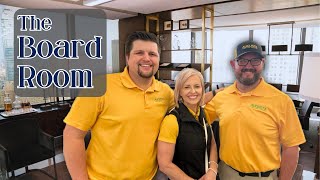
Live episode of the C. Suite Unfiltered podcast (The Board Room series) featuring host Lee with guests Liz Naber (Chief Operations Officer) and Chuck Fought (regional manager) from Augusta, a lawn-care franchise. Guests describe their career paths into Augusta, how they adapted (Liz: moved from field to command center; Chuck: law enforcement to regional manager), how they work with founder Mike Andes, and practical leadership advice for employees and managers (show up, set standards, train and take responsibility). The transcript also includes the origin anecdote for the company's P4P pay-for-performance concept (reported as conceived on a mountain run). Tone is candid, motivational, and pragmatic.
Chapters
Welcome back, Greg and everyone to another episode of the C Suite unfiltered podcast. Now.
Normally. Thank you. Thank you. Premium subs only.
Normally, I have the Brains of Augusta on stage or in the studio, but I thought, let's change it up. We're gonna hear from the Brains a lot these next two days, so I thought, I'll bring up the heart of Augusta and the muscle of Augusta. Please welcome Chief Operations Officer Liz Naber and regional manager Chuck Fat.
Have a seat.
They have mini mics, too. Look at that. Mini mics.
Are we on? Ooh.
Nice touch. What's up, guys?
What's up?
Welcome. First time on the pod.
Thanks for having us. You can come on my show sometime and I'll make you famous.
Yeah, yeah, yeah. Oh, I'm 100% riding Mike's coattails to clout. 100%.
We all know that, Lee.
Yeah, yeah, yeah. Well, we're all comfortable getting cameras shoved in our faces for the sake of content. Chuck, you know you got a lot with all your regional managers, but I want to start by asking Liz a question. Now, it's pretty obvious we look out in the audience. A lot of dudes, right? Lot of dudes here. But you are a top executive at one of the fastest growing and emerging lawn care franchises in the world.
Yikes.
Yeah. That's a. Let's go.
How have you done that? How have you overcome so many obstacles to get to where you are?
Well, you mean working with guys?
Yeah.
Well, I really had no experience in the industry or in the field, so I came with a pretty humble attitude. I didn't really see an issue working with guys. They're just people. But there's a saying that some of the best coaches never played, but they studied the game, they studied the players, and then with the team, they dominated the field. In the military, they put the rank of the soldiers by their education, not their experience. So I believe that it doesn't necessarily mean that you have to play the game, but if you study all the players, I tried to really respect the guys and ask them questions because the ambiguity of our sport, lawn care and landscaping, left me to depend on them, ask them questions in order to best help them do their jobs. So I tried to be humble and have the right attitude. And then I feel like whether male or female, leading doesn't change. So I tried to hold myself to a higher standard than I held them to, and I think they saw that and respected that. So the only time they were ever mad or frustrated is if they thought I pushed them Too hard. And those are the only times they said that I didn't understand because I had never worked in the field. But other than that, no problem working with guys.
Can I ask you a follow up that we didn't have on our list?
Possibly.
We also have a lot of fantastic ladies here. General managers, field workers, spouses, office managers. They wear all hats. They phenomenal. What? Give them one piece of advice. I know I'm putting you on the spot, but I want to be unfiltered.
Take ownership of your weaknesses and realize your insecurities. But be confident in the position that somebody else has placed you in, that you can do it.
You go, girls.
Great. Great, great, great. All right, Liz, I got one for you. So you've been at Augusta from the beginning. You saw Mike in the field. Like you've seen it all, right? You've promoted up through these things. You've grown with the company operations. You did that. You've helped franchisees, all of these franchisees. You've been in their accounts, you've had calls with them, all of those things. Now you're in command center. You're running that office setting. Totally different. Office staff, field guys. Totally different. Right. Most importantly, how do you deal with that man in the back running 150 miles an hour and tying it all together?
Yeah. Well, that's really a loaded two part question. Well, when I came to Augusta, I had no business acumen. I felt ill equipped to be an office manager and to learn all this stuff from scratch. So I had never been on a tractor or a skid steer. And the very first day I had to load product into customers trucks. And that was pretty scary. So there were no supports or assistance. So I learned everything right alongside with Mike. From there, I moved to Bellingham, Washington with our team to a bigger location where we had 19 guys. We did lawn care, landscaping, cleanups, walls projects, artificial turf. We tried to do all of it. And then from there we franchised Augusta. So that is how command center came to be. So it's an office like setting where we have agents that I empower to say they are the office manager for the franchisees. So we take all their calls, we do their estimates, we do every office task imaginable, plus their P4P, their payroll, and then we're able to communicate with them all throughout the day. So this was really a whole other business. And so it was a whole other challenge for me to take on. And I'm working with mostly women when I worked with mostly guys before. So that was a Huge switch up. So having the franchisees with us as command center removed the whole thought that they would have to have any office staff because we replaced that for them. So any new position that Mike has placed me in, I learn, listen, study, absorb everything I can about that new role when I know I'm going into it, so that I feel kind of prepared when we go into it. But Mike moves fast, and so it's always pretty uncomfortable. So if he even talks about anything, I need to start studying and learning. And I think the thing that's helped me most when I feel inadequate for the next role is to remind myself that Mike gave me a seat at the table. He wants me here. He believes in me, and he's sure that I'll be able to take on the next task that he's given me. So if you know you're welcome in the room and you have a seat at the table, then you know you can have a posture, even physically, that you have the right to be there. And I would say that to the ladies, too, or any of you in the position you're at. If somebody offered you that position, then you can be confident that that is a place you can be very confident to take. And that. That was a big help to me.
And.
And once you do posture yourself that way, people start to respect that, and then they accept you in that role, too, by the way you handle yourself. So the next part, dealing with Mike going 150 miles an hour, well, honestly, that has not been easy. There's been friction, and we're related, by the way. And so not everybody can work with family. So it's a lot of learning to adjust and to pivot. But I believe there are visionary people that were destined to give us things that nobody else has ever even thought of. And I know that Mike is one of those people. So in 24 hours, he can spin an idea, an original idea, into fruition that other people take many years to develop.
When he does his mountain run, usually he comes back with an idea and the full implementation of it. So one Saturday, he came back and he said, I thought of this idea like he had the whole business planned in his mind. And he said, this will change our industry and it'll change all service industries ever. And he said, we'll be able to have employees get a portion of all the money they make for the company. And he said, the only thing I haven't nailed down yet is should it be pay with the Period. Should it be pay with the number four performance P4P and that is how P4P was born. Was on a mountain run on a Saturday. Can I Hear it for P4P? Yeah.
We're very happy that that came to be. So that's just one thing. So when I accepted that I was working with a very unusual person and any frustration, resentment, jealousy, I had to take ownership of my attitude and adjust myself to work with him. So I try to match his pace and his speed and everything about it to be the most supportive, because I could either be a huge hindrance to him, or we together can. I can get behind the vision, and then we together can accomplish so much more together. And he's hard driving and. And he keeps me very uncomfortable. But I've learned a ton. I've grown a ton personally and in business for which I'm very appreciative. Can I ask you guys some questions?
You can do it. Yeah, let's do it. I think it's great because I think you're the type of person that wants to better themselves. And I think if you want to work for someone like a Mike Andes or for the business owners in this room, speaking to the employees, business owners that are motivated to bring you to conferences to educate themselves and you to better their future, like, those are people you want to work for.
Definitely.
And Mike pushes the three of us to be better. Like, he doesn't let us get stagnant. And it's hard. But I think what you shared was fantastic. Thank you, Liz.
Yeah. Okay, I'll ask you a question.
Firstly, hit me with it.
So you had no experience in the industry.
Oh, good. I thought you were going to ask me questions about my stock picks, which is what Mike does. And he makes me look really bad.
No, I'm into building people. Okay. So you were hired as a field worker.
Yes.
And then an estimator, and then an office manager, and then sales, and then as a coach. So that was a lot of changes really fast. So you've seen hundreds of P&LS and you've seen hundreds of what works and doesn't work for business owners. So number one part of my question, what qualities about you do you think stood out? And number two, with all your skill and experience, why would you want to work with us except that we're awesome when you could go start a very successful business on your own.
I appreciate the vote of confidence and the flattery, but let's get real for a second to talk to the employees in the room. It's so simple. And Chuck and I are black and white guys. Right, Chuck? There's no gray at Augusta. There's a lot of yellow and. And then there's black and white.
That's why they need a heart.
And if you are an employee in this room, the biggest thing is I just showed up.
Like I'm pausing intentionally because it's that simple. The Bellingham shop that I ran for Mike, every week we just account for one and a half employees off. That's the average. We do the math every year. And an average of 1 1/2 employees is off every single day. A call out, my kid's sick, my car broke down, whatever. And sometimes it's valid excuses. They give us heads up, whatever it may be. But I just simply showed up every single day. I can proudly say in six years, I've never been late. I've cut it close a couple of times, but I've never been late. And I think I keep emotion out of the business. I. When you work for someone fast paced like Mike Andes, he wants you to push back. He wants criticism. He wants you to poke holes in his plans unemotionally. I don't like it because it's not fair. I don't like it because that means I have to work harder or whatever it may be, or I have to change desks. I don't care. Whatever it is, right? Take the emotion out of it. Is a good idea or a bad idea, black and white. And I think for me it was. I showed up and I kept emotion out of the business. Business is here to make money. That's it. Period.
No whining, right?
No whining. The second question about, you know, why do I work with you guys, other than the fact that you're amazing people, this question was really hard. And I'm glad you sent us the questions beforehand because I wouldn't have known what I would have answered on the spot. I really had to sit and do some critical thinking. And I talked with my wife about it. And I really think that the good I can do in the world amplified because of a great person like Maya Gandies, a great person like Liz Naber, a great person like Chuck Fought, a great person like Kevin Fairburn. I could go on, right? I could go down the whole list. I could name all 130 franchisees if I wanted to. But I think the impact that we can have as a team, that I can have as an individual is much bigger. If I can talk to business owners all across the country, if I can help employees all across the country, if I get a platform like this to encourage and develop leaders. Develop better men. Let's be honest, the world needs better men right now. If I can use this platform to encourage young men to be good fathers, good brothers, good sons, whatever it may be, I'm gonna do that. And I'm passionate about helping individuals, business owners, employees. I'm an employee and I'm proud to say it. I'm not a business owner. Proud to say I'm an employee though, of a company that is making real change in the world and in people's lives. And that's what I do. I've bought into Mike's vision and I wanna impact people. Cut grass, as Dan Ralphs likes to say. So that's, that's why I stick around.
Like we can do more together than if we were all.
We can do way more together. I mean, you could, you could go with your eyes closed tomorrow, Liz, and run a million dollar company. Like if someone gave you $100,000, you'd have it to a million in a couple years. Same with you, Chuck.
I appreciate the vote of, but what.
Impact would you have in the world?
Don't know.
Just my two cents. We're unfiltered. There you go.
Okay. Can I ask Chuck a question?
Yeah, let's do it. Let's get after it.
So if you didn't know this, Chuck was in law enforcement for many years.
What? No, he doesn't carry himself like that at all. You got the cell phone clipped on the side there or.
Absolutely.
So he was the big, big bad wolf for a while, but we're softening him up a little bit. So Mike put a shout out on social media that he needed a GM and Chuck applied and Mike hired him without ever having met him. And then he gave up this whole career to become a lawn care guy. And for you, you're now a regional manager, which is not a general manager. You manage the seven companies that you're a regional manager of. So a couple questions in that.
Was you have all the responsibility of these companies and to make them profitable, and yet you have to manage the owner's money, who is very frugal as well. And he, he, you have to, you know, we could all make our own mistakes, but to have to actually be responsible for somebody else's dollar and be accountable for every bit. So what in the world is it that Mike sees in you that he can trust and depend on you like that? And how do you handle that kind of stress?
Yeah. So like any military, law enforcement, firefighters in here, put your hands up.
Let's Go.
Shout out.
Give him a round of applause.
Let's go.
Yeah. So we cut grass, right? Like, what stress is there about cutting grass compared to those types of environments that we go into every single day, right? Yes, it's stressful. Not downplaying that, but, like, there's a different level of stress. And, like, we just had a conversation about this. Like, it's a little chaotic right now, and it's actually kind of fun, right? Like, I'm enjoying it because when things go smoothly, quite honestly, it's a little boring. Like, which is how I got into this role, because I was bored, and Mike could see that. It's like, man, GM is a little bored. Okay, great. Here's the next step, right? There's got to be a next step. So that's kind of how I handle the stress. Like, I don't look at it like that because I always step back, detach, and go, you know what? It's grass. If I got to push a customer off, maybe it's a little taller tomorrow. But it's not that serious. And my GMs will tell you, I say that to them all the time. Like, guys, I tell Connor all the time, buddy, it's grass, man. We'll call Ms. Jones tomorrow, bro. It's grass. It's okay.
Ms. Jones is calling Connor right now. I can hear it.
But, like, how I got hired. And Mike may remember this, he may not, because he's always so crazy, running around. He posted the video on Thursday, interview on Saturday, hired on Monday. It was literally that quick decision made Monday night. I have a wife. I have two kids. We had a house, normal family, seven hours away. But I believed in the videos. I've been watching the videos, watching, watching, watching. I wanted different. I wanted that Mike had directions. I follow directions. It's very simple. I. I show up to the meeting on time. I do what I'm supposed to, follow the systems that'll. That weeded out half the people. So instantly, my competition's gone. Like, it's very basic, right? So if you just follow those directions. And I'm an employee, so I follow directions. Well, I'm not an idealist. I'm not an idealist at all, But I'm a pretty good operator, in my opinion. I operate the systems. I follow that. And I think Mike sees that and kind of rolls with it. And then I have built up that relationship capital over almost three years now. And I had a deputy commander tell me one time, I trust you until I can't trust you anymore. And that's Mike's philosophy. So I just keep the trust going, and it'll just continue that relationship. So appreciate it.
Very nice.
Beautiful. Yeah.
So eloquent.
All right, Lee, I got one for you, buddy.
Yeah, Hit me with it.
Since we're on the employee side.
Yeah, yeah, yeah.
And you know how I feel about employees. I love all of our employees. Now you're in a different role from running a business right now. You've kind of stepped out of that. And us, we are coaches as well. So, yes, you're in Bellingham, and you're helping that you're doing sales. So a lot of these guys have probably talked to you on that side, but now you're coaching all these franchisees in their business, but you're a little bit out of it. Remove from those day to day. How do you relate to them? How do you empathize with the chaos that maybe they're in and try to keep the emotions in check with you and with them?
Yeah, I think that's a. That's a great question. And with that question comes an exorbitant amount of pressure.
Sure.
But to ask you guys and maybe slip up a hand if you are a parent in the room. You guys are both parents, right? Chuck, you got kids. Liz, you have kids. Parents are listening right now. Prove to me you love your kids right now.
Discipline, all this. This is it. You do this.
I don't believe it. Liz, prove to me you love your kids right now.
I can't.
Right. I don't. And I'm not a parent, But I couldn't prove to you that I love my wife right now. Like, it's not quantifiable. Love is not quantifiable. Care is not quantifiable.
Sure.
I can't sit down and look at 50% close ratio on my care. Right. I cared 50% today. And I think, not speaking as a parent, but I think for you guys, it's. You know, you stayed up late when they were sick when they were little kids, right. You took them to Disneyland even though you didn't want to. I know you just recently had a Disneyland trip.
And World Disney World. We're not West Coast.
Yeah, all right. Disney World.
We're not going to the west Coast.
Sorry. Disneyland's. The OG Will die on that hill. Yeah, but, like, you took them on trips. You took care of them when they were sick. You gave them money for gas, for college, whatever it may be. Right. But it's the day in and day out actions that show you care. Right? And I think that goes for business owners, for employees, whatever it may be, is that you just have to show up. Once again, I'm going back to the same thing I already said. Just show up every day saying I care. And just to give an example, once again, it's not quantifiable. And if you think I'm gloating or whatever, come talk to me after we're unfiltered. But Dylan Wirtz is in the room and he's a new franchise owner. He just graduated high school, he's 18 years old and he bought an Augusta franchise, an existing business. Big investment for an 18 year old for sure. Also, let me brag on him for a second. I didn't tell him I was gonna share this. So Dylan, you're awesome. He got the highest score on the Augusta test. We test the franchisees to become a franchisee. He's got the highest score, 93 overall.
That I'm talking about.
Yeah.
Woohoo.
Dylan, this guy is, has the burden of a business. He has three employees, he's young, he's hungry, he's motivated, and he shoots me a message at 6:37 at night. Just worked a 12 hour day and he's like, hey, can you review these estimate videos? And every part of me did not want to open that message. Dylan, I'm just being honest. But on my drive home, yeah, I was driving, so sue me. I watched the videos and I sent him back voice notes for every single video.
That's illegal.
Yeah, that's fine. But I wanted, I want to see him succeed. And that's just one element of showing like I care about Dylan, I care about the franchisees. I will never block a franchisee's number. I will never say, don't message me, I will never say, don't email me. I'm available to the franchisees as much as I can and I want them to succeed. And to the point of the question, Chuck, like, yes, I am removed from day to day operations, but we have systems at Augusta and if you just follow the systems, the business should get boring.
Right.
And obviously you have outlier situations and emergencies. I am 100% sensitive to that. But follow the systems, listen to Mike Andes and you will find success. So showing up for them. And sometimes I just regurgitate a Mike Andes video on a coaching call. I'll just be 100% honest. I'll be like, yeah, I remember Mike said this multiple times on YouTube. I'm just gonna say it on a coaching call. It makes sense. It's Applicable.
Absolutely.
All right, I got one for you, Chuck. We'll put you on the spot. I think it's our last question here. What is it like to be a regional manager? And with that, I want to explain. So you oversee multiple locations, and you also have employees under those managers. And then you also have Mike, who is your manager. So you're in a management sandwich, if you will. And you have to answer to Mike for all of these locations for every single general manager under you, every single employee under them.
That's a lot of pressure. How do you deal with that level of pressure? How do you deal with that management sandwich up and down the chain, as some would say.
Yeah. So first you set the example. You can ask any one of my managers who's the first one to the job site, whether that's their shop on a job. Morning meetings this morning. Who's that first one? It's me. You set the tone, set the standard, or it's a recommendation. I don't live by recommendations. A standard. It has to be a standard. Guys, you guys, as owners, employee, it doesn't matter. Set the standard, period. There's no deviations. Like, it just has to be that simple. We just let a guy go. I'm filling in, helping with GM that's not there. Second day, he's fired, he's late. I have a standard. If you're late on the first week, you're gone, period. And I tell him in the interview, I give him plenty of notice. Like, it's just. It is a standard that I have, right? So I share those standards, but they know I hold them to it. Right. When it become. When they're managers, though, you also have to look at it from the. A different lens. If they're unsuccessful, it is your fault, ultimately, because A, I did not give them the resources or B, I didn't give them an opportunity to learn or train them properly. Right. So if you didn't train them right, they wouldn't know how to do these things. So retrain them. Give them the opportunity to correct themselves, Pour into them. Mike gives us every single resource we could ever ask for. So I make sure I give them every single resource they could ever ask for. They never want for anything. They need more information. Great. Here's a book. Hey, book a call with Lee. Another resource, right? Like, I'm not the only voice. Hey, Liz, can you talk to this person? Hey, Liz, I just hired the first female general manager in Augusta Nation.
Let's go.
Why? Because she works her tail off and Liz is in A position that she can relate. So reach out to them, you know, so, like, I'm not the only resource. But if they're unsuccessful, then I need to give them those resources, I need to train them, and then I need to take the responsibility. Like earlier this spring, all honesty, I failed. I held a general manager too long because I liked them as a person and I wanted him to be successful. But I tell my GMs if I want your job more than you do, I really shouldn't be hanging on to you. Right. I should not be fighting for your job more than you are. The heart wasn't there. I held on to him long and it kind of prolonged our success. I'll own it 100%. So I got to learn as well. And I got to get better at those things. Right? So there's, there's inadequacies all across the board. It's not just employees or general managers. And then I just hope that Mike understands. Like, hey, they're crushing it. They're working hard and we'll just keep moving forward.
So that's awesome. Thank you, Chuck. Well, any last minute things, non financial advice, you know, anything like that, or we just. We good.
Eat a lot of meat.
Eat a lot of meat.
Yeah.
You're carnivore now.
Yeah. Yeah. I'm putting you guys on financial advice.
Cool. Liz is non financial advice. Go carnivore. Chuck, you got any? I'm putting you on the spot. Yeah, I don't have any. I'll just be honest. Like every episode. I have nothing.
I thought about this because I knew this was coming. So, like, what I want to share with people is do not live in the gray. Black or white. Live by your standards. Dustin Biernick, you know what I'm talking about. I hate the gray. Gives me a hard time coaching calls. Chuck, I'm in the gray. Yeah, get out of it. Just stay out of the gray, guy. Have a standard. Live by the standard. Uphold the standard to your employees. It's giving. It's not discipline or it's not a bad thing. Give them the rules and let them play within the game of the rules, folks.
That's all I can subscribe. Smash that bell and don't ever respond to anything but super chats.
Yeah.









