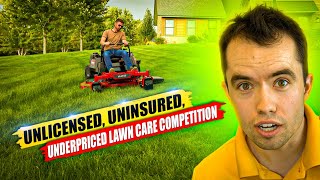
Mike Andes (Landscape Business Course) advises licensed, insured lawn-care businesses on competing with uninsured/unlicensed low-cost competitors by increasing perceived customer value rather than cutting prices. He explains a value-vs-price continuum and lists concrete ways to raise perceived value (professional website, clean/decals on trucks, uniforms, prompt office service, automated estimates, marketing that highlights insurance and liability protection).
Chapters
Hey everyone, it's Mike over at Landscape Business Course. I want to do a quick video for everyone out there, maybe a podcast too here, but talking about how to deal with uninsured competitors and unlicensed competitors in the lawn care and landscaping industry. So you might be in a place where you have 20,000, it seems, competitors mowing lawns, the average Joe just throwing a mower in the back of his pickup and trying to compete with you. How do you actually provide value in the mind of the customer, perceived value, so that they want to and are willing to pay a considerable amount more for your services? Because to be in business as an insured business, you're going to have to charge sales tax in a lot of places. You're going to have to make sure that you pay your employees above the table. You're going to have to pay payroll taxes on them, you're going to pay federal taxes. And so you then therefore it reduces their net pay. So there's a lot more expense involved. When you have an insured business and a licensed business versus someone that is just doing mowing lawns on the weekend and literally every dollar they make goes into their pocket because they don't have a lot of overhead, they don't have more infrastructure, they don't have the legal aspect, they don't have taxes they have to worry about, they don't have to worry about licensing any of that. So the big question is, should you do that? Absolutely not. You, you should not try to build a business based upon price. And the number one way to do that is to not be insured and not be licensed. Cause you reduce your overhead, you reduce your cost of doing business, and you can reduce your prices and you can beat out everyone else. Now, how do you not do that and yet charge what you need to to run a sustainable business? This is the continuum I've talked about before and I'll talk about it again. When it comes to a transaction happening, there's two things involved. It's like a seesaw or whatever they're called. It's value and price. There's perceived value of the customer and there's price. On this other continuum, as long as value is slightly higher than price, as soon as value is slightly higher than price, that's when a transaction can take place. If price is higher than the perceived value, that the customer will not make the purchase. Now, what you want to be doing in yourself, what's very easy to do, is simply reduce the price and make the transaction happen, because now value will be higher than price. The harder thing to do and what I encourage everyone to do on this podcast and watching all these videos and the content I try to create is don't worry about trying to reduce price and make that transaction happen. You should be thinking about how do I increase the value, to the point raise the value so high that my price can stay substantially higher than other people, and I still can make the transaction happen by raising the value. So instead of thinking about price and how do you compete against price, you gotta think about perceived value. What does your website look like that's perceived value to the customer? Professionalism. Then your trucks, are they clean? Are they. Do they have decals? Are they painted? And do you actually, in your marketing, talk about the fact that you are insured and the benefits of that, and the fact that if someone got hurt on their property and they weren't insured, that they would be liable for that? If they broke a window that was $3,000, a beautiful picture window overlooking the valley, and someone breaks that window, if that person's not insured, guess what? That homeowner's on the hook for that bill. You. You need to be expressing that in your marketing, if that's a big issue. I just talked to someone in Arizona last week, and they have what they call the handyman bill. I think it's called a handyman.
Basically a regulation that allows people to make a small amount of money without having to be insured or without having to be licensed legally. It's completely legally to do it in the state. And it's killing these landscaping businesses that are trying to build a professional company. The thing is.
They'Re focused so much on the price and the fact that these people are charging 30, $40 per hour when they need to realize that, okay, so this is the continuum. Right now, price has been decreased by the competition. Therefore, the competition is making money. Right? Because as soon as value is higher than price, transaction takes place. So what happens is these people come along, they're uninsured, they're unlicensed, they reduce the price, and they're able to get all the business because now transactions are happening. What you need to be thinking about, on your perspective, where now it's like, okay, I need to charge a higher price in order for me to have a sustainable business. How do I produce value now to supersede that level of price? Okay, that's your website. That's uniforms. That's professionalism. That's when they call you on your phone. You have an office staff for the franchisees, Augusta Lawn care. Our goal is to have 24. 7 coverage at the command center because there's value in having someone pick up the phone and not getting a call back the next day or two days later. There's a value to getting an estimate within minutes of the estimator leaving the property instead of weeks or even days. Like for them to be able to leave the property. And 10 minutes later, there's an email in their inbox with the estimate detailing all the information and the pricing. Like, that's value, all right? And that process is all automated. It has videos and nice pictures, and it has a link to click for client testimonials and before and after pictures. And it's all presented to them in a very professional manner. That is perceived value. And so you will be able to charge higher price. So if you raise your value so high, you'll be able to increase your price and still the transaction will take place. So that's how I want you to think about. We can talk about how horrible it is that people are uninsured, how horrible it is that they're not licensed and paying taxes. And we can go on a rant about that. And people do that all the time. But instead of thinking about what they're doing, think about raising the value. Stop thinking about price, charge what you need to make a sustainable profit margin. That might be 50, $60 per hour compared to their 40. But guess what? You are going to now market and you are going to now advertise the fact that you are insured. You're going to educate the customer why that's important. You're going to show up in a nice truck that is painted. Not brand new, not $50,000 truck, no, just nicely painted. No big dents, no scratches. It has your decals, your company information on there. It's all transparent and that's value. Your employees show up in uniforms. They are educated and know about landscaping services. They're able to talk to the customer. They know English. They're able to quickly communicate with the office via their phone. These are all things of value that you can offer the customer. Charge the prices you need and stop worrying about your competition. When you put all of your time and energy and thought into what your competition is doing and how they're lower in prices, they're undercutting you. All of these things. You need to stop focusing on extraneous exterior things outside of your business. Take that time, attention and energy and focus on how you can become better and increase the value to your customer. Thank you so much. You've been watching Landscape business. Course. I'm Mike Andes. Until next time. Be great, because nothing else pays.