From TRASH to CASH ► $200K Business Turnaround
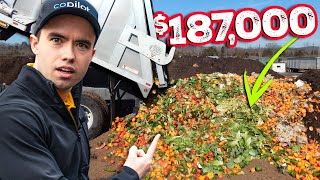
Transcript of a YouTube episode profiling Music Mountain Compost (owner: Zach Kabakis) in Vermont. Zach runs curbside food-scrap pickup (residential + commercial), composts on-site, and sells finished soil. Key items: ~572 customers (≈510 residential, 62 commercial), 2023 revenue ≈$180–187K with take-home reported around $100K and gross profit cited ≈$130K; typical cash on hand ~$15–20K. Pricing examples: commercial bin ~$25; residential 5-gal every-other-week $22 (second bucket $27); Zach previously raised residential price from $20→$22. Main constraints: owner is maxed out doing long days, difficulty hiring/retaining helpers, routing inefficiencies, muddy partner arrangement on soil side, and limited use of software. Recommended levers: set a capacity cap and raise prices when reached (suggested 550–600), adopt routing/crew software ($100–300/mo), convert website/email flow to a signup form with card-on-file, improve branding (distinctive bucket/truck color), and clarify/exit the underperforming soil partnership. The transcript also covers Zach's personal recovery story and community roles which influence decision-making.
Chapters
I was such a genuine person for 12 years of my life. You know, I did a lot of bad things.
I'm just maxed out. How do you break up with your best friend?
Just getting someone to come help you. It seems like a challenge.
I don't know how to integrate an employee. I have no clue how to do it. Everything kind of was going, you can.
Always do a little bit more.
I have a lot of negative karma to counterbalance.
Whenever you're saying yes to something, you have to say no to something else.
In my head, I'm like, I don't trust any of this stuff. I've been doing this all on my own.
Just gotta figure out a path forward.
Today we're in Vermont with Zach from Music Mountain Compost, where last year he made 180 sets thousand dollars picking up people's food scraps. But he's not been able to get an employee, keep them and grow the business. Let's see if we can turn this thing around.
This is, like, where every, like, old Hallmark movie is made on the sticks. Oh, we have arrived. Good to see ya. Good to see ya.
Absolutely.
Absolutely. Man, this is. This is epic.
Hey, Mike. My name's Zach Kabakis. I own Music Mountain Compost based out of Vermont. So currently I have about 600 customers, and I go around curbside for food scraps. I go all over the state of Vermont, pick it up. So currently I don't have any employees. I got a couple helpers. That's been one of the issues is like, trying to find a good helper that'll stick around.
So basically, I pick up these bins of food from schools, jails, churches, apartment buildings, and then I also do residential. So then I bring it all up here, dump it out, and mix it in with, like, straw, wood chips, manure, and then I bring it out into a field like right down here. That pile at the end there, that's probably two months old, and that's from rock we scraps to pretty much soil. Another month or two, it'll be ready to sell. So that's like the other part of the business is like, there's the pickup part, but then there's also, like, selling it out there.
The basic premise of Music Mountain Composting is that you pick up people's food scraps, you then compost that material, and then sell the dirt to gardeners and other landscapers. The question is, can this really be profitable and is there enough demand to actually grow the business?
I'm just maxed out, you know, I'M getting to be maxed out and I've been doing this all on my own. So the pickup part is like 12, 14 hour days. And I've had a helper a few times. They never last more than a couple months. And I pay them good start at $25 an hour, but they don't stick around. I have 572 customers right now and I'm picking up for every single one by myself. Like when I started I was like, when I hit 300, I'm gonna hire someone. You know, when I hit 400 I'm gonna hire someone. And then I got to 400 and be like, oh, I'll be alright. And I got to 500. Then it was like, I don't know how to integrate an employee. Yeah, I have no clue how to do it.
570 all by himself. That's amazing. But I do wonder if potentially his lack of organization is why he hasn't been able to get an employee to stick around.
Just getting someone to come help you.
Right, right. Like this is my every other Monday and this is the only day during the week that I don't have a route. The opposite Monday I do. And I've kind of left this day open as like I'll come up, work on the tractor, do the maintenance on the piles, stuff like that and have like a little bit of time at home.
And so I can still add a.
Route on this day and then a few of the other routes, like I can, I definitely have room add. It's a lot of logistics.
Yeah.
You know, like there's a couple routes where it's like basically 100 stops in.
A day.
Most of your contracts. Now is it commercial from the volume perspective? Like is it like 80% in terms of the volume coming from commercial and like municipalities, schools, et cetera. And then 20% volume coming from residential.
Probably 50, 50 from a revenue perspective.
50, 50 or from a volume perspective.
The business probably brings in 16 to 18,000amonth. I'd say eight grand is commercial.
Got it.
But the commercial accounts, I only have 62 of them.
Okay.
And I have 510 residential. That's why I'm trying to. I've been working on the commercial side of things to beef that up because.
There'S more money in it.
I mean I charge $25 per one of these bins and then I charge for a house, a five gallon bucket empty twice a month, $22, probably 20% have a second bucket and then I charge them 27. So every time they need another bucket. It's another five bucks. But the bulk of the money is definitely commercial.
Why wouldn't a homeowner just throw the scraps away?
Yeah, that's very true.
And a lot of them do.
I've kind of banked on people not being able to do it at home, but still want to do the right thing.
So $25 would be this cost. A five gallon bucket every other week is going to be 22 bucks for residential. So basically a residential customer, you're getting about 50 bucks a month. And we got about 60, 70 customers that are commercial and they're probably more 100, $150 per month.
The cheapest is 50. You know, they'll go every other week, one bid. The most I have is 800 to 900.
That's a JL.
And then I got a school district.
And that's about 8, 900 bucks a month.
I imagine there's not a lot of churn. Like once people are with you, they.
Just stay with you most of the time.
Yeah.
I mean, occasionally, like, I'll have a customer from the beginning cancel. And like, that's the other part of this. I get in my head about it. What did I do wrong? Like, why did they cancel after three years?
You know?
But my retention is pretty good. Yeah, it's just I feel like when someone does cancel, I kind of. I let it weigh me down more.
Than it should, you know, And I just, I'm so attached to these people, you know, Like, I never thought, like, that would be like, my biggest issue. But everyone that signs up, I care about them so much, you know, like, and maybe it's like, to my own detriment, but, like, I want them to have like, the best service possible because they're putting faith in me by signing up. So basically, I think it all stems from, like, like I said, I was a drug addict for 12 years from 12 to 24, and like, my reputation was shot. Nobody liked me, no one wanted to be around me, no one trusted a word I ever said. And so these last 10 years, I really hit the ground running with, like, I mentioned volunteering with my local town, like, doing everything I can to help people. Now that I've built up my reputation again, I protect it, I think at all costs. I'm really focused on, like, trying to help people while also, like, growing a successful business for myself. It just, like, I think they both matter to me just as much. And that might be my issue sometimes.
You know, I wasn't a businessman before this. When I Jumped into this. I was unemployed. I just gotten fired from, like, my dream job at a rehab facility and everything kind of was going to shit.
Now, during COVID right?
During COVID The beginning of COVID yeah, I got this great job because I've been recovering myself, and so I wanted to work with other people. And then Covid hit and they fired.
A bunch of people.
So I was just home sitting there for three months.
So I was a recovery tech is what the title was. I had an office off the living room in the rehab facility, and if people needed something, I was there. I got really disillusioned with the thought that we were trying to help people. We weren't really helping people. We were just trying to keep enough people there to keep the lights on. If we had 25 people, which is a full house, and like, we did a room search and we caught you with drugs, we would kick you right out. Now, if we had 14 people, which is like the minimum amount of people we need in there, and we caught you with drugs, we would phrase it like we were giving you another chance and we would let them stay. But really it was because we needed so many people there to be able to pay everybody. We'd kick people out. Sometimes I'd have to drive them to the bus stop in town. And I remember very clearly, it still haunts me. This poor girl got caught with a pot pipe. It was like 10 o' clock at night in a snowstorm. And she's from like two hours south of there.
No cell phone, no money.
And I had to drive her to the bus stop at 10pm and leave her there. And she's crying the whole way because she's got nowhere to go, she's got nowhere to be, no way to get home. And I'm just doing my job, doing what they told me to do. And it just wrecked me, you know, Like, I care way too much about people to put people in those positions.
I saw a thing on the news like, oh, next week they're starting this.
Food scrap law in Vermont.
And so I thought about it for a couple hours and I did a little bit of research and I saw other people doing it in other states. And so I told my w, like, I'm just gonna try it. And I bought a trailer. I had like five grand. I bought a trailer and a bunch of buckets, and I just started advertising.
That's awesome.
You know, and I got to like 200 customers within the first month.
How'd you get 200 customers that fast? Like, people just talking to each other like Facebook groups.
I'm not lucky. There's a wcax, which is the news in Vermont. I emailed them, I emailed all the local newspapers and I got a couple of them to pick it up and do a story about it. Music Mountain Compost is anything but a side gig.
Exceeded my expectations.
I mean, I have a little over.
300 customers and that's just in the first 12 months, just by myself, just trying to grind it out and make a bigger business out of it.
Between that and honestly, Facebook garage sale pages.
Yeah.
Have you heard of that?
Yeah. Oh, yeah.
Honestly, like, they're a free post.
Everyone sees it.
And honestly, majority of it, probably 80% in the beginning came from Facebook garage sale posts.
Wow.
Do you have a website?
Yeah.
Okay. I need to look at that because one thing I was thinking about, because it's such a low ticket item, like per month, you know, you're looking at 50 bucks. Right. It's tough to even have a marketing spend in terms of acquiring customers. But I think that if you can get people there and signing up immediately and you get their payment information and it's just like automatically put into the system, it's like, hey, we just need your address. Put your card information in and like, we'll be there next week. Right now we're just like super seamless. Otherwise this is so much time and energy just trying to get set up someone up for 50 bucks a month.
Right.
It's tough.
So basically, yeah, I mean, I spend about eight grand a year on advertising and that's online. And then radio mailers. I've kind of given up on the mailers.
You know, like, they don't really work anymore.
I mean, honestly, online is probably the best one. Google Ads I made sure, like right off the rip, someone told me, like, if you got over, I think it was like 15 or 20 reviews, Google will start pushing your ad up the listing. And so I really focus hard on that. I'm up to like 39 reviews, I think. And when you Google composting Vermont, I'm like, right there. And that's really like what I wanted.
Kudos for Zach for getting the Google reviews. That's going to help him be able to be visible on Google search when people are looking for anything to do with composting. However, I really think that once they get to the website, he could absolutely get more customers just by making sure that they don't have to email him just to get more information or email him to get pricing. He's just copying and Pasting the same exact email back to them. Why not have a form where they fill out their information? At the end he gets their card and they're a customer.
And so right now like so 2023, we had 180,000 approximately in revenue. 187 profit wise, we're running like 90 take home, but like 130 gross profit is that we're at.
For 2023 it was 187 and I'll make about 100. It was like 1 28.
Got it. And then right now in terms of like cash in the bank are around usually 15 to 20k.
Yeah, typically about 15, 20k.
Have you raised prices in the past few years at all?
Yeah, I raised $2 a month. So I went from 20 to 22.
Wow.
I know, Mike, but listen. Okay, so you should. Like I said, you should really talk to my wife. It was right when gas prices were going back up and we were almost at $4 a gallon.
And I was talking to my wife.
I was just like, what do I do? You know, and she's like, you're ready to raise your prices? And I was. And she's like, oh, 24, you know, raise it four bucks or whatever. And like, you know, I don't know. I don't know. And so I kind of sat on it for like four months. And then finally I was like, I need to do something in my head. I was like, $2. And I was like, no one's gonna quit over $2, you know? And sure enough, like, I didn't lose a single person and be like, oh, you raised the prices, like, I'm done. So it was like an extra $1,200 a month because I wasn't trying to like get greedy with it. I really just wanted to make up for the rise in the gas cost. And so yeah, I went up $2. It was dumb. Probably I should have done more. I get told all the time that like, I'm underselling my service, but they all. I'm hearing it from people that don't own a composting business. So like they have no, they have no frame of reference. Everything you said I'm going to try to do. I think the price increase will be the most difficult thing just because I'm so attached to everybody.
Well, the thing is, if you're getting current customers, like if you raise prices on let's say four or five hundred people and not a single person left, like that's enough to tell us that, hey, we're undercharging Right. And really, like, all the problems that we're having right now can be solved with money. Like the tractor, moving the stuff over, getting the new screener, you know, even hiring. It's like, if you hire, if you were able to pay someone enough money, eventually they'd stay.
That's where we have a moral issue. Because, like, I feel like I'm making a lot of money already.
Yeah.
You know, like, there's not a lot of overhead. And so I kind of just feel like, why be greedy?
Well, what's the objective of the business?
Make a lot of money and what for?
What's the objective of making more money?
Oh, I mean, set my family up. I want us to have a great life and have everything we need. And I want my wife to be able to stop working by next year so she could just focus all the kids. That's, like, the ultimate goal.
Doesn't sound greedy to me. Making more money is not more greedy. The objective of the money is to do a lot of very good things. And the fact that not a single customer left means that they see the value far above what you see it as.
Right, Right. So I guess where I get, like, concerned about something like that is like, this past month, I had seven cancellations. So in my head, I'm like. I start spiraling up, like, oh, my God, like, the world's over. What do I do?
1%.
I know, I know. But in my head, it seems very substantial in my head.
Well, even what you could do is this, like, hey, I have a moral problem with raising my price and making more money. God Forbid anything over 550 customers, we're gonna be charging this higher rate.
Okay.
And then what's gonna happen is we need to actually raise price and lose customers. Cause we can't keep doing the work yourself. And I know it's like, well, I can add one more. I can add two more. I can add maybe four more. But it's like, where do we draw the line between, like, you're eventually just gon be working 16 hours a day.
Yeah. I mean, and the whole reason for.
The business is for the family. And now we can't see them. Like, now that's stupid.
I'd hate the thought of, like, losing, like, because Mike's like, oh, you want to lose customers? And like, in my head, I'm like, no, I don't.
Do we make more money? Is not a matter of we're trying to be greedy. It's like, we will create another job. We'll be able to Service twice as many customers. And if we're trying to, like, do good in terms of the food waste issues, etcetera, it's like, we will be able to double output if we raise prices. I think what I would do is, like, set your capacity. The problem I see with you, and same thing as me, you can always do a little bit more. Like, and if a customer calls like, yes, I'll do it right. Like, you're gonna get to 700 and you're gonna be like, oh, I can try to do a couple more. Right. So, like, we need to set what that benchmark is. In my opinion, that should be probably 550 or 600.
Well, I'm at 572 right now.
Okay. So I think 550 is the number. It's like anything over 500, we either A, raising prices, or B, we have to increase capacity with more. Another truck and more employees.
Okay.
And until. And if we raise prices tomorrow by, let's say, four bucks and we were still above 550, I would be like, raise them again.
If you've seen it on the channel before, hit capacity, raise prices. If you're not trying to grow, guess what happens? You hit capacity and you raise prices. Let's say it together. Hit capacity, raise prices.
I'm pretty maxed out because on top.
Of this, I'm on my town select board.
I'm on my local search and rescue. I was just on my fire department for three years. I just got off that.
And yet you're telling me you can increase the number of customers you have by 15% more going to 700.
I'm always looking for more and trying to figure out how to do things more effectively. But I'm also not afraid to give up my time.
And especially as you read in the scale and going past your time, you only have 24 hours in a day. And what you're going to end up hitting up against is you'll run out of hours in the day. So now you're giving off Saturdays, which is time that otherwise would go towards the whole objective of this business, which is time with family. Why do that if I can go raise prices and in a month make that much in profit?
That's my problem, honestly, is I just, like, I care too much about things, but I also have to look out for myself at the same time. I mean, everything I do is for my family. I have a really hard time with slowing down.
Whenever you're saying yes to something, you have to say no to something else because you have a Finite number of hours in a day.
I'm saying yes to everything.
And as you begin to grow the business, saying yes to more things is actually going to keep you from growing.
Right. So I'm working on getting rid of some things because, like, I'm also the animal control officer in my town. I'm the emergency management coordinator. There's, like, five other little things I do for the town. I've been working on paring things down, but my problem has always been I can't sit still and I just have to, like, go, go, go. And it's at my own detriment. And I think it affects the business because I'm not able to fully concentrate on it because I'm, like, so spread thin.
Although I commend Zach for how involved he is in all aspects of his community, his family, and a bunch of different business ven ventures, I really believe that time and energy focused on one singular business will allow it to grow and give it the attention it needs, potentially. Maybe why he can't grow the business and he can't get employees is because his attention is split in all these different directions, although they are admirable and good things.
So how much. How much of the revenue is pickup versus selling the soil after?
So that's the thing, right? That's one of my problems. The pickup part is doing great.
Right.
I make a ton of money. Profit's great. For the soil part, I partnered with my best friend.
That's Jake.
Jake, yeah. It hasn't panned out for us the way we wanted it to. He just has no time. An engineer, he lives in Burlington, which.
Is where he came from.
Last year, he was only down here three days total. He told me that much time, and I said, oh, let's just do it Anyway, stupidly, he put in part of it for the tractor.
Haven't really sold.
You know, we sold probably three grand last year worth of soil.
Yeah.
And, like, I could sell a ton more than that. My idea kind of is to split up with him and just do it on my own because he doesn't have the time commitment. But I had to figure out, like, how do you break up with your.
Best friend without breaking up with your.
Best friend of 20 years?
How many yards of material do you think you make a year?
Hard to say. In the three years I've done it.
I picked up over 2 million pounds of food.
We'd have to figure out the tractor thing because it's kind of a sneaky situation with that because, like I said, he put money in for it, but we haven't made any money. So when you go to break up, like how do you do that?
Like what percentage of the rev or the business does he own? Or is it just like we're 50.
50 in the soil side.
Oh, really? Okay, so 50, 50 in the soil side, you own 100% of the collection side, which is where all the money is. Got it. So. But last year was only $3,000 on the soil side, so there really wasn't anything too split.
We spent money, okay. We had to fix the tractor and like little things came up. And then like the other side of that is I have the. He'll do some tractor work for me sometimes when I'm too busy. And when we get the bill every three months, I've just been paying it myself because I have the money. But really, like, should the soil business be paying half the bill? It's gotten very muddled.
Well, right now it's only making 2% of the revenue.
But there's a lot of money to be made in it. Cause I sell it in 50 pound bags by the yard.
What do you sell that per yard?
$100 a yard.
Do you think you make like a couple hundred yards per year?
Probably closer to 800 or 1,000.
So for Jake, your partner, have you talked about at all about him kind of leaving the business?
No. We're really good at not talking about stuff together.
You know, like when we get together, we don't see each other often, so we usually just have a good time.
From the soil perspective. He probably hasn't seen any distributions or anything.
He hasn't seen a single penny. No.
So don't you think he'd just be happy with his ten grand back and him leaving that?
So here's the other side of that, right? And maybe this is true of me, but I don't want that tractor. Like, I don't. And so how do I. How do I figure that out?
Well, how, how much do you think you sell that tractor for? Like five grand?
Yeah, we, you know, he overpaid for it. Got it quite a bit. It just seemed like in the moment that was like the best path forward. But in reality I should have just buckled down and figured it out on my own. And I'm not like a slave to it or like, you know, stuck with it. It's just like again, I don't want to hurt him. You know, he's like one of my favorite people in this world. I would never want to do anything to. To hurt him in any Any way, you know, like, I take a bullet for him. So, like, that's another part I'm trying to figure out how to navigate. Because I need a bigger tractor. So, like, why would I need his? But I don't want him to feel like I'm just leaving him with a tractor he's never gonna use.
But did he get the tractor and, like, the 10. The 10 grand for the sake of the 50% of the soil business?
No. No.
Oh, really?
I just made him a partner. I was just like, hey, you want to be a partner in the soil business? And he was like, yeah. And I was like, all right. And then we didn't even. I don't even know if we have a contract signed.
If you're gonna go into business with a friend, I understand there's a lot of. Because you've already built up a rapport and have a good relationship with them. Just keep in mind, it's also very important to communicate, have contracts, and have clear expectations of what that partnership's going to look like. Otherwise, the friendship and the relationship you've built up with them could potentially come into jeopardy.
You were raised in this park?
No, I grew up in Rutland, which is like a half hour that way. My wife grew up here. I've been over here 10 years now, because when I met her, I mean, I was. I just got out of rehab because before that, I was 24 and I was living in my car. I lived in a gold fort Ford Explorer on a parking ride for two years. I'd been homeless on and off since I was 17. So it's been a wild ride. And that's why, like, now, like, I don't have any education. So, like, with the business stuff, it was very intimidating. And I've kind of just been figuring it out as I go. You just got to do it, man. I mean, especially with the recoveries or, you know, using, you just got to rip the band aid off, you know, like, you're going to go through withdrawal. It's going to suck for a little while. You're going to have to rebuild your life and relationships, and it's going to take a ton of work. It's going to take all your time. And it's the same thing with business, really. I looked at starting the business same thing as going into recovery, because they're both really hard and you're really out of place, and you kind of just floundering clueless and just figuring it out as you go. And honestly, like, business and getting sober, they're very Similar things in my eyes.
How do you do your routing for all the pickups?
Honestly, I just figured it out. I know there's like apps that customize the route, but I just figured it out. I had 20 people on the route to begin with and I just figured out by trial and error the quickest way to get to them and then just branch it off of that. So I'm pretty good at just doing it in my head. But I know I can't do that forever.
And for the employee, right. Cause they're gonna spend 20 minutes driving out to a place, come 20 minutes back and realize, oh, the next stop is like two minutes from my last stop.
Exactly.
So you're gonna have to find something to route, like an app, anything. Like whether or not. So for example, you could use Copilot. That's the software we use where you basically put all the customers in. You set them up for a recurring service every week or every two weeks or whatever. It's gonna create a list of probably 100 people a day. You click a button to optimize the route. You give that to an employee on their app and they just go from one to the next to the next to the next, that you've got to have something to route them. Because otherwise a crew member will literally hop in this truck and be 50% less efficient than you simply because they won't know the route.
What's the service like that cost?
It just depends on what you're needing. But anywhere between like 100 to 300 bucks a month. A month. But it is literally a requirement. If you have an employee from a routing perspective, especially this many stops a week, just guarantee that someone will be 25% less efficient than you simply because of the routing.
Especially because it's not an order and it's just on a sheet of paper in like 12 size font. How would they figure out where to go?
Have pages? I could have 100 stops in a day sometimes, right?
Yeah, yeah, it's usually about. It's usually between 80 to 100 stops a day.
Technology and software can absolutely help you be more profitable by optimizing your business. Whether it be trying to optimize a route or optimize your pricing, using software can absolutely give you an edge above the competition. And if you just say, I'm not techie, I can't figure it out. Someone else is going to figure it out and they could potentially pass you by.
If I was you. Honestly, from a branding perspective, if you're trying to build a big business, I Would do a weird color. So like, if you were saying, okay, Music Mountain, I would do something like, okay, it's gonna be a white bucket, but it's gonna have a music note on the side or something.
Okay.
Or better yet, do like pink bucket or like weird color. Green. Green. So that way it's like identifiable. And then people start to be like, hey, what are the green buckets on your port? And then people are able to tell a story.
You don't think the orange ones are good for that?
Well, you could do it for now. Right? But everyone identifies that with Home Depot, right?
Yeah, that's what sucks, you know, but they're just, they're the cheapest bucket.
Cheap. Yeah. Like, I don't think for now people are gonna leave your service over that. When you start talking about branding where people are coming to you all the time. Things like painting your truck the same color as the bucket is an important thing.
Okay. So probably like an eco color, like green or blue, you could.
Or just making it weird to where people like, what is that besides.
Oh, that's a Home Depot bucket.
Exactly. If you do like a light blue bucket and then your truck shows up and it's all light blue. Blue stuff like that.
You know, when it comes to branding and marketing, we want to create a brand that people remember and is memorable. And to do that, sometimes you got to stick out a little bit. Whether it be having pink buckets or in the case of Augusta, we had yellow trucks. People don't remember the name Music Mountain Compost. They don't remember Augusta Lawn Care services for Augusta. They're going to remember yellow trucks with a big dog on it. And that's what we're going to be memorable for. And so Music Mountain can have pink buckets or some other way of getting creative with sticking inside the mind of the customer.
I also think like for now, that's not like the lowest hanging fruit. Like the lowest hanging fruit is like raise prices to increase profits. Two, it is change the website so you improve the amount of leads coming in. I literally think you could double the amount of leads you get every month by just making that a form instead of an email.
Okay.
And then third is like getting software to make, when you have an employee, make them efficient.
Honestly, when I showed up in Vermont, I wasn't expecting that food scraps could make a hundred thousand, let alone million dollar business for Zach. However, after seeing the operation, I think with a little tuning up, this could easily become a seven figure business that is extremely profitable and can provide more Jobs in the local community.
So I got somebody helping me out a little bit with the routes, but mainly up at the site, which is what I really needed. I need someone to like manage piles and you know, make sure everything's covered, clean up and do all the tractor work that I can't do. That was more important to me. But I did hire someone right after you guys came and it's going pretty well. You know, I don't know how long, long term wise it'll work out, but, you know, I'm feeling hopeful. I'll say that.
As far as branding goes, I. I got two people now going out and like going out to restaurants and businesses trying to get them to sign up for the service. I just added a second guy this past week and so that's really what I've been focusing on. I want to bump up the commercial side of things. So I got two people going out and then I'm actually taking a page out of Mike's book and doing door hangers. You know, I printed 200 of them and when I distribute them, if I get a bunch of angry calls, I'm not going to do it again. But if I don't get any angry calls, I'll just keep doing it until I do.
You know, people really value their privacy out here.
You know.
We don't have anything in writing really, which might be probably not the best route to take. But we had a really great conversation.
I kind of put it off for.
A few weeks and then my wife really gave me a kick in the ass one night and was like, you know, he deserves a no, you need to talk to him about it, blah, blah.
And he was feeling the same way.
But he didn't know how to bring it up either. So it was a good, like, it.
Was good that I did it when.
I did because we both got to say what we wanted to say and you know, we've kind of, we've come to a pretty good conclusion to how this will end. Be going our separate ways and still being best friends friends, which is all I really cared about to begin with. You know, I don't want to lose my best friends.
So, you know, it broke my heart.
Even thinking that that could happen. But I'm glad we had averted such a thing.
I did not raise prices yet. I'm going to do at the end of the year on January 1st. I figured it gives me time to like mentally prepare for it and then I'm going to raise it, you know, I mean, maybe a dollar, maybe $2, I don't know, I still don't know how I feel about that. I'm still soul searching. I don't like change very much.
So I'm currently, I mean like I said, change is hard for me, but I am, I'm adding this coming month as people will be able to pay with a card and have a card on file. It'll cut down on receivable. It's not that that was really a problem, but it'll streamline things a little bit, make it a little easier for me. Then the next thing I'm going to do is figure out a root automation software to help optimize the of the rest roots because like I've done a good job with it, but I'm sure, I know it could be a little more streamlined. And then the big thing I want to add as well, and I've done a lot of research on it is email notifications and it for pickup. And you know, I'm probably going to be looking into some of Mike's software for that. Basically it would just be an email where they would get it the night before their pickup because sometimes people forget to put their bucket out and then I have to leave another bucket and then the next time there's two buckets and so it kind of snowballs off sometimes. So if people could have reminders I feel like it would help retention a little bit. Sometimes people, they'll forget to put the bucket out for a few pickups and they're like, oh, I can't remember, I'm going to cancel. So I feel like it'll cut down on those types of cancellations as well.
I did step down from the select board, which is, it was a three year term. I chose not to, not to run again. And besides that, I mean I'm still doing everything that I was doing. I haven't taken anything on. I'm kind of like, kind of being really careful about that because I need more time at home with my family. And so I've kind of been, if anything I've been decreasing my extra things that I do a little bit just to try to have a little bit more time at home. You know, I hike a lot in summer so I want to do that a little more this year and play on a softball team. So I want to do, you know, I want to focus on that too and four wheel and motorcycle and all my fun stuff. So I want to make sure I got plenty of time to do that and hang out with the kids, you know. So I've kind of like pumped the brakes a tiny bit. When the time's right, I'll get back involved with all the other stuff.
I still have like six positions with.
My town, but slowly cutting it down a tiny bit that I got my truck back because, you know, I had some issues. The new truck I bought, I got my truck back and I'm just, just running the route, hanging out, trying to keep my head above water and enjoying it while I do it.









