How a Small Lawn Care Business MAKES MORE $$ Than Big Companies! (Lawn Care Millionaire)
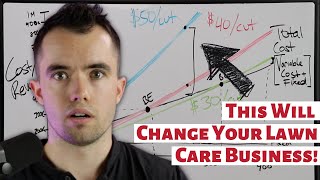
Mike Andes breaks down why lawn care businesses charging $50 per cut make more money than those charging $30, even with fewer customers. Higher prices mean lower break-even points and bigger profit margins, while cheap pricing forces you to chase volume and risk burnout. Growing fixed costs can kill those gains if you're not careful.
Questions this video answers
MBA for Entrepreneurs online course, module 8.22.
$100,000 (fixed cost baseline).
About 200 lawns.
About 50 lawns and roughly $150,000 in annual revenue.
About 320 lawns and roughly $450,000 in annual revenue.
Chapters
Hey everyone, it's Mike Andes from landscapebusinesscorch.com and today I'm gonna make a video that I actually feel extremely important. Probably one of the most fundamentally important videos I've ever made for this channel. So please stick around. Whether you're just getting started or you're already millions of dollars revenue, this is gonna be very helpful today. And I'm actually using a piece of what I teach in the MBA for Entrepreneurs online course. So if you look in the link in the description, you'll see a link to the course. Feel free to buy it. The price is going up after Black Friday, but this is kind of one lesson. It's actually 8.22 module 8.22 that I'm gonna be taking from and applying directly to the lawn care landscaping industry and talking about how your pricing affects your break even point and your profit margin. If that means nothing to you, don't worry. I'm gonna explain, I'm gonna use a graph here to explain this. And if you're like, I, I don't like grass, I just mow grass. Well, you gotta know your numbers and that's gonna be how you make a successful business. I'm gonna try to make it as simple as possible, but I hope this is branded in your mind. And I know I made a video several weeks ago about supply and demand curves, which is also inside the MBA course. And a lot of you said that was very helpful to kind of break down a very complex topic and make it simple. So I'm gonna try to do the same thing here and stick along. You know, watch this maybe twice. But I promise you this will be very helpful as you determine your pricing strategy and you grow your business. And you're gonna understand why you might not be making money yet in your business. And hopefully it'll keep you engaged in the game of business long enough to actually start making profit. Cause there is a point when you're actually gonna be losing money in your business when you first start out. So let me explain the graph and what is on the x and the y axis? So x axis, Y axis. So over here we have costs and revenue. Okay, so over here we have a million dollar business up at the top, all the way down to $100,000 business. So just getting started all the way up to a million dollar per year in annual revenue on the bottom here. For the sake of this example, I'm using number of lawns, but you could use any number of units that your business produces. Whether you're producing widgets or phones or cars. Like this graph is universally accepted for break evens and pricing strategy. So but we're using number of lawns and I'm going to also assume again very generalized numbers when it comes to the cost per cut for your lawn. So a lot of this is generalizations, but you're going to get the point. And that's all that I really care about today. So on the bottom here at $100,000, I have that as our fixed cost. These are things like the space you need to operate your business out of, maybe you got a couple acres next to your house, you purchase that, you have a loan on that and that's fixed, a fixed expense. You have some insurance, you might have some loans that you bought your initial equipment for. Whatever it is, these are fixed costs. Doesn't matter how big your business gets or whether you don't do much revenue or not. Fixed expenses. Here we have total cost, which is variable cost plus fixed. That's why it starts from where the fixed cost is. Here it doesn't start at zero because a fixed cost is. It doesn't matter if you have zero lawns, you, you're still gonna be paying your fixed costs. But as you get more lawns, you're gonna have more variable costs cause you get employees and more trucks and do advertising and all the rest of it. So as your business grows and you get more lawns, you're gonna also have a growing amount of variable cost and therefore your total cost is going to rise. So that's what this angle is right here. So don't feel overwhelmed. Watch this again if that doesn't make sense. But let me walk you through this. What I wanna exemplify today is just how important your pricing is, what when it comes to actually making money in your business. So we're gonna do a few different examples. The first example is gonna be that we price our lawns, let's just say on average $40. Alright? So $40 for our lawns is what we're gonna price. Now let me just draw the line out here. Hopefully we can make this work. There we go. This is supposed to be straight. So let me just try to correct this real quick. Boom. Yeah, just not great drawing skills. But hey, you get the point. So red line right here. So the red line is going to be that using the red line we are at $40 per cut. That's our price, same number of lawns. So as we get more lawns, this is gonna be our price. It'll be our price is $40 per cut. What that means is that right at this point right here is gonna be our break even point. Right when we cross our total cost, this is our, our break even point. Assuming $40 were cut. So about just for the approximation sake, when we get 200 lawns at a $40 per cut price, that is when we're gonna break even on this business. If our average cut is $40 and we get 200 lawns, that is when we're gonna break even. Okay, now I wanna go now. What happens if we change the average price of the cut? We keep everything the same. We keep our wages the same, we keep our fixed costs the same, everything the same. But Instead of charging $40 for the cut, we have a premium price product and we're going to charge the customer $50. Well, what that does now I'm gonna use the blue here is it increases the.
Scale of this, drawing this line here. So now with this blue line, this is gonna be at $50 per cut. We've raised our prices. So now what that does is it moves our break even point over all the way back to here. So this is our break even point way back here. And this is why you got some people that are solo operators making a decent profit because. And they only have like 50 lawns. Look at this. This person only has 50 lawns. They're doing like $150,000 in annual revenue and that's their break even point. Whereas our first guy, he had a $40 cut. So let me just write this up here. So this is $50 per cut. So premium price, $50 per cut. This person might have a website, have uniforms, have a painted truck. So therefore they're able to get a higher price per cut from the customer because they raised the value of their service. So because of that, their break even or when they stop losing money and start making Money is at 150,000 revenue and only 50 lawns. This is like a solo operator. They're able to make 10, $15,000 a month by themselves working in the field, doing 50, 60 lawns. And they make pretty good money. Alright, now let's go over to our first guy. He had to do 200 lawns. And just for the sake of this example, he had to do like $300,000 in revenue just to break even. Okay, so now the question is, okay, well, I'm going to have a $50 cut. How much more would I make in profit when I get to 250 lawns if I have $50 cut instead of $40 cut? Well, let's do the math. Okay? So maybe in year three, okay, we're at 250 lawns, okay? Let's just do the dotted line up to here. Boom. So our first point is gonna be here. And then we go up, up, up, up, up, up, up, up, up, all the way to here. And there's another point. So this is what's gonna happen If I have 250 lawns, all right, And I'm using a doll price.
Now, this is going to be my profit margin right here. This is my profit margin. This from here down is my total cost, okay? If I'm pricing at $40 per cut, this is my total cost, and this is going to be my profit. Very low profit margins, okay? Out of, let's just say probably 350,000 in total cost, I have maybe $420,000 in total revenue. So therefore, my profit is probably $70,000, okay? That's my difference. The difference above this total cost and where my revenue is at is my profit margin. Now compare that to what it looks like. If I'm at $50 per cut, this angle here, I'm going to still have 250 lawns, but now look at where my cost is. The difference in my profit is massive. I'm running like a 50% margin business. I'm probably doing 130, 140, $150,000 at least in profit. This is not necessary to scale, but let's just say, for example, probably $300,000 in profit, just massively more profitable simply because I have a $50 cut instead of a $40 cut. Now, let's erase these markings real quick, and I'm going to show you what happens when we have a $30 cut. And again, these numbers that I'm using are just subjective, and it's just to show medium, low, and high pricing. It's not to say that these prices per cut are wrong or right or what you should be using in your market. So let's draw though another pricing method. This is gonna be the low cost method. This is gonna be someone that comes in and just wants to get a whole bunch of lawns, and they're gonna be the cheapest price in town. So what we're gonna do is we're gonna draw another line here. We're gonna go like this. Boom, bam. Okay, now this green line is going to be $30 per cut. Hopefully you can see that green, $30 per cut. Now, what we've done, because we've lowered our price, it's literally Going to take us all the way to like 300, let's just say like 320, break 320 lawns and like $450,000 in revenue before we actually ever break even. Okay, so what I'm showing right now is the importance of having a higher price, a premium price, which is going to allow you to do several things. First of all, it's gonna get you profitable faster. The number one reason why people in the lawn care landscaping industry fail or they quit, I should say, and they give up is because it takes them too long to get to break even. This person had to get 320 lawns and literally do over half a million in revenue before they ever actually made a single penny. And if that took them two, three, four, five years, most of us get discouraged, most of us want to give up, most of us want to go get a 9 to 5 job where we get a stable income for our family and provide simply because all of this line all along here, having hundreds of customers, this person has 200 customers and they're losing money. They have 250 still losing money. It's not until they're above 300 customers where they even make a profit. And literally they can have 4, 400 customers, 400 customers and look how small their profit margin's going to be. Very small profit margins, that can be very discouraging, having to wait that long to hit breakeven and you're not making any money, you're losing money every single year. And so if you have a higher price, you don't need as many customers and you don't need as much time, you don't need as long of a Runway to actually hit profitability. A couple problems I see so often in the landscaping industry I want to explain on here. First thing I've already mentioned that is I see pricing as too low, which causes burnout or bankruptcy before break even. So all of this time I'm burning money, burning money because I'm below my total cost. It's not until right here and beyond that I actually start making profit. So what's happening here? I'm burning through my cash reserves, I'm getting loans. That's horrible. That's what keeps a lot of people from ever getting to profitability is simply because they're pricing so low that they never actually get to becoming profitable. Alright, the second thing, second problem I see so oftentimes is something that's inferred in this example that might not be true. And this is for those of you who have already Started a big business, you might be already 3 or 400 lawns or 8, 900,000 in revenue. This is what you got to be careful of. You got to be careful that this fixed expense line doesn't also grow. Because if you start shifting as you grow your business, this fixed expense starts going up. We go build a big shop, we get nicer trucks, we get more debt, we get bigger equipment and we get more and more. And then our payment's starting getting bigger. And because of that bigger equipment, our insurance starts to get more. If your fixed expenses grow, your total cost is also going to go up. So if you're growing this way, I've assumed that we're going to stay at the same property. We're not going to get a bunch of loans, a bunch of debt. This is where I get concerned. Why people increase their fixed expenses as their business grows. They get a bunch of loans on equipment and trucks, they go out and get a bunch of space and build a big shop and get a bunch of office staff, all overhead, all fixed expenses right here. And that's why they never actually get to break even. Or a highly profitable business because they move this fixed expense line item up as they grow their business. So instead of it being flat, the fixed expenses is actually angled. And that can be very detrimental. And people can be growing into oblivion and never become profitable or profitable enough simply because they keep adding loans and fixed expenses to their balance sheet. The third thing I want to keep you, want you to keep in mind is that loans, low prices equals low profits, and low profits lock you as the owner into operations indefinitely. So when you grow your business, this guy over here, he could be doing 8, 900,000 in revenue, but because his profit margin is like 8, 9, 10%, he's only making like 70, $80,000 in profit. That owner will never be able to get out of the business because they're not going to be able to afford a manager to take off their daily, take daily operations off of their plate. So if you're in the place right now where you are having very low margins and you've grown a big business man, I'm doing 7, 8, 900,000, I'm doing a million, $2 million in revenue, but I'm doing the estimate still. I'm everyday working 12, 14 hours in the business. I'm out on projects still moving materials from job site to job site. I'm still trying to hire and figure out marketing. You're trying to do all of that. You've got to realize that ra Raising your prices is an extremely fast way to solve this whole problem. This $30 cut guy could simply raise his prices. And by doing so, he's gonna bring this up this way, and by bringing this up this way, he's gonna move his breakeven down and he's gonna increase his profit margins. And by having a wider profit margin, like we talked about with this guy here, where he's at like 50% margin here, when you have that, you can afford to go get a manager, you can afford to hire other people to take off things off your plate. So you as an owner at 800-900-A million million plus in revenue, don't have to be there every day. You can go start another location, you can go start investing. But this is extremely important. Pricing is extremely important to your profitability, to your break even, to make sure you can actually get past the point of losing money. And this is why, this is why I see small lawn care businesses, small independent solo operators, sometimes making more profit, bottom line profit, than companies that are doing hundreds of lawns and hundreds of thousands of dollars in revenue is because their pricing is where it needs to be at. And if you're wondering, well, how do I increase my prices? Well, maybe you are so far below in your prices that you just need to raise them and lose some of your customers, that's fine. I'm not interested in building a massive business with a bunch of employees, a bunch of trucks and a tiny profit margin. I'd much rather have a smaller business, less lawns, less overhead, but higher prices to the point where I make a better profit margin. I'd much rather be the Whole Foods of the lawn care industry than the Walmart. At Walmart, they get 1 to 2% profit on everything that is purchased. Why? Because they focus on volume. They've got to move tons of product out the door. They're going to get like 1 to 2% profit, whereas Whole Foods might get 5 to 10% profit margin. They're not going to do as much volume. They're not going to be able to send, you know, have thousands and thousands of locations. They're much smaller footprint, the size of their buildings are smaller. They don't have massive warehouses, but they actually get more profit per customer because they have a higher price. They're not trying to compete on price, they're competing on value. When you walk in the store, there's really nice paintings and there's art and the employees are more friendly and they're trained to be more around the customers and give you more help. What is that? It's a matter of that they are no longer competing on price, they're competing on quality. If you can compete on quality quality, it allows you to raise price and be profitable faster. So if you're in your second, third, fourth year of business and you're still losing money, there's a very good chance that you've either starting to inflate your fixed expenses as you've grown or your pricing is so low and you need to raise it in order to have a sustainable profit margin. It is not sustainable to have an under 10% profit margin in this business. If you're under 10%, in my mind, your volume, you want to be over 15% and that's going to take some time to get there. Don't expect that in your first year. Even this solo operator guy, there was a period of time where he was putting all his money back in the business. He was under break even. But the faster you can get above break even and start making profit, that profit can be put back into the business and scale much, much faster. I hope that was helpful. If this kind of analysis is super helpful for you, the MBA course might be helpful. Landscapebusinesscourse.com might be helpful. Or come to the conference in person this coming January Landscape Summit. Just go to landscapebusinesscourse.com conference. It's three days, the 13th, 14th and 15th of January 2022, in person. I'm going to be there all three days and I really look forward to teaching these type of concepts in depth and getting your questions and answering those. Then we'll see you there. Thanks so much and happy Thanksgiving.









