How Great Founders Choose What to Ignore
In this podcast episode, Mike Andes and Jonathan Patosnik explore how founders can cut through the noise of daily "paper cuts" to focus on the single constraint that will move their business forward. They discuss the concept of "seasons" in a business – using current frustrations, market timing (e.g., fertilization/weed‑control season), and data signals to identify the most urgent priority. Jonathan explains why he has dedicated his time exclusively to marketing for City Turf, describing how marketing is the only lever that can sustain growth given the company’s churn and lead volume. The conversation delves into practical frameworks: defining what success looks like versus merely completing a task, applying a "good‑enough" mindset, and using 6‑week sprints to force regular reassessment of the biggest constraint. Mike shares how he leverages AI to surface the biggest domino effect among a long to‑do list, and both discuss the importance of clear, detailed specifications (offers, pricing, risk reversal) when launching new services such as pest‑control marketing. They also touch on leadership signaling – the founder’s focus becomes a north‑star for the whole organization – and the tension between perfection and speed. Throughout, concrete examples from City Turf, HomeWorks, Augusta, and a Texas field‑trip illustrate how they prioritize, plan, and execute initiatives while avoiding the trap of trying to fix everything at once.
Chapters
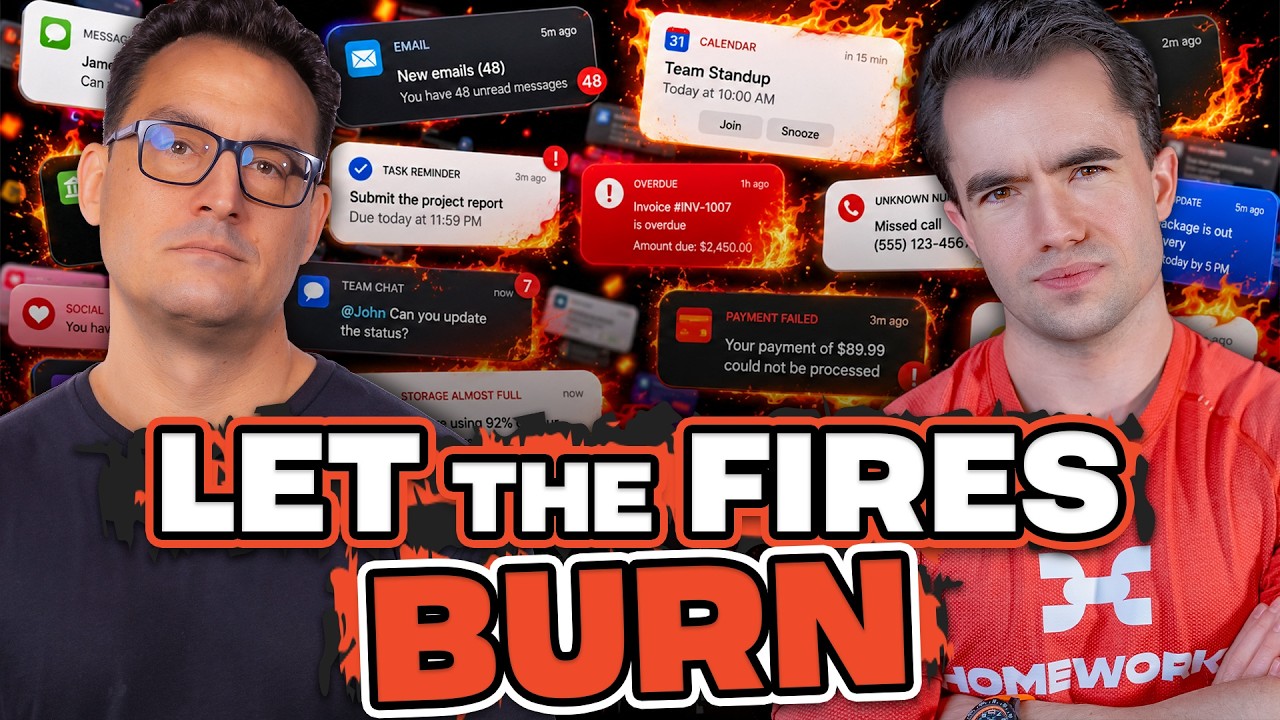
One of the sayings that I used to say is, we have to let the fires burn. That's the saying I had to say to myself, and it just— everything about it feels wrong.
How do they stay disciplined to the thing that you know is the major constraint, but every single day they're being pulled towards the distractions of the 100 paper cuts that are happening in the organization?
You can't be perfect, and your, your team members can't be perfect.
And so It's impossible.
We can't do it all. We have to pick our battles.
I talked to, talked to AI a lot earlier this year about like frustrations I had with the franchise, frustrations I had with the software, frustrations I had with the media. And the Texas project was actually one of those things that was like, you need undeniable proof and you need to stop talking and go do it. Decision-making is the highest leverage activity you can do for the business. Like, where are we spending resources? Where are we spending time? And taking shots on goal that miss can cost months of time, hundreds of thousands of dollars worth of payroll, equipment, like people get inspired, like, I'm gonna buy this piece of equipment, or I'm gonna add this service. And it's like, you took a year and you messed that up. Hey everyone, welcome back to another episode. Jonathan Patosnik. Oh, I got the— I got the right hand. I got the right hand. Let's go. Welcome back. Jonathan's been out of town, but we are back in studio for another podcast. And today we're gonna go deep on a topic around focus. And if you've listened to other podcasts, our podcast, books, other entrepreneurs, you've probably heard people talk about how important it is to focus on the constraint of the business, and be laser-like focused on one thing, not be scattered. But we want to talk about specifically for our businesses what that is actually meaning right now and what we're working on, but more importantly, why we're working on that thing compared to the other 98 fires that are happening inside the business. And our hope today is that in your own business, you're not going to have the same exact things you're working on, but hopefully it gives you a decision-making framework by which you're able to look at all the issues in your business and determine which is the thing that I'm supposed to focus on right now. That'll have the biggest impact on the organization for you as the founder. So we're gonna do 2 each. I'm gonna start off with Jonathan. Uh, go ahead and just tell us what you're working on now and more specifically how you've made, come to the conclusion that this is the thing that you should be focused on as the founder.
Okay. So sort of top level, I think this rolls right into what you just said. If you look at what I'm working on, it's all exclusively marketing for City Turf. And so that would maybe be the first example. In fact, where I'm sitting right now is where I normally— this desk is standing, but this is where I am all day, every day. I don't go to City Turf. I was there actually today. I just got back, but that was for a meeting. But otherwise I never go to City Turf because if I go to City Turf, I will see all the opportunities and I will have all kinds of conversations. And so it's best for me from a focus standpoint, like how do you knock things out to just be here and go. And so first and foremost, I won't let myself do anything other than marketing. So you're going to hear a bunch of that today. That day will eventually come to an end. I will move on to something else, but for a season, it's only marketing.
Anytime, just for context, whenever I send you a message in the background, I can always hear the walking treadmill.
And oh yeah, yeah, yeah.
So I know you're standing right there.
Yep. Yep. I just roll it under my desk and I walk.
Yep.
Let's go. So, um, anyway, so that's like the first Frame of like how are you being focused? Okay, so I think that's an important one. Maybe the way you would apply that in your business is there are seasons. Like so what what season are we in right now? Now what might define the season? What defines the season is like what's the problem? I I know we've probably both said this, but the frame I love is and and I hear myself thinking this kind of stuff. Like what am I frustrated about? What am I kind of whining about to myself in my head? You know, what are those things that are frustrating me about the business or something? Well, that to me is one of the top-level clues as to what I should be working on, which would define the season that I'm in. Another top-level clue would be what literal season is it that we're in? So if we are, we'll use the green industry. So if I know that fertilization, weed control season is coming soon, That's going to define what initiatives need to happen X number of months in advance to be ready to go when the market's ready to go. So that's how I, that's like a top-level way I think about it. So what is the most important next thing to knock down and do? And that's the season you're in. So as I looked at my, uh, Mike came up with this topic and as I was looking at my Trello board of all the things that has my name on it. That means I'm some way involved in it. There was a very obvious theme and the theme was copy. So I'm gonna kind of talk in my first— I have a really big example for you second. My first example, I'm gonna give you 2 small things, but I'm gonna talk through how I think about stuff. And Mike and I'll kind of talk through back and forth, but how do I think about what is the priority? So looking at my Trello board, it's copy. It doesn't have to be. Somebody else could do that. So I'm gonna kind of talk through why. It's copy for me right now. Copy just means the words on the page to sell. Okay. And then the other thing that you'll see, if you look at my Trello board where things are bottlenecked behind me, which is a lot, it's vision. So stuff where I have the vision for the task. Now I'll also tell you that doesn't have to be bottlenecked on me as well. So I think In this conversation, my guess is you're going to see Mike is living at a higher level than I'm living. If you had known me back in my Service Autopilot days, I was living at a very high level. Now I'm not. And I will show— I'm going to talk through this, but I'm going to slowly get back to living at a very high level, meaning where I'm doing very high-level things. What you'll notice is I'm doing what I think are very important things, but frankly, I could write a check, just get Every single one of the things I'm doing off my plate, and I'll kind of tell you why I'm not doing that as we go. Okay, so kind of starting at the top, the the what I think about when I'm trying to decide what should I be working on? To me, the top level thing is what to do. Like so, what should we be doing in the organization? What should we be doing in the department? So you may have a little small business, and it maybe it's you and. A couple trucks, but still think about your business as departments. Like, so you've got a marketing department, it's probably you. You've got an HR department, probably you. You got to sell, you know, you could kind of, you're kind of everybody right now, but they are still departments. And so what, what to do is defined by what I talked about earlier, but also what departments need the most focus right now. And I have concluded in the CitiTurf business, If we don't get marketing moving in a serious way, this business is done growing. We're growing and we've been growing. The team can probably not get our churn much lower. So like, if they, they would, they're just, they can do whatever they come up with and they're just not gonna make the company much better from the standpoint of preventing churn. They can make it a little better, but it'll have almost no impact on the business. And so, the only other level we have right now to get this business going is more growth. The other problem we have is imagine, like, we have almost 12,000 clients. So, if you just think about natural churn that happens in a 12,000-client business, we have tons of leads compared to almost everybody listening to this. I got way more leads than you have. I close way more clients than you have. And the reason I say it that way is to be dramatic. Like, I have lots of leads, But I also have 12,000 clients and some percentage of them are churning and I got to replace them.
That's the title for your next YouTube video. I lost 1,000 customers last year. That'd be a great title.
That would be, and it'd be, it'd be 100% legit too. So, you know, but that's, that's a little, little, we're getting a little outside of the theme of this, but I do want to make the point that is the top level, most important. Nothing else matters in the business. Bang. Like, there's nothing else that matters if— because nobody else can do anything to make the business better. Nobody can become better at what they do. We can't replace anybody on our team and hire somebody new that can fix it when it comes to operations. It just can't be fixed there. It can only be fixed on marketing. So again, why do I sit at this desk all day and only work on this and not go to City Turf? Because that is the only thing that matters. It's a massive undertaking. Okay, so First question I always say to myself: What to do? Like that's your job as well. Like what do? What is the most important thing to do in the business at this moment in time that will get the business to wherever you need it to go based on whatever problem or opportunity you have? Okay. Now, the what to do will change. Like right now, my what to do is I should be working on marketing. But that that's the what to do in the business. But what should Jonathan do is the marketing. What I alluded to earlier, it doesn't really have to be that way though, because I could just go spend $170,000 and solve this problem tomorrow. But I also know, just to give a little context here, that, and this is a little bit again in the weeds, but I think important to think about as you're building your thing. What am I uniquely suited to do? I'm uniquely suited to do marketing. What do I most like doing? I like doing marketing. Like, so a couple of things have converged here where They're what I'm good at. I know more than most people. I mean, it doesn't— it sounds— I don't mean as bragging, but I've had so much exposure to so many people in the industry. I've done this for so long that I have chosen not to spend $170,000 a year and do some of this for myself for a period of time. And I do want to talk through this because I think it's important as you think about your business. The reason I make this decision is because This is what I like. This is what I'm good at. And right now I am setting the example for everything that will follow in the future when I do bring in a marketing leader. How do we talk to our clients? What's the voice of the business? What is the look of the business? How do we make offers? Where do we not push too hard using certain technologies like texting or outbound sales or voice blasts or hard sell copy that like works in the moment?
Door knocking.
Door knocking. Yeah, yeah, yeah. You know, door knocking, like all the things. Like, so I'm setting the tone for when I bring in a future leader to run this, that they can sort of follow the template. It's kind of like you as a leader create the culture, and then that culture needs to get mimicked by your team. I think the most important side of a bit— one of the most important sides of the business is the sales and marketing. So I feel like I'm setting that, I'm building that. That's why I'm— I've got comfortable in my head that I'm gonna let myself do this. Now to you, you may say— you might— the reason I want to tell you all that context is this is how I've identified important, but also You might hear me say this and leave this conversation with Mike and I and think, oh, well, I should be doing that in my business, but maybe not. You may not love marketing. You may not have been to a bazillion seminars. You may not have read the marketing books I've read. You may not have the experience doing it I have. And I'm not saying I'm— I've just got so much to learn, but I— you may not even like it. Okay. So you shouldn't be doing it. You should find somebody to do it. So I wanted to be very clear. Don't copy me. I'm just giving you how I think about this. If we were having a conversation about the single biggest problem in City Turf being an operational problem, I'm going to hire that solution out. Jonathan shouldn't be doing it. Jonathan could have input. I can give insight. I can work as a team, but there needs to be somebody else better than me who loves that thing and will think about it every moment doing it. So really important context to know who you are, what you like. And in my case, this is what I like and this is what I'm good at. That's why I'm doing it. Don't copy it. But that's how I think about it. So first, what should we be doing inside the org organization? And then what should I be doing? That's like my first question, right? And then here's maybe one of the single biggest points I want to make that we'll talk about today. So the other thing that is my job or your job is what does success look like? And what does completion look like? So as an example, my job is to say, what should we do? Some people will call that the vision. Some people will call it the strategy. My job is to take all the information and say, this is the most important thing for us to be doing at this moment. Now, within that, there are a bazillion projects that have to get executed on. So for each of those projects that will achieve the outcome we want, the what we're going to do, I have to decide What are the most important projects? Or I can work with the team, but what does success look like in this project? Or when you're completing this thing? And this is where I think almost everything falls apart for most companies. And I, and so I want to give a little context here and give a couple examples because this is your job as well. Now, again, remember what I said a moment ago? If you have higher level people, you may not be doing much of this as a job. So if I had a CMO, then this— and the CMO had already built a company of my size and bigger. They could probably come in and say, these are the most important initiatives. This is what done looks like, completion looks like, success looks like. They could take this off my plate, but I haven't hired that person yet. Okay. All right. So here's what I think most of us do and why we're frustrated with our business. I sure know it's my, my situation at times. We say we need to do this thing and we tell somebody to do that thing. So my example would be something that's been going on for a long time. In Citi turf is I would say, I need this on the, on the ops side of the business, tons of data. We could tell you all kinds of things about the business on the rev gen side or the sales and marketing side. Data is almost nonexistent. So we've been building all the data so that we can make decisions. So I can say to my team, hey, we need, we need, I need key data delivered to me on a monthly basis. So I know if the marketing is working. And I can assure you, I will be disappointed with what I get if that's what I say to them. And I think this is what a lot of us do. We like, we kind of imagine the problem. We understand how to solve the problem, kind of. And then we lightly communicate to other people what we want, but it's— there's no detail, there's no context, there's no why. And what we get back is lousy or it takes forever to get it. And so my example here and what I believe, and kind of think back to Mike and I have talked about this, I put together this calendar and this task list. So a big part of defining, and I actually, uh, to go with this, I'm recording, it'll be out the same time. You'll, it's out now when you're watching this video, I'm recording a video to walk you through those 2 things. Because Mike mentioned that there was a positive response. And so I'm going to show you these in action. So go to Five for 50 and you'll see them. But for every task, I have to define what the outcome looks like. So if I say I need this data, I have to record Loom videos and literally write up exactly what the finished product looks like. So let's use data. I could just say, hey, David, he's on my team, give me this monthly report of all our key data. But he, he, that doesn't tell him what data I actually care about. He could produce lots of data that I'm now going to pay him and other people to produce from now on that we'll never actually use. He probably doesn't know where the data lives. I mean, he might, depending on how long he's been in the company, but who knows where all the data is stored? It could be, in our case, Service Autopilot. It could be another system. It could be accounting. Who knows where it's stored? It could be spreadsheets. He doesn't necessarily know what all the data means. He doesn't know what reports to pull. He doesn't know where to store the data. He doesn't know how it's going to be used. There's like— he needs all that context. So I know a lot, I'm giving you a lot of information here, but I think this is the crux of why most initiatives fail inside companies where we get frustrated that we're not making progress and why can't this other person perform? We didn't give them what we needed to give them. And so that is my job. That is the leader's job. So I have to figure out what we're gonna do. And then if I'm gonna come up with what we're gonna do, I literally have to define what done and success looks like. That is an incredible amount of work. And, and that is to a large degree what inspired me to make my master task list that Mike and I have talked about, because I needed to give the organization, this is the order of priorities unless someone else, you know, together we decide differently. And this is what you have to do to get to these outcomes. Okay.
All right.
I got 2.
I got some questions.
Good. Good. Perfect. I feel like I've been talking.
You're good. All right. So first question is, I think the bigger the businesses have got, they're, I consider it a target-rich environment. Whenever, to your point, you walk into city turf, you're like, I could fix this and this and this and this. How do you, when you have a slightly smaller business where you are there, you are present, you are seeing all the problems, but yet you know that's not the thing you should be focused on. In your case, you're removing yourself physically. Like, I will not go there. I will stay walking on this treadmill.
Yeah.
And I will stay at home. But for the person that is around it, how do they stay disciplined to the thing that you know is the major constraint, but every single day they're being pulled towards the distractions of the 100 paper cuts that are happening in the organization?
Yeah. Uh, one of the sayings that I used to say is we have to let the fires burn. And that's a saying I had to say to myself. And it's, it's, it just, everything about it feels wrong. Yeah. So, you know, something's wrong. You know that the client's upset. And it doesn't mean you ignore the client.
Or team members. Or team members.
Or team members are upset. And the bigger the— and I know we're talking small, but the bigger the business gets, I promise you, everybody will have a different opinion on what's the priority. Everybody will have a different opinion on what will work, and everybody will have different hindsight on what should have been done. I promise there's no getting around it. So you're fighting. You will never not fight this where there's lots of opinions. And that comes back to your job and the leadership's job. Whether you're 2 people, you and one person out in the field who's saying this is an issue, or it's 1,000 people, this will always be a challenge. And that's somebody, the person that's willing to take on the responsibility, it's their job to make the very best call they can with the information they have about what will move the needle most in the business, whether it be grow the business or fix, improve and fix the business and reduce churn and increase client satisfaction. So The knowing what to do is actually really hard because that's why you— I've read books. That's why I've gone to conferences. That's why I've been in business groups. That's why I've done all the things, because I didn't know. I still don't always know, and you're going to get it wrong. And so you're often taking your best guess, but you're also trying to talk to other people and see what, you know, you get the advice of others ahead of you. And, and then once you make a decision and you need to just make the decision I've learned and stick with it and see it through until new information presents itself that says, no, no, we're going down the wrong road. This is not actually even important. But once you decide this is the thing, you're still going to be bombarded with other frustrations and disappointments and problems. And you deal with, like, if it's a client, I'm going to deal with it in the kindest possible way and make it right with the client, but I may not fix the root problem. And that's where I say. Let the fire burn because there's something else more important. Because if you jump to that thing, you will literally never move the company forward. You will just jump from day to day. And I think an operational process person tends to have a harder time with this than more of a sales-driven visionary person. I've just observed that the sales just, and you should know who you are, the salesperson visionary person. for many of them, it's almost like Groundhog Day in a sense. Like, what I mean by that is you're really frustrated, you're upset, you go to bed, tomorrow it's a new day. It's like total reset.
Yeah.
Like, it's all been cleared. It's like your brain did a reset overnight and like, oh, that wasn't as bad as it felt yesterday. And you can, you know, whereas sometimes a process person will really struggle jumping I'm combining 2 things, but they'll really struggle letting these problems live out there. And so you kind of need to know who you are and say, again, I like the statement, let the fire burn. Don't be crazy about it. It's not an excuse to not go all in and build, but that's, that's one of the most important things. I don't think I fully went deep enough or fully answered the question, but that's, that's really important to understand. You can't be perfect. And your, your team members. Can't be perfect. And so it, it's impossible. We can't do it all. We have to pick our battles. And, and that's the inspiration of this whole, uh, conversation here is like, how do you pick those battles? And then what are examples of the battles that we've picked?
Yeah. And I would say like, as the businesses grow, you can almost expect there to be this to become a harder problem to solve because there's more stakeholders. So you have more customers, you have more managers, you have departments. You might have branches, you might have locations, and it's all vying, and each of them have their problems, and they have to kind of vie for resources. They have to vie for your time. And to one person, a calamity or a very urgent issue means nothing to someone else. So you fixing it doesn't help this person, but to this person, it's very important. And this has become really apparent for me, like when the owners of Augusta, for certain climates, like I need to solve snow, okay? I need to solve fertilization weed control. And like, I might spend 6 months focusing on one thing and it feels like this person feels somewhat abandoned 'cause I'm not pouring energy in towards something that is useful to them. And it's very, that's the challenging part is like, which is the most highest priority? How's it going to affect everybody, all stakeholders, whether it be customers, whether it be departments, whether it be management? And so that was my first question. I think it was well answered. Second question, one thing that I've always—
Can I say one more thing?
Go ahead.
This is where, you know, like you talk about data a lot, we talk about data. This is where data can really also help you. So just to kind of pile on what you said, because it can give you confidence. So much of what we do, if we don't have data, is I feel like— those words, you've probably used those words— I feel like, I think. And the example I would use is if I was put on the phone at City Turf in customer service, I would have a totally different frame on what the biggest problem in the business is because I might have people complaining about who knows what. But if I get like 5 of these really, really angry complaint calls every 2 weeks, to me, it feels— I remember those. I don't remember all the good ones. So, it feels like the worst stuff. So, that's what I'm going to voice to the leadership. But then, if leadership has some data, they're like, I mean, these clients only spend $82 a year with us. Like, are we really going to optimize the business for them and fix this thing for them? That's where data can tell you what the real priority is. But So I just wanted to, I'd give one more plug for why data matters. Yeah.
So sorry, go on to, I wanted to build, I wanted to build or, or kind of like, uh, double-click on one thing you said, that's success versus completion. That's how I wrote it down here.
Okay.
And the reason I wanna double-click on it, cuz I, I can argue 2 POVs on this, and that is when is good good enough?
Mm-hmm.
And for example, I have an initiative, there's something I'm working on. Do I spend a month getting it to 98% and be like, hey, it is good enough, and realizing that I can get way more accomplished in the business by moving on to the next thing and being okay with 98%? Now, take that aside. I've also heard, I'm kind of taking like devil's advocate perspective, where you say it's all in the details of that last 1% that makes it extraordinary. Similarly to the Olympian that is first place versus third place, similar amounts of effort. One person we know their name, the other person we don't even know who they are.
Yeah.
So when is it the chance, or just even speak to the decision-making framework of, hey, my marketing is good enough and now I'm moving on to the next thing and I can do that at a faster rate if I'm okay with a lower degree of error, or I should say lower degree of perfection. When is speed versus getting the details all the way to that final 1 or 2% really worth it? Is there any sort of thing you can say to that?
I can, but I don't know if I can give you a rule. I can give you my general belief, and my general belief is good is good enough and speed is what matters. And you can always come back for V2. Uh, now I'll tell you, if you were a Service Autopilot client, sometimes we didn't make it back to V2. I didn't even catch it.
I didn't even catch it.
John and I have joked about that. It's like, because this is like, that's the thing going through my mind when you're talking. It's like, yeah, good was good enough oftentimes, but sometimes, dang, if those guys had just got a little further. But, but I think on the whole, for most of us, it's the good is good enough because that perfection just doesn't generally return dividends that make it worth it. And also, I'll be frank. I mean, this sounds, I don't, This isn't the Olympics and the bar of competition isn't Olympic level, right? Like, like most of our problems are, could you just actually write the email and send it?
Yeah.
Could you just actually return the call for the, get the estimate turned around? Like most of it's like just that. So half of this game is just showing up and most people just don't even show up. So I would think about it more in layers. Like the first layer is good is good enough. Just like make it pretty good. I just don't know how to give you the bar for what that means to give you a rule. And then you come back around and you say, okay, well, it's like a re— it's a constant reassessment of what's working, what's not working, what are the initiatives? And then you come back around and make a second pass at the thing. That's more how I tend to think about approaching things when I think about the massive It's just, it's a lot to think about everything that has to get done at City Turf on the sales and marketing side. It's a massive, massive initiative that I even underestimated coming into this. And I'm very much in the good is good enough right now. I'm trying to do pretty good, but I will find out what's working and then I will come back and spend time on what's working. And there may be some things that are not working where I'm like, I'm just convinced if we spent more time on it, this could perform. So I'll make that bet and other things that just, I thought they were great ideas and they're not performing, I'll cut 'em. Like, I think that's the fastest way to proceed through this.
Yeah. Like, I think one of the things I've found for myself and others is sometimes putting something down that is important when it is at 90, 95% and realizing it, I get more bang for my buck, i.e., my time when I move on to the next constraint versus trying to push it all the way to 99, 100. Like, that's the perfectionist. And I think in some people it holds them back from growing. Yeah. Because they never move on to the next But even for us, like when we were working the first 5 months of this year, we were all focused on traffic around AEO and SEO. Like we'd tons of time on it.
Yeah.
And I had to like put that down as much as I wanna keep squeezing on it. And the thing is too, you get reinforced for the improvements. It's like, oh my word, it's working. But then you have to set it down. Like it's no longer the main constraint. We have to focus on conversion now.
Yeah.
And we have to focus on the copy. And like we have to let it go and maybe it'll become the biggest constraint down the road, but it's no longer the biggest constraint. And I have to let that fire burn and then let 98, 95% be good enough. And, um, go ahead.
Do you have any way, you know, I, I don't know how to put a rule to this is when good is good enough and we need to move on. Do you have any framework for that or a way that you would advise people, or is it just a gut feeling?
I've always just used 6-week sprints as a way to announce, to, to kind of look at and see what is the biggest constraint. And that's the part that's the hardest, like identifying what is. But then every 6 weeks when I look at what I've currently done, is it still the biggest constraint? If not, that is a good sign that I need to put it down. And traditionally when I plan my 6-week sprints, I try to make sure that I can complete a task in the 6 weeks, but it's a good forcing function to say you can only get so far in 6 weeks. And then you kind of have to like, there's very few projects where I'm like, okay, I need to do another sprint on this because it's still the biggest constraint. It's not good enough yet. Uh, but that's been a helpful thing for me to reassess. Is this still the biggest constraint or have I just got so close to the problem that it becomes this, to your point, you get on the phone and now this becomes a big problem and I'm in there fixing and making solutions when it's like, let's step back and is this still, or have you got it 90% of the way there and we should step back and reassess? So this actually, this 6-week thing has helped me a lot.
I think that's a fantastic, I wish that's the answer I had given. I think that's a great answer. I think. You know, I don't do that now cuz I'm out of the Service Autopilot world, but Service Autopilot ran as sprints, not just in development, but throughout the organization. That's how marketing ran too. And so that is a perfect way to frame it, whether they're 2 weeks or 6 weeks or whatever the case is. And then just, not everybody does it this way, but oftentimes with a sprint at the end, there's what's called a demo. You demo the work to what are called stakeholders in the business, or stakeholder would've been Jonathan had this vision. He defined the project. And so he'd be a stakeholder and so it would get demoed and then that's when the stakeholders can say, good is good enough. This is good. The sprint way is a great way to box it so that it forces a moment in time when you say, have we gone far enough? So perfect.
Cool. All right. Do you want me to move on to my, the one, uh, I'm working on right now?
Yeah, let's do that.
All right. So, uh, we actually just finished a sprint, like, cuz it's now we're recording this, what, September 3rd? So I just finished a sprint and then that one, that was a big one, was like the MCP and calendar release at HomeWorks. So that's. That's been like all I've been thinking about. So it's actually, this is very top of mind what we're currently talking about because I just made my next sprint. So I'm currently working on the Texas trip. And so—
Oh, okay.
I know we talked a lot about that. And so what went into sort of my decision as to why this would be the thing I'd work on is first off, it's kind of time sensitive in that in 10 years, I'm probably not going to move across the country for 6 months, nor will Brianna want to. So it was somewhat just the fact that we have the flexibility, we don't have the kids in school, things like that that potentially down the road could happen. And I will probably not want to do that in 10 or 15 years from now. And so it was like, there's this window of time, we both want to do it. And so I think sometimes when it comes to decision-making or prioritizations, also like, what season of life am I in? And do I have the bandwidth for it now versus the future? And so that's one, Big, more on the personal side, why we chose it. But the other thing that I do when I do my 6-week sprint is I will— now I use AI, but before, a year ago, I didn't. And that was I would just take all my lists, and I use Trello too, keeping track of like all the things I want to get done. And I would— now I just dump that into AI and say, hey, what are these things that actually have a lot of crossover and would impact 10 of these other to-dos? And just looking for like the biggest domino.
Yep.
And when it comes to what do I do next, what do I focus on, a lot of times if you just if you focus on the biggest domino, the other 10 things you're, you're thinking about would get solved. And so for the Texas trip, it's one of those things where like it touches every single part of the businesses. So for Augusta, it's really trying to help the multi-unit owners and helping them with the leadership and the general managers and training them and hiring them and having a process to hand the location off to a general manager and being able to demonstrate that to them, document exactly what we did with location 1, location 2, how it handed off, how the regional manager got ramped up, what the compensation plan was, and just demonstrate it all. So for Augusta, it's very much around the multi-unit owners and giving them the support and really just testing, being able to scale very fast. Traditionally, when someone comes to Augusta, they are coming with $100,000 to $150,000. It's kind of like our average amount that someone's spending to get started. And I'm going to go into the market and probably spend $300,000 to $500,000 very quickly. And I have a video coming out with like what the budget is. So it's already spent $300,000. And so getting to a million within 6 months, 12 months max, what does that look like? What breaks? Where are the areas that there's friction in the system when you just, you like mathematically you have to get 20, 30 customers joining a day? So where does that break down when you're trying to scale that quickly? So for on Augusta's perspective, we're looking, looking at like even at Command Center, how do we have what we call dedicated agents? So instead of A phone call coming in and one of 87 people answering it, can we have it where for multi-unit owners, a call comes in and there's a group of 2 or 3 dedicated agents to be able to ensure that there's less back and forth? That's one of the, the challenges with Command Center is if you have 87 people answering the phone, a customer calls in 5 times throughout the day because there's a problem and they get 5 different people, there can be some dropped balls along there.
Yeah.
And so how can we refine some of that that pain for the multi-owners. And then just testing a lot of things for Augusta that we've talked about for a long time, but I've never demonstrated. And a lot of it is because like I talk to other owners, I talk to business owners all day long of like what's working, what's not working. And so a lot of times I can with a lot of confidence say something is working, but sometimes it's just way better if I go demonstrate it. And I just like when I did this before in 2023 and just got one off the ground for 30 days, just the first $20,000, $30,000 in monthly revenue. I still to this day see people referring to that as why they are taking actions in their business.
Hmm.
And then I realize they have now doubled, tripled, or quadrupled the size of their business since then, and no longer are those the actions that's required for them to get to the next level, and it's actually holding them back. But they're still using that as evidence as to why they should be working on their next constraint, but it's the wrong constraint, or they're taking the wrong action when now they should be hiring this out. They should be delegating this. They should be finding a manager. And I just feel like demonstrating it is sometimes the fastest and easiest way to show. I think even when it comes to the media side, with AI, information is just becoming so easily accessible that just me demonstrating it also puts me in a place of like, I don't, this is not theoretical. I'm not looking up on AI how to run a longer business. Like, I will just show you me, show you me, show you me doing this in the real world.
Yeah.
And so that's from like the media side has been, Um, just proof. Like, what is undeniable proof? And to be able to show it and be able to have it all connected and just see it in action. Similarly to HomeWorks, it's like when it comes to the Texas project, it's like, let me just show growing the size of business and then let people make the decision. And one of the big things that we're doing this offseason is adding treatments and applications and packages a lot into the HomeWorks software. And so one of the biggest things that we're doing there is fertilization, weed control. And so I wanna be kind of dogfooding the software myself. And like, I feel like one of our unique advantages with the software is like, I'm still out there doing this, and I want to show that like, this is affecting my business and we're tweaking it. And I'm like on the engineers like, this is a pain in the neck, can we solve this? And then we, we solve it for the, for the members. And so one of the decision-making framework for the Texas Tripple is it touches every single aspect, the media, the franchise, and the software. And so it was one of those things that there was a bunch of different things I wanted to get accomplished, but in this 6-month period, we can kind of accomplish like 30 different things that was on my Trello board. And so that's why I just decided to do the Texas trip.
I'd also add to it, I would assume it's also because you're uniquely positioned. You are the only person that can do this. Like, that's another potential. There are things like that inside an organization where No matter how big it is, you're the only, you're kind of the only person that can do this because you are the face of your media side and you are the marketing side from a face standpoint. So, uh, it all, as you said, it all fits together.
Yeah. And so I think for anyone that's like looking at something in your business, maybe you don't have the size of business that where Jonathan's like, hey, I'm just focusing on marketing. Cuz yeah, to what Jonathan said, you have to do HR, you also do hiring, you have to do training. And so sometimes you gotta step back though and ask yourself, okay. Hiring, retention of my employees, my comp plan. Is this all solved with one thing? Is this just me changing my job ad and my compensation model? And if I do that, then it kind of solves my retention problem. I get better applicants. And so it's looking for the biggest domino is almost always the thing that I'm trying to think about, especially when there's just so many things to focus on.
You gave the example of using a Trello board. Are you exporting your Trello board to JSON and importing it into Like ChatGPT or something? Or what is, what would be the process that you, like maybe somebody has an Excel spreadsheet of their to-dos. What's, what's the process someone would follow to try to come up with a one thing or a few things to focus on based on everything on their list?
Yeah, so when I, so I have an hour every month, every 6 weeks where I do the planning for the next 6-week sprint. All I do right now is that before I go to AI, I try to just like, okay, I have my ear to the ground in all these different areas. What do I think is the actual constraint? And then I will battle test that with AI. And so I'll be like, here's what I think is the problem. Here's a screenshot of the other 100 agenda items I've thought about for the past 90 days. You know, what, why, what am I not, what am I missing here? And this is what AI is really good at, is like, hey, I understand you think that's the biggest problem, but if you solve this, it'll vicariously fix that problem. And that's where I think AI, like battle testing what I'm supposed to be focused on, has been super useful. But you have to give it the data of, What are all the things you're seeing as problems in the business in order for it to be able to group them together too? And so it has really helped me realize that I actually only have about eight things or ten things I need to do, even though I have a hundred task list items. But they're just grouped in certain areas, and then it's very good at saying fix this one thing. It will have a cascading effect. So I talked to talked to AI a lot early this year about like frustrations I have with the franchise, frustrations I have with the software, frustrations I have with the. media. And the Texas project was actually one of those things that was like, you need undeniable proof, and you need to stop talking and go do it. I'm like, okay, all right, that sounds like a good plan. And here's a 40 thing, it was like 30-something, 30-something things that is going to be knocked off this list if you did this project. And so that's where it kind of originated from.
And the undeniable proof was that showing future franchisees or existing franchisees how fast they could spin up their first location or a second location? Is that what you mean by Again, undeniable proof, like just show them how to do it and that it can be done. What did you mean by that?
I think all 3 areas of business, like the franchise side, yes, it shows that a more sophisticated investor that's not going to be working in the business can come in with a sufficient amount of capital, scale very quickly, have a general manager from day one, and do multiple locations. For the software side, it's like, hey, this, this software is capable of a larger business that scales quickly, and we're not going to break down on you. The third, the media is just simply when I get in front of the camera, does someone trust me?
Yeah.
If I just stand in front, sit in front of this microphone here all day long, no one cares.
Yeah.
And so I have to get out there and I have to do it. And triangulating timing of like, how do I prioritize that was why the Texas project, we have 10 hours as like my box that I can't spend more than that per week working on the business because I still have to do all the other things, so.
Right. Makes sense. You talk about sprints. Are you doing your own sprint, meaning it's just you, or, and you're doing your own planning for you? Are you doing a sprint with other people and they're involved in that meeting, or is it more your framework and your process to define what you're working on?
Yeah. So for me, cuz it was interesting is you mentioned your Trello board as something that was shared. I don't share my Trello board.
Yeah.
Okay. But only thing, things on my board I have already, identified as uniquely capable as only me doing it. And so if it's more of a shared initiative, that's where it'd be more of a collaborative environment. I'd be putting it on someone else's agenda, and then they would be checking in with me likely. But if it— I only put stuff on the Trello board now that is like, this is something that only I can be the driver on.
I see.
Otherwise, this is more like, hey, put this on your list, put this on your to-do, and maybe at a one-on-one, we're going to discuss whether or not that's your highest priority. But, uh, I've stopped doing shared stuff on the Trello board because it got really messy and it gets too long. 'Cause now instead of 100 tasks, I have 300 'cause I'm thinking about all the different departments of the business.
Yeah. Okay. So, all right.
What's your second thing you're working on and why?
All right. So my second one, and I'm gonna go through some details on this one as well, is everything pest control. Okay. So why?
So service specific.
Yep. Service specific.
Okay.
How do we grow the pest control side of the business? Now, why? Because the number one most important service to us in our business is fertilization. We control, but 93% of our clients buy that service already. So in other words, 7% of our clients don't buy that service. It's probably not that we haven't tried to sell it to them. So a massive marketing effort to try to capture that last 7% is probably not as valuable to the business As what I'd call more greenfield opportunity where a massive number of our clients, thousands of clients don't buy pest control. And, but that could also be said that thousands of clients don't buy our tree and shrub healthcare service with our arborists. Thousands of people don't buy our irrigation service. So our most deeply penetrated service inside our client base is fertilization weed control. So, So that tells me that's probably not what I should work on first. I will someday. But then within all the other services we sell, I'm thinking about what is the most profitable to the business, what creates the profitable as in it generates higher margin. I'm thinking about what makes this business more valuable. Pest control is a very valuable service from a wealth creation standpoint. I'm thinking about What uniquely positions us, it's very rare to find a full in-home pest control service in our market and a company that does these other things. Is it good or bad that we do them all? I don't know, but it very uniquely positions us where we can tell a very unique story. There are not many companies like us that are arborists, structural pest control, licensed fertilization, weed control, and irrigators. That's a fairly unique combination, mainly first because of pest, second because of arborists. They don't. And so it allows us to tell a story that's somewhat unique in the marketplace. That's another interesting reason why I say pest control. Another consideration is what service will— do we see in the data is probably the stickiest and which is easiest to sell. So we— I don't know if this data is true, but I can see that pest control is easier to sell than arbor care and to some degree irrigation. I can also see though that ArborCare is bought by all our most valuable clients. And so there's, I, and so I run through all these little scenarios trying to say, okay, what would be the most important service? And I arrived at pest control. That's really, that's the behind the scenes of what happened. And so now I have, as I've gotten back involved in the business, which has been for a while now, I've been cleaning up a lot of things, doing a lot of the basics. I've been dabbling a little here, dabbling a little there. It did a number of things for me that won't apply to most people watching. I was out of the business at a detail level for a very long time. It took a while for me to just get back into the business and truly understand what's going on, truly understand the best way to converse with our clients and sell. There's just a lot I had to learn because I was removed for a while. And so I had to go through that period of time. And so I've dabbled in a bunch of stuff, but now as I think about focus and priority, I'm like, okay. What is the most important service to sell and what is the most important way to sell a service? Okay. And I've concluded it's pest control and I'm going to go deep with just pest control. And then once I do this, I will move to the next service, which will probably be tree and shrub healthcare. And then I will probably move to irrigation and I'll just move through the services in this fashion.
And that's just focusing mostly on sales and marketing.
All sales and marketing.
Got it.
Now, I did make a list that I kind of— because I thought this might— there's a lot. I'm going to rattle off some stuff, and I thought this would be important for people to hear because when somebody hears me say Jonathan's working on pest control, and if in 2 months you hear I'm still working on pest control, this will explain why, but it will also demonstrate What, why most of our initiatives in our companies don't go anywhere because we don't go very deep or we don't. Okay. So I'll give you an example. When I say that I'm working on pest control, I have to first figure out, and I'm gonna kind of walk through a list here. And what, here's what I hope you take from this is whenever you're saying you wanna fix something in your company, it has to really be broken down into, back to my earlier point, you gotta define the problem and then we gotta define the outcome and we gotta Talk through how you get there and what success looks like. A lot of us, like my data project example, would be like, hey, I need this data. Do this project. Here is a paragraph worth of words about what I want, and it tells a person nothing, and it doesn't even— you can't even plan with that type of an example. Like, you can't actually break things down and plan and do them inside the organization. So when I say pest control, like, let's just kind of walk through what this means. This means I have to construct, excuse me, the offers. This is way harder than it appears. So as an example, I'm gonna go into a little detail, but I just want to use it again to help you think through this, because if you break things down, you're more likely to get them. You're more likely to achieve them. So an offer, like, so I could go look at Google Ads. I could go look at other people's websites. I could look at direct mail that comes in my mailbox. I could look at door hangers. I can talk to the bazillion guys who knock on my doors and try to sell me pest control. And there is, when I'm constructing an offer, I have to construct an offer that positions me in some way against the competition. So as an example, what are they selling? What's their initial offer? What's their pricing model? What is the pricing? Like, what is the deadline? What do you get? What's the risk reversal? There's all this stuff that goes into the packaging up and making an offer to somebody. And so it sounds like no big deal. It's like, okay, well, I saw an ad online, $49 for your first pest control service. And that's, I guess, a fine starting point, but that's not how you win. And so I have to spend a lot of time thinking through and getting with the team to understand what kind of offer can I even make? Like, for example, can I offer something for free? Can I give this thing away? Can I say that on the first visit we do these 12 things or Oh no, operationally that's way too complicated. We can only promise these 3 things because, and so that, that is where most projects break down. We say, I'm gonna work on this thing, but we immediately bump into all these blockers, like of all these other subprojects that have to get done, or all these other things have to be coordinated with other people. In my case, I have to coordinate everything with operations. I have to coordinate with how is the field team going to deliver? My promises. How is the office going to answer the questions on the phone? How's the office going to know what offers we're making so we don't sound dumb when somebody calls in? Like there is so much implementation that has to happen. So I have to literally think through all of this and then run it by them. And then a little bit of negotiation has to happen because I may want to change a bit of the procedure in the field. So I might make, as an example, an offer. That promises that when you sign up for a pest control service, this is the 12 things we're going to do on the very first visit to keep every pest out of your home, or try to keep every pest out of your home. Like, we don't even want them in your home, but if they ever get in your home, we'll come in and take care of it. Okay, so what are the 12 steps? So then when the tech shows up, is he talking about the 12 steps? Did he do an audit of their home? Does he provide proof after the fact the 12 steps were done? Does he record a video to show what was that like? What happens? And that's where this stuff gets really complicated to do it right. And so I've got to build the offers. I've got to build the positioning, which you might call the unique USP. I've got to think through the pricing and the billing strategy. I've got to think through the deadlines. I've got to define all the benefits. How do you find the benefits? I mine all of my reviews with AI, uh, to find out what clients are saying about us, what they like about us. I find everything that people are complaining about with other companies. I find out from call recordings what all of the, what people are calling and asking about when they ask about this service. I find out what they're talking to our techs about in the field regarding the service. All that data gets captured into spreadsheets and all of that ultimately informs the positioning of our offer. What do people actually care about? We might think They care about getting there in 12 hours, but that may not actually be the single most important thing. So how do you figure that out? Because that leads to the offer, the positioning, all of it. It can inform the pricing. Like, it might be that I think we need to be pricing at— I'll make up a number— $125 a quarter, but the client wants a higher level of service in our market, which will support $175 a quarter. All that's got to be figured out. So that's what I'm talking about when I talk about past. I gotta figure out the guarantee specific to pest. I gotta think about risk reversal. I've gotta figure out— I gotta find my reviews that talk specifically about City Turf and pest control so I can use those in my marketing. If I can find reviews that are about City Turf in Plano, Texas, I want those reviews going to Plano, Texas leads. I mean, this is the level that you could go to. Now, this is where we could go back to the earlier conversation. What is good enough? But I'm going, I'm now to the phase of going deep with some of this stuff. And I will only go so far with it, but these are the things I'm thinking about. This is what makes marketing work. And then all of that, as I said, has to get coordinated. And so that's just the packaging. And then you've gotta think about how does this impact SEO? Write your SEO. How do you write convert copy for conversion on your website? What does this, how does this change your articles on your website? What articles need to be created? What FAQs need to go on the sales pages, the service pages? On the articles. You got LSA, you got Facebook, you've got email. I mean, we could keep going. Door hangers, my techs hand out something. So we get a one-time, we do a one-time for fire ants, or we do a one-time for roaches. Well, how do we convert them into ongoing package? So what are they being handed? What is their welcome package, their first experience? Like, how do— what is left on the doors on the— in the neighborhoods we serve that expands the client? Then how do we track all the data? What are all the landing pages? So anyway, I'll stop rattling stuff off, but think about what you just heard. And oftentimes when somebody says to themselves, man, I really need to improve my pest control marketing. Did you go and did we think through all of that stuff? Or did that sort of just mean I'm going to do an email blast and I'm going to have ChatGPT write me a good email? We're going to blast it out. We're never going to look at the results. Then we're going to move on to now. Whatever the next service is we're gonna sell. So to me, this is focus. And I told you how I prioritize this service above every other service. And once I made that decision, then this is what focus looks like. And I won't not— I won't have all of these things done perfectly. Like, for example, I will, I will do one postcard around pest control just to get something out there and test it, but I'm not gonna go deep with postcards right now. I'm not going to do a big door hanger campaign. I'll do one door hanger, uh, just to kind of test some stuff out, but it'll be an offshoot of landing page copy we've already thought through. So it'll be a quick thing to produce. Um, the other thing I would tell you is when I talk about all this, it's not me doing all of this stuff, but I have chosen to take lead on this. I want to own this. I want, I want to. Design the language, the copy, the collateral. Much of it's actually been done as I've defined this. I've defined the brand voice and the look and all this other stuff already. So it'll all inform this, but I will own this. But what will happen is I will write copy. I will have some other people write copy. I will then do lots of back and forth with them on their copy. I will, I will, and I already have worked through the offers. I'm kind of owning offers. I think it's very, very important. Um, and so there's parts of this I'll own. Somebody else will project manage all this. And, but I will have copywriters involved, even though I'll do a lot of the copy. I will have designers involved. I will have somebody involved for data, and then there will be a handoff to operations for implementation. So it's not that I'm doing all of this work, but I'm, I'm sort of running all this work because it's my vision.
Yeah. One thing I'll say too is When I believe when, when mid-level managers see the owner take the lead on a project, it also signals to them what is the most important thing in the business. And they might reorganize their own list of priorities based upon, oh, if they think that pest control is the most important thing and they're literally spending their time and they're going to go really deep on this, okay, I'm going to readjust my focus. So sometimes the focus of the founder or the owner is actually a guiding function for everyone else in the organization to know what is the north star, or currently in this sprint or this time or this period, what should we be focusing on? So they can also stack rank their own priorities on their own calendar.
Yeah, you set the example.
Yeah, okay.
What do you got?
Well, I think what's interesting is about what you were saying is it's almost not a juxtaposition or opposite, but it is, it feels counter to what almost in the one way we just talked about, which is like, You want to go 95, 98%, and like, good is good enough.
Yeah, yeah.
But on the other side, it's like, it needs to be like, what do— how good is like, is it actually good? And I think this is where, uh, it is very— this is the hard part is like, when is good enough? But then when am I so shallow? I think I'm doing a good job because I got my website done. And it's like, no, you haven't done a great offer. You haven't thought about SEO, you haven't done copy or conversions or FAQs. And this is where there's a balance. And that, that I think is the hardest part for so many people.
It really is. And the way that maybe I would try to answer that, and the way I will think through this, because some of these things are going to get pushed, and I can already tell you what's going to break what I'm talking about. If I were to do all these things and fully implement them, and we find them and we had success, most all these initiatives will get paused because we haven't solved recruiting for pest control. I mean, it'll be the immediate— it's the first thing that's going to break. And so it's like, great, you did all this work, but now let's cut the ad budget.
Yeah.
And so, I mean, I already know what's going to happen. So I just, I, there, there will be sprints where some of this gets done and implemented and there will be pause and you kind of clean things up and maybe, oh, maybe the new priority is we gotta fix the recruiting thing. Then we'll come back and we'll actually do Facebook ads or we'll come back and we'll do something else. That's what's really gonna happen. But I did, I did think it was really important to show how much more is generally involved in a project. To actually get success. So, the way I would say, help you, I think the way I would articulate, how do you know how far to go with everything I just rattled off? Well, some of it to me has to be done. Like, the idea that I'm going to spend all this money on Google Ads, but I'm not going to figure out my offers, like my, I'm running ads right now, but I have a, like, I think we spend like $5,000 a month and that's not even year round. Like, I'm spending almost no money still on marketing. I'm spending more money on people, but on an ad budget, I'm not spending much. I was spending some on LSA. Well, I haven't spent the time to really go deep and focus on ad copy and offers. So I'm not willing to spend a lot of money there. So some of this I feel is like just flat out no-brainer. If you're going to spend a lot of money, then you've got to get the offer right. You've got to get the— and you've got to stay on that thing and you've got to test it. You got to try different things and maybe try different landing pages. I don't, whatever the scenario, but So that's, I say that to make the point that I gave a giant list, but some of these things I've got to do certain things first, positioning, offer, figure out deadlines, coordinate it with the team. Then I can move to Facebook or Google Ads or LSA or whatever, but then I got to kind of stay on that individual thing for a while. Now, how do I measure it? Well, I think it's a combination of the sprint concept. And it's, and then it's a combination of, let's just use one thing. We create email. All right. So we're going to start doing, we're going to eat the lowest hanging fruit, sell the existing base of clients more. And so that is the easiest thing. Again, I still gotta get copy, my USP. I gotta get all that stuff done. Then I can start marketing via email to my clients. Like that's step 1. Okay. Step 2 would be, I have sent 2 emails to my clients. And a certain group of my clients who are my best buyers now get another form, a phone call, another form of media, a phone call, a postcard, a knock on their door, something. There's like another thing that happens. We're going to go deeper trying to get in front of them. They might've been ignoring my emails. They might've got busy and intended to come back. So I've got to hit them in a different way, multiple different ways. I'm not going to do all 12,000 clients. Well, a lot of clients buy pest control, but whatever that number is, I'm not going to hit them all. I'm going to hit the best clients. Like, I got— I think I have 900 clients that are considered tier 1 clients. I'm going to hit those 900 clients. If I can't sell people that are spending $6,000 a month with— or a year with me, this pest control service, probably not going to sell a lot of people who are spending $600 a year with me pest control. So I'm going to start with that tier. Hit them in lots of different ways, see if I can make that work. And if I can, I'm gonna take it to my tier 2 clients. And so I did give a big list, but I am going to still approach this in a somewhat focused fashion. Now compare that to what most of us do. Oh, and I'm also going to have data to know how many people are buying, how many people are opening the emails, which subject line worked best, things like that. Okay. And so most of us just send the email and then we move on to the next fire. And nothing moved forward. Like it, like it didn't materially change the business. So the way I think you measure this is it's the sprint concept that you talked about, and then it's the data to look back at the end of sprint and say, okay, we got out 2 email blasts. What worked? What didn't work? Did we generate, did we create a process here where every year email can go out at a set time and it can be automated? Or did it bring in enough revenue? Did it accomplish the goals? No. Okay, we're needing another sprint. Like, that's one way you could look at this.
Yeah. One, one thing I think too, as a business grows larger, is there's 2 things that you alluded to there that become more and more important, and that is sequencing. In which order of events do things occur? As well as knowing that the bigger the business, usually the less things you can get done cuz it takes longer to turn the ship. And the swing that you take at a specific, or direction you're going, costs more. So in a business where there's 2 employees and you want to change an email, that's an hour-long task realistically. Or you want to market a service, like this is probably a weekend project. Whereas what you're talking about, this is a 3, 6-month-long project around one service inside of a very large organization with a lot of people you gotta talk to, the person answering the phone, the person that's out in the technician. But if that's you and one other person, you could potentially move much faster.
Knock it out, yeah.
And so I think I wanna kind of not counterbalance, but say to the person that has a smaller business, don't say I need to spend 6 months changing my email sequence for pest control when you have 200 clients, one technician, you answer the phone, do the email, do everything yourself. And I think the thing that I've had to learn the hard way is The amount of energy it takes to get an initiative across the line, you better make sure that's the right initiative. And this is where like the planning process and what we're talking about now is so important because as as a founder, as you grow, really the decision making decision making is the highest leverage activity you can make. You can do for the business. Like where are we spending resources? Where are we spending time? And taking shots on goal that miss can cost months of time. Hundreds of thousands of dollars worth of payroll equipment. Like, people get inspired, like, I'm going to buy this piece of equipment or I'm going to add this service. And it's like you took a year and you messed that up and like all that, all that is waste. And so I think the bigger the business, even the more strategic you have to come to where we actually shooting on goal. Is this the right initiative? And being willing to, whether it be AI or a coach or getting other people in the organization to push back on, like, maybe this isn't the most important thing. And I think the thing that I look up to in a lot of founders is when they choose the non-obvious constraint that everyone else doesn't think is the constraint, and then they're right. Those are the people that you just think, I don't know how you did it. Because there was like, innovation in my opinion is almost like the person that's able to see a problem that no one else really can see yet and they solve it.
Mm-hmm.
And it's like 1,000 songs in your pocket. We didn't know we needed that until the iPod came along. And that's why we look at Steve Jobs like, oh my word, he's amazing. We didn't know we needed 1,000 songs that we could put in our pocket. And so, uh, I think that has been on my mind as, as the business has grown is like, are these the right shots on goal? 'Cause it takes so much energy, so much time, so many people, so many meetings. And if I'm gonna make this the most important thing, I better be sure that this is going to move the needle the most.
So, yep. And since we're counterbalancing, I think, uh, let me add another one 'cause that's an important reminder. I rattled off a list of all these things. And the reality of this is like, you just need— I have a different organization than most people listening. We're bigger. I've been doing it maybe longer than you. Uh, there's a dedicated me and we got money. Like, so I could do things that others can't do. And so they can hear my list and I'm setting us up for the next doubling of the business. I mean, that's— I have a, like, that's what I'm trying to do here. So I got to do a lot to do that. And, but for most people, like, you don't need a postcard. You, you don't need half this stuff. Frankly, all you gotta do is knock on the door and you can tomorrow have $100,000 more in work.
That's the 95%. Just, just, just knock on the door.
Yeah. I mean, so you hear me talking, you're like, oh my gosh, I gotta do this, this, and this. I'm like, ah, no, man. I just pick up the phone, call through the client base. I'd go knock on some doors. I'd send a few emails. I would just, I'd be incredibly— I just, I would approach it as a personal conversation. I'm just calling to check in and make sure you're thrilled, Miss Smith. And you'll probably sell some more work. I just wanted to walk the property with you and make sure you are absolutely thrilled with our work. If there's anything we can improve on, I just love 10 minutes to walk the property with you. You'll find 9 things that need to get done. Like, that's really all most people need to get the next $100,000, $200,000, $300,000 that pays for the next truck, the next equipment. You don't have to do all my stuff. So don't get, please don't get caught up in the weeds of what I'm doing. One day you'll get to do all these things. You just don't need to do 'em yet. But I did want to, I did wanna make some broader points and I hope they came through and that's why I gave you this level of detail.
Yeah, it's funny cuz I, I was, uh, I was talking to an owner, they use HomeWorks and he gave me this 140-page prompt of how he's using the MCP to like run a lot of the admin tasks. And in there, one line, I, I just like quickly scanned it. I dropped my AI and said, hey, like, Can you give me how many, like, phone calls they're missing? And I'm like, look, this 150-page product is great for, like, manage your email and your text messages and nothing falling through the cracks and doing your dispatch. But, like, if we just answered the phone, we'd probably have a better result. And so I think that's for the probably 10 or 20% of people that hear something like Jonathan, what he's saying, and then go overboard. It's got to be that level. It's like, are we doing the basics? And can in a weekend we get to 95%, drop it and move on to the next thing? Yeah.
Yeah. Yeah. This is where we can talk both sides of the argument. What's good and good enough. Like we talk both sides of a lot of arguments, but it's really important when you're listening to somebody, um, to know like, what are they solving for in their life compared to what you're solving for? I'm solving for something much bigger right now. That's the stage we're in. And, uh, you don't need to feel bad that you're not doing all these things because you shouldn't be doing that. I wasn't doing them. Way back? No way. No way.
All right. So the other thing I'm working on right now is, uh, kind of what we just talked about, and that is getting something good enough, putting it down, and then having to come back to it. So I'm in the coming back to it phase.
Okay.
And that's command center. And so the opposite of sales and marketing. Sorry, go ahead.
And can you def— I think most people that listen, you probably know, but would you define command center?
Yeah. So answering all the phones, emails, text messages, payroll, everything on the backend for the owners of Augusta. And so the reason I put it down was I was strongly encouraged from my coaches to drop it for a second in terms of my attention. Not to say it's not important. Again, for all the people listening that think it's the most important, I had to let the fire burn.
Yeah.
And the reason they convinced me of this is they forced me to go contact other franchisors that were doing this similar kind of contact center. and see if I was comparable. And it wasn't even close. Like, we were already way above their threshold. And they were like, this is not the most important thing, although you are going to hear that it is every single day. You have to drop this. And it wasn't that it wasn't important, it wasn't that there wasn't improvements being made, there were people in the organization, but my attention had to be directed someplace else. And so—
Diminishing returns for you to personally be involved, let other people run that, you go with the next thing.
Yeah, and I was comparing good enough to like, good enough is like, Someone's sitting next to me answering my phone and being my office person, and they're like, no, no, no, you're comparing the wrong thing. Good enough needs to be, you need to go compare yourself to a franchise, and because that's what you are. And I was like, oh, sack. It's like, that was a hard realization for me because I had to let it go for about 6 or 12 months, and they let the management team really do the refinements, get their feet established underneath them, make mild improvements. But like, my Death Star kind of attention had to be off of it. And so the past few months it's been moving back. And I've been looking for how do we redo the leadership in the organization as it's grown? The command center, when there was 20 agents in one room, you kind of hear all the phone calls. You kind of hear the problems that are happening. You know that there's a problem happening over in New York. You know that there's snow coming in on the East Coast. Like, you generally know what's happening when you now have 87 people across the entire country. Like, we have across the whole country, we have about 50 here locally.
Okay.
Um, it gets— it's just very different when now you have silos of departments. So like payroll, P4P, bookkeeping, there's silos and departments for every single, uh, function of what we do. And so one of the things we had to like, okay, at the time, like even just several months ago, there's really one leader. And it's like, how do we break this up? How do we make that person focus much more on the strategy and the team and let things like how many hours is everyone working and where's our peaks. Like, that's the hardest part about contact center is one hour you have 300 calls and the next hour you have 40. Like, how do you efficiently staff for that?
Yeah.
And so that's like a whole person needs to just be doing that. That's the office manager. And then you have a head of systems now that is like, okay, this person needs to be in the weeds because there's no way one leader can lead 87 people but also know the functions of every single department. And so from a leadership perspective, changing it. And then I've been in like this long, almost 3-month search for consultants and coaches for them. And the same way, like, I go out and get coaches.
Okay, yeah.
I have people training me. I'm always trying to improve. I'm like, okay, either A, we go out and hire someone very expensive that has built this before. And I think that's probably the faster route. And I was weighing in balances and the leadership was very much like, hey, if you need to hire someone else above us, like, that's fine. And I went with the approach of like, I would rather take the cultural, what we have, and just give them the skills.
Build them.
And so I've been, I went through about 80, I know it's at least 60, so probably 60 to 70, I will say confidently, different consulting agencies and people that I thought could help them. And finally we've landed on one. And so in the next—
You talked to 60 or 70?
Yeah, just 'cause most time you can find, so what I did is I went on LinkedIn, you can pretty much find any consultant on LinkedIn. And then, you know, you get the premium version or whatever, so you can talk to them. And then usually they have a website. So lots of like just calls, lots of time doing that, but then narrowed it down about 5. And then recently we've landed on the one I'm going to use. And—
I think that's a pretty good example, though, of a little lesson there. Because like so many of us might get burned out after talking to 3, we just make a decision. Yeah. And, you know, whereas you're giving an example, if you just stuck with it till you found And sucked up the time and just did it till you found the right one.
Yeah, 100%. And I think like when you hand off marketing, you'll probably do a very similar activity when it comes to getting a CMO. It's like you're not gonna find the first person. You might have to fire one or two. You're gonna have to go tons of interviews. You're gonna want to get to know them. It's one of the things like with the GM, even out in Texas, like some people like, they're like, oh, this general manager, they look good. They have a couple years of experience. Let's throw 'em into the mix. It's like the amount of interviews I did and then going out and flying just to go talk and have dinner with him and his wife and the back and forth that like, People underestimate, again, to your point, just how much effort it is to actually make good happen. Yeah.
I don't know if I told you I used to have a CMO for City Turf.
You told me, you told me.
Yeah, 3 to 4 months of my life.
I didn't wanna bring it up. I didn't wanna bring it up.
Oh, you didn't wanna stab me in the heart?
But—
Yeah, okay, anyway, I interrupted you.
No, you're fine. So like, I've been kind of moving my attention on that mostly because although when I call like for, I hate saying names, but like I called Grounds Guys, I called these different franchises and like, what's the experience? And then I was able to talk to past executives. Don't you, again, you can find everything on LinkedIn.
Mm-hmm.
I talked to their franchisees and I said like, what can they do for you? What's your level of service? And a year and a half ago, they, my coach convinced me like, hey, you need to let this burn for a second and then we'll come back to it. So I'm in the current coming back to it, hiring at scale. How do you hire 50 agents in one month without quality dropping off? How do you get them trained up within a month or 2? Because if it takes longer than 2 months, I'm losing so much money, I can't recoup that. Um, every minute that they save in terms of efficiency saves the owners because we charge per minute. And so it's not like I'm just like willy-nilly, get, get, every single minute counts to the owners.
Yeah.
And so we really try to infuse AI a lot more. Um, and so like my focus and attention building specific things that we can make their workflow easier. So for example, do you need 4 windows up? Can we get that down to 2? How do we do that? Like, do I need to vibe code something that can track your time while you're also being able to see internal notes? Like, all these aspects of like, when you're on the call, can it be scrubbing the transcript of the call and presenting information to you that's most relevant for that location, for that climate, for the time of day? These are the type of things that AI can do well, but it takes a lot of time and effort to really make it useful. So my time and attention have been focusing, putting that attention on it. And it really kind of leans into the notion that like, if we're gonna have larger operators that are doing million-dollar-plus businesses, that's usually where we see the friction. 'Cause now the call volume's high enough, the client volume is high enough where they feel that pain.
Yeah.
And that's what we've been experiencing in the past 6 to 12 months is like, those are the operators I can see in the NPS scores, Net Promoter Scores, who enjoys Command Center the most. It's like the smaller guys, 'cause they hate answering the phone. They're just thrilled that they can go out and work. And, but they only get a few calls a day. Whereas, yeah, someone that's doing $2 million, $3 million, like they're getting 15, 20 calls a day and they're feeling the pain of not having an office person next to them and they're feeling the pain of having 87 people answering the phone. And so how do we refine that is, uh, really been going to be a big focus for me too.
How did you figure out it was time to put it back on the calendar?
A few things. I looked at Again, I know the team watches this, so I don't want anyone to be offended. But it was ultimately looking at the MPS individually by department.
OK.
So we have over an 80 MPS for the overall franchise, but under 20 for Command Center. And so it was a matter of, first off, getting that baseline information to know what are we going to start building on. Because now I can actually track, are we actually making improvements as we're making all these changes? But then also seeing where are the MPS landing. It's significantly higher for the smaller location. They love it. Whereas the opposite, like we have detractors on the higher end after they cross $500,000, $600,000, $700,000 typically. And so seeing that, but also realizing that this is my time to go from the 90 to like the 98% and spending the time on it, 'cause it can become a unique differentiator for the franchise. And so—
Yep.
When, when I can confidently say you don't need an admin person because Command Center can handle everything on the backend and then AI can do a lot of the scheduling dispatch inside HomeWorks, That'll be— that's what I'm going for. But it's going to take a lot of time. Like, 87 agents, you don't change stuff overnight. You can't do like unique offers. It's very difficult to do that. Even going to Texas.
Yeah, you're—
It's just difficult.
Like, that'd be very hard.
Yeah.
So you'd have to have— wow, I don't know, some kind of technology to do that. That'd be a lot.
And it's like, what's your error rate? Like, what is good enough too is like, what's your error rate?
Right.
So because you're going to make errors, everyone's humans, especially when they're handling all these different locations and time zones. You got people in Australia, like people are going to mess up. But what's the error rate that I'm okay with? That's the struggle. And if, if adding an additional offer or custom offer or a subscription instead of a regular per cut, like if you start doing those things, where's my error rate? And if that drops too low, that's when we hear we, we hurt our NPS or like the satisfaction of the owners.
Did you say your NPS across the franchisees is an 80?
Yep.
It's very good.
Yeah. Yeah. That's like the, the stark contrast, right? If I remove the, the detracting, of the 19 or 20 from Command Center.
Yeah.
That's like, I guess, when you survey customers, when you survey the people your business is built to serve, and it's overwhelmingly, this is our pain point, you have to put attention on it. And I think the only way to override that is realizing that something else is going to bubble up and become a bigger problem. And so you have to let it burn for a while. And that's what we did, 'cause I needed to focus on homework so much. But my attention is kind of shifting back towards command center.
Hmm. And will you— are you running this as a 6-week sprint?
No.
Or how do you think about this?
This is more like, I'd say, like a sliding scale of attention. Over the past 6 to 12 months, it's been— I've been moving more and more towards it. And it's also a way for us to do a lot of testing of some things in Texas. So for example, the designated agent is something that theoretically can't scale across the whole organization, 'cause if you take 2 or 3 agents, multiply it by let's just say 500 locations, we're not having like 1,000 agents here. Um, yeah, it just, it doesn't make any sense. However, if I can say, okay, my largest operators and the ones that have multiple locations are the ones that don't like us the most, or they have the most struggle or friction, how can I serve them? Okay, this dedicated agent thing could make sense for them, and I can make sense of it financially because they have more than one location. I can make sense of the economics of training people etc. But then like, what are the parameters? Because if someone has a dedicated agent, now do they do a special offer? And then now that agent moves away, they get fired, whatever might happen. Now am I setting the owner up for failure?
Yeah.
And so even the Texas trip is like, okay, we're gonna test it on me. We've tested on 4 locations, and it's gonna be probably a 12-month beta test of like slowly— and then like having an application to be able to get into that program, because it's got to be systematized to where the agents are still interchangeable, and if someone gets fired or moves on, it doesn't collapse the location. Because ultimately, the problem we're trying to solve is not making admin the thing that the business collapses on because by their spouse or their best friend or one person in the office has all the knowledge of the company. And so we don't want to just reinstitute that by having dedicated agents because it still needs to be interchangeable parts.
So you'll do dedicated age, like what I was picturing, but tell me if I'm wrong. I'm just curious on this. You have 87 agents, but you might sandbox 10 that are dedicated to a group. Is that what you're saying? Or you dedicate one to a company?
So it'd be 2. So there's, there's like a, a, uh, one agent is the main contact for the location and the other one's their backup. So that way, if this person is out sick, uh, also so we can have more coverage in the day. That being said, if they're both on the phone, that call will still go to the other 85 agents.
Okay, okay. That's how you'll do that.
Yes. Like, if I can get 90% of contacts to go through 1 or 2 people, the, the jump in efficiency and quality is pretty large. And knowing that, yeah, this is overflow at night, obviously not everyone's gonna— those 2 agents aren't working. But how do we walk the fine line of creating customization and dedication, But also not making it where we just create the same bottleneck that we're trying to prevent them from having their spouse or one person having all the admin responsibilities. Because I just see so many like $1 or $2 million businesses, usually it's their spouse, and then something happens, they have kids, there's health issue, and all of a sudden that business is like in a world of hurt. And we just want to prevent that from happening again inside Command Center, but also we'll help the larger operators scale multiple locations.
So, When are you coming to Texas? In September?
2 weeks.
Okay, I thought it was coming up. Okay, so in 2 weeks you'll be dedicating, we'll call it 10 hours a week to that. You're thinking about Command Center. What would be 1 or 2 other things that you're gonna— like, if you were to say there's 3 or 4 main things in my life to run all these businesses, what would be the 2 other things?
Um, like right now what I'm working on, or just like a very broad stroke?
Uh, yeah, I think broad stroke, I'm just kind of curious. Okay, you gave it— I know that one of your priorities is going to be the show, I mean, starting in a couple weeks. And then the second one we know is Command Center. You just talked about that. That's always on your mind. You're kind of working on— yeah, so like broad strokes, what are the 2 other next biggest things that are going to occupy most of your time or maybe make up another sprint?
The software. Yeah, like, okay, I think we'll probably double the amount of members we get here pretty soon. And so just with the MCP and API thing and then the dispatch board coming out, so that's still a big focus. I didn't mention it today, but the dispatch board is huge. That's the most visited page on the entire website. And so we've been building up to it and kind of speaking to what we just talked about, sequencing, we had to start 4 or 5 months ago building what no one has seen so that the infrastructure on the backend could support what we're trying to build. with the dispatch board. And so I think HomeWorks is at a really crucible point of like changing very fundamental pieces of scheduling and dispatch board while at the same time having this like kind of like power of MCP and API access now. And so we're seeing very large companies joining and it's something we haven't had before. We used to tell people like, hey, if you're over a few million, like just wait. And we're just seeing so many people be like, hey, I can build around this. I have this, my own vibe tool I like to tie in. I'd like to do my payments over here. I have this other service I wanna tie in. And so, um, it's just very interesting. Like literally in the past 3 weeks, it's just completely different. Mm-hmm.
So are you, my own interest, are you keeping the old dispatching or are you completely replacing it? Oh, like, are you, are you doing a moment? These are conversations.
Are we doing V2?
Yeah, temporarily, or how are you approaching this? Or everybody gonna come in one day and they have a whole new dispatching system?
How do you do it? I don't think there's any right— I don't think there's any right answer on this.
No, no, there's not.
There was a long meeting we had about this this morning. So we did calendar, and I, and I wanted to see what happened. So in calendar, we knew that there was less people that were using it, and it was a smaller operator that uses the calendar, like drag and drop, versus the dispatch board where there's hundreds and thousands of visits and There's a lot more happening. So what we, what we did with the calendar is we did make it where if you go to the calendar, it changed the new, but then there was a button that said you could swap to the— swap back. And what we found is mobile is where people got frustrated the most.
Okay.
Because we didn't allow the escape hatch. Like, there was no hatch to switch back on mobile. And so that's where we got a lot of pushback.
And the field team might contain a lot of people that are, even less in love with technology.
So the technicians, they have a separate mobile app that's not being touched. Oh, okay.
I see what you're talking about.
This is the CRM side of things.
So, okay.
But still, there's like the smaller operators out in the field on their mobile device doing calendar or dispatch-related activities. So first off, we learned you've got to have an escape hatch even on mobile. Well, we're considering, and again, I don't know where this is going to land. So don't hold me to this on anyone. Is allowing where we go from beta to where there's a button that says, if you want to try out this new thing, switch it, and then swapping it to where it defaults to the new thing and allows the escape hatch. So kind of more of a phased approach. But I honestly think someone would have to be crazy to think that the old one is any better than the new one. But every time, I'm sure you've said, you've said that same thing, and then all of a sudden you drop people into it and they just hate your guts. And it's not even that it's better or worse. It's like they don't want to learn a new thing or change.
That's what it is. That's usually what it is. Right.
Yeah. And so we're—
my biggest—
go ahead.
Oh, my, I might've said this to you before. My, our big joke at Service Autopilot was on the sales call, they tell us how much they despise the current system. They hate them. They're terrible. They're dumb. Everything's wrong with them. They sign up for us and they're like, hey, can you make it more like that old system we used to use? Because nobody wants to— like, wait a second. Because they don't want to change. No, but Miss Smith or Mary in the office doesn't want to change her process.
Like, yeah, Jobber is so simple and respectful. But, but also, that's why you moved is because you have more than 100 clients now and you'd like to see a little more power. So yeah, but yeah, I'm— we're thinking, kind of thinking phase. So beta, and then allowing it to where you can opt into it, and then switching it to where it's the standard and you can switch back. Yeah. Do you have any opinions on that? I'm happy to hear.
There's no way in 100 billion years I would change the dispatch board tomorrow and not let them have—
oh yeah, I know, dispatch.
I mean, as we've talked about, I just to my core believe people buy for scheduling and billing and they stay for scheduling, billing. Everything else around it lightly matters compared to that. And if you get that wrong, whether it be it's never good enough or you mess it up, that's how you blow up the business. And so, um, but I will say, no, I was gone from mess— the What we were doing at SA, which we were calling V3, never happened. We were long gone. I was gone from the business then, and it got— a lot of that got killed while I was even still there. So our vision never got realized. But I would say that what I did learn going through that— again, I wasn't there for the whole time— is I would eventually deprecate the old way and not let people switch forever, because that's just a whole different mess.
Yep. And so, and we have different code, like PHP is the old one.
Oh, that's right.
You changed code bases. React and JS is the new one. So like it's total different code.
Yeah. So I would, my opinion on it would be to do what you're doing. Let them have, let them make the move, but put a deadline on the move. And, uh, cause the other thing is if you don't put deadline on it, there's a lot of people never move. They won't even look at it. Or they'll look at it, but they'll never use it. So you've gotta, you gotta make a move because otherwise you're in a bad spot forever. Yeah.
Now I appreciate your push even several months ago. Like it reaffirmed back to what we talked about today, kind of the focus of like the dispatch board, the calendar is the most important thing. And I think that, um, I've told the team this the other day, like it's the first time I can stand up and be very confident about HomeWorks that it's like a really good scheduling platform once the dispatch board's done. And it's all been refactored. And like, I think it's like the dispatch board is great. And I, I haven't been able to say that for a long time, like parts and elements of the, of the system that I knew, because like, you know, all the, all the skeletons, right? You know, all the problems. And so sometimes like I've been very shy in terms of sales because it's been like, I know these problems, I know they exist, but like I'm literally looking forward to the dispatch board coming out. Um, so that's, that would be another thing on the back burner that's still happening.
Yeah. The, uh, The video you sent me looked good. I like the, I like the design.
I appreciate it. Well, maybe once, when we get this out, I'll let you go wild with the MCP API access, see what you can build. You can build, you can build, you can build the scheduling thing that you always wanted. Just put the prompt in, see what happens.
And it will. And are you saying that somebody could use a slightly different interface even with your system?
Yes.
Is that what you mean by that?
Several people have already built one.
So they'll build their own scheduling interface and just use you as a, like what they call the headless backend?
Yep. Some people already built like their own app. I, I, I don't hate, like, so the team app, some people like it, some people don't at Service Autopilot. We used it, kind of didn't, whatever. Some people like certain elements of it. Yeah. They have built their own skin and they've just tapped into the API. So.
That's cool. That's so smart.
We'll find out how it works. So smart.
We were, that's what we were, uh, starting to work on at SA 7, over 7 years ago now, 8 years ago, and it all got killed.
Prioritization.
I mean, you're just that wrong prioritization, but you're real, you're really smart to be, uh, But you're doing that, so.
Cool. Well, I appreciate your mentorship. All right. Thank you everyone for watching. We'll see you next week.
See you guys later.









