How Much Money My Businesses Make.... REVEALED!
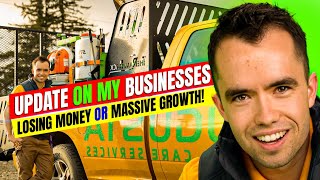
Mike Andes breaks down his business portfolio: Augusta Lawn Care targeting franchise growth with corporate testbeds, an Anytime Fitness gym bought for $500,000 that COVID hit hard, digital products like landscapebusinesscourse.com, and smaller ventures. He prioritizes sustainable growth and minimal personal withdrawals.
Questions this video answers
20 franchisees by end of June; target 40 by end of year; expects approximately 30–35 in 2020.
First month ~ $120 (started end of March); April ≈ $5,000; May ≈ $12,000; June expected ≈ $20–22,000.
Purchased for $500,000; owed about $410,000.
$15,000 per year.
$399 per month.
Chapters
Hey, everyone, it's Mike Andes and you're listening to the Business Bootcamp podcast. Today I'm going to be sharing, without any notes or anything, just a little bit about where all my businesses are at right now. I run several businesses. I'm just gonna go through them, share what kind of challenges they're facing, what some of them are growing, what some of them are doing in terms of strategy, and I think you'll learn something from it. And a lot of people ask me a lot of times, like, how is the gym doing? Or how is the franchise doing? Or something like that. So I'm just gonna give you an update, kind of share a little bit about each of the businesses, and I hope you enjoy it. Today's episode is brought to you by Gusto. I want to say a big thank you to them for supporting the show, supporting this channel, and really helping us reach as many small business owners in America as possible. Their software is great for doing payroll, doing benefits, is going to have a great platform for you and your employees to see where their money is going and their compensation. Check out today and get 90 days completely free by, by going to Gusto.com Boot Camp now. So let's just go ahead and jump right into it. I have several businesses that I'm working with and that I run on a day to day level, and none of them do I spend like full time necessarily on. But definitely the one that I spend the most time on is Augusta Lawn Care, the franchise. So we have several different entities for Augusta Lawn Care. But so when I say Augusta Lawn Care, you know, there's several different ways that I work within the organization because I work mostly on the franchise, supporting the franchisees, getting, you know, weeding through a lot of applicants to become franchisees and selecting the ones that we want. And as well as I'm also our original shop, the Bellingham location, I'm not involved a whole lot there. I usually go there two or three times a week just for team meetings, but I'm also involved there. And then also we started more recently another corporately owned store about 45 minutes south of our first location. It really is a way to experiment, test, and figure things out the same way that the franchisees are when they're first starting out. And so it's something that we'll probably do down the road on a continual basis every couple years of starting a new corporately owned store, just simply to figure out the systems, the procedures, especially from advertising and marketing standpoint, which things we need to highlight the most and if you're watching this and you ever want to come and you're interested in the franchise, by the way, actually this Saturday, June 20, is a discovery Day, and we're gonna have one of those every two months. So whenever you're watching this, if you ever want to come and see a tour of kind of all the Augusta Lawn Care command center, the training facility, both corporately owned stores, spend a day with me. I would love to do that with you and see if you're a good fit for Augusta Lawn Care. But that's kind of Augusta Lawn Care in a nutshell. It's kind of, you have the franchise, you got the corporately owned stores. But most of my time is spent really working with the franchisees and trying to help develop systems. Right now we're really working hard on another, a second version of the software for P4P, which is pay for performance, where we pay people by a percentage of the revenue of the business instead of by an hourly wage. And so that's what we're working on a lot right now. So let me go through kind of all the different businesses and share a little bit about what's happening in each. So the franchise, we're gunning here in the next little bit to hit 20 franchisees. And our goal this year was to get to 20 by the end of June. So we'll see if that happens. Our goal then is to get to 40 by the end of the year. I don't know if that will happen. Honestly. I think we might come a little bit short of that, but we're still gunning for that. The reason mostly is due to the fact that a lot of people who are going to start actually in middle of the year, April, May, June, July, they have decided to wait till next spring simply due to the fact that the virus hit their area really hard and they didn't want to be out trying to do door hangers when everyone's trying to social distance, which I understand. So I don't know if we'll hit 40 this year, but we're kind of on track to get approximately 30 to 35 in 2020. And we're really trying to gun for 50 as soon as possible, because at 50 is when we can. We're gonna develop a co op, basically a buying co op, where we're able to get some significant discounts from equipment, advertising suppliers, things like that. So we're working really hard on that and also being able to just afford more support for the franchisees at a corporate level, because we don't charge very much in terms of royalties. Like, we only get a set monthly fee. We don't get like tons and tons of money. So we gotta be pretty thrifty. And we obviously wanna add more support systems, whether it be from an estimating stand or strategy standpoint, media standpoint for the franchisees. And so we're adding in elements of that this year. So, for example, Command center is a big portion of the franchise where they answer their calls and send estimates. But we're actually starting to pilot this week, we're starting to pilot a program where we actually do full service for the franchisees, where we're going to be able to do all their billing, all their invoicing, routing, scheduling, go through their email. Really everything that an office person would. We're going to be taking over for the franchisees and we're starting to pilot that now. And then we're going to release it across the system next spring. So we're really looking forward to that because really, our goal is to. Where a franchisee never has to have an office person. And that overhead of getting a building and having, you know, training people on software and all of that is negated by the fact that they can pay by the minute for the command center to handle their books, send invoices, take care of customer complaints, and do everything else that someone in the office would do. So that's really where the franchise is at right now. We're developing the second version of P4P, which is going to be super awesome because no longer will they need to use Excel and any sort of knowing how to use Excel at all. It'll be very, very simple. It has a clock in and clock out app where the employees punch into that, which uses that data to know exactly, make sure that we're hitting at least their base pay with overtime and things like that. So we're working hard on that. That's probably going to be developed in the next two weeks. We're going to be launching that by the end of June across the system. So that's kind of where the franchising is at right now. And that's Augusta Lancaire franchise. Then we got the local Bellingham shop, the first one that I started, and I've always said that we probably won't go over 2 million in revenue at that location because we really do want to focus on the franchising. However, it's beginning to really grow organically. We don't do a lot of marketing right now, and it's been growing pretty substantially. And so just yesterday I had a meeting with the management there and because I'm not really there on a day to day level, I don't really. What I think doesn't really matter a whole lot. It really has to do with what the managers that I have in place there, what they wanted to do with the business. So we had a meeting and they were like, hey, we want to grow this thing and we really have a lot of momentum right now. This year we're probably gonna grow probably 28 to 33%, somewhere in that range, maybe a little bit more even. And so they're like, you know what, why don't we just keep this pace up? So we've been very blessed to get a very good stream of applicants to work at Augusta Lancre, the local shop. And so we're gonna keep pouring kind of fuel on the fire, keep hiring people and not really put a cap on that growth. And so we're really interested to see how that works out. And, and we're creating some redundancy in the management roles right now over the next six to 12 months. So that way in about 12 to 24 months I can pull those managers out and they can help in the franchise. That's really the goal. And really the reason I wouldn't do that right now is simply due to the fact that we gotta make sure that the franchise model can afford to have extra staff and can be sustainable when we bring them on board. So that's kind of what we're doing locally. The, the shop right now is really dumbing down the systems, making things more simple, whether it be from the office standpoint, estimating standpoint, our equipment, or doing a dramatic overhaul of our equipment. Because when I first started out I got zero turns and a lot of the things that, like if you listen to landscape business course, you know that I don't really.
I'm a huge fan of zero turns and big enclosed trailers and things like that. Well, when I first got started, we bought those things and we have four setups that have that kind of equipment set up. And so what we're trying to do is standardize things, make things simple for management. So that way if I ever needed to pull people out and into the franchise model and helping with supporting the franchisees, that that location can still thrive and not be. Have a whole bunch of complexity. And so we're actually going to be slowly rolling those out, those larger enclosed trailer models, the zero turns, we're going to be rolling those out, we're going to be switching things Pricing things around to make sure that that location is again, simplify, simplify, simplify, Allowing it to scale quickly, but then not being dependent on those managers so that when the franchise can afford them, that we can move them from that location into the franchise model and they can begin to support the franchisees. All right, so the next part of Augusta Long here is our new corporately owned location down in Mount Vernon, about 45 minutes south. Like I said of our first location, and that one's going really well. The first month in revenue we did like $120. Because we started the end of March and then April, we did about 5,000 in revenue last month, which would have been May, we did about 12,000 revenue in June, we're expected to do over 20 grand in revenue. So it's very consistent growth. It is fast growth, but we could go a lot faster if we just poured money on the situation. I'm really trying to make it where I modeled the numbers of how much we're spending on marketing to what I would expect a franchisee to spend. So that way at the end of this year I can look back, okay, this is how much we spent in advertising equipment is exactly the timing in which we did it. How much money we were making per employee before we got a second employee, how much revenue, how far we booked out before we got a third employee. All of those things we're really trying to mark out very clearly for this first year, especially because it's much more relatable for the franchisees to see that model for new franchisees than seeing like one of our first location that does, you know, hundreds of thousands of dollars each month in revenue. So we're really trying to figure out those systems and track things. That's really the growth we've seen. We just got our second employee there. Again, if we wanted to spend, you know, 40, 50 grand there and just really beef it up right away, we could do that. However, really trying to make it from a model of a franchisee needing to take $1,000 salary per week and still the business being successful, still the business growing and most importantly, still being profitable with that thousand dollar per week salary coming out for the franchisee, which in this case is a general manager, because I'm not operating that on a day to day level. There is a general manager and then he has command center to help him with his phone and email and all the office side of things. So that one's really interesting. Again, solid growth, 5,000, 12,000, 20, probably 21,000. I'm guessing this month in revenue, maybe 22. And then we'll continually be growing that throughout this year and then tracking each period and saying, okay, to get to 20,000 revenue. We have spent X amount in marketing to get to our second employee. We were already doing 12,000amonth in revenue before we even started thinking about having a second employee. These are all things that we really want to nail down. And then we're able to help franchisees better when they're just starting out. So that's why, again, we plan every couple years at least, to start a new corporately owned location simply to learn and stay fresh with marketing and really stay in the trenches with what it feels like to start. Because that's the hardest part. Once you get momentum, once you're already at two, three employees, you got some momentum and you're growing quickly. It's a lot easier than when you're starting out and you are at zero customers, zero revenue, and. And you're bleeding cash. So how quickly can we get to becoming where it's cash neutral and then cash flow positive and profitable is something we're always gonna be really watching. And so Mount Vernon has been really, really good. I don't foresee us growing at the same scale the rest of this year. I expect us to kind of plateau because we want to be remain profitable. Like, if we wanted to just keep growing and growing, we'd keep pumping marketing in. But I don't expect us to get beyond like three trucks this year because we want to stay profitable throughout the winter, which for a lot of franchisees is a big concern of theirs. And so we can't grow so big that during the winter we're going to lose a bunch of money, even though we could afford it at the corporately owned store. We want to make sure that that model is financially going to be paralleling what a franchisee would be starting, and that that's going to give them a lot of confidence seeing that model played out in front of them. So we're really looking forward to seeing that, especially in 2020, this whole year, being able to give that to the franchisees, giving it to new applicants to the franchise, and being able to show them what we spent exactly all the numbers behind it. But that's basically what the growth trajectory we're on right now is. 5,000, 12,000, probably 21,000 this month. And then we'll probably grow slightly more throughout this year, but not as much until next spring when we'll really, really put the pedal to the metal. And that's really, what we preach a lot to the franchisees is get an established base but become profitable. And then the following spring, that's when you really pour the gasoline on the fire. So we're looking forward to that. All right. Anytime Fitness. So a couple years ago, I became a franchisee at Anytime Fitness, and I did that mostly to learn their systems, their model for when we started Augusta Lawn Care. And a lot of what we do at Augusta Lawn Care is copying exactly what Anytime Fitness does. They have a set monthly fee for their franchise. They have academy, a dashboard, things that we use on our back end, the way that we support our franchisees, the way we do max metrics, very similar to their club ranking. So things like that, we are very much learning from. And I'm really happy. That's really the reason why I did become a franchisee over there. But I think it was 2014 or 15, they were ranked number one by Entrepreneur magazine in terms of being the best franchise in America. So that was really, really cool. Being able to learn from the best. They have 4,500 locations has been really interesting. Now, the coronavirus and everything that happened, you know, in the past several months has really hit the gym industry. So in the past, I would spend maybe an hour a week working on the gym in terms of just checking with the employees, having a staff meeting once a week, and really the club manager taking care of everything else and training was kind of just buzzing along, you know, humming along. Well, when this whole thing happened, we were shut down overnight. Literally overnight, we were shut down and went from whatever in revenue to zero very, very quickly. And so that was a big shock to. That required me to step in, make a lot of changes in terms of virtual training. The way that we have the club laid out, the way that we have the structure, the financial aspect of the club. We did take an SBA loan out on the club when I purchased it. So I purchased it for $500,000. So we still owed, like, 410,000. So restructuring, figuring out how we're going to work with that, using the government programs to take advantage of those, because we had closed down and wanting to keep the employees all on, we actually hired another trainer during this whole virus. And so really, that's gonna be a really good learning experience, I think, for me in the next probably five to six months. How do we pivot? How do we change the model? How do we help people get back in the club becoming healthy without scaring them around this health concerns and being in a closed environment and all that. Sort of thing. So really, really interesting. That industry is gonna be changed so much by this virus. We're seeing a lot of bankruptcies in Gold's gym, 24 Hour Fitness, a lot of other gyms that are out there. And so being able to watch the industry, seeing which gyms are coming out of this okay versus the ones that are going bankrupt is very interesting. How do they financially set themselves up as franchisors? Again, very, very good for me to learn that for Augusta Lawn Care. So, for example, we don't have any debt at the franchise level for Augusta Lawn Care. And. And we are not focused solely on scaling very quickly. I don't do any advertising. The reason for that is we'd rather grow sustainably, not have any debt, so that when there is a recession, we have the wherewithal to actually step up our support for the franchisees instead of laying people off. And that's why we're not. I'm not rushing to hire a bunch of people into the franchise system because we want to make sure it's an economically viable system, is very sustainable and that we can support our franchisees when they need us most, not laying people off, downgrading support, all that sort of thing during an economic crisis. So that's really been really eye opening and really a good learning experience for me to see the gym going through an absolute transformation in the industry, seeing who's winning, who's losing, and what I can do to make sure Augusta never gets cut and never gets hurt and that our franchisees can continue to grow in an economic crisis instead of. Instead of the franchisor going bankrupt, which is like having a ship without a sale if you're a franchisee. So very, very interesting times there at the gym. I expect us to take at least six months to get our revenue back to where it was.
Before we had to close down. That being said, we've really tried to lean down a lot of our expenses. We've really leaned down the financing of the club. So really, really interesting to see how this all works out. I think we'll probably reduce our revenue by about 8% this coming year, maybe 10%. But we're really, again, again, reason I say I'm not super confident on that is because we're really working hard on training right now and we're really trying to make the club into. From a gym to more of a training environment, training facility where we'd rather have less members, but a higher ticket item price based upon having a trainer and having sessions instead of just people Showing up anytime to lift weights and run on a treadmill and really focusing on creating that coach mentality. Having people that are watching someone's nutrition, their health, their exercise, and really looking at their whole being as a health and being able to charge more for it. So, again, maybe I'm wrong. In 12 months, we actually do more in revenue than we did this year or did in previous 12 months. But based upon what we've seen in terms of the gym, probably a decrease in some revenue. But I also think we can cut our expenses by about 25% based upon some things that we're doing. So that's gonna be really interesting. Other things we're doing that I'm doing and I'm focused on. So landscapebusinesscourse.com is where I sell a course to landscapers teaching them how to start their business. And that course has always really been built for newbies. People just want to start their lawn care business, usually helps them in their first two or three years. Because really, that course I made my fourth year and it chronologically kind of showed what I did for the first three to get to 100,000 in revenue per month. That's basically what it showed. Well, now our business is substantially larger. I've learned a lot since then. And P4P wasn't even developed pay for performance wasn't even developed that system when I made the course. So what I've done to really appeal to some larger companies, more established landscaping companies, is I've developed inside of landscapebusinesscourse.com, i've developed the training and the resources for developing P4P. So at last year's Landscape Summit, the conference I hold in January, we recorded a whole bunch of the topics and the lectures on P4P, uploaded that to the course. And then by the end of June, I'm going to be uploading version one of the software. So not the version two that we're just finishing right now for the franchisees, but version one is going to be available for all the members of Landscape business course. So what we're going to do is we'll raise the price on landscapebusinesscourse.com to new members, and previous members will just be grandfathered in and they'll get access to the whole course for really kind of newbies, and Then also have P4P the software and tutorials on how to use that software for more advanced users. People have larger businesses that are really willing to develop P4P and getting away from an hourly wage for their employees. So I'm really looking forward to that and how that breaks down for landscapebusinesscourse.com all of that money that I make from that is what I use to build like this studio, all these cameras, microphones. We traveled twice last year to go and you know, zero turn where we help with other businesses create a book last year. So everything that I do for landscape, all the money I make from landscape business course goes directly into creating more content for the landscaping community. And so this year we've been saving up money and now I'm to the point with the course, with the book and with lawn carewebdesign.com, which I'll talk about in a second. With all those things, I'm able to afford a full time media person. So Josh is going to be hired next month and he is going to be full time media. So doing all these videos and podcasts so I don't have to spend time doing it anymore late at night as well as getting more interesting content. Really kind of actually working on my content and social media. Cause right now I just like make these videos, throw them together as fast as possible and I just post them. I don't try to cut them up, I don't put them on Instagram, I, I don't really have a social media following outside of YouTube and Facebook and the pages. And it's kind of the same content all the time. It's not interesting stuff. So he's gonna hopefully bring a more creative element, more consistent element, daily content on all those platforms. So really looking forward to that. And that's a big thank you and testament to everyone out there that has become members, bought the book, lawn care web design become clients of us there. And I really appreciate that because really all of this would not be possible without that. And every dollar that we make on all those things goes directly into creating more content. So a lot of people are like, wow, in the past year and a half you really got all these cameras and really scaled things up and made more content. And it's simply due to the fact that so many people have supported me on lawn care or sorry, landscape businesscourse.com and lawn careweb design.com and that leads me to lawn careweb design.com, which is more of a newer platform that that I created a few months ago. And we've really been launching, really focusing on the past couple months. And what that is is basically the developers that create augustalawncare services.com, our website, the Franchise, because we only have about 20 locations. It does not keep my team and the tech side busy all the time. So what we decided to do is like, hey, how can we bring in more revenue to pay for new software for the franchisees? And the best solution was, hey, I'm always getting landscapers asking me how to build their websites, where can they go? And a lot of times it's tough to tell them because I know if they go try to build their own, it's gonna look pathetic, it's not gonna convert, they're not gonna be able to build it the way it should be built. It's not gonna have great SEO, et cetera. But then I also, I'm afraid to go tell them to use other services that charge them five or $10,000 upfront and then, you know, six, seven hundred dollars a month. And I just don't feel like that was fair. And more importantly, I didn't want people to get into a contract. So what we decided to do with our tech team that we had in house is like, look, let's build these sites out. It's gonna be 399 per month per company that joins us, and we'll make about a little less than $200 per month in profit. So I'm literally sharing our profit numbers. But, like, that's what we make. And that money goes directly into being able to create more software. And so that's what's creating P4P version 2 for the franchisees. And that's why by doing that, we've been able to have P4P version 1 now going to be available to the public here in the next few weeks is because of that extra flow of income. So again, really appreciate everyone that supported us there. I don't really try to sell those hard. I don't run ads against them. We simply just mention them here on the podcast. And if people want to use them, I'm so grateful that they use those. I think it helps their businesses dramatically, whether it be the course or. Or whether it be P4P in the course, or whether it be long hair web design where we actually build your website and constantly update it. And there's no upfront charges, there's no big contract up front. We just charge that monthly fee. And there's no, you know, if you don't like it after three months, you don't have to keep going. And so really forces us to consistently make the product better and improve your site. And so again, if you're interested in that, go to longcorewebdesign.com and we actually have three or four sites that we have put up as examples. So you can actually see some of the work we've done. And some of those are still in the process of like they're making some final edits because we are always making changes for people. But they're at least a couple months old. So you can at least see what it looks like on a mobile device, on a desktop and see if it's something that would be good for your business. And again, if you try out for two or three months and you're like this is not working, there's no contract, there's no penalty. It's not like if you don't, if you quit after six months that you, it's not like that you pay 399. We get start. Building your website usually takes four to eight weeks depending on how fast you get information back to us. And we build that site custom to you. And you can see those examples like they're not the same website, just with different colors. We customize the site to you, your location, your SEO, your demographics. And so if you're a landscaper and you want that service, definitely check out lawncarewebdesign.com. all right, so there's some other things that I do in terms of business. Ketosiscups.com is something that we started about five, six months ago and we really got shut down pretty hard by this virus because we were planning to really launch to the retail environment. But the show that we were planning to go to and really launch the brand got canceled. And that was pretty disappointing. And it's not that we necessarily abandoned it, it's just that I've been so busy with the franchise and everything else we're doing we've kind of put on the side for now. And especially due to the fact that traveling to retailers right now, getting new product into retailers is very difficult. Right now they're really focusing on their existing supply chains and they're not so interested in buying different suppliers. So something that's kind of on hold, we are shipping those out. We've ran into some problems because chocolate melts in the mail this time of year, especially when you're shipping to Texas or Arizona or California. So again, a learning curve. Something we're trying to figure out is like we don't have additives and preservatives in our chocolate. Cause it's all natural and it's keto based. And so it's been very difficult to ship these out and figuring out when we can ship them and knowing that they're gonna sit in someone's mailbox or in a truck that is 100 degrees and they're gonna end up being soup when they get to the final destination. So that's been interesting. That's kind of a side thing. We tried that out. We didn't like lose money on it. We made sure that we covered our basis, but we didn't make a bunch of money or anything on that. The site's still up. We still ship out product to people to direct to consumer stuff, but we're not in stores. And I know we have a whole bunch of people waiting for us to be on Amazon, but we really haven't even spent enough time to get it on Amazon yet. So that's kind of on the shelf. Same thing with. So one thing that a lot of people ask me is like, hey, you say you don't take much money from the businesses. How do you actually operate and kind of you financially, personally, what are you doing? So for me, this is how I kind of look at it. So I don't take a lot of money from the businesses. I take $15,000 salary from Augusta Lawn Care, and that's annual. And then I really try to take as little money out of the other businesses as possible. I take money out of Anytime Fitness I did last year, and that's really what helped us start the franchise with all the legal costs and all of that. But I don't take like a salary necessarily from them. But really it's the $15,000 that I make from Augusta Lawn Care. And then what happened is about three or four years ago, I took an old house when I was younger and remodeled the whole thing. I think it was 2000. So it'd be like four or five years ago. I think five years ago now. I bought it anyways. I bought it. I bought it with cash because run down. And it was my first house. I hadn't bought real estate before, bought it with cash, remodeled it, refinanced it. And basically I don't make any money from the tenants being in there. Basically just pays the mortgage in our market here, like an average house, like 3 or 400 grand. So like getting tenants to cover that mortgage is, you know, you're pretty happy with that. You're not making like it's not like a $50,000 house with $1,000 rent. It's not like that in our market. So basically I don't make cash flow necessarily from my renters, but what it's allowed me to do is with the appreciation of that asset that, that I bought for cash. Now I don't owe very much on the house. And so what happens is.
The appreciation I've been able to get lines of credit on. And so I kind of use that as a way to invest. So for example, I don't take the line of credit and keep it out. I just use it when I need it for an investment. So that's kind of how I personally am able to not take money from the businesses, is take the line of credit out. So for example, this whole virus thing happens. The stock market hits the ground. And so I took money out, put money into the stock market, and then I recently pulled out most of my money from the stuff that was really volatile, like the airlines and the cruise lines and things like that. And so I was able to make really good money on that. And you know, it's not like I'm a great trader or anything, by the way. Like I was straight lucky and just looking at the fact that there's a lot of fear in the market. So I was able to get in, make some money. And my goal is really to do that about once a year, make some sort of a play for me personally financially, which allows me to not take any money from the business. So like, I know my long term financial kind of way I'll build my wealth is through real estate, something that's more passive. I can just get a manager or management company to like manage my properties and that will bring in me personally enough money to get by. Because I really don't want to take money from the businesses. I want them to grow. They're all businesses I believe in for the long term, whether it be the franchise or the local stores or, you know, landscapebusinesscourse.com all of these businesses, I believe that they're going to continue to grow, continue to add value to employees as well as users and customers. And so I don't want to take money from the businesses. And to do that, I really focus on trying to make one investment play for me personally every year. So like this year the stock market is definitely the one that was going to allow me to have substantial amount of cash. And then I'll probably roll that into a real estate deal like a duplex or a single family and kind of fix it up and then be able to rent that out for some cash flow. And so that's kind of how I'll probably build my personal wealth. And because a lot of people ask me like, how did you build all these businesses, how did you not like so quickly, how did you do it? Well, the bottom line is because I personally didn't need to take money from the businesses, and that's very, very fortunate that I am young, I don't have a family, and I can live very, very small, very, very humbly, not have to have a lot of expenses. Like, my company vehicle is the vehicle I drive all over the place. This studio is basically my office and where I live. So, like, you know, my house is. Is rented out to tenants, and then I live in a very, very small part of this office. And so doing that keeps my expenses very, very low. So that way I don't have to take money out of the businesses, and that allows them to grow very quickly. And so if anyone is out there and they're young or you don't have dependents or you're privileged enough to be able to live small, I highly encourage you to do that, especially when you're young. Like, if you have ambition to grow your business, keep the money in the business. Like, if you actually believe in the business. This is what I always think is funny. People like, oh, my business is so great, so profitable, and yet they're taking money out of the business and spending it on depreciating assets like a car and clothes and extravagant living. When it's like, look, if you believe in your business that much, you should put every dollar possible into those businesses, and it will 2, 3, 5x over the course of the next 10 years, and you'll have a whole lot more money and you'll be able to share that with other people and give to others and still live your extravagant lifestyle, if that's really what you want to do. I personally don't ever want to live extravagantly. It's something I'm not really a fan of. I'm much more of a minimalist. I really enjoy seeing my money being put to use, whether that be building companies. I just love that. Being able to hire more people, being able to give. That really gets me going. More than having more stuff. More stuff really makes me not nervous. Like, I'm not a nervous person. But it just. I can't imagine, like, having a lot of toys, like boats and cars and houses and need to maintain all that stuff. Like, it just seems like a lot of clutter to me. I'd much rather live really small and then be able to be nimble. Like, be able to kind of live wherever, be able to start businesses, being able to invest in people, being able to invest in Companies that are starting out that I'm trying to build, being able to invest in the franchisees and not being tied down financially because I wouldn't want to ever be like, I can't do that because financially I need to be able to make X amount of dollars. So therefore I cannot risk or therefore I cannot spend invest in this. So I'm much more, at this point in my life, when I'm young, don't have a family or wife or anything like that. I'm much more focused on building the businesses and putting the money back into the companies. And then personally, I live small, and then I make sure I make at least one play a year for. To make sure I'm investing that money. And it all kind of started with remodeling a house, getting a line of credit on the equity that was substantial enough to be able to make another purchase of a house or be able to play with the stock market on the way up, things like that. And again, back to the stock market thing. I am not a day trader. I'm not a professional trader. I'm not a pro. I got lucky and just was able to realize that people were afraid and that some of the valuations that were in the marketplace were, were dramatically based upon fear and not the fact that, like, look, we're gonna eventually get through this. It might take a year or two, but, like, it's gonna, it's gonna improve. And looking at. And I think this is what, you know, honestly, one thing with the stock market is it's one time that I probably, like, was happy I had an MBA because I was used to looking at 10Ks and reports from public companies and being able to assess their health. Like, how long can you last with zero cash? All of a sudden, that became an actual question mark. When I'm looking through companies that are on the stock market, which in the past, even when we were analyzing companies, that was never something we thought about. We thought about debt ratios and looking at expenses versus revenue, but we never thought, okay, if someone had zero revenue tomorrow, how long could they last? All of a sudden, that's what I'm looking at. When it came to the cruise lines and airlines, how long can they burn through cash? Or what's their accessibility of debt to actually stay liquid and being able to stay afloat and not go into bankruptcy. And I'm not into the whole, like, buying hurt stock. They're bankrupt and there's a 90% chance their stock is gonna go to zero. I'm not into buying stuff like that. I'm buying companies that I believe in for the long term and that I thought were undervalued in March and April. And so just wanted to clarify that. But basically that's kind of my businesses and my personal kind of financial kind of statement to you all, kind of showing what I do behind the scenes. If you have questions that you want me to address more in depth, just comment below. Maybe I'll make one of these every like quarter maybe, and just kind of share what I'm up to in all the different categories. I'm sure I'm missing something. Other little things I do, but those are kind of the major things like the franchise, you know, Augusta Lawn care, the corporately owned stores, the gym, and then a lot of the podcasting media, the lawn care, web design, landscape, businesscourse.com, the summit. All that stuff is really fun. So anyways, comment below if you want more information. How any of those things break down. I'd love to share that with you. I try to make sure everything I do financially and with the businesses I can share publicly. Obviously some of it I can't, like people's payrolls or like some things I can't share. But as much as I can to help you and your small business or in your landscaping business or your gym or whatever, if there's something specifically you want to know, comment below. I'll see what I can do in the next quarter's video and try to help some more of you out. Sorry for the long video, but I think for the people who are still watching right now, this was probably helpful and might have shed a little bit light, maybe inspired you. And that's what I'm here for. So thank you so much. You've been listening to Mike Andes on the Business Boot Camp podcast. Until next time, be great. Nothing else pays.









