How to Find the BEST Location for a Lawn Care Business!
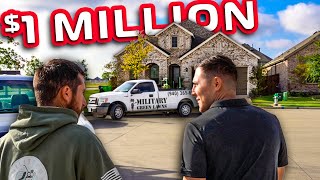
Mike Andes coaches Will on opening a second lawn care location, covering market mapping within a 5-mile radius, whether to use an LLC or S-Corp structure, and how profit-sharing improves employee reliability. They walk through client counts, pricing, and marketing spend to find the right neighborhood.
Questions this video answers
February 24, 2023.
60%.
$15,000 (Google Ads and EDDM flyers).
About a 35-minute drive.
395 clients year-to-date; lost 259 (reported attrition ~60–66%).
Chapters
Got him. Our goal is to have three or four or five locations. You can easily build a million dollar business in this section. This is a really nice neighborhood. This pool behind me is one mile long.
You can lead someone to water but you cannot force them to drink.
Dude, come on. It's not that hard. Everything is bigger in Texas. That was a grand finale. I am liking what I'm seeing.
60% of businesses will fail in their first three years. I'm Mike Andes and I'm on a mission to fix this on this, this boot camp.
Woo.
Everybody. It is like 75 degrees outside.
Beautiful.
This is windows down weather.
There it is.
I am in route as we speak to go and pop in and one of our great team members, his name is Zachary and I am going to see what he's up to, see how the quality of work is. We generally don't just pop our head in often. So this will be kind of an interesting thing to see how everything is going out there. So Zach is doing winter services today. I just checked where he was at on the dispatch board and he is still out there. So we're going to just go show up out of the blue and see what's going on and see how things are going.
So this one. So how many minutes we got on this?
30.
Yeah, like in February and January like this stuff right here is probably what we'll focus on this month. We're just doing leaves like in the beds but that'll be a good example to like kind of just prune that and like maybe even some of this stuff that's like when you guys mow, you guys are gonna get smacked with.
Oh, it's rock too.
Dang.
Landscape stuff's pretty matted, huh?
Yeah.
I was telling Levi last or yesterday when I went out, I said it's always a good idea to when you got, when it's this bad to always start kind of where the client's going to walk that way like you know, cuz obviously we're only spending the amount of time mowing and it's like if they do come out, I was like wait, okay, I got build today. But at least I can see, you know, this couple of feet got cleaned up, you know, versus if you start on the back end, they may not see that.
If LLC 1 or 2 gets like if as far as like litigation goes, if one of them gets sued, right. And that person that's like trying to sue the company or the llc, can they go up the chain up to the S Corporation and then wouldn't that affect like the other LLCs underneath it or like, how does that kind of work?
Talk to an attorney. But typically the major thing that you can't do is pierce the corporate veil and have commingling of funds. So as long as you have different bank accounts, as long as you have different insurance policies and everything is separated, you have dip tape distributions differently. You don't like, oh, this account needs money, I'll just move it from the other LLC and there's money always going to and from each other, just randomly, then you'll be okay. But talk to a CPA because you need to make sure that if you're actually doing the s Corp above with 2 LLC, it needs to be set up appropriately. I would recommend at the beginning, if you want to keep it simple, just do two separate llc. Don't worry about doing a whole massive entity above it with an S Corp until you have three locations. Because there's just no reason to have an escort above 2 LLC. Really, there's really not a whole lot of benefit. There's just more legal fees, honestly, and more accounting costs because you have to submit a separate tax return and if the articles of incorporation minutes with an attorney every year, etc. So I would consider just doing two separate LLC for now. I don't think you need a shell of a company, especially at that size. If both of those start growing, they're 6, 7, 800,000 a piece, you get a third location, then you might think about getting an S corp above it. But I wouldn't be super concerned with that right now.
Gotcha.
Okay.
And that actually leads me into my other question. Because the location 1 is an S corporation, do I like pull that out and create an LLC underneath it or should I just leave it as the S Corp and then just I guess put an LLC underneath? Our goal is to have three or four or five locations down the road.
Yep. Did you file a 1120s or is an actual S Corp.
It's an actual S Corp.
Okay, so.
So we jumped from that. We went over the llc. We didn't even do an llc.
We went from solid. You went right from the beginning. And have you been doing annual minutes with an attorney and all that sort of thing with that escort?
No.
Okay. So it's probably, to be perfectly honest, it's probably not like super effective to have the S Corp because the way you've done it, ran it, keep doing that though. I just keep the first. The first entity and just start an LLC for the second one. And if the second one starts becoming profitable. Then fulfill the form 1120s which allows you to be taxed like an S corp, but remain in that LLC shell. And then down the road what you'd probably end up doing with the help of an attorney as you get three, four or five locations is throw that escort up above and then put the LLC underneath.
Gotcha. So you, so you're saying just completely separate it, segregate it.
For now I just keep the S corp for number one, start the LLC for number two and then down the road you'd probably move that S corp up above with your multiple LLC underneath.
Got it.
Awesome.
Okay, sounds good.
So I wanted to show you guys how we came to the conclusion of where our second location is going to be. So this is a website that allows you to draw like a five mile radius. So we originally wanted to move to Salina, but once we started to go out to Salina and look at the actual like data and market of the homes and stuff, Salina is so new that like there's really only development down here in Prosper, like there's a couple neighborhoods here, but then once you get above that up here, it's really just kind of like all fields and everything. So what we did was we looked down here, Frisco is obviously well developed and there's like, if you really zoom in here, there's like thousands and thousands of homes. What we did is we said let's move this boundary from salina down here. 95% of this area in this boundary line is all residential homes. So that is exactly our market. You can easily build a million dollar business in this section. So going from this location to this location is about a 35 minute drive and we are going to spend probably $15,000 in marketing DOL with Google Ads and EDDM flyers next year and we're going to try to grow this in half the amount of time that we grew this location. But today we're actually going to go out and look at the area to see how the homes look. And a lot of the properties here are like really those cookie cutter small lots that are, you know, the guys can get in and out in like 20 minutes. So this is exactly what we're looking for.
They are perfect properties. 21 inch mower, get in, get out type of properties. This is a nice small little cookie cutter property over here that we can get in and get out. Mowing, weed, eating, etching and blowing like these guys are getting in and out in like 12 minutes of the property. So, you know, charging 6570 bucks for an application, 40, $45 to mow. Like, we're making really good money and it's super profitable. That's why we focus on these small residential properties. But this particular, particular subdivision, there's a golf course inside of the, of the HOA community. So, you know, it's high end. This is a really nice neighborhood to be so close to where we're going to be planting the second headquarters. I am liking what I'm seeing. So super excited. We are pumped. We are like three, four months away from really hitting the ground running on this second location. And it's really cool because it's starting to come to fruition and we're starting to visually see what is going to come. In that scenario where we do completely separate, is there any some kind of way that we could potentially borrow an employee between locations? I know that it would have to be completely separate. They would have to be different payroll. But would he just have like two different logins and like, it would be just our core guy who's been with us for many seasons and.
And they have, they get two different W2s at the end of the year. We do occasionally with our locations because they're so close. If someone needs help, we move them across. But it's all done separate payrolls, separate EIN numbers, etc.
I wanted to ask this, so if so you have so like, the model that we're doing, I really like it a lot. And the one GM that dispatches and does routes and like, doesn't that somehow kind of pose some kind of bottleneck for like a single point of failure if the GM is sick or like on vacation or like, what are your thoughts around that? Do we up here have to step down and fill in, or does he need to train somebody below him to pull up and like learn how to.
Dispatch and stuff like that for the sake of profitability. When you're only at two or three locations, you would be that person to step in because you can't afford to have a flexibility, four or five, $600,000 location having a GM and someone else underneath them that they're training or even is involved in overhead. It needs to be very clear that like everyone, including the working gm, occasionally touches and gets their hands dirty. So I would recommend until you have more than three locations, you just focus on. If someone is sick, they go down for a day or two, you hop in, and then after three or four locations, you're doing a HA win a 1.52 million in revenue as a combined Whole now you can afford to have a regional manager who basically fills that spot for you.
So doing simple services and in profit mode on location one and obviously starting a second one on average, how. How many clients, like residential clients should one office staff on average be able to, like, handle?
It really depends. You have a residential, you're doing mostly mowing. Like, I would say you probably need, like, right now you're what, like 180, 200.
So we're at 330 active clients right now.
Yeah, like, I would say one office manager. Right.
It would be crazy, right?
Right. Yeah. Like, I'd say with average, average cross whole year, you're probably one, but during spring rush, you probably need two. And then it's less than full time during the other parts of the. Of the year. Right. So that's the challenge, I would say, as you grow, what you might want to do is hire a position for, say, five months as an office assistant to help her, and she's full time year round. Because you've got to figure out that. That change in demand and the seasonality and match what's out in the field with what's in the office. This is something we've had to figure out with the past few years is like four months is intense. Everyone's hand on deck, working overtime. Four months of kind of like normal hours and four months where it's like you might get part time or no hours. Right. For the office included as well as the outside field staff.
Got him. All right, so I want to take you guys on a little detour. And in a community that we actually service for fertilizing and weed control called Windsong Ranch, this pool behind me is one mile long. For the HOA residents in this community, it is massive. They have, like, canoes out here. They have a dock out here. This is only about half of the actual pool. And I don't know if you could see behind me, but right here is, like, a beach area that they have, like, lawn chairs and, like, real sand that you go and you hang out at. This is insane. So much so that, like, for the grand opening three years ago, they had Michael Phelps out here that actually swam the entire length of the pool, which is absolutely crazy. But I guess the saying is true.
Everything is bigger in Texas.
That is the PGA headquarters of the world.
This question, huge red flag for me when I was looking at this. Our attrition rate from this year, year to date, showed 60, 66%. This is kind of how I figured it out. So we had 395 clients this year, year to date and we lost 259.
Okay. And all I did was divide that and how did you determine the loss?
So 63 of them said we were too expensive, 51 said they were going to maintain it themselves, 49 were dissatisfied. And then the other ones I think just moved.
The 63 that said it was too expensive, is that prior to you doing service or just like they just decided like it's too expensive, I'm going to do. We're done. Like they were doing.
It was after once we perform services.
Got it. Okay. When I look at the global numbers of the company in terms of how much it grew in that time and the fact that we can raise prices and bring down the close ratio, I would say this use your follow up sequence and your estimating process to weed those people out. So sooner like the pricing people should all like that should be half easily because you just got to, you got to make it very clear. So our first email to people is why we aren't the cheapest. And it's like hey, this is why we're not the cheapest. If you want more information on our pricing, here's why. And so we are very clear about that upfront. So if they want to go shop us around, go for it. Like we're not going to be that person. So I would attack. What would be helpful if I was you is go through every single email or cancellation that's come in and simply ask yourself how can I address these issues before they even become a customer? Customer like as a link on your blog, posted on, on your website or in the estimate verbiage, whatever it is. How do I weed these people out so they don't even become customers? Because it costs you quite a bit to onboard people and so you just want to keep them out all together.
I want to take a moment to reflect. I'm so grateful that we are on P4P because what Mike Andes is doing in this industry and all service based industry industries is like he is making a movement, he is straight changing the game of like the professionalism and how to build a scalable systemized business that runs off of systems and now people what he is doing, what he's done for our business that he doesn't even know. I mean out just like outside of the 30 day coaching call like us implementing P4P completely revolutionized our business. Like completely, completely changed it. And I don't have to micromanage our team anymore. I don't even look at the time clocks Unless there's a discrepancy, probably maybe once a week or once every other week I will actually look at like the time clocks on properties and stuff like that. But I don't ever have to worry about that anymore because they're all, all of our team is on a P4Pmindset. It has changed the culture of our entire company. Like today these guys are going out on a 13 and a half budgeted hour job and I know as a business owner that I don't have to go out there and babys sit down. They know exactly what they need to do, they've been trained properly and they're on a performance pay scale that it's in their best interest to work hard, get the job done in an efficient manner, make sure the customer is satisfied and go on to the next property and make more money. Like it truly is a win win for both the employee and the employer. Like huge, huge. Like movement in the longer extreme. Thank you Mike Andy for making it easy. Creating P4P, creating a system around profit sharing. I cannot tell you how many times we struggle with people showing up late. Like it was a constant thing. Three times a week same person would show up late and it's like dude, come on. Like it's not that hard to get to work on time. And I am telling you, the minute we implemented profit sharing that completely changed. Completely changed. I had guys showing up late three times a week. Calling off down to like once a month absolutely was a game changer. It changed the entire culture and it really allowed the A players to step up and it pushed out those C players that are like h, you know, I don't want to show up to work on time. You know, I just want to sit at the gas station and milk the clock. You know, take 15, 20, 30 minutes in between each property. You know, not, not work hard. That's not the type of people that, that we want to be around or the culture that we want to have in our business. So shout out to Mike Andes. We appreciate it like you have helped us so much that we that that words can't even describe just even these. This coaching at each week, like absolutely incredible. Just, just the valuable information and advice that, that we have received. Like we're super grateful, super thankful and super blessed for all of it.
Now. So you now you that you know kind of where we're at, where we're going and everything. I wanted to ask you, so the two courses that you have, Landscape business course and MBA for entrepreneurs, do you. Is there a Specific one that you think would bring good value to us more so than the other or like, what. What would you recommend?
I think your stage MBA would be more helpful because it's going to go deeper. You're kind of past like landscape business course is meant for getting to 100 plus per month in revenue. You're almost there. Right? So I, like 70% of it is probably going to review for you. I'd focus more on mba, where we go deep into like the LLC stuff that we just talked about. The inner circle of people, like finding a good attorney, finding a good accountant, finding a good banker. Like, it just goes deeper. Right. So it's not as specific to lawn care and some of it might go over your head a little bit, but I think there's more depth there for you. At your size and what you're trying to do with multiple locations, that would be the one I would choose.
Okay, awesome. Cool. Sounds good.
That's all good. Good stuff, man. First, just want to say, like, you guys killed it. You guys did a great job in the 30 days you execute on everything. I think we have a good platform going in next year with the two locations and a clear understanding of why you're doing what you're doing with the two and separation and clear roles between the different GM and yourself, etc. And so that ultimately is what will lead the business to be able to allow you to not be in daily operations. And so I just, I'm, I'm blown away at your execution. You did a great job of just like taking what we talked about, implementing it, and just immediately taking action on things. So that'll serve you very, very well going into the future.
Yeah. Awesome. Thank you, Mike. Honestly, like, from the bottom of my heart, dude, you're. You're an all star. Honestly, like, literally the advice that you've given us for the last 30 days is like, you can't even put a price tag on it. I fully believe that advice that you have given us will take us from 650 to 3 million easily. Like, and then we'll probably have another conversation at 3 million or probably before that of like, hey, what do. How do I get to that part? You know? But seriously, like, thank you so much.
Can't wait to see it, brother. Best of luck to you. We'll stay in touch.
Thank you.
Bye. Bye.
Let's go. Wraps it up.
That's it.
That was the grand finale. It's kind of Sad that our 30 day challenge is coming to an end, but if I had to sum up that call in one word. I would say epic. That would be the word.
Oftentimes, what makes a business owner successful is simple. How fast they can make decisions and execute against their goals. And so when you look at say, someone that takes two or three days to make a decision versus someone else who takes two or three months in the short term, it doesn't look like a big difference. However, over the course of a career, that is the difference between someone who becomes a multimillionaire and someone who is struggling to do two or three hundred thousand dollars in revenue five or ten years into business. So ultimately, making decisions quickly and being efficient with how fast you execute against your goals is typically the biggest factor of how fast and how far you get towards where you want to to be in your business. And that is why will will be successful. Throughout this entire boot camp the past 30 days, he has demonstrated his ability to be flexible in his mindset, take action towards something once he sees it. You can lead someone to water but you cannot force them to drink.
We're so thankful for that to kind of wrap this up. Thank you Zach for the opportunity. You are awesome. Thank you Stephen for your editing skills. You are awesome. Mike Andy's thank you so much for giving us your time to help propel us us from 650,000 to easily 3 million. Cuz I believe that that's what that phone call just did. In fact I know it.
I wish will Larissa and military cuts all the best. They're not going to need my best wishes though cuz they're going to absolutely crush it.
Season 2 Military lawn cuts and landscaping Signing out.









