How to Have a Team Meeting for Your Lawn Care Business
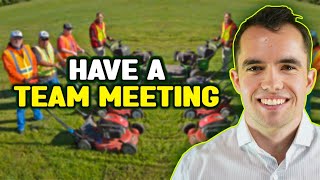
Mike Andes (Landscape Business Course) explains how he structures meetings for a landscaping business: weekly Monday project-manager meetings for larger jobs, weekly Wednesday team meetings for motivation, complaints review, "wow moments", and sharing wins, plus 2–3 annual off-site meetings (spring and fall) for higher-level alignment and financial strategy. He gives operational specifics: project-manager meetings cover jobs ≥ $3,000 and include office staff; team meetings are mid-week to re-motivate crews and review yellow-slip complaints and customer-exception "wow" moments; off-sites occur in April and October/November and focus on customer service (spring) and financials/close-of-season push (fall). Examples include crew members assisting vulnerable customers and actions that led to a $50,000 overperformance after an October off-site.
Questions this video answers
Monday mornings
Wednesday mornings
Two to three times per year (typically spring and fall)
Spring: April (sometimes late March); Fall: October–November
$3,000 or more
Chapters
Hey everyone, it's Mike Andes and you're listening to Landscape Business Course Podcast. You might be watching this on YouTube or Facebook. Well, I want to say thank you for your attention and thank you for seeing Today show. If you haven't Already, go to landscapebusinesscourse.com, check out the new website, check out the course. You can now register@landscapebusinesscourse.com conference. And that's next January. Get your early bird pricing now. Check it out today. Today's gonna be a quick episode. I wanted to go over something though that I've been getting a bunch of questions about. You've heard me talk a lot about the importance of team meetings for your landscaping company and for all of your crew members, office people, et cetera. And so today I'm kind of go through what are the things you will need to be covering in a team meeting, what are the items that you should be talking about and really just kind of share what we do for our team meeting. So we have several different types of meetings. We have our project managers meeting.
So the project managers are the people who are going to oversee each job. They're responsible for talking to the customer, for carrying out what goes on in the estimate. So the estimator kind of hands it off to the project manager for us. We try to keep the estimator and the project manager being the same person so there's less handing off and the customer has a little more seamless of experience. So that's our first meeting. We usually have those on Monday mornings and we go over all the projects that are going to be happening that week. So we have that meeting and we go over, okay, maybe there's 10 different landscaping jobs that are happening that week. Obviously we don't need to go over mowing jobs or anything like that. The project managers are only for the bigger landscaping projects. So that's the project managers meeting. That's what we do one time per week on Mondays. Then we have our team meeting.
And that is on Wednesday mornings. The reason I like to do it on Wednesdays is because the week has started. So we're kind of already broken into things and yet we still gotta finish the week strong. We still got Wednesday, Thursday, Friday. It's right in the middle. I really like having that team meeting on the Wednesday because it feels like people are already in the swing of things. It's not Monday morning. Everyone's groggy, forgot about last week was on the weekend was doing a bunch of other stuff. They're already in work mode. They've worked Monday, Tuesday, and they are. It's all fresh and relevant, but then it's also giving them kind of a shot in the arm. If it was a tough week, bad weather, stuff like that, in the early part of the week, you can really motivate them to finish the week strong. So that's the second time when we have a team meeting is on Wednesday mornings and then we have off site meetings. These are not done every single week. These are usually done two to three times a year. And right now we definitely have a spring and a fall off site. So the spring off site is usually done in April and really the beginning of April, even sometimes the end of March. And then the fall off site is done in October, November, kind of the end of the mowing season. And at that spring one, it's really about getting everyone on the same page talking about customer service, more general 30,000 level foot view. Whereas the fall off site is really about the financials of the company and how do we do, because it's at the end of the year, so how do we do? But then there's still like a good six weeks usually of the mowing season, like hardcore before Christmas. And so really at that second off site, it's kind of like, hey, let's pedal the metal. Let's crank this out. Let's get our beat our goals and projections. And so for like last year, we had that meeting in late October and we said, hey, this is where our goals are. And we were able to kind of get everyone motivated back on the same page. And then we beat that projection by like $50,000 to close out the year. So that was a really good way to finish up the year. And it was really a result of that off site giving everyone that last punch in the arm, finish the year strong. Everyone takes their foot off the gas. Come October it's like, oh, it was a great year. Usually you have a lot of cash on hand because the mowing season is wrapping up and everyone's been paying up now finally. And so usually you have a bunch of money. And so it's like October and November and people kind of coast in December and then into the winter when we really push hard to finish all the way through in December and really take advantage of market share. And so that second off site helps a lot with that. So let's go through these really quickly. But first I talk about project managers. What do we do on project managers? We go through, we have all the clipboards for the week, the different jobs that we're gonna be doing that are usually 3,000 plus that we'll go over with the project managers. $3,000 or more. So it could be retaining walls, could be product installation, it could be patios, it could be flagstone, turf. Whatever it is that we're installing that's going to go in with the project manager. Monday morning we meet about 30 minutes before everyone else gets there and we have that project manager meeting. At that project manager meeting we also have the office staff because they're always in constant contact. The project managers, myself and the office staff. And so that's Monday morning. But today I really want to focus on is the team meeting. You've heard me talk a lot about the off site, the importance of that. I feel it's very important to get your team together and do that. But today what I want to talk about is the second one and that is the team meeting. On the Wednesdays that we have, we have our team meetings on Wednesdays, but just a team meeting in general, I think it's imperative that you have at least a weekly meeting. I'm thinking about moving this to twice a week or even three times a week. Having all hands on office staff, people out in the crews, estimators, project managers, whoever should be showing up at this meeting. Now it's getting a little bit different for us. Right now we're in a bit of a transition because we're getting more and more people at our second location getting crews started out of there. And so it's two physically different shops and so having different team meetings. In the past we just recorded them or video streamed them to the other shop. But now I really want to have that person to person, face to face interaction. And so I'll probably end up having to do two different team meetings. However, for us and what we've always done in the past is these Wednesday morning meetings are very important. At these team meetings you want to do several things. Number one, you really need to motivate your people. Like I said, if you have really bad weather, if you had a really tough job that went long, was super muddy, guys were working overtime. It's important to motivate your people. So the number one reason is motivation. And that really can seem a little bit sappy. But at the end of the day, we are working out in the field, Your crews are working on the field. If you're in the spring rush right now you are getting swamped, people are working overtime, the office staff is stressed, trying to take calls and customer service and complaints, stuff like that. So Motivating your very important. And I'm going to talk about that in just a little bit. Another thing you want to be doing is going over complaints. So we, as I talked about last time, we have a yellow slip policy that we use. If you don't know what that means, you can watch the last video on customer complaints. We go over complaints, we have yellow slips. And that's when the guys are going to be talking about the yellow slips that they had to own, the ones that they had to go back to the property and fix something. And then they bring that forward to the entire team. And. And we make very clear what the complaint is. So that's also yellow slips complaints. The guys that took ownership that were at that job made a mistake and had to go back with the yellow slip and talk to the customer, resolve that issue, bring it back. It's put into the resolved area of the yellow slips, where we keep them categorized. And then at these every Wednesday meetings, they have to talk to the entire team, what went wrong, how they need to resolve it. And then going forward, what are the notes on that job that be put on there? At the project manager meeting, we have something similar to this where we are going to go over how do we improve the last week's landscaping jobs. So if there are a bunch of big landscaping jobs, retaining walls, whatever it is, excavation from the week prior, Monday morning they come in and we talk about how can we improve what went wrong? Was there any breakdowns in communication? Could we improve the efficiency at some of these jobs? Labor, things like that. But anyway, this is the team meeting, Wednesdays complaints. Another thing we do is we talk about what we call the wow moments. If you're in the course, you've heard me talk about this before and wow, wow. I coined this phrase without words. And so what we try to do with our customers, we try to create without great experiences.
Without words, without them asking, without them having to say, could you cut that limb? The guys do it anyways. For instance, last week at our team meeting, there was a customer that had just recently had a heart attack and was worried about having a heart attack and not being able to get to the hospital since his wife recently passed away. And so one of our guys that was on the mulling route actually went in and on his phone, showed him how to say to call 911 just by using his voice and saying, hey, Google, call 911, and programmed it into his phone and then showed the customer to use it as an older gentleman. And so that was a wow. Moment. That's something that we shared at our team meeting that went above and beyond without the customer asking. We did that. Another thing that happened the week before was one of the guys were mowing and one of our customers usually comes out and says hi to him, was inside and didn't come out. So he checked in on her and it turns out she had taken a big fall. She had been next to the counter and had taken a fall and was bleeding really badly. So he actually ended up taking her in the company truck and taking her to the hospital. And that was also another wow moment that we shared at our team meeting. Wow moments could be things when guys do exemplary work on a landscaping job. We go over customer reviews that are online, customer feedback, customer testimonials that have been shared online that talk about how great the team was and all that. So those are the wow moments. Those are the things that we talk about in our team meetings. So sometimes we'll mix in a little bit of strategy. So if your company is growing, so for instance, we are starting strategy. So for us, for instance, we are starting the other shop, franchising, et cetera. And so we'll talk about where are we at in the process of franchising, where are we at in growing the Bellingham shop, where are we at in growing turf sales? All of those things. We'll do a bit of reporting to you. Kind of like everyone that was at the off site in the fall knows our, our financials for the last year and things like that, because we have an open book policy. We also talk about, for instance, this past month was our top month by 30 something percent in retail sales. So selling products in dirt and soil and mulch and gravel and all that good stuff, delivering that to customers. We will share those wins at these team meetings. Positivity and wins, that's what we want to share at these team meetings. And so that's another thing. So back to motivation here. I feel this is really important. I feel like having a team meeting is super important for culture, for bringing ideas together. And if you can get your team involved in the team meeting, that is gold. So try to get your office staff to say something. Try to get your project manager to say something. If it's about safety or something like that, housekeeping things, try to get them to be saying things. Try to get other people involved in a conversation. So I'm trying to mix in every single week something along the lines of team building or some sort of something inspirational or story, something that gets everyone collectively thinking as A team. So, for instance, last week I said I was talking about how as we grow, we'll become more segmented. And what I mean by that and what I was talking about in the team meeting was, as we grow, we get more people, we get other now multiple shops and things like that. It's going to become like, in the past, everyone that worked there kind of did everything. If you were on the crew, you did all the lawn care, you did all the landscaping, you were involved in every part of the business. But as we grow, I was making it clear, hey, we're going to become more segmented. There will be project managers and there will be a turf team, and there will be a lawn care division, there will be retail, there will be more segmented.
As I was talking about that, I was making the analogy of a football team and saying that no one position can tell another position that they're not worthwhile or they're not needed. Everyone on the team is needed. The linebacker can't say to the guy.
The wide receiver, hey, man, you're so weak and you can't bench as much as me. And the wide receiver can't tell the linebacker that he's fat and ugly and all these things. They have a body type and they have a certain role that they have to fulfill on the team. But at the end of the day, the entire team has to work together for one common goal. And so whether or not you're a wide receiver, maybe that's the lawn care guys, or whether or not you're a linebacker and you are going to be plowing forward and blocking for people, or maybe you're the quarterback, maybe you're the project manager, you're calling the shots and you are passing it to people on the team, regardless of who's on the field. Maybe you're on the sidelines, maybe you're cheering, maybe you're a coach, maybe you're on the sidelines. Regardless of what you're doing, you are on the team. And there is no small role or insignificant role within the company, within the organization. And so making sure your team realizes that important. So I talked about that, made that analogy, was trying to motivate the team, and then got the guys involved in a conversation. They started talking about those things in the team meeting. So it was a longer team meeting we had last week, but it was great because we got people involved. One of the older guys in the crew started talking about. He mentioned how he was talking to one of his friends, and one of his friends asked, where do you Work. And he said, well, I work at landscaping company Augusta Lawn Care. And the guy was like, well, you know, where are you gonna work after that? Like, you know, there's a high turnover in that industry and, you know, it's not gonna last forever. And the guy that was talking, the guy on our crew, the older guy, he was, he said, why not? Like, he. And he kind of got, you know, a little angry at this guy. And he was sharing this story with the team at the team meeting, saying, like, why can't I work for Augusta for the rest of my life? Why can't I grow with them? And he was saying how he felt like Augusta and our company was like a tech company and the amount of growth and the opportunity to scale with the company, and we're just in our infancy stages, growing, growing, growing, and we'll take off one day. And so he shared that with the team. It was motivating. It was great for the new hires to hear that. It was great for the guys, families and wanting to create a future. Great for them to hear that as well. So these are the four things that we kind of implement in our team meetings. These are the weekly ones on Wednesdays. I could do the same thing for project management meetings off sites. We could dig deeper into that maybe in the future. But this is important. Your all hands team meeting meeting. All your office staff, all your people out in the field, whether it be project managers, estimators crew leads, lawn care, landscaping crews, whoever it is, they need to be involved. You want all the team together. You don't want to have. You want to segment your meetings as least as possible? Absolutely. You're going to have to have project managers meetings, you're going to have to have estimators meetings. As you grow in scale, you're going to have to have lawn care meetings, you're going to have to have office staff meetings. That's just part of growing a business. But this team meeting, all hands on, sort of everyone there from all different departments is very valuable to create that cohesive bond between departments, between people, and create a culture of being a team. So if you have questions, comment below. If you're on YouTube or Facebook, I want to know what are you doing at your team meetings? What do you think about our team meetings? And most importantly, is there something I can share with you more about your team meetings that would help you? Because I promise you, having that team culture starts with a weekly, if not daily, team meeting. Thanks so much. I'm Mike Andes. Check out landscapebusinesscourse. Com until next time Be great because nothing else pay.










