I almost quit | $300k Business in 30 Days (26)
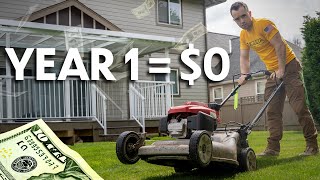
Mike Andes and Daniel push toward their $1,500 daily revenue target in Augusta, hitting $1,200 this week on mowing and property cleanups. They compare the math on recurring contracts versus one-off jobs, and lay out a $100,000 first-year investment to scale the business.
Questions this video answers
Day 26
$1,500 per day
$1,200 per day
$50 per week
47 minutes (expected future time 30–35 minutes)
Chapters
I'm traveling 3,000 miles across the country to build a $300,000 lawn care business in just 30 days. This Augusta lawn care location needs to be making $1,500 per day before I can hand it off to a general manager and go back home. I'm starting with no employees, no equipment, and no customers to prove that systems build great businesses.
Today is day 26 of this 30 day challenge. And today my goal, the game plan, is to not be jealous. Why would I be jealous?
Because half of Augusta Nation is meeting.
In Memphis this weekend, getting together, collaborating, talking, discussing, having workshops, and I'm not.
Able to be there. Instead, I am here doing a trimming.
Job, a bunch of mowing, and some estimates. Why, you might ask?
Because this week we made it to $1,200 per day in revenue, but we've got to get to $1,500 per day for this challenge to be a success.
So we're putting in the work and we're grinding.
And today we're gonna talk about why.
I do lawn care instead of other more easy industries and other more easy passive income. Let's hit it.
Now, I compare all of my business ven.
The stock market, and typically The S&P 500 gets about 7 to 8% return annually. Some years it can go down 15 or 20%, other years it'll go up 20 or 25%. But the average over the course of decades has been up 7 to 8% return on your capital, which means if you put $100 in, you can expect like $107 or $108 next year. Now, when it comes to small businesses, I'm not okay with a 7 or 8% return on investment because the likelihood of going out of business when you're very small is much greater than the chances of the S&P 500 or a company in the Fortune 500 going out of business. And therefore, the risk adjusted returns should be much greater. And I expect at least 20 to 25% returns.
All right, this is the initial MO for this client. And on the notes from command center.
It said that the client wants to talk to me. And before we get started, because there's supposedly an area that potentially might be.
Harmful for our mowers.
So they wanted to point that out. The only thing he really wanted to point out to me was there's a bunch of these little stumps and stubs kind of throughout the whole backyard. And then they got some bricks in here. Supposedly there used to be like a whole forest in the backyard. The landlord came through and clear cutted it because they owned that office building and wanted to rezone this. So there's a whole bunch of stumps kind of like throughout that whole backyard. So we'll figure it out though. I'll cut the around the stumps really low with the weed whacker so it's really obvious. And then just mow around them. Should be pretty straightforward.
Check this out.
This guy mowed this big property with this tiny thing. It's amazing. But once this whole area knocked down completely. I kind of like the daisies, honestly the bees like them too. But he was this whole area just kind of knocked down completely. So here we go.
This lawn is a $50 lawn per week. And so that gives us what? 750 divided by 70. That's like.
Three quarters of an hour, something like that.
Now one of the things I love a lot about mowing specifically is the recurrence of it. There are very few home services that you can literally go to the person's property and do 38 visits in the year, 40 visits in the year, 52.
Visits in the year.
If you look at things like plumbing, electrical, H Vac, etc, although they are much higher margin. The thing is, you might get one or two visits per year and the recurrence of those type of industries are a little bit lower than mowing. And not to say anything bad about those specific industries because they're all great and you can make a lot of money in all of those industries. The bottom line is though, when you look at recessions, I always want to get recurring revenue as high as possible because those are typically the industries that survive a recession more. Also, when you look at the enterprise value of a business, the majority of that is going to go to companies that have a lot of recurring revenue. If you think about subscription services, software, et cetera, it's because there's recurring revenue. And the dependability of that revenue coming in every single week, every single month, et cetera, is really what dictates the valuation of the business. The reason for that is pretty simple because if you ever were to sell the business.
The new owner has no guarantee that one time projects are going to keep coming in. Obviously there's brand power, but there's no guarantee like a contract or recurring revenue that for years has been growing or increasing in size.
All right, so that job took us exactly 47 minutes, a little bit longer than usual. Mostly because that back corner, you wanted that all knocked down. So that took me extra few minutes. But overall pretty well Priced. I think in the future we can get that done in 30 to 35 minutes.
Selling is because equity or the value of the business that I increase and I own, I don't have to pay any taxes on equity. And if you look at the stock market and you look at companies, they have this thing called MRR or monthly recurring revenue or ARR, Annual recurring revenue. And the value of those companies is mostly dictated by their recurring revenue. That's why some companies in the stock market are valued at like 4 or 5 times earnings versus other companies are worth 30, 40, 50 times earnings. It's simply due to the stickiness of that recurring revenue and those subscriptions.
All right, so we're at a property that we did a cleanup and mulch install yesterday at which I'll show you soon. But this bush, they also weren't done. So came back. I'll knock this job out real quick. And yeah, unfortunately, I forgot the hedge trimmer. So prune it is.
All this was completely overgrown. You couldn't actually even see the bushes. Everything was just completely overgrown ivy. Trim this one back. I got a little more work to do.
Back here. Same thing. This is all ivy all the way up. That tree looks way better. This back area, you might recognize from the other day. This entire area, it looks nuts. And it is. Let me zoom out here for you.
There's a gate right here.
Or sorry, a fence was 10, 12, 15ft tall. A lot of bamboo all cut back. Bed nice and cleared out. Looking much better over there. I almost can't even recognize this place. Looks much, much better. Great job, Chandler. Good job, Jonathan. You guys nailed it.
I noticed the lights are on.
All right, now we're going to be very conservative in our numbers because we want to account for the fact that you get into car crashes, you have insurance claims, things happen that are bad, you have to fire people, whatever. So we're going to invest $100,000 in the first year. Are you going to have to spend $100,000? No, you can get a couple trucks, a trailer, mowers, etc. You do not need to spend 100k, but you're probably going to lose money in that first little while. And that's why in year one, I'm just going to put zero dollars. You're not making any money because you're probably going to have to spend a lot of that money on marketing. Now, I am including the fact that we are paying a general manager. If you're working by yourself as the owner, you're going to be Taking owner distributions. But let's just assume it's like a $50,000 a year, the equivalent of what you'd be paying a manager. Now, if in year number two, we're going to take distributions of $15,000 as the owner, that means that we technically make about 15%, it's actually less than that because 15%, there was zero percent in year one. I know there's compound interest. Don't get complicated on me. But these are the returns. If in year three, I'm able to take 50,000 DOL in owners distributions, 50% of my money is being returned back to me. If you're number four, I make $80,000 in owner's distributions. I'm technically making 80% of my initial capital that I invested all back in one year. The bottom line is that this is an incredible return on my money, and I'm never going to be able to get this in real estate, stock market, or any other investment vehicle. But this is also why so many people will quit in the first couple years. Because if you just put your money in the stock market, if you put $100,000 in the stock market, you'd probably 100 $810,000 next year. Whereas in this case, you invest in the business and you don't really make anything until year three, four, and beyond. And that's why those first couple years are so difficult, because you're putting the money into marketing, hiring, and investing back into the business.
All right, so this first estimate, this is the house, and the customer wanted to accept the bid, but they want to just confirm exactly what the price includes because this is a door hanger situation. And.
And they want to know what the door hanger includes for the property cleanup and for the mowing. Oh, really? Oh, that's awesome.
Daniel. Michael. Good to meet you, Michael. Absolutely.
So, yeah, you just wanted to kind of confirm what that all included?
Yes, I did. And couple questions.
Cool.
Let's do it. All right, so I'm actually starting the backyard here real quick to the back shelf. And we're going to pull all the weeds out of there, all the grass. Basically, a lot of this is just weeds. Crabgrass, we got monkey grass, all this stuff here. We've got some bamboo. So let's just cut as much of that out as we can't possibly can. They do have a couple flowering plants that they have marked here with the blue little flags. Again, most of this is just a bunch of weeds, so. Well, there's a separate option for them. Probably should have done this when we had all this landscape, but you guys do dividers, like edging.
Yeah.
What kind are you thinking? Because you do the cheap stuff, which is like plastic.
You a little bit higher and do.
Something like a metal.
And then about the equivalent in terms.
Of price is going to be actual edger stones. And to do. To install that, all you would need to do is dig down. They come in about three, two and a half, three inches. So you just dig everything out and then lay it all in. And then make sure that it is nice and tight and would be actually almost exactly flat with this as it goes out. So that would be a nice edge. And you can bend it because convex, concave all along the edging. Same thing on this side and then this side. So basically, three, you would want to have a. Some sort of saw that can make a mason saw or just an attachment on the edge of a grinder to be able to cut, because you need 1, 2, 3, 4, 5, 6 cuts.
So that'll be an option for them.
Probably gonna go with like a Tuscan color kind of match. This front of the house.
Yeah. So usually, like the door hangers basically includes everything that we can see in the front yard. The mowing we can see from gps.
So that includes everything. But, like, in terms of, like, the.
Property cleanup on this one, all the.
Bushes up front, I was thinking to.
Like, getting all this grass around the edges. Yes.
And then like, trimming this. All this stuff up.
Yeah.
And then in terms of the property cleanup, the part he's gonna want from the door hanger is 299from the door hanger. And what we're gonna do is pull out all the grass is it's out of the lawn. So all the stuff that's in the flower beds and all the weeds throughout the bed. What we'll do also is rake the flower beds out. You can see there's stuff he's pulled, like, just the tops out. So we'll try to get as much as we can. And then when we rake, he said, just be careful because there is drip lines throughout the bed area. You can see the drip lines here. Just be careful when we're raking. But a lot of just little weeds. And if we just really do it by hand, we can get most of it, I think. So we can do all those beds there, all these beds here, and these beds here. And then also as part of that, we will trim this bush up. We will need the ladder and the pole saw or the pole, a hedger. Get all of this shape, everything up, we'll grab, we'll trim the tops of these down below the windowsill, but then we'll also grab the dead, dead branches that are in here as well as over on this one. Just hand prune those out. Just be carefully, selectively topping of that bush there.
Back to my little rant about recurring revenue. When you think about a company like Apple, a company we all know that makes iPhones and iPads and computers and all the rest of it now, they haven't made anything super innovative, a brand new product in a very long time. Like the most recent was probably the Apple Watch. It's not super impressive. However, in that same amount of time, the past 10, 15 years, years, their stock price has gone up by like 10x. Why is that? Not because they're selling more of the hardware and the computers and the phones, etc. Maybe growing 5, 10, 15% in all those categories and in some categories actually declining in sales. What's gone up parabolically is their recurring revenue, their services, Apple Music, icloud, all these different subscriptions that they're now selling as services. If you look at their profit and loss statement, that's what's growing and that is very sticky. And that is what Wall street likes. And that is the valuation mechanism by which many stocks and companies are valued, including your small business.









