“I didn’t want to get out of bed” | Lawn Care Business BURNOUT
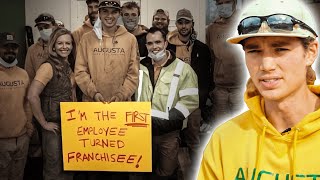
Nick, a franchisee in Augusta Lawn Care's fee-forgiveness program, lived in a van while launching his location and hit severe burnout within months. Twelve to fourteen hour days for sixty straight days left him not wanting to get out of bed. He learned the hard way: know your limits, ask for help, and commit fully with no backup plan.
Questions this video answers
November 5, 2021
Over 65 locations around North America
A franchise fee forgiveness program allowing employees who work two years in the field to start a location without a franchise fee
He decided to start in January 2020
January 13–15, 2022
Chapters
Hey, everyone, it's Mike Andes. I'm the founder of Augusta Lawn Care. We have over 65 locations around North America. And today we're actually going to hear from one of our franchisees and their experience getting a business started and the struggles they went through. And it's very difficult. It's not easy. I think sometimes the biggest reasons that small businesses fail is not because of the physical or financial pressure or pain, but mental and psychological things that we go through as owners. Perhaps the limiting beliefs we've had in the past, perhaps the things that we might have clouded our judgment in the past. And we have to break through those things, and we have to get over those hurdles and actually conquer ourselves before we can conquer the economy and the economics that we are trying to create within our businesses. So I'm really pleased to announce or show you today Nick, who is one of our franchisees that started this year, this is his first year in business. He actually came to Augusta when he was 19 years old. He used to be a ski lift instructor and worked up for the ski lodge and was operating the chairlift. And he came to us, and I remember going out to lunch with him and thinking, hey, good worker. But I don't know if this is like, he didn't come across to me as like, some great business owner, someone that was gonna be a manager down the road. Little did I know, a couple years later, he'd become a franchisee. And our very first franchisee. That was from what we call a 3F program at Augusta. It's called a franchise fee forgiveness program, where if they work for any location for two years out in the field, they're able to start their own location without any franchise fee. So early this year, Nick came for training and moved about an hour and a half south of us and has started his own location. So we hope to bring more of these episodes as well as seeing other locations around North America and also some of your locations that are not necessarily part of Augusta, but just so we can all learn and grow together in this industry. Nick is a great resource for learning about the franchise and is actually going to be taking some of your questions. So if you have a question about the franchise that you want Nick to answer specifically about Augusta, feel free to comment. In the description below, could be anything about the franchise, as well as even just how do you motivate your younger employees and people that you're onboarding to actually have a mindset that they can too, become something, become a manager, do something in this industry and actually build A career around it. So comment below if you have a question directly for Nick. And we'll follow up with him a little bit later on. But there's plenty of videos on the Internet about Nick. Upflip has made some great videos and interviews about his journey, but today we want to talk about what did he actually go through? And I still remember having the texts and the phone calls with him when it was just really, really bad. January came for training, everything was great and it was like February. Just. It was low and. Sorry. He came in December and January was really, really low and just tough to get out of bed. It was very. Just hard to get motivated to get started. And then you start getting that momentum and things go, go, go. And then all of a sudden he's working crazy amounts of hours and he can't find employees. And we had to stop the amount of leads that he was getting and turn them off on the website. So I'm very proud of Nick. It's one of the things that I probably, from a career standpoint, most proud of, as we now have a few locations that have started from the 3F program and we have many more in the future, hopefully. So without any further delay, let's go ahead and roll it to Nick. And I think most of us can identify with some of the struggles that he's gone through. And even at a young age, learning that just how much business can mold you and mold your character and mold who you are. And I think going to work every single day on yourself and not on just the jobs that you're performing is an absolute invaluable thing that we can get from our lawn care landscaping businesses. Here we go.
I'd say the biggest issue that I had was finding employees. Essentially in the spring, I got really busy and I was working seven days a week for a couple months straight in the field and then also doing the office work. So 12 to 14 hour days. And, you know, I had never experienced burnout and I just wanted to put my head down and get it done. And I did it for a while and I became grossly ineffective. So basically, you know, I had tried to hire people to no avail. There's definitely more stuff that I could have done. I can't blame it on just the labor market. Although the labor market is really difficult right now. It's hard to find people that want to actually work and instead of make decent money on unemployment. So, you know, that's kind of on me for not taking the extra step and trying to find a way around that. But we did have a month where I was booked out for the entire month on top of the regular mowing that I had. And I had hired someone. I really thought they were gonna work out, and they no showed twice in the first week. So that was kind of my biggest mistake, was not hedging against a risk and kind of putting all my. All my chips in one pot. And then we had to cancel a month's worth of work. As I'm trying to develop a name for my business here locally. It kind of took an emotional toll because at that point, I hadn't learned the power of removing emotion from business. You know, initially you want to take it really personal. This kind of goes into removing emotion from the business. So, you know, once I talked to this person, I had established an emotional connection with that person. And I told them what my goal was, was to elevate them as a person. I felt like they bought into that and like, we were off to the races. But, you know, they no showed twice in the week, and I ended up having to let them go. And I felt pretty betrayed at first, and I took it personally. I couldn't let my mistrust of that one person ruin it for everybody else. Because over the course of me scaling my business past a million, I'm gonna hire and fire, you know, probably 50 people at least. And I'm gonna have to be able to extend trust to people first and then let them decide what they're gonna do with it. And I can't just always be worried about, you know, someone doing the same thing. I guess that was a pretty valuable lesson.
It was a combination of both of those things, overworking myself physically and then kind of the mental toll that it took. There's just so much that wasn't constant that was new that was happening. So it's like I was doing estimates, which I had never done before. The work was fine. It was actually therapeutic because I could just like put my head down and just kind of block everything out for a little bit and just like focus on getting the actual task in front of me done. And that was like a n hit of like, short term gratification. But then in the spring, working like 10 to 10 hour days out in the field and then doing estimates and then doing office work. It was really long hours and really physically taxing on my body. And I wasn't getting very good sleep because I didn't have time to recover on the weekends. And it was just day in and day out. And then, you know, that happened for about 60 days until I finally hit a point where I was just like, the work that I was doing was just slow. So working seven days and being ineffective was worse than working five days and being well rested and effective. So I kind of learned a lesson there too, that I can't just like push myself infinitely. Like, I definitely have a limit, and I think it takes pushing that limit to actually know where it actually is. I definitely focus a lot more on resting and recovering and doing things in moderation.
All right, so if I was to talk to somebody who is thinking about starting a franchise, I would have two main pieces of advice for them, and that would basically be one, know where your limit is or at least find it. And it took me pushing myself past my limit, you know, working over 60 days, 14 hour days, just being completely physically exhausted and just burnt out and like, it became hard to get out of bed. But I would say, like, once you hit that point, definitely know that one, you need help, and two, you just need to like, take the foot off the gas a little bit, give yourself a little extra time to recover. The second piece of advice that I would give is to not have a plan B, because in your lowest moment, when you've been out in the field for 10 hours and it's pouring down rain and you're running behind on Moe's and it's starting to get dark, you know everything's going wrong. Your mind is going to search for comfort and it's going to look for the plan B, the way out. Just be all in, committed, know your limits, and know that everything falls on your shoulders. And if you don't take care of yourself, nothing's going to get accomplished.
So the, the hardest part about living in the van for me, honestly was the anticipation of starting my franchise and how long it was going to be until it happened. So basically I had decided that I was going to start the franchise in January of 2020. It was just all of the days of going to work getting completely soaked if it was in the winter, and then coming back to this little cold box where I couldn't like walk around and stretch and just doing that day in and day out, you know, just. That was kind of my life. It happened in like five day chunks. And then I would have the weekend to kind of take a breath, which was really nice. Yeah, it was just the anticipation, just going the entire year knowing that, like, I was just waiting for that year to pass by so that I could get to where I ultimately wanted to go.
How it feels to be a franchise owner. Honestly, it's very humbling because if you would have talked to me three years ago, before I had even started at Augusta, my life was headed nowhere fast, which is fine for a lot of people, I think. I was only 19 at the time, and you're not supposed to know where you're going, but I wasn't really on a path to discover it until I had actually started working with Augusta. I really haven't taken the time to sit there and, like, just think about everything in retrospect and look at how everything has evolved. It is pretty crazy because I didn't think that I would ever be a business owner, nor did I think I was qualified for it. You know, before I learned anything about business, I didn't even think that you could own a business without a degree. You know, it's kind of a silly thought now. Still feel like I'm me. I'm just developing myself further.
Hey, everyone. I'd like to invite you to Landscape Summit. It's a conference I have in January. It's going to be the 13th, 14th and 15th of January, 2022. It's here locally, and I'm really looking forward to meeting other Landscape, like yourself, that want to grow their business.









