I dropped out of medical school and started a lawn care business…
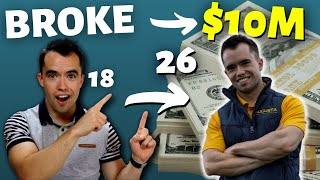
Mike Andes (founder of Augusta Lawn Care) narrates his path from mowing lawns at age 11, entering college at 13 intending to become a surgeon, then choosing at 18 to forgo medical school and grow a lawn care business instead. He explains a five-step framework to become a "lawn care millionaire": 1) Start your business; 2) Build it (focus on close ratio and momentum); 3) Implement systems (required to scale beyond roughly $600,000 in revenue so the business can run without the owner); 4) Scale or duplicate locations (the route to surpass $1,000,000 in revenue); and 5) Diversify into other services or asset classes (real estate, stocks, other businesses) to convert revenue into personal net worth. He warns against reinvesting solely in depreciating business assets and stresses building a repeatable, systematized machine before diversifying.
Questions this video answers
11 years old
13 years old
18 years old
Over 80 locations around North America
About $600,000 in annual revenue
Chapters
Hey, everyone, my name is Mike Andes. I'm the founder of Augusta Lawn Care. However, when I was 11 years old, I started mowing lawns. And I did that because I want to save up for college. Now, I started college when I was really young. I was 13 years old when I started college because I really anticipated I was going to become a surgeon, and that's what I'd always wanted to do. And so I started college at 13 years old. I paid my way through college, and then at 18 years old, right before I went to medical school, I decided I wasn't going to go to medical school, but rather I was going to take this lawn care business and blow it up and make it really big. So I've talked about in other videos of why I did that, but that's when I started Augusta Lawn Care. Fast forward now, eight years later, we franchised Augusta Lawn Care, and we have over 80 locations around North America. Today, I'm going to be talking to you about the five steps to become a lawn care millionaire and starting in lawn care, growing your personal wealth to the point where you can invest in other industries, have multiple locations, there's really five steps. So whether you're just getting started and you're just gonna be literally starting on step number one, or you are a multimillionaire already in your lawn care business and you're trying to figure out how you diversify. How do I get into other asset classes? How do I actually start figuring out the other games of building my personal wealth outside of lawn care? This is the video for you. So step number one is the one that most people don't do. And for the most people watching this video that are thinking about starting, they will never actually do it. And that is start your business. You've got to start. And if you don't ever start, you will never get to stage number two. You'll never actually achieve anything in terms of building your business, hiring other people, and getting beyond the first stage of growth. Now, all of that to say you don't need to own your own business in order to become a millionaire. I've talked about this in other videos where you can invest, you can invest in appreciating assets and actually still build your personal wealth. But if you're trying to grow a lawn care business, the first thing you gotta do is start. Now, the second thing, the second step of becoming a lawn care millionaire is you have to build. Okay, now in this stage, you're growing the business. And really all I want you to focus on during this stage two is close ratio. What I mean by that is what percentage of the jobs or estimates that you get do you close are accepted? Is it 20%, 30%, 50%? What percentage of the estimates you give are accepted by the client? During this stage, the only thing you should be focused on is, is close ratio. Because if you can get a lot of jobs accepted, even if they're not the highest prices, the best margins, it doesn't matter. Because I just want you to get the business off the ground and scale it up and make it bigger. Because otherwise everything beyond this doesn't really matter. If you have a business that does 40, 50,000 in revenue and you have a few customers you do on the weekend, it's not ever going to be anything special and you're never going to become a millionaire. You've got to achieve a certain level of scale if you're ever going to then make it efficient and become a millionaire and actually have profits and distribution coming from that business. So you've got to build the business. And at this point the only thing I care about is close ratio and momentum. And when I say momentum, I mean like when you're running a race, for example, getting off the starting blocks takes a lot of effort, takes a lot of work. That's the starting point. And the building part is also very physically strenuous. But you've got to do that work, you've got to put in all that effort in order to get the momentum to actually go fast. Those first few steps of a 50 meter dash are extremely difficult on the body. But once you get up to speed, it's hard to stop that body. It's not like you can immediately stop it because it has momentum and that's what you need in your business. That's what you don't have in stages one is you started, you only have a couple customers. Great. We started, we opened up our llc, we opened up our sole proprietorship, but now you've got to build it, you've got to focus on close ratio and momentum. When I say momentum, I mean book your jobs, book your schedule out, start to put a lot of jobs on your schedule and all of a sudden it's like, oh, wow, I actually need employee and I'm going to need another truck and wow, I'm going to need another employee and I'm five, six weeks booked out now. That's the momentum you must have and the thing you should be focused on in stage number two. Now this is going to really, Stage two is going to be pretty Substantial, because this is going to get you past 600. Let's just do $600,000, typically past 500,000. So let's just say 600,000 starting is going to get you to $1 if you can just get started. But when we talk about stage number three now we're starting to build a pretty good business. And the thing I want you to focus on is systems. So systematization.
Systems is what I want you to focus on. And at this stage of business now we're at 600,000 because we were building our business all the way to 600,000. That's when we go into stage number three, which is all about systems. And at this point, you've got to build the business to the point where it can run without you as the owner. If you're going to go past 600,000, you know you're going to have to do this. You're going to have to rely on systems. Now you can build the business to say 4 or 500,000 and not really need systems. You just need hard workers and you need to be able to yourself work long hours. You can absolutely build a business to 3, 4, 500,000 in the build stage process. And that might be where you want to get to. And because you enjoy the work, you like being outside. But if you want to become a millionaire and grow faster and get momentum and really scale past half a million, past 600,000, you've got to have systems. If you want to keep going past this 600,000 level, you're going to need systems before that. You can compensate for not having systems by just working harder. But if you're going to pass 600,000 revenue, you're going to need systems. This is going to be systems for your sales process, for your office, your administrative. These are the things that are going to be required for you to go past 600,000 and scale the business all the way up to $1 million. Okay, so this is the gross revenue marker, but again, we're talking about net worth. Revenue in the bank does not mean that's what your business is worth. That does not mean how much you could sell the company for. That is not your net worth. This is simply your sales. So over here we just have sales. But how do we get a million dollar net worth? The next stage, as we scale past 800, 900, a million dollars, we're going to need systems to get there. But if we even keep continuous scale, and we want to grow now our personal wealth, now the question is, okay, I, I've Got one location working really well. Should I scale it up, make it really big or should I duplicate it? This is something we talked about at Landscape Summit just several weeks ago at the conference we have. And that is do we scale it? Do we take that one location and make it 2 million, 3 million and really make it big scale? Or do we duplicate, do we take that 800-900 $1 million business and start copying and pasting it and making multiple locations around our county or state? Or maybe you going in between different states, you scale growing one location, make it massive, past a million, 2 million, 3 million. Or do I duplicate, copy and paste, I get a general manager, I put them in place, I have all the systems in place, I then go get people to then manage the systems and they start to duplicate that individual process that I've now created. So this scaling and duplicating is going to allow you to go to past a million dollars in revenue. Whether that is you scale up the existing location or you duplicate it by copying and pasting that across multiple locations. That's what gets you above $1 million in revenue. But what is going to be the factor for most landscapers, lawn care professionals is the fact that when they get to this stage, they spend all their money on offices and equipment and hiring more people and trucks and fancy mowers because they really don't know what they want to do with their money. And, and that's why their business becomes a million dollar business. But they never actually achieve the net worth, their personal net worth being in the multi millions because they constantly are buying depreciating assets in the form of trucks and equipment, or they're buying big offices and painting big nice things on their walls, that's not going to make your net worth grow. So if you want to become a millionaire and have a net worth that is substantially larger and divested and going into other industries, now we start thinking about diversification. So this is the next stage, which most lawn care landscapers will never get to because they get so wrapped up in buying more stuff. Diversification, it's a big word cation. I think I probably spelled it wrong. But at this stage, diversification. Let's go. At this stage now you're going to start diversifying into other assets because guess what, you're diversified right now into one very narrow industry inside of business, lawn care and landscaping. Maybe you diversify into a different industry like you enjoy restaurants or you want to do a gym, or you want to do a roofing company. You want to diversify into other industries outside of just lawn care and landscaping. Now, another way to diversify is not just inside of the business asset class. You might actually diversify outside into other asset classes like real estate or crypto or stocks or some other form of investment that you're really passionate about or just as simply a way to protect your wealth. Because what happens if the lawn care industry fails? What happens if that one thing that you built your entire net worth on fails? Well, now to create that moat, that hedge against something going really bad with that one industry, as you diversify into either a different business industries or even further diversification is into other real estate stocks, other assets that could potentially be very helpful to growing your net worth. Now, at this stage, you might say, well, I don't really want to get another business. I don't really want to go into stocks. I'm not passionate about that, or real estate. I don't want to do that. That's fine. Well, you can actually look at this point as a way to start diversifying your services. Because here, to create this machine where I build it up, I have systems in place, it's simplified. I scale it well. Now, at this point, if you're like, man, I just want to. I love this industry. I want to keep growing this business, and I've focused on scaling and duplicating it. Well, now to diversify, Instead of just doing, say, mowing grass, maybe now is the time to go do hardscaping or paver patios, or you want to focus on ponds or installing pools. That's fine. At this stage of business, realize that diversification of services, diversification of asset classes, diversification of everything in terms of your wealth happens at the bottom here, not at the top. Too many people get this totally backwards and start diversifying into other services, other asset classes, other businesses way up here, and they never actually get the momentum to the point where they get past a million dollars in revenue. And therefore, it's not diversification. If you have like $10,000 here and a little business here and this struggling little side project you're working on, that's not what you want to do. Build a massive machine, scale it, duplicate it, and then diversify into other services, other businesses, or other asset classes like real estate, stocks, et cetera. So I hope that was helpful. If you want more information, go to mikeandys.com There's a lot of resources there to help you start and grow your lawn care business. And I truly believe that this is a golden era for landscapers that are professional, that are building a business that is going to scale to this level, have systems in place, have a team in place to using P for P. By the way, this is the book that I wrote. You should definitely check it out if you're going to do those things. It's going to set up you massive success over the next 10 to 15 years as the baby boomer generation begins to age and needs our services. I'm Mike andes. Check out mikeandies.com for more information and we'll see you there.










