I Got the Mower STUCK! Mike Andes Mowing Lawns in the HEAT 🥵 🔥
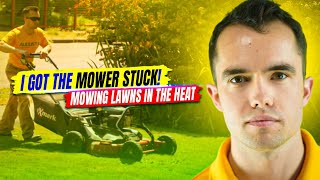
Mike Andes mows five lawns in one hot day, showing why he prefers 30-inch walk-behinds over zero-turns for smaller properties. He completes a 56-minute job in 23 minutes, explains his pricing strategy, and shares how to manage crew members and avoid burnout.
Questions this video answers
September 1, 2020.
Estimated 56 minutes; completed in 23 minutes.
They state about 80% of their lawns are under "6,7000" square feet (as spoken in the video).
Chapters
This is bad news.
Don't try this at home, boys and girls.
Hey, everyone. Today we are going to be mowing some lawns. We got five lawns or so. This morning we had an employee orientation for Lucas, new team member at the local shop. Josh is joining me. We're. It's almost noon now, but we're hopefully just going to knock out a few of these lawns, get some good content for you all. So if you don't know how to mow lawns, watch this video. Not really. I'm not the best at mowing lawns, but hopefully it'll be a little entertaining, you know, get some good content. We'll try to beat these budget hours. It's nice and hot out. Should be pretty simple to be budgeted hours. They get some of these mowers knocked out.
I don't know who had the bright idea of switching to 30x's but this ain't gonna work.
It was at this moment that he knew.
Figure out how a solo person can do this. Oh, I know. Oh, it's cool. It hit this because, see, I could tip it, but then it's going to hit you. This or this.
Don't try this at home, boys and girls.
One eternity later.
The good news, you got through the bad news. We gotta come back.
Sam.
That was a horrible idea.
All right, I'm gonna read the notes again just to make sure I didn't miss anything. There's a bunch of notes on this person's property. Almost always the.
Yellow slips come from when people just don't read the notes. I'm not getting a yellow slip today. Boom. Okay, here we go.
So on this property, this is the type of property where you could probably use a zero turn. You could definitely use a zero turn on this lawn. But a 30 inch mower probably is gonna take two or three minutes longer, honestly. Well, I hope. I can't really tell what the lawn size is, but that's basically the decision we've made to simplify the services. It's a whole lot easier to teach someone how to use this ramp and this 30x mower than it is zero turn backing up a trailer like this, this driveway, for example, you'd have to jackknife the trailer and pull out and all that stuff. This is a lot easier. Takes a little bit longer on the lawn, but cheaper to get going and easier to train.
Sam.
So some of, some of you might be like, well, should I use a 30x30 inch mower all the time instead of using a push mower or certain of using a zero turn and enclosed trailer. And it's not right for everyone, right? Don't just do something because you see someone like me on YouTube, YouTube using like, oh, I gotta get that piece of equipment. I gotta get that type of truck. Do what's right for your business model. If you're, if your average lot size or, sorry, if your average square footage of the turf on your properties is like an acre, you're not going to use a push more. You're going to have to get a zero turn. In our model market, we are able to get away with 80% of our lawns being under 6,7000 square feet. So like this lawn, anything bigger than this, you probably want a zero turn. It's probably about 7,000 square feet of turf. It gets the job done. 30x gets it done. And honestly, probably not a whole lot slower than a zero turn because you got all these wheel, all of these trees in the lawn. You got to go around all of them. So with a big zero turn, you're gonna be going around these anyways, leaving tire marks or trying to go really slow to prevent that. Whereas this isn't gonna take a whole lot longer. So people, you know, it is definitely easier to be on a zero turn sitting down. So it's easier on your buck. But in terms of efficiency on smaller properties under 7,000 square feet like this one, it doesn't take a whole lot longer. So one thing I see a lot of people doing in our company as well is when it's dry and the grass isn't growing much, they'll still weed whack the perimeter, even though it's the same height as the lawn that you're trying to cut. What ends up happening is along the edge, there's almost no grass eventually over the course of the summer. So there's times when literally you don't need to weed whack, especially if you're doing horizontal, always vertical edges to clean them up. But on that sort of along where there's that border, it's kind of a mistake almost to keep going horizontally, keep going lower and lower, and before you know it, there's no grass. Weeds start growing a lot faster there. It's not good for the lawn. So on a lawn like that, you save so much time this time of year when the grass isn't growing. So we had estimated 56 minutes for this job. We got done in 23. So. But again, that's not normal. Like usually during the spring, you'd have to make sure you Edge, every single part of that. But when you're doing a horizontal edge, it's just so much faster in the summer. All right, next one up, putting a property cleanup. So weeding the beds and mowing. Let's go ahead and map. Here we go.
This ground is like clay, so almost kick it up. See the roots?
This is what we call the coronavirus of the landscaping industry. It's called a horsetail. You pull it, and it still keeps growing. Same thing happens with the root. So I didn't even get the root here. Probably went another six inches down to the ground. So on these lawns, on these properties, we only get like 15 minutes budgeted to weed. But as long as you stay on top of it, it's not so bad. But if you let this go for, like, even three weeks, it becomes an hour's worth of weeding. So just a matter of actually spend the time. A lot of our yellow slips have to do with weeding. And just because people will skip it once or twice doesn't really seem like a whole lot, but at least a month later. So a whole bunch of time wasted trying to get caught up. About to do our last lawn. But I wanted to address something that has come up. Wow, there's a mower right there, man. You get one of those bad boys in action. So come up a few times about kind of just this time of year, people was kind of burning out. You know, physically, it's been a long year, and, you know, we're now towards the end of August. You still got a few more months in the growing season, but physically, you're drained. You're tired of dealing with customers, employees. It seems like every day you're, like, wore out. So a couple things I would say, number one, you have to work on making sure that the business is financially stable. That's the first thing. So that might mean raising your prices and not growing as fast for a little while, because the next step that you can't do until the profitability and the financials are at least stable, the next step is creating very defined boundaries of when you can and cannot work. So I mentioned it yesterday to Nick, one of our franchisees, on a coaching call, and I think Josh got on some of on video. But creating very defined boundaries in terms of what times you can work on the business or when you shouldn't be working on the business, whether it be like you get an hour when you get back home to be able to work on paperwork and the computer things. But then after that, it's like you're done and realizing that it's gonna cost the business maybe some growth or maybe a little bit of profit or you have to pay someone part time to work in the office to take care of the book work. Like that's going to come out of the profit of the business. So getting that part first taken care of and making sure you have a solid profit margin means that you can then afford to make sure you have clear defined boundaries. Like I'm not working out, you know, past 7pm for example. And creating very defined boundaries that you have to live by can really create some sort of steadiness in the whole chaoticness of running a business and really being able to work 24, 7 if you wanted to. And so creating those defined boundaries is very important, especially if you have family and a spouse that need you around and need someone that's going to be present. And so that's what I would say. If you're kind of running into burnout, number one, a lot of times that happens because of the financial pressure. So you've got to raise your prices. That might mean you don't grow as much, might mean that you lose some customers, but you've got to raise those prices, create some sort of a profit margin that is sustainable, and then have the profit to take those cuts of not working all night long or not doing the book work on all Saturdays and Sundays, or doing estimates all of Saturday and then doing the book work Sunday and then going right back into the, on Monday, Tuesday, Wednesday, Thursday, Friday, you'll burn out. And so creating some defined boundaries of when you can and cannot work is something that might help this time of year.
It's this time of year when the grass is hardly growing and we get these jobs done in like half the amount of budget time. We do something we call the wow effect. Wow without words. So without the masking, you do something a little extra. Like we just did. We knocking the weeds out in the lines of the creases of the concrete. So without words, you know, we do something extra for them usually only this time of year when it's just like dead grass. These folks are out of town just trying to do something a little extra for them to make it look nice. Without words. Wow. The wow effect.
Last paycheck was ridiculous, man. Nick made $32,000 an hour. Couple of them made like 29, 30. This PayPal.
Nick will probably make 45, 145 an hour. Oh, it's crazy. He really helped him. He did a, a 60 hour job in 21 hours.
Even did extra like a face tying them and everything. Yeah. Oh, I gotta do a shout out. Shout out to Dave and Matt Atkinson up in Canada. Been talking with Dave the past couple days. They are in that phase of kind of a hybrid P4Pmodel and they are considering dropping their HOAS or what's in Canada. It's called Strata, which is like commercial condos, things like that. So we were talking about yesterday, but wanted to give a quick shout out to them. If you've ever been to the conference landscape summit that we have in January, you know Dave's the highlight of the show. So shout out to you guys. Atkinson lawn care, Atkinson Landscaping up in Cloverdale, bc.
Yeah, so something we always do for our crew is like if you finish early, like we're. We only mowed for like we're pretty soft these days, so we can only handle two hours at a time. So we only did two hours of mowing just for you guys. But really all our crew, if they're finishing early, they know to kind of check in with the office and just see if anyone else is in is needing help. Especially on a Friday like today. We're trying to wrap up the week. If anyone was running behind, they could route us to go help them out and finish off a couple from their. The end of their route. Just so everyone finishes up at a decent hour. So usually they know that they're finishing before like 4 o'. Clock. They should check in with the office if they finish their route. So we're only 4 or 5 mo's a day. We're pretty, we're pretty slow and retirees. So we just try to knock out a couple and hopefully mount and yeah, so that's pretty much it.









