I Spent $340K to Start a Lawn Care Business (Numbers Revealed!)
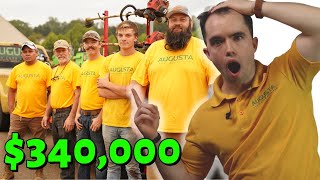
Mike Andes (Augusta Lawn Care) explains why he spent $340,000 in cash to start four new out-of-state lawn-care locations (about $85,000 each). He outlines a three-year plan targeting $500k–$800k revenue per new location, an expected distribution of ~10% (≈$50k per location) after profit-sharing, and a goal of $200k total distributions across the four sites if targets are met. He defends operating multiple modestly sized locations rather than scaling one site—arguing this keeps overhead low, enables a "working GM" model supported by a centralized Command Center, and creates upward-mobility (3F franchise-fee forgiveness) for frontline staff. He currently owns eight Augusta Lawn Care locations and says these operations generate far more profit than his media/business-education activities.
Questions this video answers
$340,000
About $85,000 per location (original plan: $80,000, increased to $85,000)
Between $500,000 and $600,000 (goal stated as 500k–600k; general band 500k–800k mentioned)
10% of distributions (he clarifies this is 10% of money taken out, not 10% of profits)
Approximately $50,000 per location and $200,000 total across four locations
Chapters
I'm going to be starting four more businesses. They're all lawn care businesses and they're locations outside of my state. Today I'm going to walk you through the math behind them. How I'm spending $340,000 in cash to get these started off the ground and how they're going to be better than if I just started one location instead of the four. So let's go ahead and break down my investment. So my investments me a total of $340,000. That's four locations. I'm spending $85,000. I'm going to. Originally I was planning to spend $80,000, but once we brought all the managers for training and had to do accommodations and travel and everything was just getting a little more expensive in terms of like the trucks and things. So we're spending about $85,000 to get those started. Now I'm gonna be making a video in just a couple weeks showing us buying all the stuff, the whole process of hiring the managers, bringing them the training. It's gonna be a great video. It was shot by my regional manager, Chuck, and I'm really looking forward to sharing that with you. I. But that's my investment. Everything was done with cash. We aren't going to any sort of debt for this at all. Three year plan. The goal with these is to get them all above 500,000. They're incentivized the general managers that we're hiring to get above 500,000. But assuming they get 500,000 to 600,000, the goal within three years is to be at that spot and have 10% of distributions, not 10% of profits. But actually the money that I take out of the business is 10% because we do a significant amount of profit sharing. Up to 35% of my profits. Actually a little bit more than that is shared with the general manager, the frontline team and the regional manager. So I guess all in all, up to 40% of my profits could be shared with the team. That's why I'm only assuming 10% distribution. But if that happens. And the reason, by the way, if you think that's crazy that I'm giving that much profit away is I literally have not bought anything, hired anybody, et cetera. So I'm okay when I'm completely removed and it's basically passive to be be giving a good chunk of the profits away. But if this is happening, I'd be getting $50,000 in distributions per location. That would equal $200,000 in distributions after year three. Okay, if we can get there. That would be great. That would be the goal. That would be approximately 2,000, about $4,000 per month in distributions per location, $200,000 total. Now the big question is, why do I own eight locations of Augusta Lawn Care? Because I already have four. We've added four just recently. Why would I have eight locations instead of one massive location? Because my very first location, we've just kept between 1.5 to 1.7 million in revenue for the past three or four years. It's been really profitable and we haven't tried to continue growing it. Why would we not just take that 1.5, $1.7 million business and make it 3, 4, 5, $6 million in annual revenue? Because theoretically, by having these four new locations, I'll be adding about $2 million in annual revenue plus, plus the other four locations that I have, adding another about $3 million in revenue. It's like, well, why wouldn't you just have a $5 million location? Great point. Let me break down why that is and why it's important to me that I have locations that are between 500,000 and 800,000 in annual revenue instead of one or two locations all doing 5, 10 million dollars in annual revenue. So first and foremost is that for each of these locations, I only need one overhead person. And so I've seen that once a location gets above $800,000, you need at least two non revenue producing people at the top. You need a general manager, and you typically need an office manager estimator. Now, these positions, when you're doing a million million and a half in revenue, don't make any money. They're overhead positions. And not to say that they're meaningless positions, it's just harder to make more profit from the business once you get above that level. Because if I have someone that I have to pay $50,000 in salary or, well, $50,000 multiplied by a 20% profit margin means that I actually have to generate $250,000 of revenue to get the $50,000 of profit that I am giving to that overhead person. So I've got to grow the business by a quarter million in revenue just to cover their wages. So instead of trying to grow, grow, grow past 800,000, I'm more inclined to keep my locations around 500,000 to 800,000. Now at Augusta, you can grow a larger location. My very first one, very profitable, I usually take away 2 to $300,000 in distributions every year from that location, and it does 1.5 to 1.7 million. And I don't have any plans of making it massive. Alright, but this is the deal. Why would I do these eight instead of the one number one, one overhead person? Now what's really cool is we have what we call the working GM model at Augusta Lawn Care, where this one overhead person is a general manager. Now above all eight of my locations is what I call regional manager. That's Chuck. You'll get to meet Chuck here in just a couple weeks. But this one overhead person is a general manager. Now we call them a working GM because at 5, $600,000 in annual revenue, I expect them to be working out in the field two to four days a week producing more money. And I say two to four because during the spring there's going to be a lot more estimates and hiring. So they're going to be less hours out in the field. Whereas during there's going to be some periods of time, like in the winter, they're going to be working four to five days out in the field. But the bottom they're producing revenue. They're a working gm. They're not just doing estimates, not driving around in an AC vehicle all day long. They are actually producing revenue. That's how you're able to be ultra efficient. Because this is the deal. This is how we do at Augusta Lawn Care. These general managers, they have to take care of the estimating and the hiring and keeping the team together. They don't have to manage is the marketing, answering the phones, the emails, pay for performance, payroll, none of that. Because command center handles all the backend admin stuff. And you're like, well, it's going to cost a lot of money. It's a whole lot cheaper than hiring some overhead person full time when I don't need them full time. At 500,000 to $800,000 in annual revenue, they're usually going to spend $1,000 to $2,000 at Command center to get all these things done throughout the year. And it'll go up during the spring and it'll go down during the summer. And so that one overhead position that general manager is actually producing some revenues. I don't even really consider them overhead position because they are producing revenue and they should at least be able to cover their wages and their salary for the revenue that they create in the field now. And by the way, a lot of big companies get bloated by having a whole bunch of overhead people. And I've seen some locations and I've seen some businesses have one person in the office for every person in the field, bloated, very difficult to make a high profit margin. And I've just seen them, companies get bigger, somehow the profits start slipping away because they keep adding more overhead people. An estimator. Then I need a foreman, then we need a general manager. Then I need an office person, then I need an office assistant. If you have five people in overhead positions, you might literally need to create $1.5 million in revenue just to break even. Okay. So skill level required for general manager position. Okay. This is the main reason why I want to have these smaller locations is because to find a person that can run a 2, 3, 4, $5 million business is extremely hard to find. Two reasons very hard to find, very hard to replace them. Alright. And very expensive. It's very expensive. If I'm going to go try to find someone that has the experience to be able to and the leadership to be able to run a business that has 20, 30, 40 employees, very, very difficult to find them. So what happens is because it's so hard to replace them, you start just paying them more and more and more money because it's so hard to replace them. You can't go and find someone that can immediately run a landscaping business that has 20, 30 people. However, what I can do is I can take someone that's entry level, understand the way that we operate, been in the field for maybe one or two years, and I can groom them into becoming a Leader and managing four or five employees in this model of 500,000 to $800,000 in annual revenue. So it's much, much easier to find my general managers as well as being able to pay them a much more reasonable overhead salary. Because if I have to find someone that's gonna run a 40 person business and has the experience and has done that before and is okay with managing multiple millions of revenue, I'm gonna have to probably spend 150 to $200,000 just on their salary. Which means if I'm running a 15, 10, 15% profit margin business, that's my distributions, that's literally gonna mean I'm gonna have to grow a million dollar business just to pay that one person. I'm gonna have to produce a million dollars in revenue just to pay the overhead required for 150 to $200,000 salary. And furthermore, that person's not coming from internally, I'm gonna have to find them somewhere. I'm gon.
Very, very difficult to find them. And they're expensive. And what happens when they leave? Now I'm left with this Black hole. Guess what's gonna happen? I'm gonna have to step in as a CEO and take over that location and manage it. I don't want to be doing that. I want to be able to step away from the business because I don't want to own a job. I want to work on the business and allow other people to grow up inside the organization and take these leadership positions. But I can't do that if I built this behemoth that it very difficult to bring in managers for. And that leads me to my third point, and that is upward mobility for future frontline team members. It's very important to me that my general managers have experience out in the field and they've come up inside of the organization. Now when we're starting these four brand new locations, a couple of them we did have to hire outside of the existing team because we only had one location. I'm adding four more around it. And so, yeah, a couple of the team members were frontline mowing team members. They literally started a year, two years ago, mowing grass. And now they're becoming general managers. Why can I do that? Because they don't need a ton of experience. They don't need leadership experience and have 20 years of running a lawn care and landscaping business and a whole bunch of years under their belt. They don't need that. They just need to understand the systems, understand how we operate in our culture, understand pay for performance, and they can run a four, five, six person operation. And I want the upward mobility. I want the ability for my frontline team members to be able to look at people in the organization, be like, oh, they worked here for a year and they got promoted to being a manager. Oh, they worked here a couple years and they went and started their own location. We have what we call the 3F program at Augusta. Franchise fee forgiveness that allows them to go actually start their own location. After working in a location for two years, they can go start their own franchise for no initial fee. And we do that to allow upward mobility. It's very, very important to me that we don't create dead end jobs in the lawn care and landscaping industry. And so by having this $500,000 to $800,000.
Location, it creates a nice opportunity to hire someone into a general management position. And I don't need them to have all these years of experience. I cannot. There's just no way I'm going to hire someone from mowing. And a year later they're going to run a $4 million operation or a $5 million operation, the likelihood of that is very, very slim. Whereas if I can take someone and they get to know the systems, how we operate inside the software, how we operate in our culture at Augusta Nation, how command center works, and what they do for us, if they can understand in 6, 12, 18 months, there's absolutely no reason why someone with a good personality, that's driven, wants to be able to sell, wants to be able to control their own destiny with profit sharing, that they can't run four, five, six, seven employees and be able to run a 500 to $800,000 annual revenue business. And I want that upward mobility. I want the opportunity for. For frontline team members. We say they did it, and they did it, and they moved up to general management position, and they were promoted, and they went and started their own location. And that's what I'm really interested in. So we're gonna follow this story, and over the next couple weeks, I'm gonna show you exactly what's happening as we spent the $340,000. I'm gonna show you all the general managers that are getting started at the new locations. And currently, I have eight locations from Augusta Lawn Care that I personally own. And what's crazy is a lot of people online think that I make all my money on YouTube or on courses and all the rest of it. Let me be very clear. In one day, my eight locations make me more in profit than the entire year of 2022 did on the media and the web design and the videos and all the content I make and the courses, everything combined for the whole year of 2022. I make more money and profit in one day on these eight locations than I do in all the media stuff that I do. I love boring businesses. I love lawn care and landscaping, and I truly believe you can make them extremely profitable if you follow systems and you put people in places to succeed and they take ownership of their position. That's how Augusta Lawn Care will change the level of professionalism in the landscaping industry. I'm Mike Andes. Check out the links in the description if you want more information, and I appreciate all of your attention.










