Landscaper INJURED on the Job! [Rushed to the E.R.]
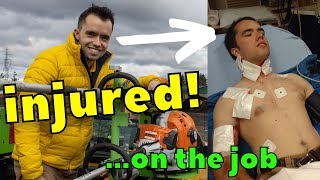
Mike Andes (Augusta Lawn Care) recounts multiple landscaping workplace injuries — from a bricksaw finger cut to a dump-truck incident that nearly amputated a finger, plus his own PTO-related choking/neck-risk episode — to emphasize the importance of insurance and safety. He explains workers' compensation (including Washington State L&I), gives rough cost estimates for medical care (surgery and ER/ambulance), and offers prevention steps: safety meetings, PPE, training, simpler service lines, hiring skilled workers, and drug testing.
Questions this video answers
July 17, 2021
About $5,000–$10,000 (surgery) and roughly $15,000–$20,000 total including wage benefits
Roughly $10,000–$15,000 (ambulances, scans, X-rays, ER care)
Chapters
Hey, everyone, it's Mike Andes, and you're listening to landscapebusinesscourse.com today we are going to be talking about injuries on the job. And I have had heard of horror stories of people literally losing their life and their employees losing their life on landscaping and lawn mowing jobs. So we're going to talk today about several different instances where this happened, where I had to take employees to the emergency room or I had to go to the emergency room. And we're also going to talk about how you can avoid some of these type of situations. And in the past two weeks, two of our franchisees at Augusta Lawn Care have called in desperation because they've had to make runs to the ER with their employees. And it's a very scary thing. So if this video can help prevent even that happening one time, it would be an absolute honor to make sure that keeps that from happening to you. It's not a good experience. It's not fun. It's very scary, not just for the you, but also the employee. So let me tell you a couple of stories. Lee is our current office manager, the one that you've seen before, and he is the office manager at the local shop. I still remember one time when he cut his finger on a bricksaw and he had gloves on, but it went through the gloves, nicked his finger. And he was basically holding, you know, hanging on. And fortunately, he was okay. But I still remember showing at the job, blood was everywhere. He was holding, you know, with his blood around, blood all over the place, and he was holding his finger on, basically. And another time, Charlie, similar thing happened, except we used to have a big dump truck, and the dump truck had on the back, like the flap that allows, you know, kind of governs the where the gravel's falling out. It would swing back when you were dumping, and then it would swing back in place when you put the dump down. So what happened is, as the dump was going down, his finger was just on the edge. He was trying to move the cobbles away as they had all been dumped. He was trying to push them away with his leg. And he had his hand up on there on the main bed part. The door came back, swung, and just hit his finger and literally severed the whole thing. And it was hanging on by just the skin. At the same moment that happened, the city inspector was coming to come check out our work because we were actually working on city property and they had hired us do a project around the park and around the bay. And so literally, the guy shows up the minute that happens. So there was two of my employees there. I had just showed up to the job. I see this happen. I knew he was hurt right away, though. He hit it and basically was holding his finger on. And so I just quickly, quietly said, go to the truck, Go to my truck. So he just walked to the truck. I had a spare shirt I gave him. He just wound it up and it held his finger on. And then the other employee, fortunately, was able to deal with the city inspector, like, make sure everything was fine and go over the job. But that was not fun. I remember driving him to the clinic in Blaine, and that was not fun. He ended up having to go through surgery and all of the surgery costs and all the rest of it that got covered by workers compensation. This is why the importance of paying your employees correctly, not paying them just cash under the table. The importance and the benefit of having that is if there's workers compensation claims, I.e. they get hurt on the job, they're going to be covered. So in all, like, I think the surgeries cost about 5 to $10,000, plus they gave him pieces of his wages as kind of a benefit for about six weeks that he missed work. And so all in all, probably cost about 15 to $20,000 that we didn't have to pay out of pocket and that he didn't have to pay out of PoC. But it's covered by workers compensation. Now, workers compensation as an owner, you don't have to do it. You can elect to be as part. You know, if you're working out in the field, you can be part of the workers compensation policy. And for every state, it's a little different. Some states, it's very public in terms of going through the state for your workers compensation. Other companies, other states, you can get private insurance or private workers compensation or workers insurance. In every state, it's a little bit different. But the benefit of having that is that the employer and the employee don't have to pay. It is going to come from either the insurance company or the state, depending on how your state is run. Now, personally, I've never had it where I have workers compensation as an owner, because it's something that you can elect into, and I don't want to have to be paying premiums because I'm working out in the field. So there was a time when I got hurt, and you've heard me tell a story before, when I was underneath a dump truck, I was manually turning on the PTO because the cable from the. Where the driver's seat was Was not working. So I went underneath manually turned on the pto. My sweater hoodie got caught in the PTO and it ended up choking me out. Fortunately ripped open, I fell out. But they thought I'd like potentially broken my neck or had a concussion. So they rushed me to the hospital and all of that. Just like going to the hospital, they had two ambulances. I was in there for several hours. They did a, a couple CAT scans and other things. X rays on my arm and all the rest of it. And that probably would have cost, I don't know, probably 10 to $15,000 by the time they kind of two ambulances taking me down and all the doctors and then a couple scans, the X rays and all the rest of it. But fortunately I had insurance. And so in my opinion, if you as the owner are not going to be on workers comp and you're out in the field working, you should make sure you have some sort of insurance, whether that be with the state or whether that be the private health insurance company to make sure that if do get hurt, things are covered. And there's a lot of peace of mind that as your company grows you want to make sure you do have workers compensation. So there's not this constant fear that if one of my employees get hurt, they're either going to sue me or I'm going to pay for the bills because I feel bad and I'm going to be out hundreds of thousand dollars because they literally are working around equipment that can kill them. And I have heard of people doing swimming pools and damn. Or on like steep embankments and excavators falling off the cliff, bulldozers going over the cliff, people accidentally dumping tens of thousands of pounds worth of material on to an employee accidentally. These things happen in this industry. It's very important to make sure that you have that insurance as your company grows. Whether it be liability insurance, whether it be property insurance or whether it be workers compensation and that type of insurance. You really want to make sure you invest and it's okay. Giving up some of your profits to make sure that there is some level of just knowing that you're going to be okay. That each day that goes by that someone getting an accident is going to. Is not going to put your business under that someone can't sue you because one of your employees drive the truck into their property. Like these are things you want to make sure that you have covered. Now when it comes to L in Washington state, we call it L and I Labor and Industries. It's where we get workers compensation. And that's where a lot of this is processed. But for us, when it comes to workers compensation, we are going to be, yes, you are going to kind of pay for it. If an employee has to take a claim, if an employee is consistently making a claim, or your company is always having people go into the ER because they're getting hurt, you're going to end up paying a higher rate, a higher premium to get workers compensation because you're more risk adverse. It's kind of like your credit score, right? If you don't make payments and you're late on payments, your credit score is going to go down and you're going to end up paying, end up having to pay higher interest rates, you're not going to get much from the bank for a mortgage, etc. Same thing kind of goes for workers compensation. If you're getting a lot of employees or yourself going and getting medical bills paid for because you're hurting yourself all the time, your premium is going to go up. And so like when these things happen, I just mentioned for a year or two, it really did affect our premium and it might be a few cents, 1 or 2% more in premium for every employee. And employees pay a piece of workers compensation, but a lot of that falls on the employer. So it does cost you. It's not like workers compensation is free, you are paying for it, but it's like insurance in general. It's the peace of mind you have knowing that if something crazy happened, you would be covered. Now there are things you can do in your business to keep these kind of crazy things from happening. Number one is safety meetings and having standards around, like what you can and cannot do. Instead of just throwing people in jobs and having them figure it out, there's actually safety meetings. And then you go over things that are wrong, whether it be having eye protection or ear protection or making sure they have gloves if they're handling heavy blocks and patios. Pinched fingers are a big, big problem when it comes to like blocks and paver patios and all the rest of it. Lots of heavy equipment, lots of handling with your fingers and training your employees, really making sure that they understand how things should be done and making sure they understand how to operate pieces of equipment. Making sure that they aren't just like learning on the job. And that job is not only on a customer's property where they're less likely to ask for help, but they're also in a kind of precarious position. They're not in a big open area they're in a position where it's very difficult to operate that equipment. Also, making sure you simplify your business, simplify the services that you offer, that's going to also allow you to reduce the liability of getting an employee hurt on the job. Also hiring more skilled employees, this is easier said than done, but hiring people that already have the skills required to do the job is going to reduce the amount of people that don't know what they're doing. You got to train them brand new. They're really green. They're the ones who usually make a lot of mistakes and hurt themselves. Last thing that you can do is do drug tests. A lot of times these worker, these workplace kind of injuries happen because people are on medication, either prescription or, you know, other drugs, on street drugs. And you definitely want to test for that and make sure you get rid of as much of that as possible because it will impair their. Their ability to do the work and it will absolutely lead to people getting hurt. I'm Mike Andes, landscapebusinesscourse.com We'll see you tomorrow. Hey, everyone. Mike Andes here. Thank you so much for watching. The reason we make this content is for you to grow your lawn care and landscaping business. Our goal here at Augusta is to change the level of professionalism in this industry, and you are a big part of that. Thank you so much for watching. We'll see you tomorrow.









