Lawn Care Business: KNOW YOUR NUMBERS!
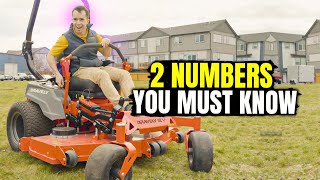
Mike Andes (landscapebusinesscourse.com) presents a live YouTube session titled "Lawn Care Business: KNOW YOUR NUMBERS!" focused on two primary metrics every lawn-care/green-industry business owner should know: (1) Close Ratio — estimates won divided by estimates sent (monthly tracking recommended); and (2) Revenue divided by Labor Cost (labor revenue ÷ labor wages) to measure per-employee efficiency. He illustrates with numeric examples (cost-per-lead, customer acquisition cost calculations) and gives target benchmarks (higher close ratios when starting, acceptable lower ratios for mature brands with low CPL). The talk includes candid remarks about recent operational mistakes, leadership responsibility, and a live Q&A about hiring, pricing, business structure, and payment terms.
Questions this video answers
March 19, 2021
Estimates won divided by total estimates sent (usually tracked monthly).
Approximately 60–70% (he says it needs to be above 50%; ideally 60–70%).
About 30–40% (acceptable when cost-per-lead is low and prices are higher).
If CPL = $50 and close ratio = 20%, CAC = $50 ÷ 0.2 = $250 (example given).
Chapters
Sam.
Hey, everyone, It's Mike Andes, landscapebusinesscourse.com and today I'm gonna be doing a live show, and I'm going to share a little bit from my heart real quick. Then I'm going to go ahead and share two numbers that you must know in your lawn care business. So many of the time, often people ask me, hey, I don't know my numbers. What numbers do I need to know? I'm not going to give you 20 things you need to know in your lawn care business and metrics and ratios. I'm gonna give you, in my opinion, the two most important ones and ones that I feel like you must know if you're in the green industry. So I'm gonna get into that. But before we do, while everyone's joining on, I want to kind of share something. I mean, somewhat vulnerable, because I think sometimes when you have a YouTube channel or you share publicly and the way that I do that people think that, oh, like, everything just must go fine, everything's a success, you're always winning, you know, you don't have bad days, et cetera. And I want to be real because that's just not what business ownership is. That's not what entrepreneurship is. It's not what being a leader is about. And so, you know, today we, we messed up at the franchise level and we had some mistakes at command center, and I'm, you know, we are hitting the spring rush with a massive amount of franchisees, and we dropped the ball on a few things and we disappointed a couple of our franchisees. And I hate disappointing people. And I think if you're like me and you're in the service space business and you're in the service industry, you love to see people satisfied. You love to do good work and make customers happy. There's nothing that makes you feel better than a positive review online. There's nothing worse than to have a negative review even in person, or feeling that a customer isn't completely satisfied with your work. And for me, it's always been my Achilles heel, and that is not just customers, but just people in general just disappointing them. And, and not so much like, I don't really care what people think about me, but when they expect something of me and I disappoint, it's very, very hard on me, very difficult. So today was a tough day for me, knowing especially too, we had franchisee training. I was training all day long knowing that in the background we were working, my team was working very, very hard. They're still working, literally 14 hour day plus trying to get some things resolved. We dropped the ball on a few of our franchisees accounts at Command Center. There's no excuses for it. And then the day it falls on my shoulders and you know, there's nothing you can really do when you have a customer, for example, that you're mowing a lawn for, you're doing a landscape job, that they're not happy and you just have to be honest. And like, at the end of the day, the only reconciliation I would have when I broke someone's window or made a skid mark on their lawn is like, I try my very hardest every single day. And I really, really care for my customers and I do my, I'm trying my absolute best. That's the only reconciliation because in the moment you feel horrible. Like, I still remember the first customer that I had a complaint from and I still remember getting the email exactly where I was driving. I was merging onto like a Y junction and just feeling like, just like sick in my stomach. And that kind of, that kind of returns. Days like this, like, it's not easy. You know, you've disappointed a franchisee. They might have lost out on a client because of something that we messed up at Command Center. And we're not perfect. And we try our absolute best. We care 110%, but we make mistakes too. And so regardless of whether or not I make YouTube videos or make podcasts or teach how to do lawn care landscaping, there are still mistakes that I make. There's still things that I don't foresee. The amount of growth that we're having and how much calls and estimates and the fact that we need to hire sooner. Like, I still make mistakes. And so the day was an obvious reflection of that. And so I just wanted to kind of share that because, like, I know a lot of times I share my numbers and I talk, I'm always teaching. And when you have someone like that, it can be very much like, oh, they must make no mistakes because they have an answer for everything, because they have Q and A. And just knowing the answer isn't necessarily always the solution. Because I know the answer is to what our problem was. I know what the answer is. But in the moment, you're just trying to play damage control. You are trying your absolute best to make up for the mistakes that you've made. And yeah, it's a punch in your gut. You feel sick. You wish you could have done things differently. You beat yourself up over it. And then you got to wake up the next day and be like realizing that like, I'm trying my absolute best here and I'm going to try to do everything in my power to make it up to these people. So I just want in case today you had like a massive negative review or someone was really disappointed with you, just realize that in this industry, all of us, if we really have a heart for our customers, for our employees, for our community in the service based business, when we don't serve, it feels horrible. It feels like, it feels just, I can't explain, like the gut wrenching feeling it has when you know you've let down someone and they haven't been satisfied with what you've provided and what you've promised. And so today was one of those days. It was a rough day. But hopefully me being a little bit more vulnerable helps some of you. And I want to say a big thank you to everyone that literally right now is still working at command center, trying to make it up to the people that we did disappoint today. And if they're, if the people who are disappointed today are watching, I'm sorry, commands are we are going to become better from what's happened. And yeah, I guess that's all I got to say. But let's go ahead and jump into the real reason why you're here. And that is what are the two numbers you need to know for your lawn care business? So it's really, really simple. I'm going to give it up front. So if you want to leave right after this, you can. Since I've already kind of gone on for a while, I'm going to give you the two numbers and then we're going to break it down in more detail. The first one is close ratio. Most of us know what that is, but I'm going to make sure you do in case you don't. And number two is your revenue divided by. I can't even spell now. Look at that. It's been a long day. It's been a long day of training. We have several of our franchisees in town. Revenue divided by your labor cost. Right? It's gonna do labor cost. Cool. All right, so these are the two numbers we're going to talk about. We're going to dive into these a little bit deeper, how to calculate these and make sure we're on the same page. So first and foremost, close ratio. Close ratio is simply the one, the estimates you've won. So estimates. Estimates, one divided by estimates total or estimates sent to the client. Okay, so this is a really, really important Ratio. This number, in my opinion, if you're in high growth and you're trying to grow really quickly, needs to be above 50% in my opinion, like it should be 60, 70%. Now, what is going to cause a estimate close ratio to go down? Could potentially be the fact that your prices are really high. Or maybe it could be that your estimates, you're taking too long to get to your, your estimates done and sent out to the client. And it could be the fact that you aren't professional enough and that you're, you're you when you show up to the property to do the estimate. You didn't blow their socks off with the level of professionalism that you had. There's so many variables that go in your estimate close ratio. And so let's say, for example, we sent out, you know, five estimates a day for the whole month, so 20 working days to say 100 estimates that we sent out. Okay, I'm trying to do this 100, okay, 100 estimates that we send out for the whole month. Now you want to break this down, in my opinion, at least once a month to know what this number is and catch trends before they start to be a negative impact in your business. Now all you're going to do is say, okay, how many estimates did I win? How many estimates were sent and were completed and won by the. By the customer accepted them? I should say. Now let's say that is 34, 34 estimates you won and 100 of them you were sent. That would be a 34% close ratio. Okay? Now as your business matures, you're going to raise your prices and therefore raise your margins because you're going to get more brand awareness at the beginning of your business. We're just getting started. Almost every single lead that comes in your business is going to come from an advertisement. You doing some sort of Facebook, Google door hanger postcard, every door, direct mail, yard sign, some sort of advertisement. Almost every single lead is going to come from that because you don't have any brand awareness. You don't have any brand penetration. You don't have trucks driving all over the place for them to be able to see it and give them a call, give you a call. And so at the end of the day, at the beginning of your business, you're going to literally be paying for every single lead that comes to your company. When you're paying for every single lead, you want to be closing, those leads you do not want to be paying. And only having a 10, 15, 20% close ratio that means that. Let's just do the math here. If I am paying $50, let's just say, for example, let's keep the numbers around $50 cost per lead. So CPL, my CPL is equal to $50. My cost per lead is $50 and I am only closing or one out of five, my closing ratio would be 20%. Okay, so let's run the numbers here. So let's say, for example, I have, I have a business and I am going to have. I'm going to do 50 estimates. Let's do 100. Just keep it simple. 100 estimates in the month and I've only closed 20. That's implies a percentage of 20% close ratio.
Now let's assume that every single lead that comes to our business we have to pay for. And as a blended average, our cost per lead is $50. What that means is that if I now divide that so I do my cost per lead divided by my close ratio, so I $50 divided by 0.2 is going to equal $250. Make sure you can see that. Good. Okay. Is it kind of. You can kind of see it. Okay, good. All right. So again, my cost per lead is $50. If my close ratio is 20%, I divide that by. So 50 divided by 0.2 equals $250. And $250 is my customer acquisition cost. At the end of the day, that drives how fast you can grow. It drives how much money you need to pour in your business in order to grow. And $250 customer acquisition cost is typically, especially in lawn care and recurring work business, not a good thing. $250 is way too much money to be spending on customer acquisition. Now the question is, how can I fix this problem? My $250 customer acquisition is a problem, but it all comes back to a couple numbers. Number one, I could improve my close ratio or I can improve my cost per lead and my cpl. So I could do one of two things. Let's do this. Let's get do better marketing. Let's focus on areas that cost, you know, it doesn't cost a lot of money. We can really focus on the areas that are performing well, whether it be digitally, etc. Let's get this down to 25. Our cost per lead is now only 25. And now let's do, instead of only our closing 20 of our estimates, let's go ahead and close 60 out of those hundred in the month, which is now going to mean that this is going to be a 60%. Close ratio. Again, we're talking about number one right here. Close ratio. Okay, now our closing ratio is 60%. So now when we go 0.25. Oh, man, I don't even have a calculator. That's horrible. One second. Stick with me, everyone. Calculator. See if I can pull this up. So, a calculator. We got $25, our cost per lead divided by 0.6, which is 60%. That's our close ratio, is going to mean that our customer acquisition cost just fell to $41. 41.67. That is now our new customer acquisition cost, literally less than 5. Like, dramatically. I get 5 customers for the cost of my old customer acquisition cost simply by reducing my cost per lead and my closing ratio. If I had to add a third important number to today's episode, today's live video, I would say that your cost per lead and customer acquisition cost are also numbers you should know. Okay, but we're not going to get there. We're only talking about close ratio. Because if I can move this close ratio, it has a dramatic effect on my overall business because it can improve. It can change my customer acquisition cost. Now, when your business is just getting started and you're paying for all of your customers, you're paying for every single one of your leads. You need to make sure that you are closing a high percentage of your jobs. Okay, again, I want to see 60, 70% or more. Now, when your business is more mature and you're really starting to focus on profitability, you can let that slide a little bit. So, for example, our corporately owned location, we might only close 30 to 40% of our estimates, but we're charging very high prices. We're charging extra fees on top of labor. We're charging overhead, recovery fees, et cetera. So we are okay with 30 to 40%. But guess what? We're not paying a. We're not paying for every single lead. We have a brand awareness. Leads come to us automatically, have lots of word of mouth, customer retention is high. We have lots of trucks driving around for people just to see, and our cost per lead is very, very low. But when you're first getting started, you wouldn't have a high closing ratio. If you are going to be paying for all of your leads, don't let them go to waste. Okay? So the number one, number one number you need to know in your business is that close ratio, which is the estimates that you've won in the month divided by the total number of estimates that you sent out right that is the close ratio. Number two is revenue divided by labor cost. The reason this is so important. So revenue is your number one most important variable cost in your business. So when I talk about variable costs, what that means is as you make more money in the business, as your business grows, as you get more work next week, your labor cost will go up. It directly goes up as the. If you get more work next week, if you double the amount of work that you have next year week, your revenue cost would go up. A fixed expense. So we're talking about variable versus fixed expense. So variable versus.
Fixed. Okay, so a fixed expense is something like insurance, rent, things that don't change month to month. You have a set amount that you're paying all the time, your payments on your trucks, etc. All fixed expenses, variable expenses. The biggest one you have in your business is labor, bar none. In this industry, labor is our biggest variable expense. Which means if I get bigger and bigger my variable expense, my labor gets more and more and more, where my fixed expense of like rent, I'm going to be able to get more trucks in the space, park them more, you know, organize things a little more, get more, you know, production out of that space, but variable, directly correlated with your labor. Very, very important to know what these numbers are. All right, so when we're looking at a variable cost like labor, the reason we need to track this number is because we need to know which employees are performing well, which ones are not performing well, and how is the business doing overall over the course of a week, a month, a year, whatever it might be. So what you're going to do on a daily basis, I would recommend doing this. And that is, you know, in the course, we talk about the scoreboard. This is that video. So go to the end. There's a video about the scoreboard. This is exactly kind of what I'm showing here. Revenue is how much the employee earned in that day for the business. Complete labor revenue. All right, so if I have to actually make this a little more clear, I do labor revenue. This is not total revenue, including, like materials and dump fees and anything like that. This is labor revenue divided by labor cost. Right? So if I look at labor revenue, let's say, for example, this solo route, one mowing guy goes out and makes $600 for the business. All straight labor, all right? No material cost, et cetera. And then let's assume over here that the labor cost for this employee, let's assume that he makes $20 per hour. And let's say that he worked for 10 hours. All right, so he clocked in for 10 hours for this day. All right, so that means that over the course of the day, we have to pay him $200. $200.
In total wages. All right, so his wages were 200, wages 200, and his labor revenue was 600. Okay, what this comes out to be is 3. Okay, I like using this method. I'm going to flip it in just a second. But I like this method because this number is very easy to share and for our employees to understand. Now you're saying, well, I like percentages. I want to see this in percentages. Very, very easy. It's just a mathematical switch. All you're going to do is flip these numbers. Now, instead of labor revenue divided by labor cost, we're going to do labor cost divided by labor revenue. Exact same numbers. We're just doing this now as a percentage. It's just a mathematical little switcheroo. All right, hang with me for just a second. We're doing labor cost.
Divided by labor revenue, which is $600. Well, that comes out to be is 33%. Okay, so what is our labor revenue divided by labor cost? 3. Now we just flip those around and make it as a percentage. What you can derive from this is 33% of the labor revenue that's earned in this day went towards wages. 33%. If this number, in my opinion, my humble opinion, if this gets over 40%, I start getting a little worried. If it gets over 50%, you're in trouble. Ideally, you want this to be under 30%. Okay, so we're always shooting for under 30%. Under 33. Oops. I. I think you guys are gonna block my computer. So, okay, so what. What should the numbers be? What. What. What should we shooting for? Because you. I want concrete numbers, Mike. I want concrete numbers. Okay, well, here it is. You want. Your goal should be under 30%.
You should be like, this is not good. 40% or above. And if you're at 50%.
It is in big, big trouble. In my opinion, if 50% of your revenue is going out the door towards labor, you're in a bad spot in this industry. Now, how can you fix that? You can raise your prices. You can figure out how to be more efficient and get more revenue in the same amount of hours from your employees. We talked about that in the last deal. Efficiency is super important. Raising your prices is good, but raising the efficiency can really blow the numbers off. And I could literally right now say, okay, well, what happens if we simply went, like, this, instead of taking 10 hours to do that work, what happens if I get more efficient? I get better equipment, I get everything streamlined. I train my crews better. Instead of 10 hours, it takes them eight hours. What does that do to the math? Well, now our wages are going to become $160 instead of 200. And we take 160 here, 160 here. And now let's go ahead and do the math here, because I could do that in my head, but it's going to be off just a little bit. So what do we do? Go to the trusty calculator. We do 600.
Divided by 160.
Just like that, 3.75. Literally. Big increase there from 3 to 3.75. Now let's look at a percent as a percent as a function of percent. We go 160.
Divided by 600.
Equals 26, 26.7%. All right, so we literally went from, what was it, 33% down to 26.7%. That difference of 7% is huge for your business. Huge. Okay, so this is the numbers that I would be looking at every single day for every single employee. Figuring out which is the highest performing employee in your organization is this number. It's not based upon just labor revenue. Everyone's like, oh, they're so fast. They're so quick. They're so. They're so awesome. But I paid them $25 an hour. Well, what if you're paying someone $15 an hour? They don't get quite done as much, but they could actually have a better percentage. This is a number I feel like you should be running every single day in your organization for every single employee. At least do this over the course of an entire week. You can add up all the labor revenue that your employees made for the week and then add up all of your labor cost and figure out these same numbers. Very, very important to track, I feel, on an employee by employee basis to know who's efficient and who needs help. Maybe they need some more training. Maybe they're being lazy. Maybe they are slacking off in the field, being less efficient. Maybe it's taking them 12 hours to do this work. And now all of a sudden, this really starts to look bad. It's going to be over 40%, literally. If we take this to 12 hours, they become inefficient. They're stopping making problems. Let's just go ahead and do the numbers. All right, so we got 12 hours now to do the same amount of 600 hours. $600 worth of work, same thing. But now our wages are going to be $240. $240. And now over here, boom, boom, boom, boom, 240. Do the math. 640 divided by 240 or 600, sorry. Total labor revenue divided by our wages. $240 is going to equal 2.5. Okay.
We tell our guys everything under three is not good. 2.5. Okay, over here, we take 240.
Divide that by 600.
Equals 40%. I nailed it. Let's go. 40% is literally how much of our total labor revenue is going towards wages. Okay. That is a number you need to know, in my opinion, on an employee by employee and daily basis. At least do this on a weekly basis. Okay. Total labor revenue divided by labor cost going to give you that number. If you like percentages and that makes more sense in your brain, do it this way. Just flip the numbers. Labor cost divided by labor revenue is going to equal a percentage in my opinion. If it's over 40%, you should be a little bit apprehensive. You're either probably a little bit inefficient or you need to raise your prices because that's going to be an impact on labor revenue and labor cost. Okay. And then you want to be shooting for 30% or less. That's when you start making really good profit margins. We could do a whole, whole like three hour thing on how long and how that math works. We can adjust things, but those are the two numbers you need to know. Number one is close ratio. Number two is making sure that your revenue divided by your labor is an efficient number. And keeping track of it is the first step to making improvements in that area. What you track and measure, you eventually can improve. All right, so I'm gonna go ahead and answer a few questions here. Can't be too long tonight because we do have training for the franchisees next few days here. Okie dokie. One second here. Let me go and pop this up here.
I'll answer a few questions here. Comments? Hey, guys. Thank you. Thank you. Hey, Mike. Why would a client want to choose a bigger long hair company like Augusta over an owner operator lco where they would get a more personalized experience. Let's assume the price is the same. Great question. So we, we know, for example, we are a larger company.
As we grow and things and it might seem like it is less personal. This is the thing. There's always going to be a subset of the market that is much is also thinking about. Okay, so if Larry's lawn care is mowing my lawn. What happens if Larry gets hurt? They don't get their lawn mowed. There's. There's absolutely a detriment to the fact that he doesn't have a crew, he doesn't have a team. They can't handle bigger projects. They can't handle different types of services. They don't answer their phones as quickly. They. Because Larry's out working in the field. So personalized and professional, there's that balance there, right? If you go too personalized now they're calling the owner for every little thing. That's not a really good place to be in as an owner. And it's not really good for the client either because they're now waiting for Larry, who's on a vacation for the next two days just to get their phone call answered about an invoice or about a bursted pipe on their irrigation. So there's a really good balance I feel between personalization and professionalism. And that's what we try to like, you know, walk that tightrope. Looking to hire my first full time guy. He's going to be out with one guy, not me while I'm at school. What should I look for in an employee? Jeff, there's lots of different videos I made up on this. Does your business have. Does your business have to be an LLC before you can be incorporated? I don't know exactly what you're talking about. If you're talking about actually making an S corp, I got to make a video about this.
I've seen some things a little bit troubling about LLCs and people thinking about S corps differently and things like that. An S corp is just a pass through entity. You do not pay corporate tax on an S corp. It's a pass through entity which means you basically get around self employment tax, but it does not mean that you pay the corporate tax rate. But anyways, I'm not exactly sure what you're asking here. Do you need an llc? You not know? You do not need to become an LLC to become incorporated. You can become incorporated from day one. Like become an S corp from day one. It's just about choosing what's right for you, your tax situation, et cetera. I'm sure we all appreciate you saying this. I know it's tough to share, man. Thanks. Yes, Jeff, it was a rough day. All right, let's keep going here, get a few questions in. What's the best way to get out of the truck? Had two employees running a truck, but when one would Call out. I was forced to get back in the truck. Then I would get behind on what I had lined up. So.
In my opinion, you got to grow out of this problem. And what that means is you need to get enough customers to the point where you can go get another truck, get another employee with you. Like, your best defense is good offense. Your best way of, you know, keeping the business together and not letting it fall apart is getting more employees, getting more clients, and creating redundancy so that other people can take other people's spot in the business. Okay. Scaling is a lot of times people think it's, like, really, really risky and they're going to mess things up at the end of the day. In some regards, it's their best defense. Because if you get hit by a bus, if you have redundancy, if you have 10 employees, there's a good chance they could keep going on. If you've trained people and simplified the systems on estimating, they can keep going. If you get hit by a bus and you're one of three people and you juggle all the balls in the business, very, very, very risky and poor defense, in my opinion. How often do you check close ratio? I raised prices recently and noticed a big drop, but it's only been a week. Jeff. Yeah. Do not look at weekly. In my opinion, you need to look at monthly. I don't mind tracking weekly just to kind of see where I'm at. But you got to realize that climate and the weather is going to play a big impact as well. You might send out, say, 20 estimates in a week, and then the next week, they all get accepted because the weather just got nice and be like, oh, yeah, I really need to get that cleanup. And they remember, they go back and accept. Even though you've called them, you followed up, left messages. They just accept on the week when the sun's out. So I don't really like weekly. I feel like it's too up and down. If I actually want to look for a trend, I look for monthly. So, like, for the franchisees, we look at monthly Data.
I'm at 46% close ratio for this month. Good job, brother. What's up, Nicholas? If you ask someone to jump as high as possible, then ask them jump a little higher. They will do it almost every time. All right. Okay, let's see here. Class is in session. Let's go.
A couple more questions here. Speaking of numbers, 50, 56 watching, only 18 likes. We need 100% like ratio, please. I love it. That's great. What's the problem too is if you're watching on different platforms. So like we have this going to Facebook, the Facebook group and YouTube. So you're probably only seeing 18 likes on your platform. But yes, I would appreciate the fact that our like ratio, that's a very important number. Thank you Bjorn for, for bringing this up. And that is that our like ratio here on YouTube needs to improve. So hit the like button. I love it. Are you a fan of 12 equalized payments? Only if I'm willing to go to court over someone bailing out of a contract. In my opinion it's more trouble than it's worth for the sales process if I'm trying to grow and scale. I love it though from a cash flow perspective. I love it from the sake of not having dips in the winter and if I have slower work, et cetera, I love that. But what I don't like is if I get someone's get their contract, their 12 month contract in the middle of March, I mow their lawn like crazy and then in November they move and they cancel service and am I going to go after them for the rest of those next few months? If not, I'm running out of risk and I'm also limiting my growth potential because I got to explain my 12 month agreement to people a lot. It takes a longer sales process instead of just being like hey, it's X amount per cut weekly and bi weekly. Here's the prices and I choose one that's a lot more simple. But it doesn't necessarily mean there's a right and wrong. If you're wanting to go high growth though most markets per cut price is good if you mow year round and your your workload is a lot more even throughout the year. I really like 12 month payments. We have a couple of our franchisees that 12 month contract is a big deal. But in their market they basically do mowing all year round. There's like they're busy throughout the whole year. It's less, less risk of someone canceling at the end of the mowing season and then you're kind of, you know, hung out to dry in terms of the profit, which is mostly most your profit margins actually accumulated in the winter. If market prices seem lower than where I need to be in my market, should I let the client walk and hold out for the ones that are willing to pay our prices or drop prices? Depends where you're at in your business, Nicholas. Again, it comes down to close ratio. If you're just getting started, you want to be closing more jobs, maybe you lower your price. That's fine. You have less overhead. If you're out in the field working with one employee, you don't have a lot of shop space, office people advertising, a whole bunch of information.









