Making $500 PER DAY as a Lawn Care Solo Operator!!
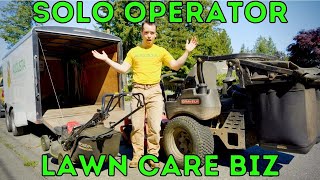
Mike Andes walks through a single lawn job on an 11,000 sq ft lot, completed in 35 minutes. He shows how end-of-job walkthroughs cut callbacks by 80%, why communication and photos let you charge premium prices to distant clients, and which mower type works best for different property sizes.
Questions this video answers
11,000 square feet
Just over 3,000 square feet
56 minutes
35 minutes
About $1,800–$1,900
Chapters
Hey, everyone, It's Mike Andes, landscapebusinesscourse.com and today we're gonna be doing a special episode. We're gonna actually show you the job, but all information here before you get started. So we threw the drone up. This is me pulling up in the trailer and the truck. Total lot square footage, 11,000 square feet. Turf square footage, just over 3,000 square feet. And you can see a tiny front yard, little side yard in the back and the side. And then there's a ditch on the right hand side along that back alleyway. So here. Here we go. Hope you learned something.
Good morning, everybody. It's Saturday morning, so you should throw a like for the fact that we're for the third Saturday in a row we're working out in the field. And it's just the only reason we're working today is to prove that Max not only drives trailerless setups, he also knows how to drive trailers. So for those of you who have hated on the trailerless setups and no trailers and said I needed a zero turn, today's just for you. We're gonna use a zero turn. You're gonna love it. Stick around for the ride. I thought that was it. So what's the first problem you're having with the trailer? Hey, hey, hey, hey. See, let's see. Looking on this, this is nc no connection. And it's not Brady's issue because I checked it again.
So basically, we have no brakes on the trailer, which basically means.
Nothing good. Nothing good at all. What? I took a wrong turnation of the universe.
Oh, it's been about one hour. We're about arriving at our first job approximately three miles from shop. Okay.
Okay. Includes mo edge, blow, weed, whack weeds, and grass in bed as well. Oh, yeah, this guy. So this guy doesn't have weeding, but he wants to knock down all the weeds in the flower beds with the trimmer. We have 56 minutes. So if we do the math on that.
Like $70. I don't know. I'm not very good. $80 per hour. 56 minutes. $75.
Sam.
All right, so we're going to go ahead and add some color commentary and business tips that you can apply in your lawn care and landscaping business as you kind of watch me mow the lawn. And I'll add some color commentary in the video as well. But today, this lawn specifically, we are actually servicing a client who is out of town. They actually live in Asia and have never been in this property in probably the few years that we've Serviced it. I still remember doing the estimate for this one years ago. So obviously they've never been home. I've never seen anyone at this property back in the day when I would actually be here on a weekly basis. So the question is, how do you actually do a service for someone who's out of town? There's a few things that are really important. Number one is communication is extremely important. It is the key to being able to do a property and service a property for someone that's out of town. Really, if you're the eyes for the customer on the property, especially if they don't have a management company, you can actually be very, very valuable to them by being proactive on watching what's going on at the property. So for example, if you know based upon the job notes that are on every visit that this person's out of town, you want to make sure that you're looking out for things like broken windows or mildew on the siding. Not only are these selling opportunities for things like bushes touching the side of the house, but more importantly, you add value to the customer by simply giving them communication about their property because they're not there. And this is the third thing, which is pictures of the property. So if you ever saw something, the ability to be able to take a picture, send it to the client very quickly is extremely valuable for them. Like it literally might take you two minutes, but it could be the difference between them paying you $70 per cut, $75 per cut and 40 or $50 per cut to the guy who just is a mo blow and go chuck in a truck type of guy but can't deliver on the admin and the opposite side. And that value add is what where you're able to really increase your prices. I know some people are like, there's no way you can charge these prices. It's ridiculous. The bottom line is having a back end office or a team that's able to send the client pictures, able to communicate, be quick on answering the phone. These are all value add. At the end of the day, if you increase value, that's how you can increase price, charge a premium price and make a more profitable business.
All right, so the whole point when it comes to zero turns like this versus a push mower, it really has to come down to the property size. I know we always jo about it and all the rest of it, but the reason I talk about it so much is because so many people are like, oh well, I saw this form or so and so told me this is the Best mower, the best brand, or the best size of mower, it has nothing to do with that. It all comes down to the property size and what your average property looks like. So, for example, this property I just did now literally would have this. This. Using this mower right here probably saved me maybe one to two minutes because I have a bunch of small patches of lawn. It's a lot of turning, and this thing takes a lot longer to turn than, than a push mower like this. All right, so There's a Honda 21 commercial. Is it fancy? No. But the bottom line is this bad boy right here, this is a commercial pro turn148. We have to put these baggers on here too. So this costs another 1,800, $1,900. So all in this thing's almost 10 grand. This is $1,200. All right. By having this, I have to haul this big trailer around. I can't use the trailerless setup. So again, this is why we use the trailer setup in our market most of the time, is because our property is dictates what type of equipment, what type of trucks, what other trailers we buy. And so we do use these at lots of our locations around the United States and Canada. However, we focus on using these on smaller properties. So if you're in an area where the average lot size, the average properties, acre, two acres, yes, you're going to need a zero turn. But if you're in a smaller area or in where properties are like this, where there's smaller patches of lawn, this will serve you. A 30 inch will serve you. You don't need bigger. Bigger is not necessarily better.
So as I do the trimming here, I want to go over the importance of what we call walkthroughs. This is basically when the job is complete that you do a walk through with the customer. For us, basically, unless it's a recurring service like mowing, we're gonna do a walkthrough every single time we do a job. So whether it be a cleanup or a malt installation or a landscaping job, and I really believe that you have to empower your frontline employees to be able to do this walkthrough. If you're going to expect them to communicate with the customer and do a great job, you've got to give them the resources and the confidence to know that they are gonna be the decision makers and they're the ones who do the walkthrough with the customer, not you coming back at the end of the day and walking through the job with the client, you're basically disempowering your employees, your frontline staff. That is really the driving force of the success of the company. And so we really believe in walkthroughs. There's several reasons why we believe in these so much. And again, a walkthrough is at the end of the job. The employee's got to walk through the job with the client and make sure everything was done according to the estimate. First thing is, by doing a walkthrough, we found that we can reduce the amount of callbacks or yellow slips by 80%. That means four out of five yellow slips or callbacks when a client is unhappy can be avoided. If we simply had done a walkthrough with the client and said, hey Mr. Jones, we're about to wrap up the job, we're just cleaning up right now, but if you come outside, I'd like to walk you around the property, Just make sure everything's done to your satisfaction. And according to the estimate, if they do that, literally 80% reduction in yellow slips, because most of your yellow slips are, hey, I got home and this wasn't done, or I went outside after your guys left and this, they forgot the tree and they forgot this. A simple walk through five minutes around the property would get a lot of those things out and the client would be less mad if you had actually made the, you know, tried at least to do a walkthrough with them and walk them around the property. And then maybe they forgot or didn't see something until the next day, but they won't be as accusatory and feeling like you just like left the job if you try to do a walkthrough with them. The next thing is, it's so important is because it increases the client satisfaction and the review online review response rate. So we automate the way that we get our reviews online. So Google, Facebook, etc. We automate every single job at the end for they get an automation to ask for a review online. If we've done a walkthrough, the response rate to that email and the response rate to giving an online review is much, much higher. And by the way, most clients in this day and age, they're not used a frontline employees having the professionalism to be able to do a walkthrough, they're used of a manager showing up and doing a walkthrough. By empowering your employees, you're showing to them that you trust them and you're showing to the customer that when they have an issue, when they have something they want to add to a job or take away, or they have a question, they don't have to call the office, they don't have to call the manager. You don't have to call you as the owner. They can simply talk to the frontline employees. Last thing I'm going to go over is when to stop doing estimates. I know for a lot of people right now you're extremely busy. Here's a few reasons why you might want to stop doing estimates or prevent the lead flow. If you can't get to the work and you're super overwhelmed and just completely breaking down physically or mentally, you definitely want to slow down your estimates. To do that, you can put all of your estimates on one day or maybe two days a week. So maybe on Saturdays you do all your quotes. Maybe it's Tuesdays and Saturdays. Make it where it's not going to be every single day. Giving you the time to train your hires, get the work done. Especially if you're falling behind, you're understaffed, you're trying to get new hires trained. Absolutely. Something you're going to want to do is move all your estimates to one or two days. All right, we went ahead and wrapped that job up. We took about, we took exactly 35 minutes. We had 30, 56 minutes budgeted on that job. The unique thing about that job was the weed whacking in the flower beds. Again, really important to have job notes for. So in there, for example, this person's out of town, they just want it looking half decent. So he literally told us, just use the weed whacker and knock the weeds in the beds down. We put that in the job notes. Cause otherwise pulling the weeds in those flower beds would've took an extra hour. So again, make sure you have job notes. But today, the moral of the day story is that using a bigger mower is not necessarily always faster. There's several things that took longer today because I had the zero turn. Number one, I have to have this massive trailer. I have to back it up. I have to, you know, jackknife and all the rest of it. That takes more skill from an employee too, if you're trying to hire and grow and scale the business. Also on a lawn like this that's smaller, it really doesn't save you any time. Again, if you have an acre, two acre big parcel of lawn that you're going to be using continually, the mower all the time. And your asset utilization is where, when you get to a property 80% of the time you're on that mower, then by all means get a zero turn, but you don't need it if you're doing smaller properties like this one. You can still make money on these smaller properties with the smaller mowers. So what I talked about there is asset utilization. And what I mean by that is if you have a big mower, make sure you're using it throughout the whole day. If you're gonna buy a bigger truck in order to compensate for that bigger trailer, make sure you're using that mower throughout the whole day. The thing that really irks me and the reason I talk about it so much is people getting a 52 inch zero turn along with a 72 inch zero turn along with a 36 inch walk vine and literally on this massive 20 foot enclosed trailer with a, a diesel truck that they're pulling this thing around with. And literally each of those mowers maybe gets used an hour or two a day. Asset utilization is how can I take the assets, the equipment that I use, and maximize their usage throughout the day? I'm Mike Andes, landscapebusinesscourse.com We'll see you on the next job.
Hey, what's Mike here? If you're part of the 10% of people who actually got to the end of the video, congratulations. And also you should definitely make sure you follow me on TikTok and Instagram. Always posting there every single day. And we actually show the prices of jobs that we do in short form videos. Check it out.









