MASTER CLASS to Build a Multi-Location Business Empire
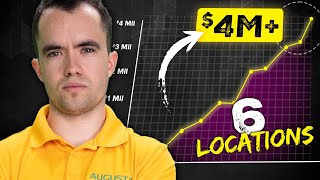
Mike Andes outlines a 10-year plan to grow a home-service business from $140,000 startup capital to multiple locations. Year one targets $400,000 revenue from 200 recurring customers at $2,000 each. The roadmap follows seven stages: hit $500k, lock in profit, systematize, scale to $800k, hire a GM, replicate locations, then exit or reinvest.
Questions this video answers
$140,000
$30,000
Lead cost $50; close rate 50% (implying $100 CAC)
$400,000
$2,000 per customer per year
Chapters
This is the ultimate guide to creating a multi location business empire. Today, I'm going to give you the step by step roadmap to building a home service business that has multiple locations. My name is Mike Andes. I'm the founder of Augusta Lawn Care. We have over 150 locations in United States, Canada and Australia. And based on all the things I've Learned Doing those 150 locations, I'm going to share with you today exactly how you can also have multiple locations inside of your business. Now, if you watch the entire video, I'm going to give you the step by step roadmap of starting with $140,000 and turning it into a business that does over $4 million in annual revenue profits, $400,000 every single year for you as the owner. And you're completely hands off in the business, not in operations. You're not even working on the business. You're basically passive. I'm going to give you the step by step to get there in 10 years.
Now, there's three different types of people that are going to watch this video and I'm going to explain who should watch this video and when this video is going to be useful for you. The first is probably 95% or more of my audience and that is if you don't have $140,000 in cash. If you don't have $140,000.00 in cash, just realize it might take five extra years and you'll start your business. Now. You'll listen to Landscape business course or, or MBA for entrepreneurs. The courses that I've made my content use lawncaremedia.com, all the tools that I talk about. You'll be able to use those over the next four to five years to build a business and then have $140,000 in cash. And so just know that as I talk about this 10 year plan, I'm starting with 140,000. That's like day zero. And this $140,000 is money that you could literally invest and you don't need in your personal life. You, you're, it's not going to ruin you, it's not going to bankrupt you and you can actually use it for the business. And so if you don't have 140,000, you can still watch this video. Just realize you should not take action on the roadmap. You should build the business that will get you to the budget of 140,000. The second group of people that might be watching this video is if you're starting from Scratch and you have $140,000. So you might be thinking about leaving corporate America. You, you might have some cash set aside cashing out a 401k. You might already have a really lucrative business that is in the professional services like a dentist or a doctor or a lawyer. And you're like, I just want to diversify into something else besides going into the office every single day. Again, you have the 140,000, but you're starting your business from scratch. The third person that is going to watch this video is you have an existing business in the home services and now you're trying to think about starting a second or third location. You're, you're trying to actually do this multi chain thing. I've done 150 locations and I want to share what I've learned and what's worked really well for me. I'm going to talk about all different aspects and some of it might seem random, but these are the things that I've learned the most in going from 1 to 150 and the things that break all along the way and having to recreate the business when we hit 10 locations, 50 locations and a hundred locations and we'll probably have to rebuild it again and at 200 to make sure the infrastructure is built so we can continue to scale and make the systems better and better. And so Those are the three individuals. If you're in the first camp and you don't have the $140,000 in cash to get started on this roadmap, that's fine. Build a business, make it cash flow, raise prices and follow all the other content I've talked about. I know that this video won't get a lot of views, so, so if you enjoy this because this is definitely deeper content, let me know in the comments. I have spent a lot of time on putting this together. The reason I actually spent a lot of time putting this together is because this is actually exactly what I'll be doing in the future for my own personal wealth. When it comes to Augusta Lawn Care and the franchise, when it comes to Copilot CRM and the software, and the software that we're building with pay for performance, et cetera, a lot of it. It's very, very capital intensive and I put all the money back in and, and we're growing quickly, but it's like just trying to make the product better all the time for myself personally to build my wealth. This is what this, this exact strategy I'm talking about today is what I'll use And several of our owners are already on this path as they've been a few few years inside of Augusta. They've built the $140,000 and now they're starting to do multiple locations.
This is the exact roadmap I will use because I believe I can take 10, 20, 30 locations, pay packages them up, sell it to private equity, and it'll do very, very well. And so if you're trying to look for an exit strategy, multiple locations is a great option. And I'll explain why as time goes on. The quick kind of giveaway on this is it reduces key man risk and it allows you to be able to diversify risk when you do multiple locations versus having one massive one. And we'll talk about also in a little bit who I believe should do multiple locations and who should just one build one massive behemoth. But let's go ahead and first talk about the budget. Okay, so I'm gonna talk about the budget. Then we'll talk about who should have multiple locations. This is the budget we're gonna be starting with. Alright, so we need $140,000. Again, the $140,000 is money that you can actually spend. It's not gonna put your livelihood at risk, your family at risk. You can spend this cash and invest it into the business. Now, the very first thing, I'm gonna lose people here, but this is literally my budget that I've put up for locations that I'm going to do. And I will do this in the next several years to build my own personal wealth using Augusta Lawn Care. But you could use this in your own business too. I am going to do a franchise. I'm a huge fan of franchising, and I was a franchisee at Anytime Fitness before I was a franchisor at Augusta Lawn Care. And because of the systems, because the franchise, it can still run today without me having to be there a whole lot. And that's Anytime Fitness. And so I'm a huge proponent of franchising. I would never want to start an independent gym by myself and I would never want to start a lawn care business without having the systems and infrastructure of Augusta Lawn Care. Call me biased if you like, but when I do this exact roadmap that I'm going to be showing you today, this is exactly what I'll be doing. The 22,000 is the initial fee. I want to spend that at a franchise so I don't have to worry about the branding, the website, the colors, the graphics. There's marketing systems in place there's infrastructure for my admin to be handled. We'll talk about the cost of admin and why that's important soon. There's so many elements of a franchise that I really like and we're doing multiple locations. One of the things I like most about having a franchise is that there's someone else overseeing the numbers and giving feedback and coaching to my general manager. So someone else is going over the numbers, someone else is giving them critical feedback, someone else is benchmarking them their success so I don't have to like overlord them or make them feel like I, as the owner am Grady. It's like these are the numbers and corporate is keeping them accountable to the numbers. So I'm a big fan of franchising. If you're like, I hate franchising, great, take this number out. But you'll have to do a lot more legwork and creating infrastructure and I don't believe it's worth it. I want to be able to focus on sales and hiring and not the aspects of admin creating, brand and a whole lot of other things that a franchise can take off my plate. I don't believe I'll be able to execute on this 10 year plan. And if I don't join the franchise again, you can do what you want. Second thing is trucks. $25,000 and I know, let me just take this back. I know because I have a franchise. Everyone's like, you're trying to sell franchises. If I was starting a window company, if I was starting a painting company, if I was starting a garbage collection company, I'd be joining a franchise. It cuts off like a good solid. I'd say two to three years of just learning branding, etc. And the systems and infrastructure, especially if they have over 100 locations, will be super beneficial for, for me to plug my locations into and run much more smoothly. All right, trucks. So I have two trucks for $25,000 each. These are not old trucks. These are probably three, four years old. They probably have 20 to 50,000 miles on them. But they're gonna be relatively nice. I want them looking pretty good. And I'm gonna spend 25 grand a pop. I'm gonna spend $30,000 in marketing in my first year. Again, this is not an entry level budget. We're gonna starting a lawn care business. In this case, any home service business, you don't need 140,000. But we're trying to grow very quickly. And in order to do that, I need to spend a lot of money on marketing. This is a big reason why people that don't have the 140,000 actually don't grow is they don't have enough working capital and they don't have enough marketing budget for their first year. And so because of that, they don't grow fast enough. That is no marketing budget. And they run out of capital because they don't have enough working capital, enough money in the bank to make sure they actually get through the first six to 12 months of no profit in the business. So I'm going to spend $30,000. If you look at other franchisors, they'll call this usually grand opening budget and you know, Anytime Fitness, for example, I'm not going to start a location for 140,000. That's the beautiful thing about home services. I'm going to be looking more like 800 to 900,000 to do a build out and my initial marketing spend might be 40 to $50,000. Again, not comparing the two. There's great models in every single industry. I like the fact though, the islands have spent 140 to to be able to generate a business that does. You know, we're going to talk about $700,000 in the second year in revenue. All right, so first year we're doing $30,000 in marketing. I'll show you the breakdown of what I expect for that $30,000 in just a moment. Now I'm going to buy a trailer for my location. It's going to be a smaller truck trailer that can be pulled by my smaller trucks, but it's going to be for a dump trailer for debris removal, property cleanups, etc. Do some small projects mostly to fill in the time around my recurring jobs. Make sure I keep my crew busy. If you don't need a trailer, that's fine. You'll probably spend a little more on tools and equipment since usually I'm not going to get big mowers, et cetera. You might spend a little bit more on the tools and equipment, that's fine. And then I'm going to have the $10,000 for tools and equipment and then I'm going to have $20,000 in working capital. Working capital, Just money in the bank to make sure that over the course of the, especially the first 30 to 60 days, I have enough money for payroll and any sort of materials that I'm going to be getting for any jobs that I have to make sure I don't run out of cash. The number one reason why home service businesses fail in the first couple years is they run out of cash. They don't have enough working capital. This is actually something we learned even doing Augusta. We allowed a lot of people to join the first few years that had hardly any money, and some of them just crushed it. Like, they just worked really hard and did well. But we did have failures simply due the fact that we allowed people in that they had way too little capital. And because they didn't have any capital to spend on marketing and they didn't have enough money in the bank, they had to actually give up and they had to quit or they went back and did something else, or what mostly happened is they had a personal life event happen. And because they didn't have enough working capital and they didn't have enough momentum cause they didn't have enough to spend on marketing, they did go out of business. And that stinks. All right, so this is our budget. Let's go ahead and break down what exactly we're going to be getting for this $30,000. I actually quickly drew this up, kind of breaking down exactly what I expect this $30,000 to be able to provide us. So at the top there, you can see I'm spending $30,000 in marketing. Now I expect to be able to get a lead for less than $50. At Augusta, we do tracking with Facebook pixels and Google codes, etc. And usually we can get leads for between $30 and $50 across our locations. I'm going to use 50 to be as conservative as possible here and realize that some of this might bleed over outside of the spring rush when I can't get $30 for my lead cost. So I'm going to assume 50 to be conservative. I'm also going to assume a 50% close ratio, which means 50% of the leads that I get I'm able to actually convert into customers that is sent estimates. 50% of them are converted into accepted estimates. So if I use that math, I can then assume a $100 cac, or customer acquisition cost, which means I have to spend $100 in order to be able to get one new customer. If I spend $30,000 on my marketing budget and I'm buying customers essentially for $100 per, that means I'm going to get 300 recurring customers. All right, now I'm shooting for at least $2,000 per year per customer, which for in lawn care, if I'm mowing their grass for 150 or $200 per month for maybe seven or eight months out of the year, I'm not going to be able to make the $2,000 per year per customer, I'm going to have to upsell them some other service. That might be Christmas lights, that might be winter services, that might be mulch installs, weeding, bush trimming, property cleanups, chemical or fertilization. I'm going to have to do something to be able to get that up to $2,000 per year. Now, I'm being conservative. If you take 300, 300 customers and multiply it by 2,000, that'd be 600,000. The first year in business, we're only going to do 400,000 in annual revenue, which means one out of three of these customers are going to churn. Mostly because you're new. You're going to have holes in your operations. You're not going to have your best employees. You're going to lose customers. I want to be conservative here and realize that the very first year I'm literally going to have a 33% churn rate. I see this happen a lot with new owners and they get very discouraged. And what they have to realize is when you're spending tons of money on marketing, your churn rate is usually higher as the business matures. And people are coming from referrals and they're coming from existing customers that tell other customers about you. Those people usually stay with you longer. When you're doing Facebook and Google Ads and door hangers, you're going to have a little higher churn and you haven't buttoned down operations yet. So I'm going to be conservative there with my numbers and just assume that, that out of those 300 customers, I'm only actually able to keep about 200 of them. And if you take 200 customers and you multiply it by that 2,000 per year, there's my 400,000 that I'm going to be trying to get for the first year. So I know that's a lot of numbers and I know numbers don't do great on YouTube. People usually check out. Again, let me know in the comments if this is helpful. I'm going to dig very, very deep on exactly step by step of what I plan to do and what you can do in your business. And to be able to scale up multiple locations. Now, when it comes to $2,000 per year for a customer, if you're going to hit that, you also really want need to avoid what I call Q4 collapse. And some people it's Q1, but really it's a cause of Q4, and that is revenue drops off massively. In Q4, and usually then it hits the bottom line in Q1 and you have massive losses. When I look across home services and I see thousands of profit and loss statements every single year across all different industries, not just lawn care, landscaping. That's about 40, 50% of the PNLs I see are from the green industry. The rest are from a variety of other home service contractors. The vast majority of them have one quarter where they lose money. If you take that one quarter out, they'd actually be very profitable. Usually 18 to 22% profitability. If you take one quarter out, when you put that one quarter back in, that has a negative cash flow balance and they're losing tens of thousands of dollars. It brings that average down into mid to low single digits. There's people that are losing money and some people make 8, 9, 10% of profit margin. But that 1/4 collapse kills home service businesses. And so I want to be shooting for at least 10% profit margin. When I'm out of the business and it's running completely passively, I still want to be making 10% profit. If you're an owner operator, you're going to do far better than that. Probably 15, 20, 25% is very possible. If you're a smaller operation, you're also going to have a higher profit margin. One of our operators last week on the mastermind for Augusta Lawn Care that we have every day with the owners inside of Augusta Nation. He's doing about $40,000 a month in revenue and he's having like 35% profit margins after paying himself smaller operation, he's still managing the location. I'm shooting for at least 10% profit once I'm completely removed, not from the field, not from daily operations, I'm actually completely passive. I want 10% distributions at least coming to me. But in order to, for this to this math to make sense, you're gonna have to get rid of a quarter that usually cripples home services. And so for Augusta Lawn Care, we've gone all in this year on making sure that we fix this using Christmas lights. So we have a usually a eight, nine months, very busy season to cover that quarter. We do Christmas lights. Some of our owners will do snow plowing, some owners will do winter services and do other services where the grass is not growing to be able to keep revenue coming in for the all four quarters of the year. Now I want to go over this and these are actually the seven stages of wealth inside of Augusta Nation. And we're going to go through these. I'm going to kind of show our progression over the course of our 10 year plan where we're at in these seven stages. All right, so let's just go through these really quick and then we're going to go through our 10 year plan. So the first stage of of wealth at Augusta Nation is growth. We're going to grow past 500,000 in annual revenue. I believe that this is table stakes to get started. Not a single one of our locations that has grown from zero to past 500,000 has ever closed. After 500,000 you have a lot more ability to be able to get a manager in place. And if something bad happens to you or if life takes you in a different direction, you usually can afford to have someone manage the location or at least optimize and raise prices and immediately bring 50 to $100,000 to the bottom line just by raising prices. So I'm always a big fan. This is the number one thing. And unfortunately a lot of times what happens in ICU home services is people haven't yet got to the first stage of growth and, and they're already thinking about things that really shouldn't be thought of until the stage five, six or seven. So let's go through what all seven of these stages are. The first one is just grow the business to 500,000. The next one, because I'm going to get there as fast as possible. I'm going to grow and grow sucks cash. I'm not going to have a lot of cash because I'm just trying to get there as quickly as possible. And if you watch my content, you know that I talk about the wilderness of profitability from 200,000 to 500,000 that typically happens is in home service businesses. I'm going to get there as quickly as possible and then I'm going to take a little time off and actually profit. I might raise my prices, my optimize my route. I'm going to make sure I have two months worth of payroll in the bank account. Stage three is I'm going to systematize. I'm going to get out of the field so I'm not actually doing the work anymore. You're going to be focusing on sales admin, doing things outside the field. And I'm going to start really dialing in my systems because I need to do this so I can start copying and pasting. This is when I start thinking about like having the same trucks, having the same equipment, making sure the setup is exactly the same. That's when the systematization really starts. To take effect. Again, focusing on this when you're at 150,000 annual revenue, not as beneficial. Also, we should not be thinking about multiple locations when we're still in these first few stages. It's not beneficial at all. All right, next one. Stage number four is scale. We're going to grow the business past 800,000. This usually kind of ties in next stages, which is doing multiple locations. But I want to make this agnostic to whether or not you're in Augusta, because I would really prefer before you go to seven, before you do 800,000 annual revenue, start multiple locations. But I want to start scaling the business. So you'll notice here I get to 500,000 and then I take a little bit of time. I like the idea of taking a year, really dialing in systems, optimizing your profits, optimizing your pricing, and then going back into growth mode. I really like this model. I see a lot less financial stress when people take one year to get through stages two, three, and four. Instead of trying to do all of this in one year, a lot of times I just see really low profit margins and lots of debt. Stage number five is I'm going to get a general manager. And a lot of times what you'll see is stage three, four, and five will happen pretty quickly. And that's getting that general manager put in place. This general manager is going to be making sure that you get out of daily operations. So the first day was just getting out of the field. But then getting out of daily operations means you're not holding the team meeting anymore. You're not doing hiring, you're not doing firing, you're not even doing the estimates themselves. You're out of daily operations. And a general manager is responsible for the financial performance of the location. They're responsible for everything to do with making sure that location runs well. And at my distinguishing factor is who does the team contact in the morning when they are calling out they're sick, something bad happens, who are they contacting? If it's. If they're contacting you, you're still the general manager. I'm going to be trying to get in stage five, a general manager in place that is going to run my location for me and is going to be able to take all daily operations completely, all equipment maintenance, hiring, team meetings, everything. And again, this is the hardest stage of doing multiple locations is this stage right here. Because really, the success of every location is going to hinge on the general manager. A great general manager placed in a mediocre or Bad market is going to crush it. They're going to do very well. A lousy manager put inside an awesome market with a great team in a profitable location within 12 months will tank the metrics and make it completely unprofitable. So the general manager is the most important thing. And again, I recommend taking some time here and at this stage. And you're going to see the first few years of my tenure plan, I do not start a second location. I'll show you why. The big thing is I want to solidify this general manager position. And most people rush this process, and for that reason, they think multiple locations are impossible because they're spread too thin and they don't have great management. Stage six is really what we're going to spend the most time on today, and that is repeat. That is copy and paste with multiple locations. So I'm talking about this here. Realize that before I even jump into my plan, all these other stages have got to be completed. If you don't and you start trying to repeat a process that has not been systematized, it's not profitable, you don't know how to grow and scale and get leads, we're going to have a big problem. You're just going to dig yourself a bigger hole. Like a broken business model with more leads, more employees, and more customers is just going to cause bigger and bigger headaches. Okay, the seventh, seventh stage of, of of wealth at Augusta Nation is actually optional. The reason I say it's optional is because I have seen.
People, billionaires, build wealth by just copying and pasting in stage six and staying there forever. For example, the founders of Panda Express, they've been doing the exact same thing for 40 years. Just one location after the next, after the next, after the next. And now they have like 2400 locations. They have a net worth of $3 billion. But for 40 years, they, they just stayed doing stage number six. Most people would have gone for five or 10 years, built up a little nest egg, and then gone, done something else. I really believe that most home service business owners, once we're successful, we stop at stage five. And what's crazy, if you can build a business that actually gets through stage five that runs without you in daily operations, you're probably in like the 97th or 98th percentile of expert level in the industry, whatever industry you're in. And so it seems ludicrous to me that you try to jump stage six and go to stage seven and go into a different industry or go into real estate. Like, if you're in the 97th percentile in an industry, you have a massive advantage. You have a massive edge. You are able to have a massive competitive advantage against competition when you continue to expand versus, like, I'm gonna go to real estate now. You're probably like the 15, 20, maybe 25th percentile of real estate investors if you're actually being objective. And that is the fact that you don't have experience, you've never done a lot of deals. There are people that have spent 20, 30, 40 years doing that already. They know deal structure, they know how to negotiate, they know which markets do well. They know all about cap rates. Like, why go invest when you have something that works well? Most will get out of this industry way too soon. A lot of times because we. You have this inferiority complex when it comes to home services that like, somehow it's less than when in reality, if you just stayed in copy and paste Mode for another 10, 15 years, you'd massively, exponentially grow your wealth compared to going investing it in other areas that you don't have any skill or unique advantage in. And so I do have it as stage seven, though, because a lot of times for our owners at Augusta Nation, we do talk about in the masterminds about creating wealth in terms of investments or real estate and when to do that. The reason for that is sometimes you're like, hey, I'm not trying to optimize for money. I just want to have more enjoyment. I just want to be able to live more passively and be able to do some of the things I'm really passionate about. Great. That might allow you to do that, especially from a tax advantage perspective, especially around real estate acquisitions of other businesses. Being able to do that, awesome. It's an option. But keep in mind, it's the stage seven after you've done all these other six. And so getting these stages out of sync and out of doing them in order will cause you to be poor. And the reason many home service businesses will fail is because they don't follow these steps in order. They will be like, oh, I'm doing, I'm investing. Yeah, but you, you haven't grown a business past 500,000. That's the first stage. Or they, they go from stage one, like, I have a $800,000 business. And then they jump to like, getting a general manager. It's like, whoa, whoa. Have you made it profitable yet? Have you created systems? Like, if you haven't done those things, getting a general manager, you're just going to make their life Miserable. So I believe these stages should be followed in sequence. All right, so we're going to focus on stage number six, which is the multiple locations. And we're going to talk about what I'm going to do in every single year in a 10 year plan to make this a reality. Now before you do that, I want to talk briefly about who should start multiple locations. Because not everyone should. I believe there's really three reasons why you would want to start multiple locations. The first reason is drive time. As you increase your service area, you are going to decrease your profit margins because you're driving longer. Your crews are less efficient because they have more windshield time. And as time goes on, you spread out your service area and it is the fastest way to grow revenue. It's also the least profitable because you're driving so far. As soon as you start driving above 30 minutes on a route based job where you're doing smaller ticket items like maintenance, it's very difficult to make money. If you're doing big projects, you can drive further. Like if you're in 40, $50,000 big hardscape landscape one time jobs, you can drive further and still make those work. But keep in mind, every single day that crew is driving the there's still now let's say they're driving an hour, that's 25% of their day just driving without any other waste happening in the day load time, et cetera. So you could literally be 35, 40% of their day not actually producing revenue. Hard to be competitive on pricing, hard to be efficient, hard to be profitable. This is why we focus on 5 mile radiuses of service area at Augusta Lawn Care. Because I don't want to be driving more than in 15, 20 minutes for most of my jobs, the vast majority of them. The second reason why you'd have multiple locations is to be able to promote within the company and actually have a way for people to move up inside of your organization. The number one way to retain great talent is give them more of a challenge. And if you have great team members out in the field or maybe they've become an estimator or someone in the office, the only way many times to actually promote them and keep them moving forward in their career is to make general managers of them and that is run their own location. And I believe that 90% of employees that are great are entrepreneurial but should not be an entrepreneur. Which means if they go and start their own business by themselves, they fail. And if you just look at the math, it just holds out like 80% of people that start businesses, within five years, they're out of business. I think a lot of times those operators would be great general managers, but because they want the control, or someone told them they should do it, or they weren't given the opportunity inside their current organization to be entrepreneurial and have more control, they go and start their own business and they fail. And so ideally, you're able to retain great people and keep them in your organization by having multiple locations and a general manager gives them like a lot of entrepreneurial freedom. They have a lot of control with that location and, and so you'll be able to move them up inside the organization. And it's very fulfilling to have someone start off entry level, move them up in the organization to the point where they're actually running a location. They're making really good money. And instead of pay, you know, more time for money in exchange of, you know, their hourly rate, now they're actually making a salary, they're getting a piece of the pie in terms of profit sharing. And a lot of times they'll make just as much, if not more, being a great general manager than trying out, going out on their own, wasting money, and eventual failure. Like the failure rate is so high, it's usually better for them to be a great general manager unless you're an entrepreneur and like, you can't do it without having your own thing. Again, very high risk compared to what you could offer them to move up inside the org. So the ability to promote general managers is another reason to have multiple locations. If you have a great number two or great employee, you don't want to lose them. Multiple locations is a great idea. Third reason to have multiple locations instead of having one massive location is the management that you put in place has lower skill. You don't need someone to have years of experience in terms of leadership if they're going to be managing a crew of two, three, four people. If you're going to be running a location as 2, 3, 4 million in revenue, a lot harder to create systems in place and management and find people to be the managers of those locations. If you look at most businesses that do between 1 and $3 million in annual revenue in home services, the owner is still involved in daily operations. And if they're not involved, if something was to happen to one person, the business owner would be brought right back into the business daily operations. The reason for that is because finding someone that's going to run that size of business, one to two million dollars takes a lot more skill than Then finding someone that can run a business that has a few employees, has grown to 500,000 in revenue, and then starts to optimize for profit and raise prices. Like you can literally grow your business as fast as possible to 500,000 in annual revenue and then over the course of a couple of years, just raise your prices as you get more leads coming in, raise your prices and dial up to 700,000 and make it very profitable. And that's the preferred route. For me. This is my personal preference because I know that if that general manager leaves, as they have a life event, if something crazy happens to them, it's relatively easy for me to find someone to replace them and be a working gm. And we'll talk about what that is defined as shortly. But I'll be able to take someone that is in the field as a crew leader that has been with me for a long time, understands the systems. All I need them to be able to do is communicate with the customers and communicate with the team. That's what the general manager's main role is. And they don't need to have multiple layers of estimators and project managers and designers underneath them. That head honcho, that leader is going to be extremely hard to find, extremely costly. And most important, if they go down, I as the owner will have to step back in. And when I'm doing multiple locations, I don't want that risk. Especially when I talk about 10 years from now, I do not want to have the option of ever having to be pulled back into daily operations. So I like the idea of having lower skills of someone that's only managing a few employees. They're easy to find, easier to replace, and ultimately the valuation of what you're building here goes up because you reduce key man risk. If you have one massive location that has multiple layers of management and there's one person at the top, that person, if they go down, you're stepping in and the business massively gets hurt. I don't want to have key man risk. I want to reduce that every single level from management down to admin. Talk more about that in a moment. When it comes to general managers, as I've already stated, they are the most important aspect of every single location in terms of its success. I believe there's two different types of general managers. There are starters. People are really good at sales and like starting things off. They like, they like the first year, they love the hunt, they love knocking on doors, doing door hangers and getting the location off the ground. They hate daily minutiae and operations and they don't like doing the same thing over and over and over again. They do not enjoy the process of stages two and three. They don't like this process. And even four of like optimizing for profit over the course of a couple of years, they don't enjoy it. They like the hunt. They like the thrill of building and growing and getting more customers, increasing revenue. So that's the sales or the starter role of GM. On the other side you have operational GMs. These are people that typically worked with you for quite some time. It's a huge advantage. If they can work with you in the past, the likelihood of a general manager working out long term much, much higher. Even if they can work with you for like six months, we have seen a tremendous increase in their uptake and their success rate. If they've worked with you for at least six months, ideally a few years. When you go past like two or three years that they've worked for you already and they become an operational gm, very high likelihood of success. An operational GM is usually isn't as comfortable doing a bunch of sales. They don't knock on doors. They don't like going after. The thrill of the chase is not appealing to them. What they like doing is optimizing. They don't mind doing the same thing every day. They like making it better and better and better and tweaking it and making the systems more profitable. They're really good in this stage, stage two and three and four, whereas the starter is really good at number one. And I believe there's different skill sets, different. It's difficult to find someone that enjoys stage one of growth growing to 500,000 and then also enjoys taking a couple years and just optimizing it and making it more profitable and getting your team better trained and get like that's a different skill set. And so I've in the past hired a starter. They start multiple locations and then behind them they install an operational gm. Someone that isn't going to be as boisterous. They're not going to do door knocking. But they like the operational. They like the fact that they're going to nail every single system. Budget hours get honed in, the schedule gets honed in. That's awesome. So I have a starter GM and I have an operational gm. If you don't find a starter gm, you're probably going to be that person in this example and that is you're going to be the entrepreneur. You're going to say very sales driven and then you're going to hand it off to an operational gm. Once you've crossed the first year, alright, Once you've crossed that, you hand it off to a GM and they're going to be more operationally driven. Ideally they've worked with you and they're going to optimize it, make it more efficient and make it more profitable. All right, Compensation for these general managers. I could take probably four hours and talk just about this. I'm going to break it down basic. I want to be able to. When they're in growth mode and they're going in there, especially in that first year, especially starters that are getting a location started, I am going to incentivize them based upon revenue in bands. So we have like 20,000amonth in revenue, 40,000amonth in revenue, 60,000amonth in revenue, 80,000amonth in revenue. As they hit those levels, they get bonuses each month that they get above that amount of revenue in a month. But really what I'm trying to get them is a piece of the profits. Now we talk about profit sharing a different than a distribution sharing distributions is simply every time I take a dollar out of the business they get a percentage slightly different than just taking a percentage of what's on the bottom line of the profit and loss statement and giving that to the general manager. Again this is something that we could talk about forever. I'm not going to go really deep into it. But what you want to establish with your general managers is are they getting a piece of the profit and loss statement bottom line or are they getting a piece of the distributions? Which means every time you get a dollar they, they get a chunk of it. I really like the distributions ones. Once it's in profit mode. Once it's in profit mode it should be very, very profitable. And really as someone who's not in daily operations at all and is removed from the business, I only care about distributions. I just want it to print money. And so I want my general manager always think about distributions. So again we could talk all day about those different compensation models. But if you're growing, if you're in growth mode, make sure there's some sort of incentive around revenues and then the real money you want them to be focused on and the real compensation. And like long term incentive is profits is distributions create something around that more long term. I want the majority of their long term compensation to be made up of profits sharing or distributions sharing. Now when it comes to growing these locations and now we're going to step into stage number six Repeating these processes. One thing you want to be very careful of is your admin cost. You. Now, as a rule of thumb, I want to stay under 15% of my gross revenue. My total revenue, 15% or less of that I want to spend on admin. If you're spending over 20%, it's very difficult to make money. Now, are there going to be times you spend more than 20% on admin costs? Yes, usually when you're growing very quickly. Because when you're growing very quickly, you're spending a lot on ads. There's a lot more turnover in terms of employees, there's different amount of payroll stuff. Having all those new customers, you're getting cards on file, you have more complaints, more turnover. And back to the point of our budget, when I spent so much on marketing, I know that I'm going to lose some of these customers simply because I'm growing so fast. And so during that growth period, I might spend more than 15% of my revenue on admin, but I do not want to be spending that long term, especially when I go into profit mode because I'm just optimizing my current database. I'm doing more upsells than I am new customers. I want to be focused on profitability. Now, if you're going ideally, try to shoot between 10% and 15% of your total revenue going to admin costs. Now, admin costs include things like salaries of your office team, office rent, very big office equipment, software, and the cost to train office people. This is grossly underestimated until you actually look at all the costs of admin. So some people are like, oh, I only spend like 5%. You're looking at just the gross wages that you're paying to the admin person, the worker in the office. You're not taking account the fact that you're paying. You're having to buy an office space. And that office space is 3,000amonth when you could get the same amount of land for $1,000 a month if it didn't have an office, you have to pay utilities. You could pay hundreds of dollars a month for things like Internet, water, sewer, trash, a coffee machine, a printer, all the stuff that goes into running an office. And so usually whatever you'd pay in salary, you have to double that to actually figure out what the admin cost would actually be for your location. And if you have a great admin person, you usually will pay them throughout your off season simply to keep them on. And now you've made them is a fixed expense. I want to avoid that at all cost. So I'm kind of getting ahead of myself. So let's go over this in depth because I do believe I see a lot of home service businesses as they scale past 500,000 and even beforehand hiring a full time office person. And I think that's a mistake. My goal is to be able to have a working gm. A working GM means that they produce revenue into business and they're still doing work for at least a couple days out of the week. That's why I like to stay under 800,000. I like that 6 to 700,000 level in terms of revenue because I know my general manager can still produce revenue and is not an overhead cost to the business. They're going to do overhead, they're going to do sales, they're going to have to sharpen the blades and do equipment maintenance and they're going to have to take things materials around. But they'll produce enough revenue, at least cover their cost and their salary. And that's my goal. I don't want overhead, I don't want admin people sitting in office. I don't want fixed expenses. And so my working GM is going to be able to produce revenue all the way up until they hit 800,000. And if they get like 700,000, I'm, I don't want to grow anymore. Just keep raising the prices and increasing profits. Now there are a couple scenarios where I would recommend I'm going to spend a little time on the admin side where I do recommend hiring an admin staff or I'd say it's permissible before you hit $800,000 in annual revenue. And these are kind of like the three different scenarios. One, you have an expensive office already that you're paying for a big savings and not having an office and trying to get it distributed in terms of someone remote or calling service that, that charge you by the minute. The biggest advantage is the fact that you don't have to pay a bunch of money on rent. And again rent is a fixed expense. Or I see people getting into real estate really by buying land or buying an office space and they're putting like 50, $100,000 down on a piece of land. If they put that money into marketing they could grow way faster. Typically real estate is not the most efficient way to grow a home service business. Because a real estate you're not going to take $140,000 cash and turn into 4 million in 10 years. It might double, it might triple, but it's not going to do that kind of revenue growth. So you got to realize what business are you in? Do I think you should buy real estate? Maybe down the road, once you're more in stage seven of growth, which is investing, but not at the beginning, it's not as efficient in terms of use of capital. You might get a 10, 15 year annualized return on, on real estate if you're lucky. But the problem I see people put tons of cash into buying office space or they're paying a bunch of money on rent and that's a fixed expense. It's not going away, it's going to stay there during the winter. I want variable expenses because I have a seasonal business. I want my expenses also to be seasonal, which means I am willing to spend more on something like a calling service during my spring rush. You're like, man, I'm saying five, six thousand dollars a month on this calling service. Why in the world would I want not, why would I not hire someone for four or five thousand dollars a month to be able to take over my admin? The problem is that first off you're going to spend several weeks training them. They might leave also again. And it also is the fact that you're not taking account the fact that during the off season you're going to still pay them that $4,000 a month in salary and you're going to have to get a shot for three or four grand a month. And so all of a sudden your, your overhead and your fixed expenses throughout the off season sink you. I see this all the time.
But we're talking about when you can and should hire someone. That's in terms of full time admin before you hit 800,000 because I don't usually recommend it until you hit 800,000, you don't need a full time office person. And I see people doing on the turnaround show that I do, I'll see people like 2, 300,000 annual revenue and hiring a full time office person. I'm like this business will never make money because just their salary is 25 plus percent of revenue, let alone all the extra costs of training them and their software and the rent for the office space, et cetera. So number one, if you have an expensive office that you already locked into a lease, you're already eating a lot of the costs of having an admin person in person. So you'd probably just go for it. Because having someone in person, you're going to have the highest efficiency. You actually have an office space, you're going to have the highest Efficiency, highest compliance, they're going to follow exactly what you want. You can change things much f faster, et cetera. It's the best in terms of efficiency to customize to your location. However, the problem is going to be the fact that I'm going to need that big office space. I'm going to have the fixed expenses and until I hit 800,000, it doesn't make a lot of sense. But if you've already paid out for the office space, it's already furnished, et cetera, you're already paying for utilities. Go ahead. Second reason why you might get a full time office person in a shop space with an Office prior to 800,000 is if your significant other or partner is willing to work in the business full time doing admin, then it can make some sense because now there's less key man risk of them leaving. There's keyman risk, but you know, you're pretty much, you know, especially if you're married to them, like you're with them forever. I believe it does introduce different type of risk. Like if you have relationship problems or they have health issues. Now you're all of a sudden like someone who has a lot of negative knowledge about the business is in jeopardy. And I've seen people, you know, they go through a divorce or they just go through a rough patch in health with their spouse or whatever and all of a sudden the business gets cut in half. I don't like that risk. And so again, I am willing to pay a little bit more to diversify that risk, get it off the plate of my general manager and have someone else do it. And so the third thing is.
When you'd have an actual office person, I would hire them and is ideally if, like for three to four months when you're really, really busy. If you can hire someone full time just for those three to four months, that's ideal because then you can save a little bit. You don't, you're not paying a calling service like Command center, for example, they do all the payroll and they can do everything for owners in terms of admin, but it's going to cost them a little bit more during spring rush when there's tons of leads pouring in, lots of calls, it's going to cost a little bit more compared to just having your own person. But it goes way down then during your off season. Now if you can be around that 6, 700,000 level, maybe you try to find someone for three or four months that can work really solid, save you a little bit there and then Hand it back to like a calling service or someone that can handle your admin. There's a lot of different variable companies. So if you're not in Augusta, like just so you know, Command center is just for Augusta. It's only for Gusta Nation, only ever will be. But there's other services like there's, there's Jill's office, there's Ruby, there is Call Boss. And you're usually going to pay somewhere between one and four dollars per minute. It's not cheap when you're really, really busy, but it's a variable expense which means as you get slower in the off season, you don't have that cost, you don't need a big shop space, et cetera, and expensive utilities and all the rest of it. But again, the third reason why I'd actually hire someone for admin is if you can get them to work for just the off season. The critical thing about this is if they leave in the middle off season, you are very handicapped. And the training period for someone that's good at admins going to run payroll for you and answer texts, answer emails, send out estimates, et cetera can be three to four weeks before they're decent at their job. And I see sometimes just risk when someone hires someone like two weeks before spring rush with the hopes that this person works out. It can be very risky. Just keep that in mind. But again, my goal is to avoid, avoid fixed cost for my locations. I try to make sure that I am spending between 8 and 12% of my revenue going to command center. And so that keeps me under my 15% goal of admin and my location. Are you 8 to 9% of revenue every single month going to command center. Which means that when I slow down, 8 to 9% comes down with it. When I'm going really high revenue, I'm going to be spending more at command center. I prefer that instead of having months where maybe I'm only at 5 or 6%, but then during the offseason I'm paying 20, 25% of my revenue just to keeping my admin staff, my utilities, my rent, etc. So I've got to keep admin costs down if I'm going to make this multi location, you know, this empire work well. So I'm shooting in between 8 and 12%. That's what we tell our owners at a Gust Nation of what they can expect for admin be covered at command Center. Keep in mind you're going to have a lower efficiency as you go from you doing the admin to, then like maybe your spouse doing the admin to. And then you hire someone to do the admin. And then there's going to be like having a distributed workforce that does per minute cost because they're doing it for a whole bunch of other companies. And you're going to have to follow very strict systems if there's going to be things that fall through the cracks because they're not actually at your office, seeing your crew, seeing the weather, talking to your customers. There is lower levels here. But the bottom line is I want to be able to not think about admin. It doesn't grow a business. No one ever built Million Dollar Company because their admin was great. They built it because they're great at sales and they're great at hiring. And then they delegate admin to people that could do the job 80% of their efficiency. Let's say you're 100% like, everything you do is perfect in terms of emails and phone calls, et cetera. It's perfect. Then maybe like you hire your spouse, they're probably like a 98, 97. And you're like, well, actually they're better than me. Maybe you're the 97, but you're very, very high. Then you hire someone, let's say they're in person in the office. You're able to talk to them every morning, you're with them most of the day in the office. And they're probably gonna be like a 95 or even a 92 as soon as you go somewhere. Like remote staffing. I've seen that drop way down. When you try to hire someone remotely, it's very difficult to manage them. Some people like, oh, I can get cheaper. I don't need the office space. It will cost you more in your time in managing them. Trust me, I've gone, I've done this hundreds of times now. I've seen this over and over. Unless you know the person, unless they have a ton of experience and you know them very well. But now you're going to step down to probably an 85 or 80 if you're going to go get a service that's going to charge you by the minute and they're gonna have to follow much more stringent systems. They're not gonna have all the details and not in the office with you. But I'm okay with that because I know I just need to focus on sales and hiring to grow the business. And yes, I will lose a few leads and maybe my customer acquisition cost could have been 80, but it became a hundred because they weren't as great at the, at the admin, they weren't great at the office. They didn't do what I would have done on the phone. They didn't sell it quite as good as me. But I don't care because I'm able to go get way more leads and increase my close ratio and do follow up calls and increase, increase the efficiency of my team. That has a much bigger impact than that drop in efficiency at the admin level. Because the admin level just doesn't grow the business. It is necessary, it is required and I want to tie it to a variable cost instead of fixed. And again I think people are going to think that I'm trying to like this is like a sales thing for the franchise and if you're interested in it you can check out the website. But like it's not like. What I'm saying here is if you're trying to multiple locations without a franchise, building that infrastructure for admin will take you three to four or five years. And that's why I'm kind of proving my point I guess in terms of the franchise fee. I'm willing to spend that because I don't want to have to build that infrastructure. It's very difficult to build the admin infrastructure to have, you know, seven day a week support on the admin side as I do multiple locations. That's what I believe. Franchising is good. Plug into the system so you can focus on growing the business. Okay, let's keep moving along now. I want to talk a little bit more about admin in the fact that the reason admin kills is because it's non revenue producing employees. And recently there was an acquisition. Someone's going to buy out another company inside of Augusta Nation. And the owner was talking to me about this potential purchase that he was going to make. And the company he was talking about did $48,000 a month in revenue. And they had three non revenue producing employees, an office manager, a general manager and an owner. And they were making about $5,000 each per month in salary. So that's $15,000 a month in salaries on a $48,000 per month business. If you do the math that, that's 31% of revenue just on the salaries of non revenue producing employees. You will never make money doing that. And that 48,000 was during peak season, during the off season when revenue goes down to 25 or $30,000 in monthly revenue. More than half of the revenue was going to just the Salaries of non revenue producing employees. You will never be able to make money doing that. And so if I was to take that location over, I would get rid of the office manager, I'd throw it back to command center. And yes, I would probably have to pay them four or five thousand dollars a month to run the admin and run payroll and emails and do all the stuff in terms of the software and the invoicing. I don't want to deal with that. I don't want the office person there. I want then my general manager to go into the field and do work. I want them to actually produce revenue on an ongoing basis to at least cover their wages. And if they work two or three days in the field they should be at least be able to cover their salary. So now I'm able to wipe out all of the overhead expenses and bring down back to our under 15% level for admin costs. That's my goal. And if you notice they had three people and non revenue producing, they had five labor employees. So people actually doing the work out in the field. So there's a ratio of three to five. I want this to be one to five for every non revenue producing employee. I want five labor producing workers. These are these, this ratio is a big indicator of labor businesses when I go into them of how many people are producing revenue versus how many are not producing revenue. And as this number gets higher than 1 to 5, I get very concerned. So in this case they had three to five and I want, I wanted to eliminate two of those positions to get back to my ideal ratio of that way I can get 15% or less time spent on admin and any sort of overhead that's not producing revenue. And with the working GM model I can do that at that 5 to 700,000 in revenue by getting the GM to manage a few employees, a few crews, but then be out in the field most of the time producing work. All right.
So we're going to start a fictitious location. This fictitious location is going to have the working GM model to say so that the GM can stay efficient. I'm going to have all the admin be handled by command center and like hey, I'm not part of Augusta. Great. You're going to have to build that infrastructure for your multi unit operation. You're going to build that. It's going to take you a few years. You, it will be the hardest thing you do and it's very difficult. Um, I'm not saying that like it sounds like a pitch. I'm not meaning it to be that way. It's just very difficult to scale admin when you're building dozens of people. It, it's just very hard, trust me. And you do multiple locations and people aren't in person. It gets very, very difficult. And so there's just so many variables that go into our industry. It's not like software where it's easier to support remotely. And I've done the same thing with software. Like it's easier to do that when it's like everyone's seeing the same thing. In home services, every single type of climate is different, weather is different. And the weather in one area, it's like it rains. We still mow grass in the Pacific Northwest. It rains in some areas down south. You stop everything. And so the way that you handle every call is going to be different just based on weather, based upon the type of house. Like if it's stucco, it's different for Christmas lights versus a wood or vinyl plank on the siding. There's so many different variables. And so it gets more and more difficult for admin as you scale. So this fictitious location though, we're going to keep the working GM in the field. We're going to keep him efficient so we can reduce key man risk. So if something happens to him, the business is not in jeopardy. No office is going to be required. So I can keep my, my cost of rent very low. I'm probably going to park my trucks at like an open gravel area or like a farm or a storage facility and keep that rent as low as possible. Ideally I under 800 bucks a month. I don't have to go into office space on a five year lease paying three or four grand a month. Don't want that. And then I use command center to be able to handle the admin. All right, so that's the fictitious example again. If you're not inside of Augusta, you'll need to build that admin arm up to be able to do multiple locations and make this math work. Okay, so we've already talked about year number one. Year number one, we're going to do $400,000.









