My Secret to Hiring GREAT Lawn Care Employees! (Behind the Scenes)
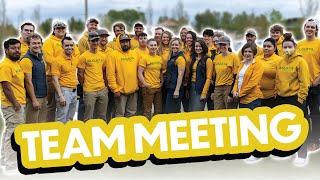
This YouTube vlog by Mike Andes documents a spring team off-site meeting for Augusta (May 1, 2021). The video shows a team activity where individuals draw enlarged versions of small colored squares that together made a Roman-numeral-style clock, and Mike uses the activity to illustrate how individual roles ('squares') combine to form a larger company picture. He outlines cultural priorities (constant improvement; team-first mindset; ability to grind), warns about risks like cultural drift and complacency, mentions operational structure (41 franchises; two off-sites per year—spring for future goals, fall for year-end financial review), thanks key staff (Liz, Lee), and ends with social media call-to-action.
Questions this video answers
41
Twice a year (spring and fall)
Spring: get the team together and share projections/goals for the upcoming year; Fall: look back at the year and review financials/sharing numbers.
Chapters
Good morning, everyone.
Mike Andes here today on the vlog is going to be a little bit different. We're not going to do a whole lot throughout the day, but this evening we have a team off site meeting. So we have two of these a year, one in the spring, one in the fall, and we're going to try to get some behind the scenes of getting that all set up. So these spring ones are really just trying to get the team together. A lot of them have not met each other just because we're in different offices now, as well as just kind of giving the projections and some of the goals for the upcoming year. And then the one the fall is more or less looking back at the year, looking at the financials, sharing numbers, etc. So this morning or this evening I should say is really more about sharing the future of what we're trying to do, what the goals are for this upcoming year. And I think it's really, really important as owners that we share this information and share our vision for the company with our team to make them part of that vision. So stay along for the ride. We're going to show basically this back room at a restaurant and we're going to be able to show kind of some of the things we're doing about an hour and a half of that team meeting. So here we.
How many franchises do you have right now? 41. I'll have them over here. But what we're going to do, we're going to do a bit of an activity while we're waiting for the food. It's going to take you all of 30 seconds. But on your piece, the little tiny square, flip it over to the, the side that actually has color on it and then look at your big white piece that has the, the number on it and flip it to the other side.
So what you're going to do is basically try to take what's on that little square and draw on your large square what you see. So I know it makes no sense, but try to be as detailed as possible of what you see on the little square. Put on the big, try to make it the scale as well, if at all possible. So thank you for coming. We'll go ahead and jump into tonight. Couple things real quick. Obviously you can't see it, unfortunately. I was gonna bring tape, but I forgot. But you can come over here and look at later what all together kind of made. And it was basically a clock. It's like a Roman numeral clock. The objective in saying that is, you know, kind of the Objective of this whole meeting is the fact that each of us, every day, whether it be command center, the media side, locally at the shop, the management, we're all kind of working on our own square. And sometimes it can kind of seem like you don't really know why. This is how this is fitting into everything and you're just like diligently working on your square and people like Garrett are creating their masterpieces of shading skills. Any one of these squares really doesn't make a lot of sense. Like in and of itself, it doesn't really do a whole lot. Like, this is not going to win any sort of award. I don't know if our whole thing together will. But one square in and of itself doesn't do a whole lot and doesn't have a lot of meaning. And I think as a team, that's really the beauty of building a business together is like in and of ourselves, we aren't that special or great or awesome. But when we come together, that's what makes something really cool. That's what makes something that people can look at, they can learn from, grow inside the business. That's something that's special. When we get together sometimes, you know, sometimes, you know, we all have issues, we have flaws, we have, you know, stuff. Maybe we do a job wrong, we mess up on something. But the end of the day, like when you step back and look at what we're doing as a whole, and it's really, really cool. My biggest fear is cultural drift. As I become less involved in the day to day as Liz, Other ones that have been here for a long time start to either move on or start to move up in the company and not have that day to day connection. I do fear cultural drift. It's the thing I hate the most. It's the thing I will fight the most. And there will come a day, whether it be in two years, three years, I don't know where I will pull the plug on new franchisees joining Augusta because of cultural drift. And I'll say you have to join from the bottom because in my opinion, what I hate about owners is their inability to connect with their frontline employees. I hate it to the core. I've seen it time and time again where I go to bigger companies and their owners do not know what it's like to work out in pouring down rain, don't know what, they've never done it. They literally just have a bunch of money, buy 20 trucks, hire a bunch of people and start working. And you lose the feeling for Everyone that's on the front lines, and that's something that I never want to do. And as we grow and there's people in this room that will be the leaders in the future, that will also be removed, as I am now, we will not lose that. Whether that be we all go work out for a day out in the field, whether it be we start answering phone calls occasionally, we can't lose. What really makes Augusta different than everyone else. Things I support, things we support as a team, like what we stand for as a culture, is number one. Constant improvement. Whether it be the audible program, whether it be us trying to get you to the next level in your career or learning something new, making more money, that is the number one thing. Constant improvement. Number two is team first. I hate when people think only about themselves. Drives me bonkers. The people that I draw closest to me and will come up highest in this company as we grow will be the people that think about other people first. And so the third thing is the ability to grind, right? And I know this is what I appreciate about so many of you who have been here for several years now. The ability to grind and working on your square year after year after year, I appreciate so much. It's part of building something special. No one sees the beginning days of when it's really, really hard and stinks to go to work. What we all are doing in our individual squares, and that's not what's gonna be seen. But that ability to grind is absolutely part of our culture, our DNA, and something we have to protect. Like, I am watching this on myself the most. There's a reason why I still live in a closet and drive a little Honda Accord, has 250,000 miles. I do not wanna lose the ability to grind. It's what got me here, and it's what's gonna get me to the next spot. And I encourage you. That's what got Nick to where he owned a location a year ago. He wasn't hardly thinking about it. Went and lived in a van like that. No one's gonna talk about that in 10 years. That's what set him up for where he's at now. And that ability to grind is something that's so important. Three things that I was thinking about. We will constantly fight. Disconnected management. Kind of talked about that already. And we're going to bump into each other occasionally. Like, you see a running back run, like, plow back into an offensive lineman sometimes. Like, dude, you're in the way. But we all are trying to get the same direction here, right? We're going to have friction. We're going to have times where it's like, we don't get along. But we have to realize at the end of the day, we're all trying to get the same place. We need to communicate when there is that mess up, when that is that bit of like, oh, man, we're just grading each other against the wrong way. Like, so and so just not having a good day. We need to be able to talk about it. It's very important. Last thing, complacency, the third thing that we will fight. This is very different than contentment. So when I talk about complacency, it's not saying, oh, I don't want to be content. That's wrong in my opinion. And I said this recently. Someone asked, well, what do you think about what's success? I said, success is being content. Because I've seen successful people in Africa making $2 a day and they're thrilled out of mind and they're content is all get out. They've won. I've seen people make a million dollars a year and absolutely miserable as I'll get out. Not content. They fail. They're failures. I don't care how much money you have. So it's not contentment. But complacency is wrong. Complacency, like, oh, I'm good. Like, hey, 18 bucks an hour. Like 15 bucks an hour. I'm good with this. Like, I'm doing a pretty good job at my job. Like, everyone thinks I'm a cool guy. That's not what we stand for. And that leads me to kind of like, I was talking to Danny on our trip. Something that was. I've been wrestling and, like, thinking about a lot is something I'm working on. Like, I'm not very good at. And I'm trying to figure out that line of caring a lot for someone and pushing them. That there's a line between that and then pushing someone too hard, too far, and then just breaking right. And I even know, like, for example, at Command center locally right now, we're working crazy hours and there's a line that we have to. We have to account for. Like, there's a line, you push too far, too hard and you break. And long term, that's a bad strategy. But in the short term, and more importantly, you will not get anywhere if you don't push yourself to some extent. If you become complacent, like, hey, I'm just going to show up to work, put my time. I'm Going to chill out on the weekends. I'm going to just live my life. And I have no plans, no goals. I'm not improving myself. Complacency is not what we stand for here. I'm all for someone like, hey, I just like my job. I want to be here for the rest of my life. Great. But get better at what you're doing. Why be the same in a year from now, even if you are still in the field, if you're still answering phones? Like, we can become better at our craft.
At the end of the day, I just wanted, like I said, tonight is really about just saying thank you for everything that you do. And I wanted to especially thank Liz in the back there. She really is my right hand. Everything on a daily operational level. Dude, I'm gonna cry.
That's sick.
No. So I appreciate her so much. Everything that she does for all of us and trying to take my vision and put it in the daily operational side. So much of what I do every day is zoom calls and phone calls. Just trying to help the franchisees. And she stepped in the gap massively. And in doing so, has also put Lee in a position to have to step up the Bellingham shop. And I appreciate him for doing that, but couldn't do it without her. And I really do appreciate it. Guess we'll see most of you tomorrow. Awesome. Thanks so much, guys. If you want to see this masterpiece, feel free to take a look.
Hey, what's Mike here? If you're part of the 10% of people who actually got to the end of the video, congratulations. And also, you should definitely make sure you follow me on TikTok and Instagram. Always posting there every single day. And we actually show the prices of jobs that we do in short form videos.
Check it out.









