New Service or New Market? Don't Get Stuck!
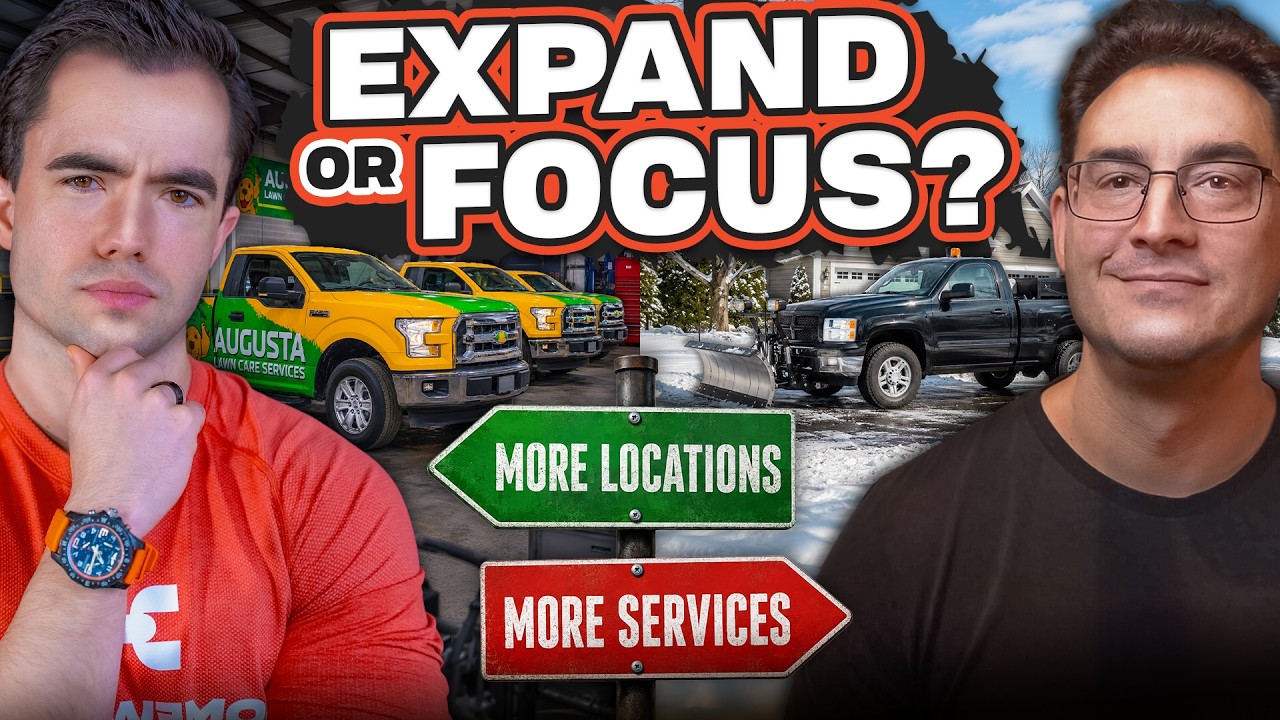
In this conversational interview, Mike Andes and the host discuss practical tactics for home‑services businesses facing seasonal demand fluctuations. They explore how bundling year‑round services (e.g., mowing plus leaf‑mulching, downspout checks, salt spreading) can keep technicians busy during off‑season months, and how adding high‑margin seasonal offerings such as Christmas‑light installation or snow services can bridge revenue gaps. The dialogue covers hiring challenges, technician churn costs (≈ $10,000 per tech), cross‑training, route ownership, and compensation models that align incentives. They debate market‑share versus customer‑acquisition‑cost (CAC) dynamics, using AI‑driven market sizing (e.g., estimating 3 % market share in Whatcom County) to decide when to deepen penetration versus expand to new zip codes. The conversation also touches on the operational complexity of multi‑location growth, emphasizing the need to simplify the service menu before scaling. Marketing tactics are examined, including granular Google Business Profile setups, Facebook ad creative splits, direct‑mail experiments, and the importance of consistent brand visibility. Finally, they share non‑financial advice such as running personal finances like a business (P&L in QuickBooks) and the value of “swiping” ideas from other industries. Throughout, the tone remains conversational, anecdotal, and solution‑focused, with a generally enthusiastic and pragmatic sentiment toward experimentation and data‑driven decision‑making.
Chapters
For every additional service, it's, you know, it's not linear. It's like almost exponential in a way in how complex it feels.
Your menu in home services is what services you offer. And if that's a long menu, it's going to be very difficult to do multi-location. I will drop a service when I realize that it is 20% of revenue and causing 80% of my problems.
We doubled the business every year for the first 5 or 6 years. My experience was that as we got out of things, things just kept getting better and we went faster.
It's the level of leadership that most people don't have, the ability to lead from 2 hours away, an hour and a half away, have management in place that is solid, have the systems in place that they can actually duplicate and be effective at.
I've always loved that idea that the big breakthroughs really come from looking at other industries and swiping what they're doing in other industries and bringing it into your business or into our industry. Hey everyone, how's it going today? Mike, how are you doing?
Fantastic. Ready for another episode.
Yeah.
Hey, last, last week we broke the 2-hour sound barrier.
So, and I think we broke another like 45 minutes just for the first topic. So that's how you break the 2-hour barrier. So out of curiosity, what's the temperature there right now?
I think it's like 63, 64 degrees.
That'll be relevant for a little later when we're chatting.
Okay.
I'll bring that back up. So today we've got quite a few things for you. So we're talking about when do you add services, when do you drop services, when do you add markets, how much of a market can you realistically take, like what percentage of market share, what are the best ways to expand, how do you find employees. So we got a lot of really relevant stuff today. But before we hop into that, Mike made a pretty interesting announcement yesterday, which will probably be about a week, week ago for you now when you're watching this, but when we're recording, it's about a week ago, and he announced that he's going to move to Texas for 6 months.
Is this the temperature thing going to come up?
It could. I mean, what do you think? It's only 100 here today. So anyway, he's moving to Texas for 6 months. He's starting a mowing business and a fertilization weed control business. He's going to show you how to go from zero to a million bucks a year. He's going to record it all on camera, which I think is pretty cool. That's going to be pretty cool to watch. Would you say all that's correct? Is that— did I— I read your thing, watched your video yesterday. Does that sound about right?
Sounds about right. But given that this is the cold open and I don't have any notes on this, I know there's— it's going somewhere.
What would give you that idea?
Yeah, yeah.
And that leads right into the next part, which is the thing Mike didn't tell you in his videos. He's coming into the CityTurf market.
Let's go!
He's coming into my market. So CityTurf had a big meeting yesterday, and we believe the best defense is a really, really strong offense. And so we don't want Mike— I know he's already got some franchisees here, but we don't want him to feel too terribly comfortable about the Texas market and think it's too good. So we've come up with some strategies, Mike, where we think we're going to be able to bleed away your money and your time when you come into the market.
It's a war of attrition.
Yeah, but, but because we're friends, I thought I'd let you choose how we're going to do it.
Okay, okay, pick my poison.
That's good. Yeah, exactly. So I've got two. So first on the time front, how we're going to bleed you financially. I'm gonna let you pick how we're going to do it.
Okay.
All right. So our first idea is we're going back to biweekly and weekly mowing, and you don't have to pair it with another service.
Okay.
We're also going to constantly monitor your pricing. We're going to price 20% under market.
Okay.
And we're about to release online signup. So that's the first one.
Well, that's just one. That's just one.
That's one. That's just part. We are, like I said, strong offense. This is how you win. Okay. So it could either be that, or we're going to deploy a marketing budget so ridiculous that we're willing to spend $500, $700, doesn't really matter to us, per client to acquire, acquire these $40 mowing clients.
Okay.
So you can either, we can either drop prices, quit putting conditions on buying mowing from us, or we will just spend crazy amounts of money in the market. Which direction would you prefer we go?
That's a great question. Okay, so I would probably take the second one because I do think I could out-market you on Facebook ads.
I will bet you all my money you can because we're not marketing on Facebook.
If you spend $700 per person, I'm happy to take that bet.
Yeah, I wasn't entirely sure which would be the worst. I kind of theorize actually number one because Yeah, I don't know, because man, trying to bundle mowing, not doing biweekly, bundling it with fertilization, weed control really slows down the sales. But, but spending a lot of money in a market doesn't. So I was curious what you're going to say.
All right.
So your next one, this one's really aggressive, kind of mean, frankly. All right. So this one, you had made mention that you're only going to spend 10 hours a week on this. So I figured if we could burn down your 10 hours.
Did you take this? Okay. Wait, I have a question before we get into this. Did you take the transcript and dump this into AI to figure this out, or did Did you come up with these while you were listening?
Okay, I wasn't gonna tell you. I actually came up with all of these. Okay. So I gotta tell you a funny story, but I wasn't gonna do it here, but I gotta tell you. So I've been testing out Fable, but I can't really figure out when to use it. So I ran this through Fable and I think usually I'm asking it easy stuff. It blocked you?
It blocked you? Like you can't use the model for destructing someone else's business?
No, no, it didn't do that. Although this second point that I'm gonna make here in a minute, it didn't like that. It said maybe I shouldn't say it. Anyway, okay, but here's what it did. So I said, I want to come up with something, you know, gave it the whole spiel, funny cold open, something like that. I already had this basic outline that I'm giving you now, and I pasted it in there, but I thought it would come up with something different. Here's what it did. It came back and said, before we proceed, I want to bring something to your attention that you might want to talk to Mike about. Did you know he's coming into your market? And then it said, do you know that he's launching a, um, school and you used to do coaching. And I'm like, Fable, he's a, he owns franchises. He's already in my market and I don't have a coaching business. So anyway, it decided it should bring it to my attention before it even would give me anything funny.
So it's your strategy, it's your PR making sure you don't overextend.
It's trying to protect me. So whatever. Anyway, so, but this second one, it didn't like it and I understand why, but I'm going to go with it anyway. All right. So I'm going to bleed your time. Okay, so my ideas to bleed your time are one, longer answers to the podcast questions. Yeah, exactly. No, no, real— these are mean. These are mean. I'll just go ahead and say I would never in 100 billion years do these, but okay, which would, which would suck up more of your time? Okay, every time you hire an operations manager, I will— we will aggressively recruit them and offer offer them a $15,000 signing bonus to join CityTurf. My theory being you have to hire your operations managers yourself. It's too big of a hire. You're going to be involved. And second, it'll suck you back into ops for a moment where you can't focus on your Facebook ads.
Let's go.
Okay. That's, that's one.
Okay.
Or this is the really mean one that I would never ever do. Or we could follow around your trucks with the new and offer the new P4P compensation plan that we've just— to all your technicians. So which would, which would be worse? Constantly losing an ops manager or constantly like trying to keep your team? Obviously they wouldn't all switch, but you'd lose a few here or there. You'd be constantly battling this problem. Which would hurt a company worse?
Oh man. Um, so I have to choose which one I would want. I would probably— let me think.
Hmm.
I'd probably have you follow my crew around, mostly because I know that that you don't do the model where they take their vehicles home.
So yeah, okay, that'll be your competitive advantage.
Yeah. Now if you were following them, that's a good one, convincing them to like, hey, I'll give you $100,000 to go start your own business, then I would be—
I would make you a contractor.
Yeah, exactly.
Yeah, yeah. I would never do the following one. I think that— I think that is how you start a war.
Yeah, yeah.
In a market, we had somebody do that to us in the early days of City Turf, and we like We, I'm pretty calm, but we got pretty aggressive on that. I think, so I just think it's a cruel thing to do. Anyway, all right.
Okay.
I got, I got, we're, I got 4 more for you. These are different though. I want to see how big of a threat assessment you are. This I absolutely used Claude to help me come up with these. And I think so. All right. Okay. So imagine you're now a Texas-based company. So imagine it's January and a customer calls you and they say, hey, We're supposed to get a really hard freeze tonight. Do I need to worry about my sprinkler system? What do you tell them?
Well, I'm not going to answer the phone. Command center is going to. They're going to have no idea. And so we just don't do sprinklers. That's it. And we would have someone that we would refer them to around sprinklers.
And so maybe CityTurf.
Well, here's the—
OK, I hate to ruin this for everyone, but we're not going to be your marketing partner.
I know.
Hey, hey, but I thought you might say that. Yeah, exactly. This is how it starts.
Stars.
Exactly.
Definitely, definitely year 2 when we move up to Frisco, probably. That's probably when, yes, 100%, I will be having City Turf for every—
Then you'll be directly in my market.
There you go. How about you don't like mowing, you hand us the mowing, you can have everything else— the trees, the, the, the sprinklers. We'll hand it all over, you know.
We, we still like mowing, it's just we can't build the size mowing business we want at the profit we want. I'm going to go ahead and ask you my next 3. I just want to see if you can answer them. Okay. All right, so a customer says, I've got Bermuda in my front yard and I've got St. Augustine in my back. Which one can you scalp and which one can you not scalp?
So I have zero experience on worms in the grass. Yes, we're an operations manager.
These are bad questions.
Um, yeah, so this is, this is when I have to have a great operations manager. So fortunately I have, I've hired the— my GM is, was, has worked there for 20 years for all their parks.
Oh really? You already found somebody?
Yep. Yep. When I was down there last time, I went out with dinner with him and his wife and stuff like that. So, um, really solid. And, uh, he will know that answer.
Oh, he'll know all these answers. I won't even ask the next two. It's not as fun. So, yeah. All right.
Well, anyway, just again, proving my incompetence for the local area. Hire Augusta Lawn Care today.
If you did it to me in your market, we'd— I mean, I'd sound like a complete idiot.
Oh yeah, we got bag clippings. Let's go.
Yeah. Yeah.
It's so funny, like, little, little stuff like like even like warm season grasses, but also the fact that you guys don't have to bag literally changes the whole business model. Whole business model.
Yeah. Yeah. Yeah. The, what do you do with all your clippings?
We, we have to take 'em to our, we recycle 'em on site and then if we don't have a spot to dump them long-term, like in a, on property, then our locations will take 'em to the dump like once a year.
So, so you're bringing 'em all back to your shop?
Yep. Yeah. So stinks.
Would— when people bag here, or historically when they used to bag, they'd put them a lot of times in these brown bags and even put them behind the client's fence that the city will pick up. So, but other than scalping, we don't bag.
Yeah, when I— when I did my location in North Carolina, it was more like that. Like, you just could put debris out next to the curb, but if you had like a big property cleanup, you run the risk of like them not wanting to pick it up or taking like 2 weeks. And now it's like the customer's mad. It's horrible. Yeah.
Yeah. Yeah. So what are you working on this week?
Uh, this week we are dropping the first part of the refactor for events. So it's called the all events page. That's exciting. It's all in the new code base. And then also the rev share program. So 25% for people if they refer people.
Oh, you announced that.
Yeah. Yeah.
You said that well back.
Yeah. So, um, it's dropping and I'm excited. I'm excited to— it was a good point of like telling the story of like, here's why we're affording the 25%. We're not spending— we don't spend money on ads, et cetera. And just kind of making it more of a community-led growth. And then I've been developing a lot of this assets for the rev-share partners. So like, here's logos, here's graphics, here's how to make a post, here's how to make a comment that would get someone to actually use your referral link. So things like that.
Yeah, I think that's a good idea. Are you doing the rev-share for the first year or forever? Forever.
Yeah. Okay. I fought with this a lot and it was just like, what's the most like, What can we actually afford? Like, we always work backward from CAC and like, what can we afford on spending on ads? What would I do? And then what would I do if, uh, this was community-led? And so they're giving away basically one free month and they can't get that free month from anyone outside the rev-share program. So like, we don't use it for internal sales or marketing. It has to come from someone that exi— has an existing account if they're gonna get a free month. So that's kinda like the bait for them to share their referral.
So. Whomever is getting the offer gets the free month, and then the person making the offer gets 25% of the deal forever.
Yep, exactly.
Yeah, yeah, seems pretty, pretty strong to me. Really strong, actually.
So, so it's good you came back from vacation. Are we, are we hitting the ground running, or where are we at?
Uh, we went to the World Cup game Monday, so I didn't get anything done Monday.
Oh really?
Which one? Yeah, Spain and Portugal.
Oh really? Cool, let's go.
Yeah.
Yeah, it's kind of a boring game, wasn't it? From what I heard.
I mean, I enjoyed it. I like it better than watching football, like American football. I enjoyed it. Um, but yeah, as far as some of the games, it like this last, this only score of the game happened at the very, very end. So it wasn't, it's like super exciting, but I, I really enjoyed it. So it was cool. It's a good game.
Should have been. Yeah.
So the Argentina game, the comeback, that would have been, that, that would have been incredible.
It's crazy.
Yeah. I would have liked to see a USA game and, but I'm glad I didn't go to the USA game up your direction. I'm glad I was at the Portugal and Portugal, Spain was cool because we took the boys to Europe, to Spain way back, like a long time ago. And we wanted to go to one of those games and it just didn't work out. And so it was cool that we, Riley and Gage both went with us. So it was cool that we finally got to do it.
Very cool.
We had tried to do one in Barcelona. So that was fun. And then while I was there, I, we were looking at tickets. Tickets are so stupid. I don't know how many, so people tell me how so many people could afford these tickets. It's so insane. But we were looking at tickets and if we, if we wanted to go to the next game and sit where we were sitting, it was like 30,000 a ticket.
What?
I mean, how do people write these checks? It's crazy. Like, it's just mind-boggling.
FIFA's a non-profit. Non-profit.
Is it really? Like, is that what they call it?
Oh yeah, they say that.
Didn't know that.
Crazy, huh?
Yeah, somebody's getting paid big salaries. All right, uh, so to answer your question, the last 2 days I'm back at it, and I did some prep for this because I was in Wyoming, so I just did that this week. And then I was kind of— everybody that I'm working with, I was sort of doing meetings with them, making sure everybody's moving. The, the thing I got to get done this week for a project we're working on is I've got to get some offers done for a project, but I probably won't get to that frankly till Friday. This week's a lot of keeping everything moving and doing a few things and responding to lots of people that the projects have come back to me and now it's my turn to do something so I can turn them back over to the team. So I feel like it's a little bit of a catch-up week.
Very cool. You're back, back to your marketing manager mode. Let's go.
Yeah, I need to get out of this mode.
Yeah.
What, what about you? I'd have so much more time if I wasn't marketing manager. Anyway, what's up with you?
Yeah, mostly just been work on the homework stuff.
Um, oh, what you said. I'm sorry. You did say, yeah, yeah, yeah. Okay. So is the official public launch about to happen or has it happened? I'm not in the loop.
Yeah, this week. So this week it's going out. Um, it's just one of those things you want to be careful with betas. So like I have learned not to give dates, times. It's one of those things where it's like, it'll go out this week. It'll go out in the next few weeks. I've stopped like, hey, tomorrow it's coming out. It's like, no, there'll be a last-minute bug that all of a sudden we need to figure out.
So yeah, one day it'll be, it'll come out this quarter.
Yeah, exactly.
After you get kicked in the face enough.
Oh man, totally. Yep.
So I was browsing the financial news and one of the things that I've seen, uh, saw in a couple places, not a ton of it. So I kind of question for you. So the, the gist of it was that There are June reports that are showing that small businesses, not necessarily— this wasn't necessarily specific to the trades. They were calling it more services, like small businesses offering services are finding it harder and harder to find employees and that they're starting to report that this is their top challenge. And, but the government data, like at the federal level, is reporting that they're softening in the jobs data. So I'm curious. Across your franchisees? Are you hearing anything? Has anything actually really even changed? Do you— have you ever felt softening? Has it ever felt easier? Does it— does recruiting always feel the same? Here's your take on this.
Yeah, like, first off, compared to when we first started the franchise, like 2020, 2021, it feels very easy still because like 2020 and 2021, it was just so hard to get people to apply, let alone show up. Let alone work out for 2 or 3 weeks. So it still feels very easy. So this morning though, I actually polled—
Easy to get people?
Yeah. Or mostly applicants. So I'll get into kind of like the, the, the fine print, but like in terms of applications, I ran a poll with the owners of Augusta. Jace, if you could throw it up. Um, it's only from this morning, so it's somewhat limited data, but it was like, hey, if you throw up an Indeed ad or a Facebook ad, how many applications are you getting within 2 to 3 days? And so they're still getting quite a few applications. Most of them are getting 50 plus, no, 40 plus applications in a couple days. I think the part that I still see as the bottleneck to getting good people, 'cause good people is not good applications, right? Or even like volume of applications. This more or less just measures the volume of applications. It's really a matter of like filtering those applications to get good candidates and then turning people you've recently hired into great technicians. And so last year we really focused on like how do we weed out 50 applications down to the 2 or 3 that you should be looking at? And that's like using the video process, using AI to like get down to the, the cream of the crop out of your applications. And now we're really focusing on like, how do you get someone once you've given them a job offer and they're like, yes, I'm showing up to not turn after 1 or 2 days. And, and that's just really onboarding, training, creating a better system for that process. That's something that I feel like we've been weak on. And so the past year we've really focused on the front end of that funnel, which is like from Indeed into job hire. Now we're focusing on, okay, you showed up to first day of work, what does that look like? So having training modules, integrating a better onboarding system. But in terms of like getting applications, we— this is not— this is definitely not our biggest constraint right now. Um, but it's, it's very regional. Like even underneath this survey, there was members of the community were talking and it's like some of them was like, it is— people are like hostile when I contact them. Uh, They, they, or they don't even know if they applied. Like they've just applied bulk applying. I think some of this has to do with how Indeed is, is playing with some of these things. But, uh, even running Facebook ads has been really interesting recently to get job applications. And so we've been averaging at Augusto, at least like $9 to $11 per application running Facebook ads for applicants. And that's something we had not really played with before. Um, but I thought your video last week was really excellent about making this more of an internal marketing engine and actually deploying energy towards creating a referral plan for your technicians. And I think it's funny how people are like, you'll get like $100, uh, if you bring one of your friends. It's like the amount of cost of getting a new technician is like astronomical. And so we've, we've done the calculation on this. It's almost $10,000 by the time you take all costs into cons— not, not just the marketing cost, interview costs, onboarding costs, training costs. Once you take all of that and then calculate churn, of technicians, a churned employee for us at least is around $10,000. And so why would I not be offering $2,000, $3,000 to my current team to bring in a great technician?
Yeah. Yeah, that was, that was the gist of my argument as well as, and you gave it from the cost side and I actually don't know that number. The team probably would know. I'm not involved in, but $10,000, hearing $10,000 is interesting. I was thinking about it purely from the standpoint, I talk about this in that video that If a crew's worth, we'll just make up a number and say $200,000 to you, why would you take 6 months or 8 more months to get to a place where you finally staff the crew because you're going so slow and you're just trying to find a person through normal means versus just arguably throwing money at the problem and solving the problem quick? Because the longer you wait, the less you're growing the business, the slower it's growing, the slower, the longer it's gonna take to fix other problems inside the business.
So I think when I, when I heard your video too, like, and, and even looking at this, I was, it kind of goes back to the basics of like knowing your numbers because I think if most people knew their numbers, they would either, this would become a binary decision of where I deploy my energy, time, and money to getting more technicians. Cuz yes, it makes perfect sense if I have $200,000 that this is my main constraint of my business and I focus on it. But most people don't even know what that number is. Sure, they don't know their gross profit, or they don't know if I had one more technician without having to buy any more trucks and equipment, but I added another technician, they had $130,000 of revenue, I paid them $60,000, I'm very profitable in the rest of what's left over. Oh, this is a $50,000 problem, right? And it's not seen that way. And we chased whatever, like, the fire in the businesses versus the very basic economics of, like, if I just get one more technician, I unlock this revenue.
Yeah, yeah, I just, I so agree. It's amazing how so many things just come back to knowing the numbers. As I did Service Autopilot, and as I've grown and learned in business, it's like, it's been a long time now I've understood this idea of the numbers are key to everything. But it's like, once I finally got that concept earlier in my career, it's like, how could you not see this sooner? It's the key to everything. It answers every question. Well, not really, answers most questions. Tells you what to do.
Yeah, it's been so interesting. Like obviously from a serv— the service business side, knowing your numbers is important, but even like on the software side, the ability now with AI to be able to get your numbers, assuming like you have some sort of data architecture, is so much better. Like for example, the other day I was like, we were making a product decision. I was just like, I went in and I just asked, we call it Stew. It's just our Open Claw in the backend. And it was just, okay. And I just said, hey, I wanna know in the past 30 days what percentage of transactions were credit cards, check, and like everything else. And for it to just spit that out within 30 seconds and you're making that decision is super useful. And so even if someone might not know, quote unquote, know their numbers, like when, when Jonathan says $200,000 per crew, you're like, well, I don't know what mine is. But the ability to be able to have some data architecture to be able to ask and, and, and get that information is like super valuable.
That's true. That, that idea right there is really gonna change the game for a lot of people where it used to be hard to get your numbers and now it's gonna be easy. Yeah. Do you guys use, that's interesting. You mentioned OpenClaw. Are you doing a lot with OpenClaw?
Our internal team is, so we've connected to like a lot of our, like Notion where we do a lot of product stuff to our Slack. So like, for example, for myself, I'm in a, I'm not in a lot of Slack's, uh, channels, but I can have it send me reports. I can go in there and ask it things like, hey, what's the status of this current project? Where is it in beta? You know, how many people have responded back to a response form and not have to go and find it. So it's really just a portal inside Slack right now that allows us to be able to like even asking technical things for me to be able to get, hey, this, this is what the engineer said. Can you break this down? Go reference the ticket, tell me what's going on here. Um, so that's, we mostly use it for internal.
Okay. Is, was part of that motivated to save money or was it motivated to more sandbox your data?
A little bit of both. A lot of it for the engineers, they probably use it differently than I do. I use it much more for the sake of I want to know what's going on, but not have to be in every single meeting, not be in every single Slack channel. Uh, and if I'm communicating to the members, I need to know what's going on and you know, where's the status of that project. But more importantly, what I'm using it now more and more for is like making a product decision based upon the true accurate numbers without being like, in the past this would've been A couple years ago even, this is probably, hey, get back to me in a day or two and let's run some serious number calculations on transaction volume of hundreds of thousands of invoices. And so now for that to be 2 minutes, it's just so, it's almost, it's almost like you have to retrain yourself to think I can get those numbers very quickly now versus in the past that was like, oh, I'm gonna have to sit down for a considerable amount of time and do some, you know, extrapolation. And so, yeah, I'm really excited because like, In a way, like what that level of hopefully data architecture in Homeworks will give people the ability to just be like, ask Claude or anything with MTP access, be like, hey, what's my churn based upon channel? Things like that. That'll be hopefully very useful. That right now even is very like hard to figure out and takes a lot of time. So, yeah.
Interesting. You, um, earlier you mentioned talking to some of the franchisees and it the challenge of labor was different in different markets. Do any markets come to mind that you noticed were more difficult than others?
I feel like when we get extreme weather, so dead, dead winter, dead summer, the churn, the quality of the candidates seem lower, mostly because they, they show up for their first day and then they bounce. And so one of the biggest things that we're trying to focus on is like during onboarding and training is How do I make sure that expectations, reality match? Because if someone churns within their first couple weeks, it's almost always a mismatch of like, here's what I expected and here's what it looks like. Now, in the middle of summer when it's 100 degrees outside, like you're talking about, 110, whatever it might be, humidity. If they didn't expect that and that was not clearly articulated and there wasn't expectations of what it looks like in the fall, what does it look like in terms of your pay? Like for us with P4P, we've gotta set the expectation that, hey, your first 1 or 2 paychecks, you probably aren't going to make a bonus because you're still getting good at this. But here's what people's paychecks have looked like in the past. And like your third or fourth, here's what it starts to look like. And here's someone who's been with us for 6 months. And yes, they're making $10 an hour more. And so that's really been our focus. Like, how do we make sure the expectations are correct so we don't have churn the first 2 weeks? You know, if you can't keep someone 2 weeks, you're not going to keep them for a year. And I look at even someone like Tommy Mello, where in, in, you know, garage doors, they train their guys for 6 weeks and they pull them from the entire country to Phoenix.
And oh, okay.
And it's a very extensive, very— well, yes, their tenure for those technicians is significantly higher. They also pay them significantly more. But I do believe like the amount that we invest in our technicians on that upfront has a direct correlation to how long they stay with us. And yes, it's going to be hard work and it's going to be bad weather and all the rest of it. But if we don't set the expectations correctly and give them the right tools and the training, and we just throw them in a truck, like, what do we expect to happen? And so for us, it hasn't really been the candidate or getting people in the door as much as once they're here, how do we make sure they stick and ensure that our onboarding is better? And that's really been my— that's going to be my focus here in the next 6 months. Hmm.
Will you have a corporate level training for them? Would you do such a thing like Tommy does? Or— Yeah, like, does that make sense for what you're doing?
No, I would love it. I would love it to be where We know if you consider the lifetime value of a customer, right? That, that's how much we can determine our customer acquisition cost. If we just flip that to, to labor, it's like, well, I know how much the revenue and profit this person's gonna bring me for the long term. Here's what I'm willing to spend to acquire them, get them trained up and ready to roll. The problem is if even the average technician stays a year, I can't make sense of flying them across the country and spending 2 weeks in training. Yeah. It just, the math doesn't make sense. Um, and so what we're really focused on right now is how do we embed the, the expectations around like pay for performance, profit sharing, open book management, the culture, the stages of success in a video format that is repeatable, but not in a way like we can't train them how to do the work because every single market's so different. Grass types, mower types, equipment, trailers, all that. But what we can do, and the part that I feel like the owners have struggled with in the past, is communicating the message and the branding and the opportunity for the technicians and making sure their expectations do match reality. And so being able to have like our leadership team that all started as technicians be able to talk on the training about like, here's how I felt and here's what I did for a year or two and this is what got me to like the next stage of my career. And then we tie it to where they have to listen to each module, they finish 90% of each video and at the end they get a certificate and that gets them to the stage, like the next stage. We have 7 stages for the technicians. And so some of the owners are baking that into prior to them showing up for day 1, they gotta watch the video, get the tech, unlock the certificate and they get paid for the time they spent on that on day 1. How I'm approaching it for my locations is much more a matter of like, hey, day 1, we're going to do this video module, then we're going to talk about it, we're going to do examples, you're going to ask questions, we're going to really digest it and then spend a whole day on it. But it is tough when you start looking at the math of like, how much can I spend on the upfront time, energy, etc.? But I'd say the vast majority, 95% of us are not overspending on onboarding and training. It's, it's quite the opposite.
Yeah. One thing Tommy's also doing is he's doing a lot of sales training because his, his installers are also sales guys. So that, that's a harder thing. You can almost imagine why that probably has to happen at a corporate office, especially that sales side. Makes a lot of sense. Yeah. So something we've talked about quite a bit, or at least touched on, are some of the topics we're going to talk about here where, like, how do you— we've talked about markets before, we've talked about not doing too many things, services, not being in too many markets. So I wanted to run through some of these topics today. So one of the big ones that I've addressed for years, and I know you think about, and again, we've talked about it here, is when you think about, you might— this scenario, you might have started your business and you started doing all these services. You were saying yes to a client. Now you're doing this. Another client says, hey, can you do this? Now you've had another service. You've got all this stuff that you're doing. How do you think about, as you clean up that business, dropping a service or getting out of a service? So that'd be like, we'll call that part A. How do you, how do you think about improving the business and refining it and making that decision? When and how would I drop a service? And then the other part of it's the inverse. How do you know when it's time to add a service? So how do you think about stuff like that as you're working with your franchisees or other people.
Yeah, I, I kind of always look at it as an 80/20 rule when it comes to services. And it's like, if I will drop a, a service when I realize that it is 20% of revenue and causing 80% of my problems, that's usually what happens. Yeah. You could also say it's like 80% of mistakes are caused by 20% of services. 80% of your time and attention, your focus of the owner, like dependence of the business on you comes from 20% of the services. So that's what I'm always looking at, like what's, what's the indiscriminate value coming from in terms of upside and downside? And I'm just trying to cut the downside ones. I'd say anything above 2 or 3 services just starts to get very difficult to manage if, uh, if you're under a million, uh, in terms of having the time and attention to be able to deploy towards marketing, training, et cetera. So dropping it, I'm, I'm a big fan of dropping services. It's also very difficult to do. And so I first start like first location, Augusta had so many services. Tearing those out was very, very hard. It took 3 years of trying to like just stabilize revenue, slowly bring out the worst performing ones. But it was always just a matter of like, hey, which were the ones we don't hit budget hours accurately on, we don't make great margins, or it's in, it's all over the place. Uh, and where are the complaints happening? Like, and if you just fix those things, most of the time your time and attention poured into the other services, it'll buoy the, the revenue, it'll increase the margin. But have you guys dropped services in the past, like ever? And why, why have you all done that?
Yeah, so when, when I started City Turf, it started as commercial and switched to residential. And because I came from commercial, you had to sell to win the contracts. You had to be doing the irrigation, the fertilization, weed control, you had to do bushes, you had to do all of it, flowers, all of it. And so that was my mindset coming into this the residential side of City Turf. I also had bought 75 accounts from a fence company in residential. That's, that's sort of what I had been thinking about, this residential thing. And then I had this opportunity to buy these accounts from this fence company that wanted out. I bought the accounts, and that fence company was doing a whole bunch of stuff for them as well. And so I ended up literally doing all the services from irrigation to fertilization, weed control, mowing, all the stuff I named., and the business was terrible. And so yeah, we dropped, I think we dropped irrigation first. I, I, I can't remember now, uh, the order, but we dialed it back quite a bit and we did hang on to, we never dropped flowers. We still do flowers to this day. We never dropped flowers. Uh, so there are some things, if I could do it again, I would've dropped them as well. Um, but flowers and mulch tended to work out okay for us back at that time. And, but I would have dropped those services. But we really, the few, some of the, even though we still had several services, we predominantly were a mowing and bed and bush company for quite a while. So we did fertilization, weed control, and that was pretty good, but it was pretty lousy in the early years. We probably should have dropped it as well and then have added it back. Um, so yeah, no, I've been through that whole whole process, but it was even worse than that. It was— I was dropping lots of clients, so I had to fire all the commercial clients. Then I fired all the big residential clients who were over a certain property size. Then I fired all the clients who were in certain markets. Then I got rid of out-of-services. So the cuts were very painful. I, I'm the one that made all those calls and it was really, really painful. I was stuck in a few contracts for commercial that I couldn't get out of for a period of time. So we might be doing 3 commercial properties and residential that lasted for a little bit, but that's how we unwound it.
Was it like a few years of basically flat revenue as you'd made the transition?
No, actually, we doubled the business every year for the first 5 or 6 years. So no, I think my experience was that as we got out of things, things just kept getting better and we went faster. There were less distractions and CityTurf was always part-time for me. I had I was doing two other businesses at the same time. And so it was just imperative that we got out of these other things. And so it was two things. It was one, by getting out of the services and shrinking the market, I was still in the early days of City Turf. I was selling all the work or most of it. And so it made it easier for me. I could do more faster, which allowed us to keep growing. And then it just made it easier to hire. Like, everything got easier. So no, we, we never took a step back. If I were to drop a big service line today, that would be a different kind of thing that would hurt in a different way. But, you know, when I was making those cuts, we were probably a $400,000, $500,000 business, wasn't that big. And so, but, but frankly, I mean, if you kind of think about it, almost all that revenue got replaced, almost all of it, because if you think about starting as commercial and transitioning to residential, so, but no, we grew right through it.
And did you start with the commercial just because you had done the, the movie theaters, you knew the commercial game, and so it was like, oh, we should just be doing outdoor and do commercial fit?
Okay, got it. Yeah, yeah, yeah. And what it— little real quick on that story. So I actually, before City Turf, did a different business with my partners in real— just like for a very short time, 1 year with my partners in that cleaning company. It's not City Turf, it's a different business. And so because we already had the experience, they wanted to do the business, I didn't., but they knew I had experience in it. And so we ended up buying this lawn care company for like $7,000 or I don't remember now, it's like $7,000 or something, about $50,000 of revenue. There are these warehouse properties in Irving, not too far from where you're going to be living. And that's what got us into the business. I never wanted to be in the business. I did not want to be back in lawn care. I had no interest. I was only I just want to be in technology. And I was doing the cleaning thing with my friends and I just wanted to be in tech. And so it's really a fluke and an accident that I even ended up in the business. So as soon as we got into that business, my partners in the cleaning company, they wanted nothing to do with it. So it became my problem and I never even wanted to be in it. That's kind of how the whole thing happened. And so I'm like, I just kind of got to this point where it's like, I don't really want to build this business for the long term. This isn't what I want to do. And then I started thinking about, well, if I did do this, what would be the best business? That's where I started thinking about the residential thing. So that's how we got started in commercial. That's what got, got me back into the business.
Yeah. Like, I think it's so painful for many people to, to remove services. The addition of services on the other hand, people love, people love adding services. It's so fun and exciting.
Yeah.
And so what, what services have you added? Cause the question kind of is like, when should I remove? When should I add? When did you add those services and why as the business began to grow?
Well, we've done it right, we've done it wrong, and, and I think we've generally done it wrong. Um, I'll give you an example, um, some of the things I've learned. So we cut a lot of services and then eventually we added back, for example, irrigation. Long time ago, I don't remember. Well, let's rewind even further than that. So we're predominantly a mowing company and a fertilization, weed control— I'm sorry, mowing and bent bush company. Then we get serious about fertilization weed control. So for the longest time on fertilization weed control, it was a huge time suck for Phillip because there's complications in that business. There's a lot you have to know, a lot more you have to know to run that business and deal with all the problems and the advice and consulting than you do with, say, mowing or trimming bushes. Just a lot of additional. So it's one of those things where you don't necessarily trust just anybody to do this and maintain your reputation. And so Philip got— it was the first area where I felt like Philip was really stuck having to do it. So one of the big— so while we didn't cut that, it just wasn't going very fast. And then even as it started going faster, now it's like, man, this has taken up all his time. He's working a bazillion hours. It's like, how do we get him out of that so he can really grow the business? And so we, we recruited somebody away from TruGreen that was very senior, a lot of experience at TruGreen.
Oh, that was all their trucks around. I got you. I got you.
Hurt. The guy, the guy was not on the truck. The guy was not on a truck.
It was a $15,000 signing bonus. I apologize.
It's not as hard as that to recruit away from TruGreen. People were happy to leave and come to us. That's right.
So yeah.
Yeah. So anyway, um, so that was a pretty— I'm turning this into a long answer, but hopefully there's some interesting lessons here. So that was a real. The one of the first times that it's like, man, before you add a service line, you should really go hire somebody that could run the service line. Otherwise it's just too big of a distraction for the current team. I don't think we fully had learned that lesson yet, but that was like the first time I was like, okay, this is how maybe we think about it. And so then when we did irrigation, I remember we ended up getting somebody to help us run irrigation. So we got back into that. Then we got into pest control. We went and found a guy. That I think had been running a few branches at HomeTeam, if I'm remembering. My facts could be slightly off. It's been a while. We brought him in. Well, then that became the next lesson. It's like, okay, great. We went and found people to help us run this stuff, but we weren't ready as an organization and prepared to do all the marketing. So a lot of times you might say, I've got X number of clients. If I could just sell 50% of my clients this service, this is going to be great. The reality is really hard to sell 50% of your clients any service, even if you're doing a great job at that extra service and for a whole ton of reasons. And so that was then the next lesson to me where it's like, okay, one, we should never add a division until we're ready to hire somebody to own the thing. Two, we are service line. We should never add another service line till we can both hire the person and we're ready to deploy a marketing budget to really go build it, both selling back into our clients and promote it in the broader market. And train our team to sell this thing. And so those are probably my two really big learnings and lessons that, you know, when you think about what would you do differently, I would have done those two things differently. And I've learned them because I felt like we, we got them both wrong and it just made adding services more painful in the business and to the point where the services sort of became a little distracting for the amount of revenue and profit that they were producing.
Yeah, I was talking to—
that's how we've done it.
I was talking to a big operator the other day of doing probably $12 million. And he said, uh-huh, basically all those same things before they added service. The other thing he added, and it was interesting, was they would actually make sure that they had already honed the offer and the marketing and then sold it to their existing customers with a timeline so that they, they already knew when they were training their team that this work was like on the schedule, ready to go, the revenue was booked. Um, and so it wasn't a fact of like, let's go hire someone and then go find the work. Or upsell our customers. It was already like, we have sold X amount of weeks worth of work.
Revenue.
Yeah, revenue. And now we're gonna go hire this person, train the team.
Oh.
And like, he was just ultra conservative before, uh, adding a service. Like we must, and he actually said there was one or two services they thought they were gonna do, but they could never get enough upsell to their existing customer base to ever warrant going out and finding someone or bringing in the extra complexity. But obviously that's a larger, larger scale. You can really build a whole department around that service.
That's really smart. I would tell you that had we pre-sold pest control, we would have never got into pest control. So it's an interesting point. I'm glad we got into pest control, but we got into pest control really slow because it was way harder to build— add pest control to the business. And what I've learned is that is exactly what a lot of other people that are in the green industry find when they try to add pest control, like in-house pest control. Like you can add perimeter pest control and you'll get some number of clients and you don't have to roll the truck on a separate visit. So it's like, who cares? It's not the end of the world if you don't sell a ton of it because you're already there. There's not an additional stop cost or anything like that. It's not that hard to even learn. You're just doing a perimeter treatment. But as soon as you add pest control from the standpoint of going into the house, most companies don't have very strong success adding that service. It's way harder than you expect.. And so had we done his approach, um, we wouldn't have ended up in pest control.
Yeah. It's interesting.
So not a bad idea.
As I've been planning out, like even the location out in Texas, it's like I tried to break down kind of like what you do with your marketing where it's like instead of by role, it's by like task. And so I did that and what I would do, I did is I would add services as a variable and the, the number of tasks that were, were, it was like very Multiplicative, exponential, I guess.
Like a diff.
Yeah. Yeah. As soon as you start adding services, the amount of tasks that would be required, like it just, it compounded and it was enough for me to convince myself like, okay, we, let's strip out everything possible. Get to get down to the point where I can at least just cover my off season slightly. But outside of that, like adding each service would sometimes double or triple my list. So for example, like hauling away debris. Immediately is a whole nother level because it changes the trucks, the trailers, where the debris goes, where I— how's that debris, uh, am I trimming bushes? Okay, now I gotta teach people how to trim bushes. Okay, is it flowering? What time of season is it? Is it dead? Like, whole nother level. And, um, it really showed to me just how much more complexity services can add. And I think I kind of mentioned it last week in terms like Mike thought process for adding a service is literally I'm only gonna add if it's gonna fill my offseason. If for some reason I have extremely limited LTV, like lifetime value.
Yeah.
And I have to do that in order to make sense of my CAC, or if I'm in a really, really small market and the only way to grow my business is through additional services, even that, it starts to become, should I just move to a different market or do another location in 30 minutes away? I still think that friction might be lower than the complexity that comes with, okay, let's add a whole other service, a different type of truck, a different type of equipment, a whole new sales cycle. Uh, it's just a lot of moving parts.
Yeah, it is. Two things. One, going back to something you said, just to make sure everybody understood it, you were talking about LTV to CAC. And so I know we've talked about it before, but just for anybody listening, let's say you added fertilization weed control, and just for simple math, let's say it just generates $500 a year. And you only keep your client for 3 years, and so that client's worth $1,500, some percentage of that's profit, but it costs you $500 to acquire a client. That's a problem. You might be able to continue acquiring clients at $500. Again, I'm just— don't, don't bank on these numbers. I'm just using them as examples. But if you could turn that client into a client worth $7,000 a year, suddenly $500 isn't so bad. It's that— that's what Mike's talking about there.
Yeah. And so assuming you can reduce churn so much to where they keep 'em longer, awesome.
Yeah. Oh, that's another way. Yep.
And so again, that, that's where always it's like adding more services is one of those things that's kind of like, you will always make more revenue. But my question is first, did we just, did we really decipher, can we reduce churn on our existing customers? That would fix the LTV problem. You might grow, possibly you might grow a little slower, but, uh, I think it's just, it's the easy button and many times it's the thing that has to be undone, especially if the business is not of size to where they can go out and get a manager for that department. Get someone who really owns that service and really create structure for the organization.
Yeah. And generally it's not just one thing. That's the frustrating thing. We're all like, want that silver bullet. Like, oh, if I just fix this, it's fixed. And usually it's 3 things you've gotta do to get to the outcome you want, which is the frustrating thing. So which of the 3 do you do first? And will, is it really one of these 3 or is it one of 5? I, it's like, so this is where it all gets frustrating and people, we all feel like, is it worth it? Yeah. So yeah, around this whole complexity thing where you talk about for every additional service, it's, you know, it's not linear. It's like almost exponential in a way in how complex it feels. CityTurf has no desire to sell. I seriously doubt we would sell our business in any time. But Philip jokes— or maybe it's not a joke, I think he's actually serious— if we were doing CityTurf, he'd just start a pest control business and he'd only do pest control. Like, it's, you know, that craving of when you live inside a big business that has a lot of services, you know, their dream is that, boy, it sure would be nice if I just had to do one thing with one type of client, be so much easier. Whether it's easier, I don't know, you know, because you have to get a lot of pest control clients to grow a decent-sized revenue or business, whereas you're offering 3 services, it can be a fraction of size. Or if you're serving big properties versus small properties, it could be a fraction of size. So Who knows what's really easier?
I think sometimes too, adding more services is actually a bandaid for not being able to acquire customers repeatably or consistently and not knowing your customer acquisition cost. Because the only way to make more money and grow the business from a top line revenue perspective is add more services cuz you don't know how to get new ones.
And yeah, so, yep. So along these lines of complexity, um, At City Turf, we created some complexity for ourselves, but I, but I believe for the right reason. So the backstory here, and we've probably talked about it here, is we— our mowing business is smaller than it used to be by a decent amount, and that's intentional. And we started transitioning the business years ago to more fertilization we control. So something like 93 to 95% of all our clients buy fertilization we control. Almost all of them. And we— and the reason we like mowing, we, we still love mowing to this day, but it's— we have found it incredibly difficult to build a— we'll call mowing a— even in Dallas, mowing a service that's doing more than $10 million a year just in mowing. We found that to be like— doing it, no, not that— not as much the problem. There's problems with mowing, but more the staffing has always been our challenge. And so what we did years ago is we got rid of biweekly. We didn't— we found biweekly to be more troublesome and less profitable. If you're going to get negative reviews, if you're going to get complaint calls, generally biweekly, it's like— so we just got rid of biweekly a long time ago. That was an example of, you know, some problems we got. People were not happy when we got rid of biweekly at the time, if I remember correctly, 18% of our clients you know, something like that were biweekly clients. So people were upset. They're like, hey, we've been your loyal clients for all these years and you're just going to let us go? We of course tried to move them to weekly, but you know, that, that was painful and caused us some problems. But it was definitely the right decision for the business. And so it allowed us to reserve our pool of labor and team members for the weekly clients who also tended to be the clients who would buy other services. So then we progressed that even further where we got to a place like, we'll only take you as a mowing client if you buy mowing and, well, let's say fertilization, weed control, core services, core services. But that, that, that is, that is dead. That is over.
Sorry, inside joke.
For the sake of this video, mowing and fertilization, weed control. So anyway, that's a whole nother conversation, but So, but I will tell you that really suppresses the buying. Absolutely. And that's why when we, I was joking at the beginning of our intro, I was like, hey, we're gonna bring back biweekly mowing and weekly. You don't have to buy anything else. It's like, cuz we just, if you look at our lead flow, we just get unbelievable amounts. We just, we get so many mowing leads, so many, but we don't win a lot of 'em because of the combination.
Mm-hmm.
Like, and so, um, anyway, Where I'm going with this is I just wanted to give the setup. That's what City Turf looks like. So kind of my question to Mike is that I wanted to talk through was if you wanted to build a really big mowing business, like, well, you can use the Dallas market because it's huge, and you wanted to grow to call it $10 million in residential, uh, revenue. And also keep in mind, in the Dallas market, you're, you're mowing 32, 34 weeks a year. That's your number of cuts. Do you, do you, how would you staff that business? Like based on what you've learned over time, do you think that you could realistically have, like, let's say you had a franchise, we'll just use a franchisee, a franchisee. Could they realistically, you think, staff a $10 million business or is it better to run these smaller mowing businesses, like a million dollar mowing business than trying to build to a $10 million business? So it's two parts here. One. Is the million probably a much easier business to build than 10? Is 10 even realistic? And if it is realistic, how would you go about staffing that business?
Okay, I will answer the question, but I wanted to follow up on another one. Sorry.
Yeah, please.
I will come back to it though.
Um, yeah, yeah.
So when you say you require weekly, do you require weekly year round or for like 8 months of the year, 9 months of the year?
Oh, weekly during the growing season.
Got it. And then it's just off outside of that.
We actually require probably some of our mower. Yeah, yeah, we're off other than that. We have some of our competitors probably mow more frequently than we do, though. You know, especially if they're putting you into like a package or something where you're just paying a monthly amount. But we just mow when it needs mowing. We're anyway. Yeah, I gotcha.
Okay. Yeah. So like, I kind of attack it from a few different angles. The first one is probably closer, I would imagine what you do, which is basically allowing people allowing technicians to be okay with, hey, you're gonna be off for 3 months, or bringing in like temporary labor, whether it be H2B, or you even temporary housing for people that you would do, hey, you're, you're going 8, 9 months, and then you don't have any work for 3 months of the year, and potentially taking some hit on that in terms of like, whether it be from people being laid off and taking unemployment, or if your H2B program costs extra, etc. So I think that's probably the first place I'd be going in terms of like, if that's the model, how we're doing it, like when I'm going there, because essentially what we're doing is we're trying to push everything to do with treatments outside of the mowing as much as possible, outside of like the peak growing season when we require weekly. So we're requiring weekly for certain months and then every other month will be biweekly, including the quote off-season. Those, okay, the biweekly will, will be intact. But how I'm trying to do it specifically in my location is by having the crews be governed routes with their truck or their van and equipment, they're really incentivized to make sure that they keep everyone on the route. And so they're going to do the extra little bit, you know, if there's a branch, etc., the little things to make sure that their customers do stay on schedule since we don't have contracts. And, um, I also believe you can But how we're doing is using the offer to keep them on that schedule. It's like, hey, if you go off the schedule, if you go to biweekly, it's such a price difference, you might as well just stay on weekly. And so I'm kind of shoehorning them into it. And therefore, from a labor perspective, I have to then set the expectation for my crew that, hey, you're going to make— you're going to probably get 25 to 30 hours during the offseason. You're not going to get 40, 45 plus that you would during the season. And so from like our P4P perspective, you might make $8, $10 more per hour during growing season because you got a full route and you're just cranking. But now when we say, hey, people are going back to biweekly, you are likely going to make— let's call it 25 hours, 30 hours— and $3 to $5 more per hour above base pay. And so just the expectation, like setting that expectation, is really the, the model I'm using. I think the third, the third option that some people use for Augusta specifically is adding a completely new service. So that's like we have Augusta Lights is it's a whole new thing you bring in. I think this is where, again, it's a slippery slope to adding more services to keep your crew busy. But it's probably the last line of defense in terms of making sure you fill your off-season.
So are you saying, like, for example, your franchisees in my market right now, in here in Texas, are they doing biweekly outside of the growing? So essentially, are they there at least every 2 weeks, 52 weeks a year?
Correct. And, and some of them have varying degrees of enforcement. So some people might be like, hey, like, you are not a client unless— kind of like the City Turf Model, like, you must do this. And other ones are like, hey, like, I will upsell them into this optional thing during the offseason. I will promote that value, and if people drop off, it is what it is. And so there's— I think there's varying degrees of enforcement. I'm going to be pretty rigid on it. But then I think also by having the technician aligned incentives with keeping their route on schedule, like keeping them on the, on the route, it'll be helpful.
Hmm. See, I wouldn't have thought that the client would go for biweekly through December, January, February. That's interesting.
Right now, like in most of our markets, we have about a 60 to 70% take rate, even if we don't enforce it. And it's really, it's just a matter of selling it to the customer on the upfront. There's usually things we can do on the property still. And we just, we were able to show like, hey, we could, we could come do your leaves, you know, in fall, it's gonna cost you $1,000 to get them all off the lawn, whatever. Or we just keep coming on a biweekly basis, we'll keep mowing if needed. So some markets like you might need mowing once a month. Even in Washington State, it didn't snow last year. And we were mowing like, kind of on a monthly basis. Throughout the winter. Huh. But in other markets, they might have to throw in something like, hey, if, if it's frozen, we'll put down like Salt Melt on your steps, for example. And they'll throw some other little things in to sweeten the pot during those winter months.
Okay. Yeah. If we do our job right on fertilization, weed control, there is absolutely nothing to mow at least 3 months of the year. It's just completely dormant. But if we don't do our job, then there would be weeds in the lawn. The challenge— this is interesting— the challenge is I'd be scared to add leaves, but you, you come from markets that are heavily treed. If so, if you're saying, hey, we're going to kind of mow up the leaves, you're going to bag them, do you just like— let's say it normally, you normally spend 30 minutes on the property, just to make up a number. Would you just give it 30 minutes and there will still be whatever leaves are left, or whatever is what's left? Because leaf cleanups can be huge undertakings here.
Yeah, so I'll broadly speak for Augustination because there's so many different—
yeah, yeah, every market's different.
But in general, it's— we, we try to explain our best to the customer that, hey, we're going to spend the same amount of time on your property that we would mowing. And if that means, hey, there's leaves in— okay, we're gonna spend a little extra time, we're gonna mulch them up, we're gonna bag them if that's what it requires, but we're spending this amount of time on your property. And then how we do it is like there's a checklist of things that we can get through that might not be mowing the lawn, but there's some things we can do value-add. So for example, if it's a market where it can freeze, we'll check the downspouts, making sure it's like, hey, is there flow? It's all things that are just straight labor. There's no technical skill needed. Even putting down like salt in some markets where it's freezing, it adds value. And customers usually really like it because someone's showing up their property and making sure it just looks decent when otherwise we would be gone for 3 months and there's a branch down there's a bush that died, there's that sort of thing. And so we edge the property, blow off everything. We look for things like cobwebs up in the eaves, little stuff like that that we will do. And we still have about 60-70% people will take it. New customers, we can get 80-90%. It's if you're trying to convert people after they've already— they've got used to 3 or 4 months off, maybe 30% will take it.
Huh. Interesting. Do you have any idea how you're selling? You're explaining all that upfront on the initial call.
We do, but take it back. We say this is a year-round service, these are the schedule, but people forget. And so we usually try to get ahead of about, about 6 weeks. So for example, if it's gonna start dying off in November, we're gonna start talking about this in October, and we're gonna explain it thoroughly to the customer so that when— way— when that time comes, they already know what's going on. And then we do— we just allow it because people miss it or whatever. If they call after their first bill, they're like, it's not even— it doesn't need it. And they didn't get the communication, we just refund them. But if we've done our job right, we've sent them a video, we've called them, we've communicated and confirmed, okay, this is what the service is. The costs are exactly the same. We spend the same amount of time on the property. We just do these other services while we're there. And a lot of people really like it. Hmm.
That's very interesting. That solves or greatly reduces— that can offset some of the labor problem because part of the labor problem is also, as you know, I'm not saying anything you don't know. It's how do you staff great people 9 months of the year? Because they're not going to sit on unemployment. They're going to go get a job and they may not be coming back next year. And that's a huge part of the problem.
And I've seen some people get creative too with finding other people in their market that have a completely different service and they have a good relationship with like, hey, we end this date, you're going to take my employees and then your service is done and they come back to me.. And so for example, up in Alberta, there's Yard Dawgs, their company, they do just, just treatments and all their crew goes to a snow company for the winter and they come right back to them when spring comes. And so sometimes that works depending on your market as well, finding someone else. So they actually, it gets just like everyone moves over there because they need labor and they all come back and then you're not competing for that labor in between. Because that's the challenge. If they go find another job, to your point, they might not come back.
Yeah. When you added, when you added Christmas lights to the business, I assume you did it to solve for this winter challenge. Would that— because that's adding another service. What percentage of your franchisees are installing Christmas lights at this point?
About 55%.
Okay.
Yeah. So we kind of have like, that's your last resort if you can't solve Q4, is you add in the Christmas lights.. But before that, it's like, can I just advertise and absorb a higher customer acquisition cost? If it's completely dormant and there's snow on the ground, good luck trying to sell to a customer. That's not gonna work. You gotta keep moving along to snow, snow services. Okay, can I sell a recurring package where it's recurring revenue year round? Well, some markets that doesn't work and you're gonna get huge amounts of cancellations. Okay, can I do Christmas lights? And so it's always solving for the off-season cuz I believe that's like the problem with home services in general. And to your point, it's not just the marketing side, it is How do I retain my staff if I have a huge downfall of those leads?
Yeah.
So one question I had for you is, from the mowing side, understand there's that 3-month lull. Do you, for the treatment side, do you make your packages to the point where essentially doing pre-emergent during those months and you're able to fill that with a little bit less of a dip in labor?
We don't use the same people. Our techs are completely different people. We do an aid application program. And so we keep our techs busy. Because our techs could also be doing grubs, or they could be doing ants. They could be doing a variety of additional services that kind of go into the fertilization, weed control world. So maybe you'll have take-all root rot, or you'll have some other kind of a— people will periodically get these different issues in their property. So the techs can stay busy. Um, our tech revenue— our techs do, uh, stay busy in January and February. So theoretically if you could use a mowing technician when they're off, there's definitely applications to be doing during the winter. But we also have a lot of applications to do throughout the summer as well because we do 8. I think if you were doing 5 or something like that, maybe it'd be a little bit different.
Very cool.
I don't know what other companies— that's just how we do it. Yeah.
Yeah. That's one thing that part of it is like when I get there the winter, I really want to see that winter before I scale hard next spring. I really want to feel it. Like, I have some ideas of two different routes we could go. One more being winter services, like I've mentioned. One being more, hey, do I need to cross-train people or do I lay them off?
Yeah.
So I'm going to— so for that specific market, I don't know the answer, but from what's worked at Augusta, it's a matter of like figure out one of these 4 or 5 routes and then you just got to stick to it. And for some people, like Christmas lights is their best service of the year. That's where they make all their profit. It's like the whole year is you just are getting your crew ready for 3 months of installing a lot of lights.
Yeah. Are you going to do— you're not doing beds and bushes, right?
No.
Okay. Yeah. Those are some of the things that you can do in the offseason as well. But if you're not doing it, the problem is you complicate the rest of the year. Yeah, you, you can't use the same people.
I'll be honest, like when it comes to doing the winter services, that's when we start to— even though we don't offer that service, it's one of those things the crew will start to just do. Hey, there's a limb down. I will just go ahead and trim that up for them. They're— because they're looking for things to do on the property to add value, to retain the customer. And we see if you have the route locked to the technician, there's even more of that. Like, they really want to make sure they don't lose anyone on their route. So they'll talk to the customer like, hey, do you like— hey, I'll take that down real quick for you, no problem. Little stuff like that just to add value. But, um, every market is so different. So I'm looking forward to seeing this winter, like, specifically in that market, what I do.
When you say they talk to the home, the per— we'll call it the homeowner. Who's doing the talking? The owner of the franchise or the technician crew? The technician is—
yeah, like they won't typically talk to the customer. I'm saying when they have ownership of their route and they want to make sure the customer's happy, satisfied, knows what's going on with the winter service, understands why we might not get everything done on the property, that's when they'll talk to the customer. Uh, you see a high propensity for them to do that if they know that if this customer is not satisfied and they cancel, I have less hours. And so we've always just been really clear with the technicians, like, hey, the whole objective here is to add value to customers so that we can keep 60, 70% of your hours. It's not going to be full-time, but you might get 25, 30 hours. And what happens usually for the person is like, hey, that's not okay with me. They'll go get another job that's temporary, bringing therefore the work for everyone else up. And so that's— we've seen it usually balance out pretty good. We tell everyone very upfront at the beginning, hey, hours are going to be less. You're going to be at 25 to 32 hours a week. And if you're not okay with that, let us know. Totally fine. We'll have a guaranteed start date with a return to work bonus at the beginning of spring. Otherwise, you're just gonna have less hours. And then it's really up to them.
Hmm. Interesting. Well, this might be interesting. We'll see if you come up with any great ideas that I can swipe.
It's okay. I'll let you follow my technicians around late in the season. They can hop over to City Turf, help out, then come back in the spring. Yeah.
I'm also, I'm also gonna watch all your Facebook ads.
That's right.
That's right.
Swipe and deploy, baby. Swipe and deploy.
I, I'm gonna, I'm gonna copy 'em. I'm gonna upload 'em to Claude. I'm gonna have 'em change a few, the logo, and I'm gonna put 'em up on Facebook.
We've talked so much now and our so much voice and video of our faces. You can just be like, hey, this face. Now they see this face. Swap it over. There you go.
Exactly. This is gonna work out wonderfully.
Fantastic. All right.
Okay. All right. Um, anything else on that topic? I think we covered that one pretty well.
It's a tough one. Yeah, it's a tough one. I think for every industry, it's the hardest crack thing to crack. And I think most time these topics, I feel like correspond so well, cuz adding more services for most people, what it does is just build and build and build their peak season and make the difference between their peak season and their slow season even more and more further and further apart. And so to say, hey, I'm mowing, therefore I'm going to add pressure washing. You just took the exact same demand curve and just compounded it. And so for me, it's like, if you're going to add a service, kind of what we talked about before, it's got to be an inverse demand curve of your primary service. That's like the best case scenario, or at least something that you can do during those months if you're going to add a service.
Yeah, 100% agree. Mike mentioned this earlier, but I did just put up a video a week ago or so about finding team members and recruiting and looking for people. We talked about it earlier in the session, and if you're struggling with it, I would recommend checking it out. And one of— we covered one of the points. One of the big points is just get aggressive with what you're willing to spend and get aggressive with the amount of time you're investing in this because it's the key to everything.
Low view videos equals high view— high value videos.
So what— wait, say it again. What equals high value videos?
Low view videos equals high value videos.
Oh, I think it is another Love U video.
I saw, I saw, I shared it. I shared it with several people. Yeah.
All, all the stuff that I think like, man, this is stuff that actually really matters. That like, if you do it, you'll make more money. That stuff never does that good. It's all the feel-good stuff. It's all the feeling stuff. Like, oh, if you're, you're feeling kind of down and burned out, like it's okay. That stuff does way better.
Totally.
But you, everybody needs that too. But I'm just like, man, the tools, the tactics, this is how you get it done.
I did a 4-hour video the other day for, uh, about marriage and budgeting with your spouse for the school community. And I was like, guys, the reason that this is here is because if I put this on YouTube, my demand might, might, my chart would be off.
Collapse your numbers. Exactly.
Yeah.
Yeah. I'm just not really a fluff person. I'm like, just solve the problem. Let's quit talking about the problem. Let's solve it.
So.
I want to create stuff that solves the problem anyway. All right. Moving on. A question I've been asked many times is what is a realistic— and I don't— I'll be right up front. I'll say I don't have a good answer for this, but I'd love to just talk through it. I don't know the answer, but what do you think is a realistic percentage of a market that somebody could capture? So in other words, you'd say I have 3% of the homes or 10% of the homes in my market. Now, I think this would very much depend on the service.. For example, mowing is going to give you a much— you could capture a much higher percentage of a market for mowing because a lot of people buy mowing services in some markets, whereas a lot fewer people might buy pest control. Ah, pest control is bought quite a bit as well. Not as much as mowing, I don't believe. Um, the more people will buy mowing than they'll buy house cleaning. So it kind of depends on what service we're talking about. But in, in regards to, so we could use mowing examples, we could use other services as an example, but how do you think about this one? Do you have any insights on this or ideas?
Yeah, I think this is a great use case for AI. So I actually pull up an image where I use like my local area and this is like just really quick and dirty math and it's, you can see what my prompt was here. I tried to keep it simple. You could make it better. Um, but in, in my service area, how many households have over, let's just call it $100,000 household income. But you'll see here in the response ChatGPT gave me is it broke down how many households in my county have above certain household incomes. So first off, okay, above $100,000, that's like immediately only 40% of my market. So that's like, okay, that's probably who I'm trying to probably target in terms of has discretionary income. So like, for example, in, in Whatcom County, you can say customers served last year was, let's just call it 1,000, and there's 36,000 potential customers. That's like 3% of the total market share. And I think the vast majority of us, because we're in our businesses all day long, just completely overblow how much of the market we actually have. And so I think this is a good exercise to determine what is actually your market share. And I think it's much more a matter of like adding another service or expansion because of a small market. I think running through this exercise is very useful to really question, are you actually boiling the puddle? I, I use this terminology all the time. It's like, I like small markets cuz I can boil the puddle instead of trying to boil the ocean. And so, but still, even in a smaller market, the ability to know, okay, I only have 3, 4, 5% of my market. I'm much more looking at my customer acquisition costs to determine whether or not I've actually exploited and fully mined or stripped out everyone inside that TAM that I can. Uh, and so is my TAM rising? That's like, that is more of the thing I'm looking at. As an indicator because market percentage is just— I don't see that as a viable way to say, oh, I have 10% of the market. I tried to determine this before. I'm like, okay, is there a threshold where I see CAC start going up? And I don't. Like, I've seen multiple locations where they have 5% and their CAC starts going up and I don't know why. I don't know if it's because I tried to put a bunch of math to it, but I couldn't. And then I see other where they have 15, 20% in a very small market and they— their CAC is still just the same as it's always been. And so I would much more rack looking at, is your CAC below your target? If not, you just keep deploying cash towards it, optimizing that before you start thinking about needing to go into a new market, new service, etc.
Yes, this has always been my same conclusion as well. We— I did— I, I've looked at our City Turf data. We don't— I don't use— I didn't use 8i to do it because I didn't know how accurate it'd be. So we literally got We have every home in our market. And, and so if I look at all the homes in the market compared to how many clients we have in that area, our biggest city, we have 13% of all the homes in the market, and then we have a lot of 5 or 6%. And I'm not convinced that the 13% means anything. I mean, other than the reason why I think we have 13% in that market is because it's closer to our office.. And so we have all these rolling billboards, essentially our trucks passing by these neighborhoods, this city all the time. And the two biggest cities by house count that we have, one's a smaller city, one's a bigger city. They're both the closest to our office. And I think that's very, very telling. And I, again, I'm not the— I've always believed working with other people, CAC, just as you said, Mike, is the way you figured this out. It's not how I can figure it out in my business because we haven't been spending any money on marketing in this business. That's why I've gotten back involved. And so eventually I'll start to be able to see these types of numbers and understand what we're spending by market. I have no idea how else you would figure this out. I think the percentages are meaningless, to your point. I think they're just interesting to know, but they don't tell me anything.
Yeah. Even as we go into like further out from your market, but like we're actually doing different LSA accounts, different Google accounts, et cetera, just to be able to have the granular detail of like, okay, so this very small area has 15,000 people. I might be able to boil that pretty quickly, but is my CAC actually going to be higher or do I just keep deploying energy towards there compared to a location or another territory has 150,000 people? And so it's been really interesting because even when we were trying to figure out Augusta leads is like, we've got to separate all the accounts because I want like super granular detail even on LSA of what my CAC actually is for each, each market. Um, and separating the accounts gives us the most granular detail.
Are you going to run a Google, a different Google Business Profile for each one as well? Yep. Interesting. Are you going to use one location and one physical address or two?
Too.
Yeah.
It just makes such a big impact on Google.
Yep.
And, and even, even when, if someone's searching in the area versus searching outside the area, if you have an address inside, like we are already on the top and we didn't even, we haven't verified that address yet. We're just at service area. Cause I haven't, to verify the address, you have to be in person. And so I won't get the addresses done till I'm there. Yeah.
So one of my to-dos is to set up another office., over on the opposite side of our market. And then the other, the other challenge I have is like, oh man, if there's any service in our business that should be separated out, it's pest control, which brings up a whole different— like, so there's both geography and then there's this service that frankly doesn't really fit as nicely with the other services. Yeah, from a—
we have the same thing, we have the same thing with the Gusto Lights. So some of our owners will do two.
Yeah, this is good. So years ago, I've lost— I think we lost 1,200— 1,000 or 1,200 reviews years ago because I used to have multiple locations.
Oh, so people would do 2 or 3?
Well, what we are doing is we were, um, we were paying people to use their addresses or giving them free lawn care and doing things like that. And then Google went through and shut down like 5 of our accounts at the same time.
Brutal.
Yeah, we lost all of it. It was pretty, it was pretty significant. It was painful. Yeah. I've always started— I've always felt it really hurt our lead flow. I mean, our lead flow held up really well. We always had too many leads to what we could even close because, I mean, we just, we did. And we really changed our lead flow when we combined mowing with fertilization, weed control. It really changed how many, how many our conversions and frankly started to change our leads as our prices on mowing started to move up. We saw our leads start to come down. You could directly see it. And so we— there was a couple of things going on, but losing all those separate addresses was a kick in the butt. Yeah, our face, it hurt. So interesting. Okay.
There is a legit way to do it. There is a legit way to do it.
Yeah, I know that's not the legit way to do it anymore. And I know I— yeah, I've talked to some other people about this in terms of the legit way, but I'd love to chat with you about that at some point, make sure I'm thinking about it right. Uh, because I want to spin up an account.
Let's go, let's go get those rolling billboards.
Just gonna get ready.
Yep. So, all right, just park your trailer. I would say we have— you could park your trailer right outside and just have like— so this happened one time in our market, like here in Washington. A new competitor came into town, they— the private equity got involved, they bought someone else out, merged, and started a big company. So then they kind of number 2 in the market got a semi-truck, uh, with a semi-trailer, parked it on the other side of the road where their office was, and like rented that land, parked their trailer, and all it said on there was like, now hiring, their hourly rates. It was just like right when they drove out. It was crazy.
Oh yeah, I've, I've, uh, there was a friend of mine that had, uh, I think it was his competitor, or he did it, or his competitor did it, put up a billboard at their—
that's so funny.
Oh man, again, that's how you start a war. So it gets expensive. That's funny. All right, uh, I think we've— anything else? I think we both agree CAC. I just don't know how else to do it when it— when we're talking about determining if you can keep going deeper into a market.
Yeah, some people will look at like close rate, but like I'd say like your triple cross is You have your CAC is rising, your close rate is dropping, and, uh, like your ops are stable enough to where you could do it without any disruption. That would be like the time where I'm like, okay, let's move to a new market or let's add new services.
Yeah. If your, if your conversions are dropping, that obviously is gonna drive up CAC so you can, yeah.
Yeah.
I don't know of a better number.
Okay. All right.
The next one I wanted to talk about was, do you think going deep in a market, like market share, going deep into the market is even the right goal? So there's a couple of ways you could play it. And I think— I know that in your business, because you're franchising, you're, you're covering lots of markets. So I think we kind of need to ignore franchising and just like look at it in a different sense in that if you're— if you weren't in the franchising business, do you and you were doing company-owned locations, would you prefer to have one location go really deep or two locations and go deep in the market? Or do you think the faster way to grow the business is to spit up a number of locations and sort of skim all the easy-to-get clients off the top of the market? Because I do think there's an element where I could actually argue both ways. I was going to say, I do think there's this element where it's easy to skim some number of clients off. They just want a different solution. Than everybody else is buying. They don't want the, the same company everybody else has. So how do you think about that? Is going deep in the market even the right goal? Because that's what we were just talking about. Mm-hmm.
I think in general, I'm a big fan of trying to take your existing customers and make more from them. Mm-hmm. Whether it be adding, like when I say, when we talk about going deep, I see this as add more services, continue to really focus on lifetime value, going deep that way.
I'm spending more and more money in that market versus taking some of the budget and adding another zip code and another zip code. So you could look at— that's how I think about it.
Yeah, I think of it like if the— it still just goes back to CAC, like the, the cream rises to the top. Like if you're just going to take the cream, that is only going to usually work if you dominate online to where you just have to put your site up and you start getting passive leads. And yeah, because If I'm gonna start running ads, unless my CAC goes down, I'm just gonna keep putting more money in that one market. There's no reason to move on. And so I think the last question answers this one. It's like, I go deep until my CAC is going up to the point where the disruption that comes with operations and the dilution of my marketing efforts and my management efforts, when that is equal to the, the weight of my increasing CAC, that's the only time I would move along. And yeah, like, because when you do— when, whether it be multiple locations, whether it be adding more services, you are diluting your marketing and you're diluting your management focus, like whether it be managers or yourself. And it, that comes at a cost. And I'm only going to do that if me getting more customers costs so much more to continue just doing the same thing over and over again. Um, I would say in general we should focus on one. Like the vast majority of us. But it's easy to— what, to your point, like I never had really thought about until I actually saw your question is like you can jump into a market and almost immediately get to like, you know, 100, 200 customers just like just by putting a site up, having a decent looking truck. Like it's not difficult. It's that, okay, from 100 to 500, from 500 to 1,000, that's when you start to feel a little bit of like, uh, friction. And what I think, some people will watch this video and they will interpret that slight amount of friction that usually is actually operational with like, oh, I need to go to a new market. It's like, no, no, no.
Right.
You're having operational stress. Not— it has nothing to do with your customer acquisition cost. And so this is where, again, knowing your numbers is the actual unlock here to know, am I actually— what is the cost of me going deeper versus going to a different market?
Yeah, yeah, I agree. I was wondering if you'd have any different perspective on this because of the franchising experience, and you've spread out, like working with other people, you've spread out. But I agree, I think the density sort of builds a moat in a market to a degree. And I, the, I actually, there's this one argument where, okay, CAC could start to go up as you go deeper in a market. But I, there's this counterargument that says, if I go really deep inside a market and I have trucks everywhere, I have maybe yard signs, I'm just seen everywhere. All my marketing spend is concentrated on this group of people. It actually brings down my CAC because it works better. All that marketing is supporting all the other marketing. And it makes it work better. It's kind of back to the old saying that they need to see you 7 times before they trust you. Or there was a, there's a similar argument that you could enter a new market. And if somebody has seen you 7 times, they think you've been in the market forever. They, it's like, so how fast can you get in front of them over and over and over again? And that's an example of concentrating all your money, all your spend all your visibility in one very tight, tight area actually brings down CAC.
Yeah. So I'm a big fan of boiling the puddle. So even when we have like our 5-mile radiuses, we usually go after a 1-mile radius. I don't even look at like expansion as like another territory. I think of like inside of my 5-mile radius, I still am going after 2,000 houses to start.
Yeah.
And I'm going to boil that. And before I expand even outside of that, um, But I think people underestimate the cost of diluting your management talent, diluting your route density, diluting your marketing focus, especially when we're talking under a million dollars.
Yeah. Yeah. When I was in my 20s, I did that cleaning business and, uh, with several other guys and we were cleaning theaters around the country and cleaning wall carpet and carpet and movie theaters and seats, like, so we were your 22 states. And one of the big lessons I learned inside that business was we were based out of Texas and we— Texas was our best market because that's where all the owners were. Yeah. And so those clients got the most attention. That's where our core management was. It's where our office was. It wasn't that we neglected the other clients, but there was a difference. If you, for example, if you just had one theater in Montana, it got a— it didn't get visited very much by a manager, just had some people cleaning there. But if you're in Florida, where we had bazillions of theaters, then you had a region leader, a district manager, you had dedicated people there. That market was better. So I always think about this too, as you spread out, it's like if you're the owner, you've got to go drive 4 miles to see Susie, or you've got to drive 38 miles to see Bob. Bob's gonna not be quite as happy probably in the long term with your company as Susie. And there's these little things like that that just slowly harm your company, your reputation, how well your marketing works as you spread the thing out.
And in this case too, it might be worth having a higher CAC to be able to have better route density because now your efficiency is 20% higher just by having better route density.
Yep. Yep. I would agree. So continuing on with this idea of potentially adding and growing. If we think about expansion, whenever you— and we've kind of talked about this, but when you hit a wall and your CAC is rising, you've hit a wall, and let's just assume you did the proper analysis to understand, is this really— I just can't get more clients at a reasonable amount of money in my market. And so you've decided I need to add new markets. Or when you hit the wall, I guess the better question is, do you add new markets? Do you first add new services or do you do something else? Because those are— I don't know what the something else exactly would be. That's kind of a little bit of a question for you. But, you know, the first thing I think of is probably add a new service. Depends. Maybe then add a new market. Or is there something else that you would think of doing?
Yeah, I'm— I see all the pros and cons of multi-location because obviously we do that. I think that multi-location demands simple systems. So whether you look at like Raising Cane's, In-N-Out, Chick-fil-A, they have a very, very simple menu and that's why they can aggressively grow into new markets. And so to think that like a new market is going to solve all of your problems, but you have 12 services, you're involved in operations all of the time, you can't step away for a few days without things falling through the cracks, like it's going to be chaos. You're just going to dilute your attention. You're gonna dilute the amount of high-end, uh, high-level management directed towards the first location, and your second location's not gonna do so great cuz you're gonna be stressed out by the first one doing less good. Um, and so if you look at like those examples, even from restaurant's perspective, there's, by having a large menu, you have a lot of food waste. There's more training the employees, you make more mistakes on the different menu items. There's more logistics for the, the kitchen, like How long things have to be in the freezer, all the rest of it. More storage, have larger restaurant footprint. All of these complications are just a downstream of large menu. And so I think this goes all the way back to what we talked about earlier in terms of adding services is like your menu in home services is what services you offer. And if that's a long menu, it's going to be very difficult to do multi-location. Very difficult. It's just so hard. I've— this has opened my eyes even so much more even now. Like, think about, okay, this location starting out on the other side of the country that I'm not gonna be able to be there half the year. Like, you think about it completely different. And so if someone's genuinely thinking about a new market, we have to first address the menu and nail that before we think about, you know, let's do another one 30 minutes away. I think as soon as you go above 30 minutes to an hour away, like you have to have these things. If you're like, if we're talking 15 minutes away, okay, you can probably juggle it a little bit. But that's kind of what I've seen. And a lot of times when I look at like sales, operations, and admin in a business, we want someone to run the first location. And usually that's like a really good operations person, someone who knows how to get the work done, take care of their crew, train them up. But then we also are like, oh yeah, by the way, I need you to meet the customers. I need you to understand all about projects. I need you to sell the job. I need to run payroll. I need you to check the email, doing all these sales and admin tasks. Nothing to do with operations, and then we're, we're setting up for failure. And you know, by the way, I need you to answer the phone when it rings. And so it's very difficult to actually think that scaling a new location or a new market is gonna be effective if we have not simplified things down to the point where your key person takes care of operations, which is the work itself and the people that do the work. And that's what I've seen work is like that model perfected. And as soon as we start complicating it, it's miserable failure.
Makes tons of sense. I don't know what Philip would say to this, but I've thought before, if we were to spin up— and it's not something we're going to do anytime I can, could even possibly imagine— but if we were to go hypothetically where you're starting up, I would probably just start fertilization weed control in that market, or just start pest control. Probably fertilization weed control, frankly, and then I'd add pest control next, or something like that. Because if you try to take all the service offering there, what a mess. I just— that would be almost— that would be so complex to scale and have that many people with that much expertise getting the business to a place where it can support enough, bring in enough revenue to support that level of expertise. It would be really tough.
And it's very different to like, even in Dallas, when I think about our, like our next location, it's like, Oh, it's 15, 20 minutes away. It's very different when someone that's listening to this is like, they're middle of wherever and the next territory that they're moving into is an hour and a half or 2 hours away. That's a completely different next location compared to, okay, I'm going to drive down that highway and 15 minutes down the street is just a different city. Very different.
And I think, I think that's what a number of people in small markets are facing. They can't go 30 minutes, they need to go the hour, hour and a half. And so how do they start that business?
And that's, that's like the only time I'd say maybe we add some more services, we go deeper with the customer, we try to upsell our existing customer base because that, that level for some people is honestly, it's the level of leadership that most people don't have. The ability to lead from 2 hours away, an hour and a half away, have management in place that is solid, have the systems in place that they can actually duplicate and be effective at. It's, it's a, it's a tall task.
Have you ever heard some kind of a number that— and well, I'll ask the question, I'll give a little more detail. Have you ever heard some kind of number that says a market with 50,000 homeowners can support X size, 10 $1 million businesses? Or have you anything of that sort? You ever heard any rules of thumb or theories?
I could make some up, but I've never heard any that are like really solid either. It's so dependent on like your pricing.
Yeah.
Service mix, the whole nine.
Income in the market, like the household income. There's so many variables. Yeah, I've not heard anything. That's just curious if you had.
Yeah, there was one thing, kind of in relation to several things we talked about today, that I remember Alex said one time, and it threw some of our owners through a loop, I felt like, because he was talking about how sometimes you take on the client that wants everything to cover basically your op cost for example, the cost of your general manager. Okay, I'm going to have 2 customers that I, I, they spend $3,000, $4,000 a month, but I'm going to extend my services for them and everything else will be simplified. I think that's a slippery slope because as soon as I start saying, okay, I'm going to do premium for a few people, because his point was he did personal training for one client 5 days a week, personal training one-on-one, it was $5,000 a month that paid for his living expenses and then everything else was gravy. And I feel like sometimes people hear that, but they don't understand that adding services in your home service means new equipment. It means new services, and it ties you directly to the business. Like, you're not going to be able to scale that. And if you do try to scale, which is the slippery slope, because now suddenly, what if you had a third one? What if you had a fourth one? Okay, let's just start a new division that just does very high-end residential. It's a totally different business. So It's a slippery slope.
Yeah. If I'm hearing what he was saying correctly, he's making more money delivering more of the same service. Is that what you were saying? Like, he's delivering more frequent personal training for longer or something like that. So that's how he's driving more revenue. Maybe selling them supplements. That doesn't complicate the business that much because I know he did a lot of that. But in our worlds, we're doing mowing and pass— or mowing and furrow and irrigation and bush trimming and Is that what you're kind of alluding to here?
Yeah. Like he, he, his thing was like one-on-one training.
It's not the same comparison.
Yeah. Like I, I would say he was doing more individualized service by going one-on-one for a very premium customer that was willing to pay 5 times more. I think though that when we serve that customer in home services, we have to change the business, like the equipment, the type of work that's being done. And you are inextricably tied to that customer forever. And so we're not, it's a short-term gap measure to cover expenses. But many times it's either a slippery slope to adding more services or locks you into daily operations and doing the work.
Yeah. So the equivalent analogy in what we would be doing, like let's say you're using a mowing example, you could mow 20 quarter lot homes or you could go win a campus and like of a, of a corporate location that's massive. That'll take you 3 days of mowing and that equals, you know, 60 small properties. That would be more the equivalent to what he was talking about. If you did want to spread out your services.
Correct.
That's what I'm hearing. Yeah. Yeah. That's the thing with like you've got to— people really have to kind of think through this advice that's given out there. It's not wrong. It's the same with us. Like we could be talking about mowing examples right now. And, you know, in this example, we did talk a lot about green industry type examples, but it may not apply to garage doors, it may not apply to HVAC. So you got to kind of I think it's really good to hear in Alex's world how he'll be talking to different kinds of businesses, or, and maybe you are not doing the kinds of businesses Mike Andes and I do, but you're hearing what we do. It's like, what I'd encourage you to do is when you're listening to Alex or you're listening to us or you're listening to somebody else, like, what ideas can you swipe? Like, or what ideas can you be like, okay, well, it doesn't fully apply, but it kind of applies. How could I, how could I model that in my business? I've always loved that idea that. The big breakthroughs really come from looking at other industries and swiping what they're doing in other industries and bringing it into your business or into our industry.
100%. Well, let's wrap it up with non-financial advice. Aside from, aside from stealing people's employees, offering more money to their general managers, sucking them dry. Outside.
That's gonna be my advice.
I recommend everybody run Facebook ads today.
Yeah, no, I do not recommend that. That was all a joke. Uh, my, mine would be— so we've, I think last week, and I might have got mentioned again this week, it's kind of this joke. I did this video, uh, with my French bulldog. His name's Oliver. And the premise— and look it up on Five for 50 and subscribe if you would as well. No, the premise of the video was that When you're selling, you're not just selling to the person you're talking on the phone. And so I'm gonna, I'm gonna set this up and I'll give you some advice that I really believe in. So normally when we think about selling something to a, our prospect, if we don't close the deal, we naturally think, okay, well, I need to follow up. Most of us don't do enough follow-up, but we do intuitively know we need to be following up.. And in that video, one of the things I was talking about is there's, there's more to it than just following up. And so the idea is that if you don't make the sell, then the person that— but they're still considering you, then that person is talking possibly to their spouse who is now— they're jointly making the buying decision together, but you only talk to one of the parties. You didn't talk to the other, and that leaves the other person Generally, if the spouse isn't doing a good job selling them on why you're better and different than everyone else, they're generally— you're going to find yourself in a situation where it's more of a price discussion. And nobody, none of us hopefully want to be the cheapest price solution in the market. And so one of the ideas that I put forward in that video, and I would recommend you watch it because there's more than just this, is that how can you show up in their mailbox? Like, this is complicated, but if you don't make the sale today, can you show up in their mailbox tomorrow so you get in front of the other party? Or if that's not the idea, what do you have to do so that you, you get in front of the other person? And think about that a little bit because it can move the needle.
I like it.
Back to my— back to my direct mail. My—
let's go.
My like and dislike of direct mail.
You could also use Facebook ads to target just men and women. Kind of, as long as you cast a wide enough net.
You could.
Yeah.
I'm pondering that for a second.
We'll split them so it'll be like, we'll do one for the women and be like, tired of nagging your husband to mow the lawn, for example. Yeah. And then we'll swap it and do tired of your wife nagging you to mow the lawn. And we'll just target different people.
Maybe. Yeah, I could turn that into a long— I've got all these ideas now that you said this. So, all right, what do you got? What do you got for us today?
I thought this was more common language, uh, like common knowledge, but I shared it and a lot of people were like, oh, this is new. So I'll start here in case it's new for someone else. Uh, and that is instead of doing a budget, especially if you're, uh, the business is doing well, you have a little more profit and it's not necessarily like pinching pennies, is instead of doing a budget, doing a P&L for your personal expenses and running it through QuickBooks just like you normally would for your business. And it's more of a categorization and awareness instead of like we only have X amount to spend this month, It's much more around general awareness, uh, and having an asset, you know, your assets and your liabilities on your balance sheet and then your P&L.
So, so run your personal life like a business.
Yeah. Yeah.
Run it like, interesting.
Run through QuickBooks like you do for everything else in your life, you know?
Interesting. I don't know that I've heard that either.
Eh, it's, it's useful. It's, it's been really good.
Okay. So I assume you do that.
Yeah, it was, it's more useful when, for us at least, where it's not like, am I gonna tell her you can't buy this on the 30th because there's not enough in that specific category? I'm not gonna do that. But I do want us to be generally aware of how much we're spending, what our overall burn rate is, where's our investments going, what that— where the money's going. And so it's the same way a P&L kind of gives you that insight on a monthly basis, the ability to be able to just not have the constraints of a budget, but then still having the awareness of, uh, where the money's going.
So you, so you don't do a budget, you just look at this?
Yeah, okay. We start— we started off with the budget, like, uh, the EveryDollar app from Dave Ramsey. Okay. But it was just— okay, it was more the confines. It's like, these are artificial. It's not like we're gonna run out of money if we spend extra on food this month. It's a— so the awareness was— has been more useful for us, and better conversations.
Cool.
That's so—
that's interesting.
That is my financial, non-financial advice.
All right, fantastic. All right, well, thank you everyone for showing up and watching, and we will see you next week.
Everyone needs to go check out the video with the dog. We've talked about it like 5 times.
Yeah.
And you also need to comment on it, like get the views up. It's a great video. I've never brought a dog. I don't even have a dog. And the dog's my mascot. And here a man is committed fully to not only having the mascot on the truck but also bringing it to a video. And no one likes the video. Do a man a solid.
Yeah, please. I'd appreciate it. And a few subscribes.
Let's go.
See y'all. All right. Thank you. Great seeing you.









