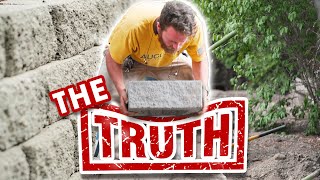
This is a short how-to/advice video by Mike Andes (with Brad) about homeowner considerations for retaining wall projects. The speakers emphasize proper base preparation (compacted gravel with fines, appropriate depth), correct backfill (angular crushed rock that drains, geogrid for larger walls), and drainage (weep holes, 4" corrugated pipe and diverting gutter runoff). They contrast block sizes (garden 4", solid 6", larger structural units) and explain setback (about 6–12 inches) and a rule-of-thumb for base depth (about 1 inch of compacted gravel per 8 inches of wall height). Practical notes include material cost significance and a common business practice of requesting a 50% deposit before purchase/installation.
Questions this video answers
Approximately 1 inch of compacted gravel for every 8 inches of wall height.
A setback of about 6 to 12 inches (tilted back toward the fill).
50% down deposit.
Chapters
Hey, everyone, it's Mike Andes@landscapebusinesscourse.com and today we're going to be talking about what your landscaper is not telling you about your retaining wall project. So if you're a homeowner and you're looking to get a retaining wall installed, stay tuned for some ideas and some tips about choosing the right contractor or when it comes to the base prep as well as the installation of a retaining wall. Let's go.
The base is one of the most important parts of a retaining wall and constructing one. If your landscaper is going to use like sand or is going to use pea gravel. No, no, no. You need to have gravel that's going to compact, that has little fines in it, that allows it to use a compactor or a hand tamper to make it nice, solid and flat. You cannot use like it's two by six. I once saw a homeowner literally use a two by six. They put it on the ground and figured, hey, if I can just put the blocks on that nice and flat, nice and straight, no, that wood is going to retain water, it's going to warp, it's going to rot. And at the end of the day, if anything is moving around your retaining wall, it's a bad thing. Whether that be the gravel and the base underneath or the backfill behind the wall, you don't want things moving. Now, this wall that we're building here today is only about a foot and a half tall. It's just literally a couple courses tall. But if you're going to do a taller wall, you're going to actually have to go deeper and have a bigger base in terms of the amount of gravel that you install. If someone's putting an inch or 2 inches of gravel like you see in this video, but you're building a four or six foot retaining wall, you better be questioning the integrity of that contractor because absolutely, it's necessary that there's a good spirit, solid base layer of compacted gravel with fines in order for that wall to sustain the test of time.
What we got going on today is basically putting in kind of two sides of a retaining wall here for a client. So we're basically just kind of doing the base prep for that. And yeah, really the biggest, the biggest key in doing a retaining wall would be basically getting a good base set and making sure that everything is nice and level. Yeah, we'll go too high on the blocks. That will be nice, solid, about 3 inches of base there. A general rule of thumb that a lot of landscapers I know like to follow is probably do about an inch base of gravel for every basically 8 inches in height in the wall.
So once the trench has been dug out, we got a basin, we're starting to put blocks in. Great. But what about the backfill? What goes the wall is also extremely important. There's a couple things that are important about the backfill. Number one, it needs to be crushed rock that does not have fines and allows water to drain through because you want the water to not be locked up behind the wall, hydrostatic pressure and causing a failure of the wall will happen. So first of all, you need crushed rock that allows that water to be good drainage. And number two, you need angular rock that's gonna lock up. You can't have smooth round drain rock, for example, or cobbles or pea gravel. Yes, it will drain well, but you don't want that behind your wa. Guess what? Smooth doesn't lock up. It's not angular that will lock up and not move. That's your goal. And in fact, what we'll actually do for the backfill behind a retaining wall that's a little bit larger than this one that we're showing here today, we'll actually put what's called geo grid, which is like almost like a chicken wire type of material, A roll that we put between every few inches worth of backfill. And that is simply because it's going to help lock up that backfill even more. So with that angular rock going into the geogrid and locking that material and locking up that earth behind the retaining wall. And this is what's so important, is the fact that you've got to match the type of material that you use to the type of wall you're building. You do not need a super highly engineered, super massive blocks for a small little wall. For example, behind here there's a garden wall block that isn't small, only 4 inches tall, much smaller block, much more cost effective. And the material cost on a retaining wall project is significant by the time it's shipped. And the purchasing price of that material is extremely expensive. And that's actually why we need 50% down on most of our retaining wall projects, is to be able to recoup that cost before we come to your project, actually install the job.
Another piece that I did just to get the block laying flat on the ground initially was actually took this little sledgehammer here and basically just knocked it off this little lip of the block here. And again, I only do that for the first base Layer and again, that gets all kind of back filled in so that you don't see that. But really what happens there is essentially this allows the block to lay perfectly level on the ground. The block will come. So I've, I've already knocked this one down, but yeah, the block will come here with this kind of little lip on it here. And the reason for that is for basically when you're building up that, that comes in pretty handy so that you can just kind of set it back there. And then.
Of course for the video, this one's chipped a little bit, but yeah, basically. So that lip comes right over the side there. And then you can just kind of butt it up to it and then you know that it's going to hold nice and solid.
As Brad mentioned in the video, that is a setback. That's a 6 to 12 inch degree setback. It's not that the wall is tilted or messed up, it's just that we need to tilt that backwards because it helps with the structural integrity of the wall by having a slight angle back towards the backfill instead of having it straight where it can topple over a lot easier.
So in that video there you saw, we're putting these six inch blocks that are actually solid. There's also wall blocks that are, and they're lighter, they're 8 inches tall. But then in that same video there you saw in the background, garden blocks are only 4 inches tall. So there's lots of different types of blocks. When it comes to retaining wall, you want to match the structural integrity and need for that block to the type of wall you're trying to build. If you're trying to park an RV right up against on top of that retaining wall and it's supporting a driveway and there's a bunch of weight or like a house or a shed. And that's why this, they're putting these slightly larger blocks here. It's because there's going to be a shed right above here. You need the extra weight and the structural integrity of these blocks to be higher. If you just want to do edging or two or three courses high, garden blocks are just fine. They might only weigh 20, 30 pounds per block. These ones weigh like 50 or 60 pounds. And there's much larger blocks. The bigger the wall, the more structural integrity is required and the more weight behind that wall, it's more important to have those bigger blocks. Now the number one reason why retaining walls fail is because of bad drainage. So not only is the backfill important, but also Keep in mind, like if you have gutters pouring onto the lawn and then the lawn is a few feet away from the wall, that water's got to go to the lowest point. It's going to flow past that retaining wall and you don't want the retaining wall keeping all that water behind it because eventually there will be hydrostatic pressure, there will be pools of water that will eventually erode the backfill and it will eventually wipe out the retaining wa. Make sure that you have good weep holes in the blocks of the wall to make sure that the water gets through, as well as corrugated 4 inch pipe that divert the water away from behind the wall and out to the sides towards a sewer or some other form of drainage.
If you need a retaining wall just like this built on your property by reputable professionals, check out augustalawncareservices.com and we'd love to be of service to you. I'd like to invite you to Landscape Summit. It's the conference we have in January of 2022. Go to landscapebusinesscourse.com, conference for more details. We talk about P4P efficiencies and how you can grow your lawn care and landscaping business. I look forward to seeing you there.