SAVING a $3M Lawn Care Business from FAILURE!
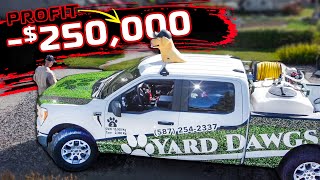
Mike Andes visits Yard Dogs (a Calgary lawn care business) to review a previous turnaround and provide growth advice. Yard Dogs lost roughly C$250K in 2022 after a premature second-location expansion (reported 2022 revenue ~C$1.1M, -C$250K profit) then recovered in 2023 to C$2.0M revenue and C$420K profit with about C$300K cash on hand. Key operational topics: Canadian seasonality (May 1–Sept 30), truck leases (~C$900/month), marketing (direct-mail to competitor addresses), and retention tactics (auto-renewal, one-day notification service, soil-sample requirement to prevent cancellations). Strategic themes: increase retention (from ~65% toward 80%+), create repeatable/location playbook, hire/retain strong general managers, use profit-sharing/distributable-cash frameworks (example: 35% distributions) and scale via copy-and-paste systems.
Questions this video answers
C$1.1M revenue and a loss of C$250,000.
C$2.0M revenue and C$420,000 profit.
Approximately C$300,000.
Retention increased from about 50% to about 65%.
May 1 to September 30.
Chapters
Mowing lawns, washing windows, landscaping, toilet scrubbing, whatever it took.
What are you willing to risk?
I thought about quitting. Don't get me wrong.
Holy.
We have to, have to. Have to get ourselves up.
It is a risk. It's a roll of the dice.
Everything will break.
The harder you work, the worst everything got.
Let's go all in.
Hope to God that they're gonna renew for one more year at least.
What the am I gonna see today?
Pretty crazy news. So today, coming to the yard dog's office that we call the pound is Mike Andes gave us a call last Thursday. Lo and behold, it was the media. Hey, guys, we're in calgary, but it'd be a sin not to come and visit you guys while we're there. So we said, hell, yeah.
In 2020, two yard dogs lost $250,000.
None of that 20, 23, $400,000 in profit. If you want me to turn around.
Your business, go to mikeandies.com turnaround today.
Extra large coffee is ready to go. Mike Andes is coming to town. Gottimpressmykandys. So shower check, Pump on check. Gotta clean the office. Gotta. Got to go get a car wash.
What's up, dude? Good to see you.
Good to see you.
Thanks. My pleasure.
Welcome to the yardic.
Yeah, dude, it's close. It's, like, cold here.
Oh, yeah. Just a little bit chilly and stuff.
Oh, man.
Everyone always asks, what do you do in the winter? Did you snow? I'm like, no, we just think about grass getting ready for the next season.
Oh, man. Good to see you, brother.
Good to see you, buddy.
Absolutely.
Good to see you, man.
Good to see you. How are you doing? Fantastic. So this is, like, most of the gang for the winter then?
Yeah, yeah, yeah. We have, like, one more as well, but, yeah. And we're not in, like, the offshore gamer gig right now. Right now it's just like, here and there, right?
So it kind of kicks into high gear. What, end of February?
Yeah, exactly.
Yeah.
Two years ago.
We've been calling everyone right now, like.
Going hard, like, want to buy again? Want to buy?
But, yeah, not right now.
Then we just shut it down.
Let the people just enjoy their winter.
And stuff like that. And then you'll call them, like, more like in March then, like, right before service starts.
So what we noticed a couple years ago when we did the turnaround with you, like, in the past, we'd had, like, we called it a disaster year, because what we were doing is, like, we thought, oh, like, we just need to Add more contacts to our customers to increase our retention. So we call people, like, on average, I think 18 times in the off season when you combine emails, texts, and calls. Yeah, 18 touch points. And people like, stop calling me. I will buy lawn care from you. But it's like mine is 30 right now too, for the snow. In fact. No, don't call this morning. Hang up there.
A couple years ago, Yard Dogs tried to expand their business prematurely by starting another location in a different office. Office a few hours away from their first location. Although it sounded great in theory to grow the business, that was back in 2022. And in that year, they lost over a quarter million dollars and were extremely unprofitable.
So then this past year we like, you know, after the calls, like, you know, let's just kind of slide in. It's a continuous service. Let's slide in, give them the one day notification that we're coming by, get it done, leave. And then if we don't hear anything, charge the credit card. Problem solved. And our retention went from 50% to 65%, which is awesome. But now we got to get that up to 80 plus percent for sure. Our big thing with Canada is like, we can only actually do Lawns from May 1st until September 30th.
Right.
So we have a good relationship with the Stormobile company in town. All of our technicians that want work will go over there. Some guys just go on EI and take some time, spend their family and whatnot, or go do some courses and stuff.
All that great stuff. Do you want to show me around a little bit?
Absolutely.
Let's do it 100%, dude.
The dogs on top of the truck and our lawn care signs, though, I've never had so many people say, I was walking my dog and I saw your sign. And back in the day when we were talking just casually, people like, oh, I have a company called Yard Dogs. They're like, oh, what's that? But this year, if the dogs. Probably like half people I talk to, like, oh, yeah, no, I've seen their trucks driving around.
And then what right now?
Are you financing the trucks when you buy them?
What's that look like?
Yeah, it's just an operating movie. So we get to write it off on the P and L. But you don't, like, build equity in them until you actually sell them. It's not a capital lease. It's not rain lease.
Got it. And what are these per month for the lease?
900 bucks per month. Got it.
Yeah.
Okay. And they all in the same Lease. Because they're all the same truck.
Yeah, they're all. Yeah, they're all 20, 22. Yeah, that's been good. Trucks, but it was about 12 last year. Was spent on trucks.
Got it.
So I don't know how to go with that. I don't think it's good.
These are. These are the laser printers. This is. I remember this operation. All right. What do you have to. Claire?
Getting all of these letters packaged and stamped. So it does all the folding, all the stuffing. Right for you right there.
Wow.
How much time does this thing save you? A bajillion hours.
Just hate some kids. We call them kids driving around leads on the P and L statement. They literally drove around all day and they saw a competitor sign on a lawn. They wrote down, who's the competitor and what's the address? So we had 7,000 contacts. So now send them letters like, hey, like, this is James. I'm a service manager with yard dogs. I was driving by your house earlier, and I noticed you're with one of my competitors. I would love to tell you about yard dogs and stuff.
Really?
But everyone gets the letter says, oh, that's nice, and throws into the blue bin, you know, like, no one opens letters.
It was like semi. We, like, actually, like, said, hey, like, weed man customer.
Yeah.
I went pretty much targeted.
We've had a couple people say, you better stop sending those letters. So we stopped.
That's hilarious.
These Canadians are vicious. I don't know if I necessarily recommend this, but you have to give them.
Brownie points for trying. So 2022 revenues and then profits for that year.
1.1 revenue, negative 250k profits.
That was the year we kind of had to eat. The cost of trying to do the expansion.
Correct.
That was a disaster year. Yeah, to a degree. Do you ever miss 2022, like, the disaster year? Do you ever miss it?
In the moment, I hate it. But in retrospect, I'm so happy it happens. So, like, I wouldn't undo it is the tricky thing. It's. It's a lovehate relationship that I have with 2022.
The only, like, the. Some parts, like, I miss is, like, the adrenaline of, like, holy hell, we have to have to have to get ourselves out of this. And it was like, you absolutely must.
You know, argue, like, can somebody actually make it if they don't have those, like, so many people, like, think of, like, spoiled children. They never have hardships put on them. But it's the people that seem to, like, gone through kind of, like, the roughest start that turned their life around the most. It makes me think, like, sometimes struggling is a very important part of the equation because without it, you need that shaping. You need to learn those lessons. And how else do you learn it? By going through it yourself?
Yeah. And then we basically took that cost, ate it, brought it all back under this one shop. Yeah. And then 2023, what did that look like?
Two million exactly on revenue. And then 420,000 profits.
Got it. And then how much of that is actually retained earnings? Like money in the bank now.
So pretty much all of it. Might as well $30,000.
So like 300 grand basically in cash.
Yeah, exactly. Our goal for this year, we want to hit a million dollars profit.
Okay.
That's our big goal. So we got to be as lean as possible, also try to grow the team. But, like, that's our goal is 3.
Million revenue, you know, 3.2.
I think we can probably lead up.
A little bit more.
Okay.
And push for like 3 million with 30% profit.
Are you going to go try back to being doing multiple locations? And I know that's kind of been like the thing you've been throwing up.
Well, we got a. Got a whiteboard in the room. We have all these questions, but one question is, like, what do we do here? Like, I think in Calgary, like our biggest competitor, Green Drop, they have about 60 trucks in town. They've been around 40 years. We've really been doing this for five years. But we do think there's a lot of potential. People love our brand. We do pretty good work and stuff. But we got to fix our retention because so long as retention's 65 or under 80%, it's incredibly hard to grow year over year.
Let's churn. Last year, for example, 35% by the end of the year.
Everyone calculates it differently, but at the end of the year, 65% of people that were customers in 2022, they were still got it. So, like a lot of people calculate the churn at the start of the year. If they got one service in and then they cut it off.
Right.
For us, we went to the very end, got it. So 65%. But it's very tough to grow because it's a formula.
Right? Right.
And if we're only adding like a fixed amount of people, at the end of the day, our customer growth.
Exactly.
Plateau or even go down.
So right now it is just like all in on the one and grow this. It's just a matter of like, how do we get the space to facilitate 50, 60 trucks.
And how do we not get bored in the process? Because sometimes as entrepreneurs, like, oh, no, we could do more. We should be doing that other location because the first year always sucks. Let's get it under our belt already.
And go, what would having a second location? Like, how would that scratch the itch of wanting to do other entrepreneurial things other than just saying we have two locations? Because you'd be doing the exact same thing there. Oh, I hear.
I know what you mean.
Well, it's.
It is like a new adventure, you know, like a new location, new general manager kind of. You get your call center, like, together and all that. I just love growing. I love seeing other people become rich as well and just be. Become less successful. Like, that's like my favorite thing, seeing, like a young guy, ambitious, becomes a general manager or whatever it might be, and they become like a millionaire. Like, I love seeing that. I love seeing continuous growth.
You know, in the first few years of growing a business, you're usually not super profitable. It's actually once things get, you know, pretty boring and you're running operations and refining the processes, you actually make all of the profit. But a lot of people never get to the profitable stage of their business because they're constantly having the shiny object syndrome, going from one thing to the next, and they never actually make a business that makes money.
I think our current plan would be, like, corporate growth. They want to make Calgary like a million dollars in profit, and then let's see what the options are, which would. As of right now, things could still change.
Right.
But, like, most likely be like, corporate expansion. We go to Edmonton, Red Deer, like Saskatchewan, all that stuff.
Yeah.
And then just kind of grow corporately with, like, general managers.
I like the idea of doing like 15 to 20 locations in Canada because then you can dominate Canada. It's like, it's. You literally need 10 locations to be everywhere in Canada. My biggest concern is, even after you do say two, is it going to be challenging enough to keep you involved? Like, are you going to have other itches that you need to scratch? Because, like, that's the issue I kind of see is like, once you nail one location, starting a second one is difficult.
Yeah.
But once you've done two, it's like the difference between two and 10 is not as much as going from one to two, because it's a matter like if you can nail two and you have a really good program for training general managers. Great compensation plan. Like, everything hinges when it comes to secondary locations on your General manager, solid general manager, solid location every single time. Bad general manager, bad location every single time.
It cannot be understated just how important a general manager is to making sure that your location is successful. I had a location a couple of years ago that didn't have a great manager in place. And in one month, June, they lost $50,000. The very next month, after changing it to a new general manager, that was extremely efficient and really pushed the envelope with the team. They made over $60,000 in profit in just one month. That shows the difference of what a good general manager will do for your business.
Do you recommend giving that general manager, branch manager, a bit of equity in that branch or something to keep them really motivated to keep growing?
The problem with equity is really the values there. Only if they sell. If you sell. Because for the first three to five years, you're taking all the money and putting it back into the business. So there's not really distributions from equity. There's really just. You're growing up. The net worth of the. Of the asset. Yeah, the value of it. And so unless you sell, they never actually realize that. So I like to be more generous on profit sharing because that's. They'll get that faster. And so, like, for example, the first 24 months, you could say, hey, we're going to be giving, you know, base salary and then a bonus based upon certain revenue markers. So if you're over this amount per month, you get this bonus. If you're over this amount, you get.
This much for the first couple of years, like just grow like that.
Top. Well, because you're just trying to grow top line. Right. And then you have a profit sharing of X amount. You're not going to see it for the first couple of years because we are in growth mode. But, you know, you're incentivized to get that as fast as possible, possible to a certain level.
Then just a matter of how do you compensate them in the short term to grow and in the long term for profitability. And I'd give them a lot of.
Profit sharing because, like, what percent?
So if someone's starting from zero, I give them 35% of distributions. So it's different than profitability. Right.
So like, sorry, cash, like free cash flow.
Yes. So it's like when I take a dollar out, you'll get 35 cents.
Got it. So nonprofits, free cash flow.
Exactly.
Got it.
And so that's one way to do it, because I used to give 25% of, you know, profit sharing based on a quarterly P L. The problem with that is you could have a winter where you're losing 15 to 20 grand a month, especially in this sphere. And so then they have this massive trough, and then second quarter, they're making all this profit. You're giving them a massive check, and you're like, well, I'm just still getting out of the first quarter. Every dollar I get, you get a cut of it. And I'm willing to give more because I know that as the revenue increases, I need more money in the bank for working capital. And so what you can say is like, hey, anything over one month of revenue is going to be considered distributable cash.
So is it annual free cash flow distributions or is it monthly?
Still quarterly.
But what we're going to do is we're going to look at the end of every quarter and say, okay, how much money is. Can we distribute to the ownership and the management? That is determined by what was the average monthly revenue for the past 3 months for the quarter. So if we did 80,0001-000001-20000 for that quarter in monthly revenue, the average would be 100 grand. Anything over 100 grand in the bank is distributable cash. So that way, as the business grows, you need more working capital, you need more cash in the bank. So when you're doing 200,000amonth, anything over 200,000 becomes distributable cash.
Mike Andes is the chat GPT of the Lawn care industry. You guys, you ask them a question, he just spits out an answer like, Mike, what are the five most economic ways to grow a company? Oh, Mr. James, very easy. Number one, you got to make sure you build a scalable team. Number to make sure your financials are very on the. Number three, make sure that you have your fertilizer products nailed down. Number four, and make sure you have the product distributors ready to go and you have the best cost analysis. Number five, make sure that your trucks always clean. And like, he's a. He's a chatbot robot.
Yeah. Like, I think defining for the team, too, like your individual roles and who they go to for what. Like, if you're going to be focused on sales, there's really not a lot of reason for you to bring up things like compliance, safety, and anything in a team meeting. It is simply like, you bring up sales stuff, right? And that's tough because, like, you guys have both acted sort of like split owners on a lot of things. And even when I ask, like, what's the role? It's like Well, I kind of do sales. I can't do operations. Like, and, like, who's the leader in teaming? Like, kind of both are. That needs to be defined as you grow past 2 million. Right. Otherwise, you're going to have confusion from your ops manager, your office team, and your sales team. Because, like, it'll be like, okay, well, if. If Liam walks in the door and talks to the sales team, is he able to give us direction? Like, who. Who's my main manager? Is it both of them? Like, you both are owners, but it's a. Like, what are the roles defined? Right. And then just realizing there's gonna be times where, like, you want to step in and help a salesperson and you actually don't. Like, you actually stay away from it. And you might report back to him and be like, hey, I saw this and this and this. But you are not gonna go fix it yourself. Same way that James will see something in operations or, like, in a team meeting, want to say something and he'll shut up. Because, like, that's. That's not my department.
Okay, so if you were us, like, doing, like, the corporate, would you advise us trying to get, like, this location, like, 5, 10 million, or do you think it's just, like, smart to stay and call it two or three, keep raising prices?
I'd probably do three. If I was you, I'd probably do 3 million. Try to do it 10 times and can.
Sorry, 3 million and 10 locations.
So then it's like, what do you. What do we need in terms of this, like, organization at each location for 3 million to be possible? Once we hit 3 million, we're in profit mode. We're raising prices, we're out.
Why stop at 3 when this could do 6 with not too much effort?
Because you want to build a model and then copy and paste it.
Yes, we can do that.
If you go, say, 3 million, and then you're going to start another location, it's not like 500,000 the first year, a million the second year. That's so different than now. This one, that's going to 5 and 6 million.
Yeah.
Like, you're going to have different businesses.
Yes.
Right.
This.
If you go to 6 million with this, this has a whole nother layer of. Of hierarchy now. Correct. So in my opinion, like, I like.
The model of build to.
I want to make, in terms of business model, make sure it's repeatable and profitable, and then just copy and paste it. I think you can get them to 3 million within three years. If you perfect the model 10 million, you're gonna hit saturation on some of these markets before you get 10 million. When you're, when you're trying to do multiplications, like I just always recommend, figure out what the model you believe is going to work, test it, prove it, and then just replicate it. There's no right or wrong. Like, do you Want to have two that are doing 10 million or 15 million or 10 that are doing 3 million? They're both doing the same amount of revenue. What business do you want to build? And then you could just play with how do you roll those out. So for example, you could do where someone starts out their garage. Like, hey, when you get to X amount of clients, we get you a shop. When you get to this many clients, we get you a second truck. We get to this many clients, we get you a service manager. And you just start moving them like to this progression. So they're not like expecting from day one a shop space that costs 15 grand a month to burn.
At Augusta Lawn Care, we have over 150 locations around the world. And the reason we're able to do that is because we simplify what each location is supposed to look like. And then we can copy and paste that using the systems that we've made in the business. And that's how yard dogs, if they're going to do multiple locations, needs to think about their systems, create a solid system, solid framework, and then know exactly what your general manager and what your structure is going to look like as you copy and paste each location around the country.
How can we actually increase retention? So like we have, these are the three things we can think of. The way the expectations are based out on the sales call, the way that we actually do the work, are we making grass green, healthy and weed free. And when someone has a question or an issue and they call them customer service, they are just given like frictionless experience and stuff.
We know statistically if they're a first year customer, they're going to cancel at a much higher rate than if they've been with two, three years, right? So like how do you make that first year experience so damn good?
Part of it though too is like, keep in mind, people do move on average few years, anything more than a.
Churn of like 33%, like a third.
That's when I start to like get.
A little more question, like under that, you are starting to fight the forces.
Of people just moving on average, right? Like if you have a 20 turn, it means that one out of five years, which means people move every five years. Right. So there, there's a lot of natural turn. What I potentially think about is like, can we measure why the churn is happening? Like, did someone move? Did they pass away? Are they unhappy with the price? Then attack all of those individually and differently.
I think that's like the number one issue. Like it's, it's so tough to grow when you're turning 35%. I don't think the moving is that high. I do have like the reasons why people can't pull it up. I, I think moving was almost like 5% or whatever it was. It wasn't actually as bad as the price.
Really high.
A lot of it. Auto renewal, it's like we just showed up.
End of the day.
It was a huge win.
Yeah.
But a lot of it was like.
What the hell, guys? Like I.
You just showed up and charged my car.
Right. I want to cancel.
Right.
When they cancel, it's not cuz of the auto renewal. Like there's got to be a reason why. Is it price? Is it the fact that they're annoyed? Like, why did it. Like that's when they cancel. But why did they cancel?
I know what you mean. What the root cause.
I would say when you do your renewals issue, like you get started and they're gonna be people canceling. Try to track why not when.
If yard dogs is going to continue growing their business, they've got to get a handle on all these cancellations. One way that they could do that, just as one example, is requiring that they do a soil sample for customers before, before they cancel. And just telling the customer, we want to make sure that the soil is up to the standards that we require before you cancel your service. And then they could use that soil sample and compare it to what they believe the soil is going to look like in a year if the customer does cancel. And then tell them, hey, look, if we don't do service for a year, here's what's going to look like. And here it's going to cost to remedy and fix those problems.
Like if it's a genuine person that's been a client for two or three years and they're saying, you know what? I lost my job and went through a hard time. They've been loyal and stuff and say, hey, Mrs. Jones, you know what? You've been a really good client. I'm going to do it for you for free this year.
It really comes down to just that compared to customer acquisition cost, like our.
Gross profit is 34 or 74%.
Yeah.
And we're already in that neighborhood doing lawns.
So. But it's going to cost you 100 bucks in actual, in cogs. And we're not talking about overhead. Like, you're still going to have to contact them. You're still going to have them in the database. They're still going to complain. Right. So let's say it's 100 bucks. The question though is like, if you know that your customer acquisition cost is $80, why would you do that?
Well, because how many people are probably going to. So this is the cost to do the service right now from the people we actually do retain. So say we do what's called we do 100 people lawn care for free.
Yeah.
Now, out of that hundred, how many people are going to most likely renew for the next year?
20. 25.
That. I honestly think that's a low number.
Let's throw up 25%.
You think that they're going to get a better situation next year, but they're.
Going to, they're going to sort of like feel bad or whatever. I think 25% is reasonable. I don't think it's like 5%.
Even if they renew for one more year, because I feel bad. You're just going to recoup your costs.
But you're going to build goodwill, you're going to get more awareness, more signs, etc. Etc.
Tell the friends, tell their friends and family.
You're going to spend $100 and hope, hope to God that they're going to renew for one more year at least. Whereas if you pay $80, you have a paying customer from day one that has no anticipation of discounts.
If they're going to give away free services, it means the entire first year of a customer's relationship completely free. We not only don't make money, we lose profit. Second year, we gotta hope and pray they actually stay on. And if they do, we do that entire year just to break even. And it's been two years. And finally in the third year, we can actually make a profit. That's a big risk to have three years before you actually make money on a customer. Speaking of free services, for absolutely $0, I'm happy to come to your business and help you turn it around. Whether you just cannot grow the business or you're losing money hand over fist like yard dogs was a couple of years ago. I'd love to come help. Go to mikeannies.com turnaround and for free, I'll come out and turn around the business.
Like if you, if you Are going through some issues with your lawn landscape company right now. Submit your application video. Like, you have nothing to lose from having Mike come out there and turning things around. You have everything to gain. This guy, like, he's flying on his own dime and stuff. Like, does it hurt to be on camera talking about bad things are. Sure. But you're going to learn more from that video than any other viewer that's watching it from a screen. No.
I really think too, like, the secret to sort of being like successful is taking that learning curve and shortening it.
Right.
And Mike will absolutely do that for you.
Right.
Like, I'm sure you could probably build a 10 million or a million dollar, like lawn care business over the course of 30, 40 years. But if you get that knowledge of somebody that's done it before, that can. Instead of 30 or 40 years, it could be one or two or three years.
Thank you, Mike Andes. Say, Tyrell. Thank you.
Mike. And he's leaving. Thank you so much, Mike. That was awesome.
Shout out to yard dogs for actually implementing all the advice we talked about a couple years ago to make the turnaround possible. Now, not all owners, when we do these turnarounds, actually listen and implement everything we talk about. Watch this video here. We're six weeks after the turnaround. We checked in with the owner and unfortunately they hadn't taken any action.
I actually got a call after they left 30 minutes later saying, hey, guys, James, we forgot our camera bag at your office. Can you bring that out to us? So I'm just jumping in my truck right now, double timing it to the airport so they can catch their flight and get them all the camera from all the media they just filmed. It sucked to lose that, but that was so awesome. Jimbo saved the day of this camera bag delivery, which is our new business, Uber yard dogs. All right, we're looking for a gustonation in yellow. Those guys be.
Have you lost cameras before?
All of our camera gear didn't come through on the plane. Here we are, man.
No worries.
Zahl, you got time for your flight? We'll see. Yeah.









