Service Titan IPO and Behind the Scenes - Episode 086
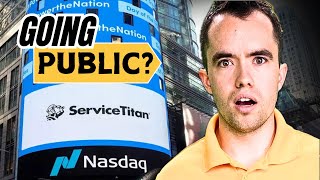
A conversational episode (C-Suite Unfiltered, Episode 086) featuring Lee and Mike Andes. They revisit a past business-boot-camp client (Aaron), examining his equipment-driven growth, large debt payments (~$35,000/month), 40% interest restructures, and the trade-off between growth and profit-mode. The hosts then discuss Service Titan’s IPO—quarterly revenue (~$198.5M), reported loss (~$47M), customer counts (self-reported ~5,000–8,000; other references ~7,500), and enterprise pricing/ARPU differences versus mid-market products like Copilot/Augusta. The episode closes with non-financial holiday advice (screen/blue-light mitigation and watching Charlie Brown Christmas).
Chapters
Alrighty. Welcome back. Another episode C Suite Unfiltered with Mike Andy's Merry Christmas.
Ho ho ho. We got lights behind us.
Let's go. Yeah, we, yeah, we got some Christmas lights hanging out. So that's exciting. I gotta. I got a fire hydrant over here. I'm in a new spot in the office. You took my old spot. I'm in a new spot. So it's a lot of changes happening this time of year. How have things been going with you?
Good man, Very good.
I would like to start because you gave us some teasers that you went back to Arizona to meet with one of your probably most watched and most controversial turnarounds, Aaron. Is that correct?
Yeah, he was actually we were doing back in the day was business boot camp where for six weeks I would check in with them on each week. And so yeah, he was the very, very first one ever actually and definitely not our most watched but definitely the most controversial. And so yeah, we went back and visited him yesterday and it was, it was fun.
Yeah. So for those who do know who Aaron is and watch that turn or not the turnaround, sorry, the business boot camp. I apologize. Any good teasers? Let's give, give us an idea of the direction he's going. Is it positive or negative? Where do you, what do you see happening with Aaron and his business?
Well, I think if you watch the business boot camp, it's not surprised that like he, he wasn't going to change anything after the coaching that we did. And so, you know, sure enough now the business is basically in the same spot. He's bought more trucks, more equipment. He has downsized the number of employees and basically retained the same amount of revenue. So like that's a positive thing. But there's over $35,000 a month in just loan payments. And then he defaulted on a big chunk of that and so they restructured it. He's paying 40% interest. $300 a day to pay that down. So yeah, yeah, that's okay. So you have to just wait until it comes out. But yeah, when you're paying 40% interest on, on debt, there's some structural issues. But again same thing happened the other day. It was just a matter of like he doesn't see feel that pressure as much. But yeah he does. Like he, he. It's, it's just, it's just different. So the parting words were we have different philosophies.
Okay.
He's constantly kind of like, oh, I'm going to pay this off, I'm going to pay this off, like in three, five years, I'll be fine. But then like, you just bought a $90,000, you know, rig for like a boom, and then you bought like $120,000 tree chipper that you use maybe once a month.
So just different philosophies. Different philosophies.
He's such a good person.
It's so hard to go like full out Gordon Ramsay on. But like, that's what should have happened.
Yeah, no, he is, I would say he, he has a high risk tolerance from what I've seen in my. And, and I've gotten to talk to him too. Like, I've met him in person and watched some of the videos with that. What would you say? And this is kind of zooming out from his personal perspective. In his business, a lot of people have a hard time determining their risk tolerance. What's your advice to them to determine that? Is that kind of looking at the big picture of like, what's your age, like, what's your marital status? Do you have kids? How do you have available? What's your current income? Is that, do you just look at it like from the bare bones perspective or is there like a greater philosophical question or coaching type question that you can ask people when assessing their own risk tolerance?
Yeah, like it's, it's a very individual thing for some reason. Like someone like himself has kids, has a lot of like, you know, dependence, etc. And doesn't feel the need that risk is such a big problem. He's also come out of like drugs and had to rehab and everything. So he's risked his life in that regard. So coming back to a business, it might not seem like such a big deal in terms of risk. So whether that's a good thing or bad thing is debatable. Yeah, I think like, you know, ultimately if someone. The business should serve you and for him, he wants to continue to grow. And I said, look, there's two ways to do this. You can either outgrow this problem like the, the U.S. government trying to outgrow their debt, or you can.
And go fiscally cut all this. Because I said, look, you, this was crazy. Okay, so you're doing like $1.2 million in revenue. 40,000amonth of that is recurring maintenance. Like, the name of the business is Arizona yard maintenance. 40,000 of that is. Is recurring maintenance. All of the equipment is paid off. Mowers, the smaller trucks, the smaller trailers. He has the $35,000 a month in payments is on big trucks and big equipment like these he has two rigs that you need trees like aerial massive. Crazy. This tree chipper dude is a 19 inch tree chipper. Has like a winch on it to pull trees into it and like crazy stuff. It's from Vermeer, so at least $120,000 massive diesel thing and it maybe gets used once a month. But the, the logic of it's $2,000 a month, $3,000 a month. If I get one job, I'll pay for it pays for itself. Like that is such a slippery slope when it comes to projects because you like, you will always be sold on that by a salesperson. And like I was joking with the media team afterwards, like the best day of any salesperson's career is when Aaron walks into their dealership because like it's such an easy sell and we all fall. Yeah, it's like oh, this piece of equipment is X amount per month. No problem. I just do that. Like if I get one job a month, it pays for itself. Oh that's so easy. But then you fail to realize is that when you don't use it for once a month, month or when it breaks down, all of a sudden you cover that fixed expense and then your insurance goes up and your liability, you have to park that thing. So you have to get bigger shop space, your maintenance goes up. There's so many other aspects of buying equipment. And so that was a slippery slope he fell into. And so now all of a sudden, you know, 40% of his revenue is coming from recurring maintenance. Zero percent of his loan payments go towards maintenance related equipment. But yet $35,000 a month, which he maybe does 50 to $70,000 thousand dollars a month in projects. But literally half of that revenue is going out to loan payments. You'll never make money. So in my my, you'll see that in the video. It's like if I was you, I would just sell off all your equipment. I'd go in on the maintenance side and grow. This is 60 or 70,000 with two, two employees and be really profitable.
But anyways, do you think that some people it's less of a risk tolerance issue than it is a planning issue. Like they don't even consider the risk tolerance. They're just, they're just poor planners. And I'm not saying Aaron is in this case, but do you think that some people don't even consider the risk tolerance? Like well if I'm gon business like I'm going to have to take out debt, I'm going to have to finance piece of Equipment. Right. If I do, you know, sometimes that logic actually does work out. The numbers work out where? Well, if I do finance this mower and I know I'm going into spring rush, and I know if I can get 30 more clients, I'm going to have more than enough money to pay off this and turn a profit. Right. Sometimes that works out. But do you think it's poor planning or poor risk management?
I think it's a poor. Poor planning as a result of bad advice. Like, he got advised to buy a new truck at the end of 2023. So he paid 50,000, $60,000 or got more debt on another truck that literally was just sitting there, but it was for the sake of taxes, when in reality he had a net loss. So, like, he gets bad advice. And so the challenging part, as entrepreneurs, like, you do need advice from accountants, attorneys, lawyers, bankers, but you need to know. You need to know enough to be able to understand their language and actually vet what they're saying. In part because he doesn't have his P and L put together. So it's like planning probably is the downstream effect of bad advice. And the bad advice is probably a result of not having any numbers. Like none, no CRM, no P and L to show me. It's like I couldn't even dig into the numbers. There were no numbers. And so you're just like, well, what percentage of your revenue is coming from tree service? Like, you have hundreds of thousands of dollars worth of equipment. Like, no idea. So, like, if you don't have numbers, you can't get a good advice. And if you don't get advice, your plan is gonna be messed up. And so the trickle down effect is you buy a truck that you do not need to save up taxes that you aren't going to pay, and it sits there and collects dust While you pay $1,000 a month in loan payments and insurance. And so that downstream result is an effect of bad planning. That bad planning is a result of bad advice. And that bad advice is a result of not knowing your numbers.
Yeah. And it's one of the things that Augusta, that we talk about.
Right.
I'm just thinking one framework of many that we have, and that's capacity based growth. Right. We're like, okay, what's the asset capacity currently at? What's the labor capacity currently at? What's your cash position? Should you grow or should you be in profit mode, kind of lining your pockets for that next surge of growth? And that's more of a planning framework. And then it's up to each individual owner in Augusta to decide what their risk tolerance is. Because if they say, okay, this is the framework for planning my growth, but I'm okay with less in the bank. Like I'm comfortable with less than a month or two of payroll in the bank because I'm going to trust my gut and just go full bore into it. So it's just interesting finding that balance for people at the end of the day with entrepreneurs, I think it's just there's, there's a pull the trigger moment and some people are trigger happy and some people are trigger shy. Would you agree with that?
Yeah. And like, honestly, asset based capacity is probably the most underrated system that we've ever talked about. Like, like we. It's super common outside of Augusta. Cause we all are. So we do it every single month. We all, it's at the back of our mind like, what's our asset capacity, what's our personal capacity, what's our labor capacity? But like that is the most underrated thing we've ever talked about. If you talk to people outside of Augusta like that, aren't deeply involved in the content, they have no idea when they should buy a truck. They really don't. It's like, oh, I'm really busy, I should buy another truck. It is a math problem. And so when it came to Aaron, he probably has the capacity for a 3 to 4 million dollars business, but he's doing 1.2 million. So I said there's two ways to do this. You either grow 2, 3 to 4 million dollars in revenue, you have a million dollar maintenance division, a million dollar landscaping division and a million dollar tree division. Or you've got to cut back, get to $800,000, do everything we've talked about in terms of getting to profit mode. He's just not going to do that. The mindset, like, he is okay with the risk, it's okay, it drives him. But when people say that, I also look at their actions and like he had a big collapse, like just mentally like breaking down earlier this year. Well, he had to get huge amounts of debt to restructured and 40% interest to cover that. And so as much as someone wants to say that they're okay with risk, I would just really encourage, like think about the bottom line. Grow a smaller business, be more profitable, do services that are simplified and standardized. And if you're not using that equipment at least two or three times a week, sell it, get rid of it. He's like, well, I'm going to take a Loss on it. Great. I'd rather have a six, have fifty or sixty thousand dollars of bad debt that we're paying two or three grand a month on to pay that down over the next several years than $35,000 a month of debt.
Debt payments. Payments. Like, I would guess that his actual debt, like, principal was well over 5, $600,000 easily.
Like.
Like, very conservatively, probably more honestly. Because if you're doing. If you're doing $35,000 a month, there's a very good chance it's close up to a million. I don't know the numbers. I didn't have a balance sheet, so I can't. I don't even know what to talk about. So. But when you're paying $35,000 a month towards debt payments, you better be having very close to 300,000, $400,000 a month in revenue.
Yeah, yeah. And if your debt payments are half of the revenue you're producing with that equipment, you can assume that the other.
You will not make money.
You could assume that the other 40% goes to the labor to actually service that work. So that other 10% cannot cover the rest of your costs. There's just no way that. That. That math. Maths. Right. And I think it's funny because while you were talking, I was thinking about it that you said you should have advisors for your business. You should talk to an attorney, you should talk to a bank, someone else in the industry. I think it's so funny because you and I are in these community groups, you know, kind of incognito, if you will, on Facebook. Right. I'm in one that's huge for tons of lawn care landscapers across the whole US and it's just a public community group. I can't tell you how many times I've seen pictures of them celebrating their new piece of equipment. I have never seen a post in those community groups that says, I had a great strategy session with my lawyer today. I had a great strategy session with my banker today. It's check it out. I was able to afford this new check. Check it out. I was able to afford this new zero turn. And there's nothing wrong with that inherently, but it's wrong if you don't have a plan in place to actually make that asset make you more money.
Yeah. I think there's two things there. I'd say first off, a lot of times those groups are full of people that are in the labor stage, like the labor 0 to 200,000. And so actually buying a piece of Equipment is actually a huge impact to the business. Like you don't see a business that is 3, 4 million dollars or has multiple locations cheering out their new equipment because they realize like they should, they're getting, they're getting more excited about having a general manager that started, that has experience is going to crush it. Right? They've realized that there's higher leverage things than just buying a piece of equipment. So usually at 0,200,000, the greatest degree of leverage you can have is more productivity. And a better piece of equipment or a better truck might actually help you achieve that. That's why people get excited about it. And what got you there though is usually not to get you to the next level. And that's why like from 200,000 to 500,000 people stall out because they still are getting excited about trucks and equipment. And instead of what they should be thinking about is like hiring, like I found a great employee, I figured out paid for performance so my guys can be more efficient. And so the thing that made you efficient at 0, 200,000 is not the thing that makes you efficient for 200,000, 800,000. Because from 0 to 200,000 is the better piece of equipment, it's a better truck, it is the better uniform to be able to keep working extra hour in the rain or like rain gear. The thing that makes you efficient for 200,000, 800,000 is I train my employees better, I got a better onboarding experience, I have better automations, I figured out a way to be able to pay them by performance. I have a better yellow subsystem. And so those things are not glamorous. Also, I would say second thing is those communities usually are not really great for bragging about business related wins. And so this is inside of Augusta. When we do the on the Facebook group, I say, hey, if you put win at the very beginning of your post, you have free reign to just brag about something you've just done. The reason is because every single post you can go, I did this the other day. I went through every single win inside of Augusta Nation. There's not one negative comment. The problem with a lot of the competitor based public forums is if you put a picture of your bank balance and said, big win. Last year I was at 10,000, now I'm at $48,000 in my bank account. If you did a screenshot of your bank balance, you would just get reamed. And so I think that's why it's so important to have a community that celebrates your wins and Then when you're down, they don't kick you. And that's about the power of any community. And that's why I always say the thing that makes join Augusta Lawn Care, the most valuable thing is two words, Augusta Nation. And it's the community. And that's like, can't be manufactured. It is the people inside of it.
Yeah, yeah, definitely. And when you have a community that you can trust for advice, you know that they're going to be kind of on your side and you can supplement with your attorney, with your banker, like that's a plan for success. The unfortunate part is that people like to shotgun blast for advice, right? They're like, oh, I don't know what to do, right. And then they, they ask you a question in the YouTube comment sections and then they ask Keith Kelfas a question in the YouTube comment sect. And then they go in this community groups and then they show up to a seminar or a conference, right? And then they ask everyone they come in contact with and now they're getting all this information and then they don't know what to do with it. And then you get that kind of analysis paralysis. You get to that trigger pull moment and then they're either trigger happy if they're more risk tolerant or trigger shy if they're more risk averse.
Yeah, a hundred percent.
Yeah. Alrighty. Well, switching topics here. This was big news. Kind of related not necessarily to Augusta, but to Copilot. I'm sure you are aware of this. Maybe your team talked about it a little bit. This is an article from CNBC. Service Titan pops 42% in cloud software vendors NASDAQ debut after selling shares at $71 per. So do you know much about Service Titan going public last week?
I do. Obviously it's kind of like where we want to be at in 10 years on the software side and then obviously the branch of the franchise behind that. So yeah, super interesting. They're obviously servicing much more of the mechanical side of home services. So H vac, electrical, plumbing. That is like what I would recommend anyone. Those, Those bigger like 10 plus employees do that it's worth. Once you have like they're expensive. Like we're talking triple, quadruple 5x the cost of like a jobber service, autopilot, co pilot, etc. It's extremely expensive. Like if you, if you're complaining about $20 or $15 per user inside like co pilot, like get ready to be shocked once you go into Service Titan. But they've been around for a long time. And I think what they've done for that market I would like to be able to do for the green industry and recurring services they really focus on the installs. So garage doors, like John Tommy, I was with him the other day, he has his beast with them but ultimately he's supported them for a long time. He has a piece of the company too.
So.
Yeah, I'm definitely taking a look at it. And billions of dollars have been thrown around for their ipo. So we're saying, okay, what's that dollar amount? They went way up market so they actually don't have a ton of members. If you look at the number of members, it's not as high as you might think. But they charge so much. They went way up market. Like I would guess, I haven't looked at their financials and I will once they start doing quarterlies but I would guess they're a like their average revenue per user ARPU is probably in the neighborhood of like 30, 40 grand maybe.
Okay. Wow. Yeah, so that's pretty high end software.
Yeah. So like we're at 3,000 just. Just for.
Yeah, yeah.
So it's just a matter of, you know, they obviously have gone upmarket and so like we would have to go more scale in the middle market probably to achieve this sort of like we want to go up a little bit. But I will never like I'm never going to be able to charge a new owner inside of Augusta nation, you know, 2,000, $3,000 a month for entry level software and you're starting at zero, you're just not going to get it. And so they're serving a different market. But if you look at the number of users it's actually relatively low. But anyways.
Well what's their, do you know their number of users?
I'm trying to pull it up. I read it the other day and I don't want to.
Well, because I have some of the financial data here from the CNBC article last quarter. Now this is interesting. They posted a net loss on 9 or, excuse me, 198.5 million in revenue. That was their last latest quarter revenue available to cnbc.
What was it again? Sorry, I did not read that.
Sorry. Yeah, no, you're good. 198.5 million was their latest quarter revenue that CNBC was able to access. So I don't know if that's last quarter earlier this year, end of last year. But that is a recent quarter of total revenue from service titan.
Got it. Yeah. This is cool. I'm sorry, I'M just looking at some other stuff I'm getting.
Yeah, you're good. Feel free to bring in whatever. But what an interesting part to hack onto that while you're looking up number of users. Because then we could quickly do some math. They also posted a 47 million dollar loss on that revenue. So that is not ideal.
Well yeah, but they're scaling like crazy. What's interesting here. So for example, they are self reporting 5,000 companies.
That's like so. Yeah, I don't know. See I'm getting another number here too. It's lower but they're self reporting 5,000. One spot. I see another spot. 7, 500.
So that puts them in about 16,000 per user. If you do 5,000.
Got it. Yeah. So but still relatively like if you look at number of users, it's like I, I know for a fact, like.
Oh wait, hold on, I did the math wrong. No, no, based on revenue, that'd be a hundred and sixty thousand per user. Because their revenue. Yes. Yeah, yeah.
So they go with the big boys. Right. Because the reason I say like, so for example, they would have like the biggest H Vac companies in the world that have 500 employees. They're paying literally hundreds of thousands of dollars per month. And so it brings that average way up. But yeah, this is a different market obviously it's very, very valuable. It's enterprise level. When you're starting to pay someone, you know, 50, 60, 70, $80,000 a year for software, you're a different, different league than us. And so it's interesting though, we're really watching it. I'm watching it. I'll be looking their financials significantly, but they get value very different, differently than us. Because even if I had, let's just call it 7, 500 companies inside of co pilot, I would not make a fraction of that revenue. And so they get valued very heavily. And that's why like their stock pops so much.
Yeah.
So they sticky at that size of business. Like no one's leaving. Right.
Yeah, yeah. Do you think that's why Tommy's kind of one of their public spokes. Spokespeople. I see his ads all the time on about service titan.
Yeah, he gets kind of his, his way of things because he is the public kind of face of their marketing to the consumer side. But they're driven much more enterprise level software sales. Like they will send salespeople out to go get companies because if you're making hundreds of thousands of dollars per user, you can do that.
Right.
So just a different game but they've been doing it for a long time and I think we can emulate that and do much of actually their feature work for the lower market. And from a, from a use UI perspective, a lot of what they do is actually very complicated. Like most people would get into it and feel like it, it's pretty overwhelming. But they don't, they don't really focus as much on recurring services. And that's really our bread and butter for Copilot.
Yeah, yeah.
So they raise recurring services, does less in revenue. Sorry. So like that's why like our market is just like our average revenue per customer that they're making like our, our members is so much lower than service heighten.
Yeah. So they raised. This is an interesting part that this is a different direction that you want to take. Augusta and Copilot, they raised about 625 million in an initial public offering. And service Titan, their share jumped 42% as we already talked about. So they are venture backed. So what are your thoughts on that versus being kind of founder led and no venture back in your case with cop out and Augusta versus they went venture backed. And I don't know exactly when that was, but obviously that is what they kind of headline is of this article. Like they are a venture back to ipo.
Yeah, there's nothing wrong with it. It's just a matter of like the. The founder and like the. The executives probably very, very small stake. But again like there's no right and wrong here. They're all now billion, like not billionaires. They're probably 100, you know, DECA millionaires. And so like they obviously have won and just a different route of getting there. We're going more the bootstrapped route and like maybe allowing Augusta to be able to get participate a little bit but like it's just a different route. It's a different way of doing business and there's no right or wrong.
Yeah, yeah. So I looked it up here in this article. Now the article does say that it targets kind of plumbing, landscaping, electrical, other trades, software, managing jobs, blah blah, blah. And this article, it says they have about 8, 000 customers with more than 10000 in annualized billings. So now like the numbers are all over the place. That's where I'm confused because if they're posting a quarter, I got, I got.
Another one from them.
I guess it's between. I guess it's around 7,500. The most recent one from them I see is 7,500.
Okay.
But even if it's 10,000. Like their ARPU is just huge.
Yeah, yeah. And then they also have a net or, sorry, I already covered the net loss. Their growth does suggest 24% year over year. So that's pretty aggressive for business of their size, would you say?
Yeah, and the thing is, what's cool is like they're probably, I would imagine they have, and we'll see financials now quarterly, so that's cool. But I would imagine they have net negative churn, which means they're raising prices faster than the churn rate. So if you lose, let's just call it 10, 15% of customers a year, but you're raising Your prices by 20% or the companies inside of your software are buying more and more seats that increase the amount that they're spending every year. You can actually have negative net churn, which means that you don't get any new customers and still you get more revenue because you're raising prices fast enough. And so companies like Salesforce and Service Titan, they are like programmatically raising their prices 10 to 20% every single year. And it's reflective in their stock price. Like when you come into the market, they have a 42% jump in your stock price. That is indicative of a company that can raise their prices. And no one leaves. And they, it's so funny because home services, like we might raise it once every three years and it's a big deal. Like Salesforce if you're in there, Quickbooks, if you're in there, they raise prices every single year. And many of them have doubled their prices over the past five years. They've taken what usually was like 7 to 10, 15% annualized increases. They've taken it like 20, 30% annualized increases because you know, they just know no one's going to leave. So is that right for the consumer? Is that right for the, for the companies using software? Maybe not. Is the value prop there? You know, there's obviously huge companies making that investment. It makes sense. And these companies are large enough where they could probably build their own thing and they don't. They decide not to because it's, it's backed by something that's more stable. And so. Yeah, it's interesting. Very interesting.
Yeah. This is something that in the article, I did not know that they are, are an Armenian based company. Did you know that?
I not know that?
No. Yeah, yeah.
Companies over there, Damon Israel, also some really good tech companies.
Yeah. So they're based out of Yerevan, Armenia and they have over 400 members of their staff. Are actually over there and that bulk of that staff is for their R D to really kind of push growth. So that, that was interesting as well. Kind of US based because you hear a lot about these US based tech companies and SaaS companies. But it was kind of cool to see that they're outside of the US growing and getting a good foothold in the service based industries in the U.S. yeah, no, totally.
And like a lot of times most of your engineers, if you're actually trying to get the best engineers, you have to get outside of, you know, your local market. Like if we just hired in Bellingham, we would be very, very constrained. Like we need a back end dev, we need PHP developers, we need like the talent pool is just not big enough. And so that's why many times engineers going remote, even though you might like, I want the culture in house, great, you're going to have to pay double, get them to move or you're going to just like increase the filter at which you're willing to hire and then hold other KPIs in terms of whether it be efficient, etc.
Yeah, so it was interesting. We're watching it. Service titan going public one day, you know, maybe copilot Augusta will get there. We'll get to ring the bell.
Lee, goodness.
Trying to, I'm trying to be humble. I'm. I'm rooting for you, bro.
Come on.
We will. All right, all right, all right. I just want to be, you know, public facing, you know, we're going to be humble. So do you have any non financial advice for the people this week before Christmas?
Go ahead, my friend.
Mine is, mine is Christmas related. This is, this is, please, not financial advice. Take 25, 30 minutes, sit down with your family. If you're single, sit down by yourself.
You know, and watch the Charles Schultz Charlie Brown Christmas is a fantastic piece of Americana, if you will. I think it was made in like the 1960s. It's very peaceful, very quiet. Just, just chill out. You know, the holidays can be stressful. People move too fast. Take 20, 20, 30 minutes and just relax and watch Charlie Brown Christmas.
Let's go. All right. My non financial advice, two things. Blue light, you know, whether or not it's a real thing. I'm gonna be in blue light glasses. I'll change my screen protector on my device to also have blue light blocking screen filter. So we'll see if that makes a difference because my eyes have been hurting me but just too much screen time probably. So I'm trying to, I'm trying to reduce the one thing that could, like, that's easier, which is just put some glasses on and run a screen. And then we'll. We'll address the sleep later. Yeah, after conference.
Okay, cool. That's. That's what you got?
It's all I got.
You said two things, so it was the glasses and the screen.
And the screen protector.
There you go. There you go. Cool. Well, thank you, everybody, for listening, like and subscribe. Hope you have a blessed Christmas with your family and your friends, and we'll see you soon.










