Starting a Lawn Care Business in High School and Getting Your First Employee | RoundUP ep.25
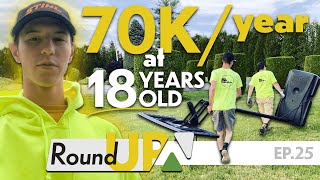
Episode of RoundUP (host Mike Andes) interviewing Xander Fallon about starting and scaling a lawn care business beginning in high school. Xander (age 18) registered his business in 2021, started with flyers and informal one-off jobs while in school, then went full-time after graduation. He describes seasonality and revenue: June peak (~$20,000), July–August (~$10,000/month), and reinvesting cash into equipment. Pricing evolved from ~$20/hr to a labor-rate-equivalent of $59/hr and moving to per-job pricing; he plans to raise the mowing minimum from $40 to $45. Typical property sizes ~0.5 acre. Staffing included two friends part-time in peak season; 2022 goals: 40 residential mowing accounts and ~$150,000 in sales with one full-time and one part-time employee. Contact: baloclandscaping website/email.
Questions this video answers
18 years old.
2021.
Approximately $20,000 in June.
About $10,000 per month in July and August.
About $20 per hour.
Chapters
Hey, everyone, it's Mike Andes here for another episode of Roundup where we interview other landscapers in this industry so you can learn how to grow your lawn care and your landscaping business. Today I'm really excited because we are having an 18 year old on the show. That's actually the year that I started Augusta Lawn Care. Right as I was finishing up my degree and you know, I was still doing part time personal trainer and I decided, hey, I was going to go get my MD and become a medical doctor. So kind of a cool, cool day for me. We'll have someone young like this on the show. I'm always amazed when I go to places like G, also known now as the Equip Expo. I'm always amazed just how young so much of the audience is. 12, 13, 14 year olds that are getting their business started. And I think a lot of times we have a lot in common because they're taller than me almost by the time they see me at 12, 13, 14 years old. So it's a lot of fun though. I think it's a really cool industry to get into when you are young. There's so many skills that can be learned that regardless of whether or not you stay in the industry, serve you really well going down the road. Payroll, marketing, all the things that go into running a lawn care business successfully. So we're looking forward to this episode to see our younger literature, take some notes and all learn something from our guest today, which is Xander Fallon. Xander, welcome to the show. Thanks for coming on.
Hi. Thanks for having me.
Cool. So let's, let's go first and foremost through kind of what you currently are doing is this was your first year of lawn care landscaping.
Then this 2021, this is our first like registered year in business where I'm actually full time into the industry.
Cool.
So last year, doing it a little.
Bit before that, like after school and kind of weekends, things like that.
Yes. This is my first year out of high school. Last year we were shut down due to Covid. So I kind of just took that time to just go out, hand out some flyers, just see what kind of work I could get. Kind of like a trial and error, just like a proof of concept kind of thing.
Cool. And when you were doing the flyers, like, what was your sales pitch or did you have a sales pitch? What was kind of the thing that you kind of tried to stand out from everyone else when it came to the, you know, mowing the lawns or getting more customers?
Um, honestly, my sales pitch was just my Name is Xander Balak. This is what I can do for you. And I think the only thing I really had against other people at the time was that how young I was. And I was obviously pretty cheap as well because I was not very professional. Like my flyers looked cheap and it was just like obviously you could tell it's a first time thing.
Very cool. And so how many customers did you have while you were still in high school? So up until I guess this, this past spring when how many customers do.
You have until then I had three mowing customers where I mowed consistently and I had a lot of like odds and ends job where it's just like a one time thing, like maybe cleaning their house or like power washing or like maybe a one small mulch job or something like that.
Cool. And so to get those. Was that when you were doing the flyers, were you focusing on the mowing side or really just trying to get those one off projects? Because that's what you could kind of fit in around your schedule for school.
I was trying to just get those one off projects. My mower, I was just using my mom's little riding cub cadet mower. So it wasn't very efficient or very effective. So I was just trying to get those, those labor jobs where people just didn't want to do it.
Got it. Cool. And so then you graduate this year. Are you planning to go to college or is this you going to kind of take a couple of years and see what happens at the business? What's kind of your plans in terms of honestly selling your parents on the idea that you're going to do mowing instead of go to college right off the bat?
Well, I graduated this June, so I've had about six months to kind of figure out if the landscaping was really going to work for me or not. And so I was able to, I just said I was going to take a year off of college and just see what I could do with the landscaping. And it actually went a lot better than expected and grew a lot faster than I anticipated where it keep me busy full time. And it had a lot of growth potential where I could see myself living off this sort of salary compared to having to go to college and you know, maybe make, you know, just a basic income.
Now obviously this half of half of this year you was really in school still. But you know, from July, August, September, October, et cetera, this year up until now, we're in December. What was kind of like the average monthly revenue were you looking at like 8,9000 or was it mostly just you working full time throughout that period of time in June?
It was really crazy because that was when I first had the full time experience where I didn't have anything going on just besides work. That was also when the spring rush was kicking in my area. So in June, I think I probably made $20,000 in one month. And then July and August, it started to kind of like, slowly.
Like lower a little bit to maybe 10,000amonth. I was so like, yeah.
And then do you have throughout June when you got that much revenue, did you have a little bit of help then during that period of time, like one of your friends or something help you out?
Oh, yeah. I had two of my buddies who worked about three days a week helping with me with all the mulching and the bigger jobs that I couldn't just do myself.
Very cool. And so over June, like, what did you do differently in June versus being in school? Was it just a matter of like, hey, now I have more time to knock on doors and pass out flyers? What was the catalyst from going, I would assume from like a couple thousand dollars a month to. To, you know, 20,000? Was there something you had strategically, like, put jobs scheduled for June, or was it like, hey, I'm gonna literally just pound on doors and give out flyers until I fill my schedule?
Well, it was really just like a drive thing where I was like, well, this is it. This is life. Now I see that I go out there and make things happen and just talk to as many people as I can and just try to get as much work as I can, or I just give up and kind of go to college. So I said, I'm gonna at least give it a solid try and see what happens.
And then how is your. How's your family been in terms of, you know, supporting the business? Is it something they want you to do? Is it's like, hey, try this out for a year or two, then you got to go to college? Or is this more or less your decision and how are you handling that side of things? Because obviously, you know, there's a lot of pressure to, like, figure things out at this time of life, figure out what career you're going to have, figure what you want to do in the future. How have they been either supportive or not during the time this, this past year?
They. They kind of wanted me to go to college, but they've also been very supportive of me doing the business. My mom kind of doesn't like the fact that it's all at her house still. And it's kind of like making things a little bit messy. So she doesn't like that part. But no, they're very supportive on everything and really helping me grow.
Cool. And then in terms of, you know, looking at what you've been doing for marketing so far, as you look forward to next year, what do you think needs to change for you to get to the next step? Like, I know you said this year did like 70, 80,000 in revenue. Next year you want to do 150 or more. What are you doing differently over this next few months to get ready for 20, 22 in terms of new systems or software? What are you doing to get ready for that growth next year?
Well, I really kind of figured out how to market myself better, so I got more professional flyers. I had my sister design me a website, so I'm hoping that that will start driving some sales. I'm going to do some direct mailers in the springtime. And I got yard signs as well and truck decals. I have the landscaping shirts. So I'm really trying to get my name out there as much as I can. Whether you're just getting started in the landscaping industry or you're already an established business, you're getting a professional website to ensure your customers know how to find you and what services you offer. Lawn CareWebDesign.com is here for you to set you up, keep you going with SEO. You can do unlimited changes to your website, all for a flat monthly fee. Check us out on lawn carewebdesign.com and.
In terms of the budget side of things, when you first got started, I know you said you use your mom's club Cadet kind of got things started. I assume very low budget. As you begin to grow, you need more equipment. Were you just paying that from the cash from the business? Did you get a loan? How did you finance and what did you buy to kind of kick things off? Even in June, when you're going to need a lot more equipment, doing 20,000 compared to 2 or 3,000, what did you do to finance that?
So when I first started out, I didn't really have any money. I just had my mom's cup cadet and some flyers I was able to print out. So when I first got my first mowing job, I didn't have a weed whacker or blower or anything. So I just spent $300 or whatever and bought a weed whacker. And when I got my first power washing job, I never had a power washer. So I went out and Bought a power washer for that. So I kind of just kept throwing the money back into the business. And once I found a job that I needed something that needed to upgrade on, I just used that money and was able to make the upgrade.
How has your pricing changed since the beginning when you said, you know, hey, you're new, you're doing things lower price, that was kind of your unique selling proposition to some extent was just that you were so cheap. What, how, how have you raised the prices since then? Do you plan to anticipate to pay to raise them even more as you get more employees and more overhead? What's your plan in terms of pricing?
So when I first started, I said I would work for $20 an hour plus whatever cost I had. So I really had no idea how to charge for things. And then, so then this year I was, I kind of figured it out where my labor rate was kind of $59 an hour. I kind of set that. And then instead of charging per hour, I did it by the job. Because me and my guys, we worked really hard, so we were able to kind of profit more due to working harder instead of by the hour. And it led to no confusion with the customer on what the price would be or it's not saying like we're working not as hard as they expect. So I really just kind of did the buy job pricing. And for next year I want to increase my mowing prices a little bit. I had a $40 minimum for last year and I'm going to raise it to a $45 minimum to help fight off some of the inflation and some gas price increases. And I also got a new skag mower, so I need to recover some of that money as well.
Very cool. So what's the average size of your properties right now? Because obviously you need a zero turn. I'm assuming there are some larger properties like quarter acre or how big are they usually?
Yeah, so most common property I have is about a half acre and it goes up to probably about 2 acres, but I like to get those smaller between 1 acre to 3 quarter acre lots that are pretty close together.
And then when you were in school and you were trying to kind of juggle the business alongside of, you know, going to class, what was, what would you say to someone that is in that same situation trying to figure out how to balance like homework along with the fact that customers are calling and need work done? Obviously you didn't have a whole lot of, of recurring modes, so it's a little bit more flexible. Because you can move the jobs around. What would you recommend someone that is trying to kind of at least get the business going or just make some extra money while in school and. But balancing out their schedule?
I'd say the best advice would be to just go out there and actually do it. Not just think about, oh, how am I going to balance it? How am I going to, you know, do all this? Don't look 10 years down the road. Just say, hey, like, if I want to, if I want to try this, I'm just going to print out flyers and give it a good shot and just see what happens. I think the biggest fear for people is just making that first step, because I think it's so difficult, like, trying to do all this, and they think you have to be super professional. But when you first start out, it's better to just start from somewhere than to never start at all.
In growing this past summer and this fall, has it been a challenge for you to deal with just the fact that as you have employees, as you have more customers there, you know, it's. It's almost, you know, you're going to have mistakes, you're going to have times you mess up and maybe get into a job, you don't know what you're doing. Have there been a time when customers either left it on a bad line, bad online review, or, you know, shared negative feedback and you kind of have to like, look, you know, like, I know for me, it was that year when I got, like, my first big negative review as a first year. I got in that first year, I got my, you know, first big damage case and broke someone's glass door. Has there been times like that where you're like, man, maybe this thing isn't for me. And you were like, maybe I should just go to college, or like, you kind of are set on this from the get.
So there's definitely a lot of times where I said, you know, this is not for me. I hate this so much. But there's a lot more times when I'm like, I want to be any happier working for somebody else instead. So I had a couple damage cases where I had, like, a bolt on my mower breakdown and the deck dropped and just scalped like, a couple yards. And I had a couple complaints from that. And just things like that where you can't really control, but it happens. And it really just kind of like ate me alive, where it really stressed me out trying to make everybody happy and all of this, but I really just kind of learned to deal with the stress and push the problems aside because you can't change them. I just do my best to make the customer happy and just try to do a good job and not let the negative comments really get to me as much.
And in terms of the hiring side of things, are you mostly focusing on hiring some of your friends and people your age, or has it been somewhat difficult just finding someone that wants to work that you don't know or is older? I know a lot of times that first one or two employment is nice to have people you know, you can trust them a little bit more. But as you kind of get into next year, is that still the plan to stay with a couple people that you do know, or are you going to start hiring people that are outside that sphere?
Well, it was actually pretty perfect for me this year because a lot of my friends just graduated and were like they weren't working over the summer or anything like that. So it was nice that I could give them some extra money. And it wasn't like a consistent like you have to be here at this time, you know, five days a week type of thing. So that was really easy for last year. This year I'm looking to get one full time guy, maybe someone who's just out of high school, maybe taking a gap year out of from college, and a couple part time guys who I knew in high school who might be looking for some extra summer help or summer work.
And are you adding more services right now or are you really trying to focus more on building up the recurring side since now you're out of school and you can have more of that dependable schedule? What's kind of your plan for 2022.
Instead of adding services? I'm really looking to just make the services I have very profitable and really specialize in those. So it's not difficult two or three years down the road. And I try to train multiple employees on various tasks and they're able to just really do a couple of things really well.
For someone that is 18, 19 or even before 16, 17 when high school, from your personal experience, where did you kind of learn a lot of business concepts around like, okay, I can't charge $20 an hour, I got to go to 60. Like, is there something, some resources you can give to someone that is potentially younger and trying to think or even, you know, listening to podcasts, what was it? Was there certain things that kind of helped you along that journey that first couple years of business?
So definitely read POD or read books and some podcasts, watch a lot of YouTube. I learned quite a bit about how to do certain tasks and how to price on YouTube such as your channel, Brian's Lawn Maintenance. They have really good content for landscape companies and for pricing wise, you really just have to be confident in what you want to charge.
A lot of people might think $50 an hour is expensive, but if you're confident in your pricing and you know that's what you're worth, then you just stick with it and you'll find people who will pay that.
That's awesome. Well, thanks Andrew for coming on. I really appreciate it. Tell us a little bit though about 2022 before we close things out and what, what your plans are in terms of revenue and goals in terms of even beyond 2022 as you grow the business.
For 2022 I'd like to get 40 consistent residential mowing properties and a couple commercial as well. I like to hit about 150,000 in sales with one full time employee and maybe a one part time guy in the spring or as needed for those bigger mulch jobs. And for the future I'd really like to kind of grow the business and systematize it where I don't have to be there for the everyday.
For the everyday problems. And I can kind of supervise it, maybe working two or three days a week on it and just kind of be the manager that helps guide the growth.
Do you think your goal potentially could become where you would go to college but still manage the business but have the systems kind of taking over? Is that sort of what you're thinking down the road?
College isn't really in my interest as of right now. I really plan on just kind of growing this business, kind of letting it like work it run itself for a while like once it's built up and then maybe focus on growing other businesses or other investments.
Very cool. Good for you. Is there a place where people could come and reach out to you, whether your website or email or something like that, that they could reach out and contact you?
Yes, my website is www.baloclandscaping.com and my email is baloclandscapingmail.com Perfect.
Awesome. Well, thanks for coming on Xander. I really appreciate it. Your inspiration to a lot of young people, I believe. And I think it's a very great industry to get your career started even if there are other businesses that you're wanting to do down the road. So congrats to you and all your hard work. I know it's not easy. I know that first year is a, a big grind. But yeah. Great work and congratulations.
Thank you very much. It's nice meeting with you.
Would like us on the roundup show or Zero Turn where we actually come in the facility and take a tour of your shop, go in the description, click the link and sign up. We'd love to hear from you. We, as an entrepreneurs, as business, as landscapers, can learn so much from each other. And that's what this episode, that this is what this whole show is all about. I appreciate you listening. And if you haven't already, make sure you check out landscapebusinesscourse.com conference and sign up for Landscape Summit 2022. You can meet other landscapers just like Xander have built their businesses. They're just like you and you can learn so much from Forward to it. I look forward to seeing you there. Thanks so much and we'll see you tomorrow.









