Starting a TACO BELL vs a LAWN CARE BUSINESS!!
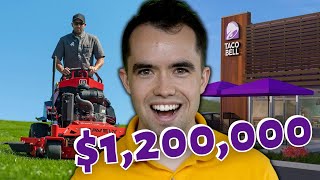
This content was created by Mike Andes. This content was uploaded by Mike Andes. This is a YouTube video titled "Starting a TACO BELL vs a LAWN CARE BUSINESS!!" created on January 13, 2023, by Mike Andes. The video features Mike Andes discussing the financial comparisons between starting a Taco Bell franchise and a lawn care business, specifically Augusta Lawn Care, highlighting the return on investment and business models for each.
Chapters
Hey everyone. Today I'm going to compare opening up a Taco Bell versus starting a lawn care business and see the difference in when it comes to the numbers and the return on investment and which one is a better investment for you to start. Let's go and get started with Taco Bell. Everyone loves a good Taco Bell. It's better coming in than it is going out. Let's just call it like it is, alright? We got a Taco Bell and we're going to assume that the initial investment that it's going to cost to get this Taco Bell off the ground is going to be, let's just call it 1.2 million. You're looking at least spending this by the time you have franchise fees. And if you're gonna build a self standing location like by itself, you're looking at $1.2 million easily for a Taco Bell, building out the restaurant and all the rest of it. Let's assume that in the second year, cause first year you're ramping up, you're getting things rolling, you're getting the supply chain, getting employees, et cetera. But let's just look at second year revenue. Okay? Look at second year revenue we're going to assume is gonna be, let's just call it $1.5 million. That's, that is the revenue. This location does pretty good for a Taco Bell. If you look at the math across their locations. $1.5 million, not bad. So now let's go look at our profit margins. So if we look at profit, let's assume a 20% profit margin. So profit of 20% would equal $300,000 in profit in year two. So we have 1.5 million in revenue in year two and our profit margin is 20%. That would be $300,000 in profit. Now what's really cool is you can take how much you invested into the business, which is 1.2 million, and then you can divide that out by 300,000. You take 300,000 divided by 1.2 million and you're gonna get 25%. Okay? So what that means is 25% of what I invested in to get the business off the ground, I return, I get distribution of 25% of that in year two. Alright, now let's go ahead and compare that to a lawn care business. Now I'm gonna use Augusta Lawn Care for an example because that's the one I know the math on the most. And I'm recently right now starting four new locations. I am spending $80,000 per location. This includes my franchise fees. This includes two trucks, a trailer, equipment, hiring several people. It means training those people up. It means the marketing of 10,000 to $15,000 over the first three months. And it includes the working capital required to get them to profitability in quarter two. After the first three months where we're ramping them up, that's what I spend. I put 80,000 DOL in and I hope is that I don't just put any more money in. If they want to continue to grow the business really, really quickly, they should be able to do it on the profits the business is generating. So $80,000 in, that's what I'm investing. I'm going to now skip forward again to year two because always year one you're figuring things out. You're growing really, really fast. Let's just go ahead and say year two revenue is 500,000. Alright? Now we incentivize our general managers to be able to get to 500,000 in the first year. But just be a little more conservative. Maybe the first year they got to like 300,000 and in second year they get to $500,000 in annual revenue. Now we're going to go ahead and assume again a profit margin of 20%. Okay, pretty good profit margin. 20% is going to equal 1050. It's gonna be $100,000 in profit. Okay? That would be a 20% profitable business. Check this out. If I take $80,000 and I divide that or sorry, yeah, I take $80,000, divide it out by 100,000, sorry. Take $100,000 divided by $80,000, I get one hundred and twenty five percent return. Check this out. I am going to make one hundred and twenty five percent of the money I invested in year one to get the business off the ground. I'm going to make that in year two. Right here. Check this out. 25% return. 125% return. Oh well look, that's just being like way too optimistic. Okay, okay. For myself personally, I have working GMs, I have a regional manager. I give profit sharing to the team members. Let's assume I'm not as efficient and profitable. Let's assume I'm only a 10% profit margin business. Okay? So on that $500,000 I make instead of $100,000, I only make $50,000. Now if I do that still, if I take $80,000 that I invest in the business and I make 50,000 on year number two, that is my second year in business. That means I am going to have a 62.5. If my math is doing right in my head, 62.5% return. That's a 10% margin of business in year number two. Look at this. Check this out. 62.5% return on investment versus 25% compared to a Taco Bell. And this would be a good performing store. 20% net profit margins, 1.5 million in revenue. This is why I truly believe the reason most people overlooks home services is because the law of small numbers. We're not starting with a massive investment of 1.2 million. And so it's like, oh well, I'm not making $300,000 in net cash flow at the end of the year. Yeah, you're right because you have to invest 1.2 million in rather you're working with smaller numbers. Alright, if you can run a profitable business, this is not hard. Second year to pool $50,000 out of the company at 10% profit margin, $500,000 in revenue. That's possible. It's very possible. It's a law of small numbers. But your return 62.5% is literally more than double the return that you have on a Taco Bell. Now here's the problem. The problem is that it's hard to deploy capital in a lawn care business at this same rate, this larger number, if you don't have systems in place and you can't copy and paste to make multiple locations. And that is the announcement I have today that Augusta Lawn Care is now solving this because over the past three years we've done the solo operator model, which is allows people to get started by themselves. And for one to two years they're allowed to be a solo operator before they become the second, which is the growth model where they get a territory, they're able to grow and expand and they're able to grow as big as they want for $1200 per month being part of Augusta Lawn Care. Check this out. Alright, this is the announcement for today. We are now competing against Taco Bell. How are we doing that? We are allowing people to invest more money into the franchise by getting more locations and having the systems in place to be able to spend. Scale it up using the math that I just had on the other side of the flipboard. It's called the executive model. It includes six franchise territories and they got to be connected, alright? You got to be close together. I currently have eight locations and this is what I'm doing. I'm literally looking at this like a capital allocator that is I have money to invest. Where's the best return on my investment? For me, it's buying more Augusta lawn care locations. I am right now getting four of these. I literally last week spent, transferred $320,000 into accounts. Four different accounts. My regional manager steps in, buys everything, has the systems in place to be able to make sure that these things happen. Six franchise territories, they're connected. The initial fee is only $75,000. That is $12,500 per location. Right now. That's almost 50% off what you'd be paying if you are getting a growth model. This number will go up by the end of this year. The initial fee, it includes all six franchise territories. And those six franchise territories have to be activated within 12 months. So what is you can get started a couple of them now, a couple of them a few months later, and maybe even wait till next spring and start a few more. But within 12 months they all have to be active. The monthly fee, exactly the same as the growth model, which is $0 for the first three months, $600 per month for the next 12 months, and then $1,200 for the rest of your franchise term. And there is no change. If you want to do a million dollars in revenue, if you want to go way higher, great. We recommend this model doing $500,000 to $800,000 in annual revenue. Having a working GM where that GM works out in the field two to three days a week and then the other two to three days a week they're doing estimates and they are hiring. Everything else on the back end is being handled by either the regional manager, especially like marketing side of things, and then everything in terms of phone support, email, payroll, all of that can be handled by command center. That allows you to get a working GM much easier than finding someone who has a massive amount of leadership and executive experience. Because they're much easier to find someone that has experience in the landscape industry. But you but doesn't need to manage 10, 15, 20 employees. They need to manage 3, 4, 5 employees out in the field working and let command center handle a lot of the back end. That's where you get six GMs, one GM for each territory and then one regional manager. You might be the regional manager, but ideally this person that's buying into the executive model is going to hire a regional manager. I have a regional manager myself and that regional manager is going to manage the general managers. The general managers are boots on the ground working with the team and the regional managers, making sure that all the numbers are working, making sure that they are actively managing the managers. This is that mid level manager type position. They're going to be making sure that they're hitting their KPIs, they're watching their dispatch board, they're hitting their budgeted hours. That's the job of the regional manager. And that's what we are nailing down right now with my regional manager, Chuck, making all the systems in place to ensure that there are good cadence of general manager meetings and we hold them accountable for their numbers. Now at Augusta Lawn Care, we've always tried to make it accessible where anyone can join. Whether you're just getting started or you're extremely experienced, here's the deal. You have the solo operator model where you can get started for literally $7,000 per month. Sorry, $7,000 initial fee. The monthly fee is 699. That's the solo operator model. You're allowed to use that for up to two years before you become a growth model. Now most people start as just a growth model, but if you just simply do not have the capital to spend on $20,000, which is the growth model, to be able to lock in your franchise license and a territory. You can start with the solo operator model. The solo operator model gets you started, gets revenue, up to 20,000 per month in revenue and then you should be able to have the money to be able to go get the growth model, lock in a territory and really grow and expand as big as you want. Now this is the third option and this is going to allow for people that are literally looking for investment. They're looking for places to park money. They want to be able to find great management, put their capital at work and have a better return than Taco Bell. Because that's the alternative to Taco Bell is someone that's going to come in and they're gonna buy an executive model and I can guarantee that their rate of return and the return on investment is gonna be better with Augusta Lawn Care than it is with Taco Bell. Alright, now, financial requirements, we do require financial requirements on this one. We don't. On the sole operator model or growth model, we don't require you to prove funds. But when it comes to the executive model, we do. Because there is so much investment and especially when you're hiring general managers and they potentially might be to your locations, etc. We do require you to prove that you have $100,000 in liquid cash and $400,000 worth of capital to invest, which means you could have up $200,000 in cash. We need to see a bank statement. And then you could have up to $200,000 in some sort of SBA loan, home equity line of credit. We need to see that you have at least $400,000 to invest. But I guarantee you $400,000. Of course, I cannot guarantee that your financial performance of your locations. That would be be stupid of me to do. But when you look at the math, you can change these numbers and be very conservative in knowing that after two or three years, a service based business that has a much lower startup cost is going to outperform the likes of Taco Bell, McDonald's. You can look at all the other numbers, punch other numbers in here, like go ahead and put 2 million, like the top few percentile of their Taco Bell locations. Throw in 25% profit margin. I can guarantee you that this business is still going to run it from a different, much better performance. From a number standpoint, you're like, oh no. Well, it's because the industries are different. Lawn care is harder. No, no, no. The systems should make sure that you have a good regional manager, that you have good general managers in place. The same way that Taco Bell make sure they have a good store manager and an assistant manager and a night manager to do the drive through. That's what their systems are for. We have systems in place to make sure you have a good regional manager, good general managers. And the general managers manage the, the daily operations. They manage people calling out, they manage the employees that are freaking out at them and all the rest of it, the flat tires and the trucks and the equipment. But then the regional manager is responsible for the numbers. But ultimately the goal in this is for people in the service based businesses to start thinking like asset and capital allocators. Which means I have $100,000. I want a return on this money. Where's the best return on that money for some people? Like, oh, stock market, real estate. I can DO s and P500, when in reality the fact of the matter is that you are vastly more equipped to be able to outperform the market using home service businesses because you've already figured out how to do that. Our goal is to replicate that copy and paste it over and over and over and do boring businesses and make billions of dollars. That's our goal at Augusta Lawn Care. If you'd like to join augustalawncareservices.com franchise. We only got a couple trainings this entire year because we're gonna be doing a whole bunch of them next winter. So if you want to get in now, check it out. But make a call with Lee. He can talk all the details. Go over all these. Look at your territory, look at your area, and see if there's a good fit for Augusta lawn Care. Augusta Nation. We enjoy having people that are passionate about each other, helping each other. They're passionate about changing the level of professionalism in the landscaping industry, and that's what Augusta Nation will do over the next several years. Thanks so much. I'm Mike Andes. We'll see you next time.









