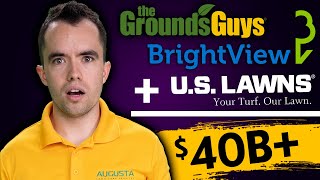
Mike Andes argues that private equity giant KKR is building a "600 pound gorilla" in the lawn care and landscaping industry by acquiring and consolidating multiple brands (e.g., Brickman, Valleycrest → BrightView; US Lawns; Neighborly/Neighbors). He cites KKR's public valuation (over $40B, nearly $80B high in 2021), BrightView's >$2B annual revenue, and location counts for franchises (US Lawns ~225, Neighborly ~210–220). Andes frames the trend as part of broader M&A and software/CRM consolidation driven by portfolio strategies: stable, cash-generating ‘‘boring’’ businesses balance higher-growth assets, often prioritizing short-term returns over long-term innovation. He predicts continued consolidation over the next decade and invites viewer discussion.
Questions this video answers
KKR
Over $40 billion (peaked near $80 billion in 2021)
$1.6 billion
Over $2 billion
About 2% of the total U.S. lawn care and landscaping market
Chapters
What if I told you that the same company that owns Brightview also owns the ground guys and us lawns. This is the 600 pound gorilla in this industry that is spending billions of dollars to merge and acquire companies and make a behemoth in the landscaping industry. For the past couple years I've talked about how the lawn care and landscaping industry is ready for innovation and how massive companies are going to conglomerate and are going to consolidate in this industry to bring in massive billion dollar players. And most of us know the likes of Brightview that does commercial maintenance, snow plowing, hardscaping and just about everything when it comes to commercial lawn care. But what if I told you that there's a company behind brightview that doesn't just own them, but also many other brands inside of this industry? The company behind all of this is KKR. Now KKR is a publicly traded company worth over $40 billion. They've been as high as almost $80 billion in the high of 2021. And they are a consolidation of a whole bunch of different companies. You can go to their website and scroll through their portfolio and see just about every sector. They have their fingerprints on everything from energy to healthcare to technology and software, and yes, even the lawn care landscaping industry. Now, several years ago, they actually bought and acquired Brickman for $1.6 billion. And through their strategic acquisition, they merged with Valleycrest to create what we now know as Brightview for a behemoth that does over $2 billion in annual revenue. Now, for context, that only makes up about 2% of the total market share of lawn care and landscaping and the total revenue that's produced across the country. But remember, the other 98% is literally constituted of over 600,000 different providers. Everything from truck and a truck all the way to larger providers that do multiple millions in revenue. Now what's interesting is there's other brands that are part of these acquisitions that you might not know is actually owned by this private equity firm. Now Valleycrest is actually the owner of US Lawns. US Lawns is also a player in the landscaping industry when it comes to commercial maintenance and they actually do franchising. So some would say they're in direct competition for Augusta. I don't really think so because we don't really focus on that large commercial work. We focus more on residential and that's not their focus. That being said, US Lawns since the acquisition really has not gained any more locations and has hovered right around 225 locations for the past five to 10 years. Now, in 2021. KKR also acquired Neighborly Brands. Neighborly includes a whole bunch of different home improvement franchises that everything from electricity to Roto Rooters and yes, the grounds guides for lawn care landscaping. Now they also have been kind of topped out around that 210 to 220 location mark for the past several years. Now the reason I'm talking about this today is I believe this is a trend that's going to continue over the next decade. And that is in these boring businesses, these industries that have been asleep for decades, you're seeing massive amounts of money being moved in and mergers and acquisitions to create the leaders in these categories. Because honestly, even a big player like KKR has less than 5 of the market share when it comes to the total addressable market and the revenue that is inside of lawn care and landscaping. As the stock market begins to get interested in our industry, you're seeing massive amounts of money being poured into these type of mergers and acquisitions to create these 600 pound gorillas that begin to dictate the market. Now we're not just seeing this when it comes to the actual landscaping businesses, we are also seeing this when it comes to software in these industries. Every single home improvement industry has some sort of CRM, some sort of software that's been really transform over the past 10 years as it's moved to cloud based CRM solutions. But even as we speak and over the past few years there's been a massive consolidation as these, a lot of these companies have begin to merge and a lot of companies that are CRMs are being purchased by payment processors because the real value is now being seen that billions of dollars are being processed through these CRMs. And instead of charging a lot for their subscriptions, they're instead going to take a 1% or a half a percent off of every transaction through the form of owning the payment processor. The reason I'm not concerned with this type of movement in our market is the fact that typically when I look at private equity or money moving into these type of acquisitions and bring a bunch of companies together, I'm seeing several different trends. The first is that they're doing it for a strategic buyout later down the road, all they're trying to do is package together a group of companies and sell it off. And now you're seeing subsidiaries of subsidiaries of subsidiaries of subsidiaries simply being packaged together and trying to be sold to another company. When this happens, typically leadership falls, falls off and innovation dies. It is at that point that the company and the brand and what its impact is going to have on the industry begins to wane. I've seen this in software, I've seen this in the franchise level, I've seen this in many different business levels in the home improvement industry as dumb money, that is people just looking for a extra 10% on their money every year starts to move into the market. If these massive mergers and acquisitions and these holding companies are not concerned about their next round or the next sale of that packaged item, that packaged business, they're more concerned about their next quarter, what it's going to look like on the stock market and what Wall street thinks about their numbers instead of what the consumer thinks and where the industry is going over the next couple decades, not the next couple of weeks, months or a year. What I find so often with these massive companies that are formed is that it's actually just a piece of a massive bundle of businesses. So if you look at kkr for example, you look through their portfolio, it's literally hundreds of businesses. Everything from Artlist that does music to 1, 800 contacts to an aviation company, it's literally all over the place. And they do this to bundle up all of these different businesses and then offer as a package in the form of a publicly traded stock. Now there's nothing wrong with that, but what happens is it begins to just become a very small piece of a portfolio. And a lot of times the reason these businesses, these boring businesses like lawn care landscaping, are bought into from these portfolio companies, in my opinion, is because they are cash cows. They generate a very good amount of income and profit and balances out the portfolio, allowing more speculative high tech, high growth parts of the portfolio to be balanced out. A boring lawn care landscaping business that pumps out 20% profit margin on $1 billion is very, very valuable. However, it's not going to offer a lot of enterprise value. What I mean by that is that $200 million in net profit might only have a 3 or 4x on the enterprise value. That business might only be worth 800 or 900 million on $200 million worth of profit. And I'm just using this as example. These portfolio companies then take that $200 million of profit from a boring business and invest into high tech, high growth software type businesses that have a higher, much higher valuation mechanism when it comes to their business model. For example, a company is in software or energy or some high tech type of firm, if they have $200 million in profit, is probably going to be worth 10, 20 or $30 billion instead of just 800 million. This is why so often when I see these publicly traded funds get involved in an industry like landscaping and law, really just see them try to extract as much profit out of the business as possible. They're not interested really in growth. They're not really interested in innovation or improving the product, whether that be a software CRM or whether that be for their franchisees, whatever it might be, because they're not interested in that. They're just interested in taking as much profit as possible and balancing out their portfolio for Wall Street. I'd love to hear your thoughts about this comment below what your thoughts are about kkr, Brightview and these massive conglomerates. Also, check this video out here where I talk about what my predictions are for this industry over the next 10 years. Yes, it includes robots.