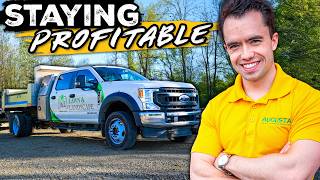
This is a recorded conversation between Mike Andes and Thomas (Littleton, Colorado) about Thomas’s landscaping/seasonal-services business and whether to expand to a second location. Key facts: Thomas reported ~$447,000 revenue in 2024 and projects $515,000–$550,000 in 2025 (conversation suggests ~560–570k estimate at one point); he had about five employees (now four plus himself); working capital reported between $55,000 and $75,000; current profit margins reported around 22–25%. They discuss operational changes that improved profitability (reducing service types, retaining experienced staff, enforcing weekly maintenance cadence), seasonal service mix (leaves, snow, Christmas lights — 13–16 installs last year), options for growth (push one location to ~$750k then partition territory or create a GM-plus model, or wait before acquiring another existing location), and the importance of measuring budget-hour capacity and raising prices to enter "profit mode." Mike recommends focusing on personal capacity and profit mode before opening a second location.
Questions this video answers
$447,000
$515,000–$550,000 (conversation also mentions estimates near $560–$570k)
Five at one point; later clarified as four employees plus himself
$55,000–$75,000
About 22%–25%
Chapters
Today we're on the road and we're headed to Colorado to talk with Thomas from Littleton, Colorado. He's an owner inside of Augusta Nation that did a little over $500,000 in annual revenue last year. I'm super proud of Thomas because the changes he's made in his personal life so he can focus on the business. This is his first year. He was able to put it in profit mode, get things growing smoothly. And he's already thinking about second location. So if you're around that 300 to $700,000 in annual revenue range, this will be super useful just to figure out when do I start a second. How do I hire general manager, what systems need to be in place to make more money. We got profit mode. Did $447,000 in revenue in 2024. This year, projected to do 515 to 550. That's a big range. Does that depend on Christmas lights?
You know, I think last time I looked, we're already. It's. Yeah, yeah. Well, we still got more leaves that are going to show up and more Christmas lights. Of course. Yeah, we're definitely. I'm pretty certain we're gonna pass 350 now.
550. Okay, cool. So almost 560. 570 somewhere in there. Okay, good. I know up here. I was talking with Joel. Cause we went out to his shop right before this. Kind of like you got leaf season, goes right into snow slash Christmas lights, like right off the bat. So cool. Five employees. Does that include yourself or by yourself? Okay, cool.
We're down to. Where are we at now? We are down to four. Well, four now.
Okay.
And then myself.
All right. And then working capital somewhere between 55 and $75,000. Cool. Anything I can help with? You're in profit mode, so life should be good.
Yeah, we're looking solid. This has been my best year so far. Q1 is all and Q2 even has both been pretty stressful in the beginning years and this year. This was our first profitable Q1.
Cool.
We even did the profit sharing and that was great. Q2, we didn't get hit as hard as before. So currently we're around, I want to say as of today, around like the 22 to 25% profit margins currently. And we like said we've never been that in that spot this time of year.
What's the difference between this year versus previous years?
And I've been trying to just really home in, hone in on that.
Yeah.
What was so different? And winter Services, winter services, snow, Christmas lights, all those things. Having a couple guys roll over from last year so that I didn't have to train them all, all those things helps. We also ended up, like, I think it's just a bunch of things, but besides. Besides those things, we kind of didn't allow, like, we also stayed away from certain services. Stop doing these things. And those things, like SOD installs, anything that just requires me to be there, just keep it all super simple.bi weekly mo's. During spring, we used to let the clients do that. And then when the team shows up, it's super tall. And then we get yellow slips and callbacks and the team members are upset. We kind of just listen, you gotta be on weekly or else we're not a good fit. I think all of that really added up. And then I have a guy who, he's really experienced. He knows how to do things fast and efficient and with quality. And since he rolled over, putting him on projects, he's just crushing budget hours. So I think it's just all of it combined.
Cool. Awesome. Is there anything I can do to help? What's the goal? Like, what are we trying to do with this location? Are you trying to get this to 800,000 and stay with one? Are you trying to do multiple. Are you trying to go GM plus model with it? What's your kind of goal?
It's kind of a. I'm on the fence about which way to go with this exact location because it's sitting on such a big footprint. So we have a lot of residential homes, like a lot of them. So like I said, I'm on the fence about should we partition it out and really maximize what's available versus, you know, keep it at a, you know, max or besides. Or instead of take it to like 800,000 and then stop, because all the overhead that comes with that is why don't we just like partition it out and then. 800, 800, 800, 800 or whatnot.
Got it. How far is the drive? Like, is it pretty bad traffic from one side to the other?
It can be. If I were to go from like the north northwest down to the southeast, I mean, that could take. Yeah.
So maybe if you hit like 750, 800, you just inside of your territory, you start like a sec. Like a. Almost like a little storage facility or something.
Yeah, yeah, maybe. Yeah, something like this.
So it'd be GM plus model. Like, you'd basically still probably have an operations manager, like, then kind of take all that off your plate. Yeah. And then. Because that would be the thing, like, if you're gonna split it off inside of one territory, you would want to have ops taken care of so that someone is on that other one while you're at the first one. Right, right. Yeah. So cool.
Yeah. So I'm kind of. I'm at that. That part where it's like, you know, get this and start breaking it apart or, you know, maximum, you know, grow it and then break it apart. Or we have another location. I've been speaking with Lee about. About, let's go buy this location. But then it'd be anyway.
So I would not buy the other location.
Not yet.
No. I think either a, you get this 1 to 750 and have $150,000 in distributions and then get a second location. Or you do your first plan, which is get a 750 and, okay, I'm going to go to a little storage facility, take a route up top. I'm going to put a GM place, this one, let it run, and I'm going to go up here and just build that aspect of my territory out. One of the things I talk about with Thomas is going into profit mode and before he starts his second location and profit mode is when I hit capacity, I raise my prices, and I don't buy more trucks or hire more people. But one of the things people fail to do is actually measure what their capacity is. When should I raise prices and go into profit mode? That's why inside of homeworks, we track the budget hour capacity for every single location. That way you know exactly when to raise prices. It's not a guessing game. It's not based on the weather, not based upon the time of the year, not based upon how you're feeling. It's based upon the math. Your budget hour capacity limit is something we track every single visit and every single job inside of homeworks, Go to home workstoday, schedule a call as a team, and see if joining the software would be something that allow you to get your business to the next level. Grow without breaking.
Yeah.
Like, probably the first 30 locations in Augusta have large territories. Too large. And it puts people in this weird predicament where it's like, I'm kind of wanting a second, but I could just kind of grow inside this one. But it's a long drive, and so I would be very prone if I was you, to go your first route, which is like, build up a 750, then just be, okay, I'm going to break out 150 of that over this area, I'm going to go pretend it's in growth mode inside the same territory, and then let an operations manager run that first one.
Yeah, okay. Yeah. No, I like it.
There's no reason to get a second location unless you really want that spot.
Yeah, I really like my spot.
Yeah, just stay there. Let's go make more money. So. Cool. Anything I can help with, though? Like, anything specific?
I've been beating my head against the wall about what questions you're good I have for you about this location. I just want to make my main focus along with everything is I want to repeat what I did as far as profitability next year.
Right.
Just keep. Because like I said, especially with that, it's been less stressful. It's just been really smooth. And I just. I want to keep, you know, keep that growing instead of throw some more wrenches in here and make it worse or whatever, you know?
Yeah.
Go backwards.
Can I give my opinion as to why you did it better this year?
Give me your opinion.
You have grown personally a lot in the past 24 months. That's the difference between last year and this year. Yeah, 100%.
Well, I appreciate that.
Yeah. I remember some of our conversations and things, and I'm really proud of you.
I appreciate it.
You crushed it, dude. Yeah. So. Yeah.
And I'm thankful for you to be in his life because you're, like, huge for us, for him.
So just.
Thank you.
Yeah. That's the difference between 2024 and 2025.
I appreciate it.
All those other things were there, but once you got that right, like the personal capacity, those other things fall into place. And so that's what's so difficult. Even when we did these turnarounds, I don't have the rapport built to where I can be like, no, no, no. This business stuff, that actually doesn't matter. What really matters, you have this personal issue. If you just. All of this would take care of itself. So you did the hard work on that part together. And because of that, that's why things fell into place this year. So just want to commend you for that.
Thank you. Thank you.
So I think what's cool is now that that is this year has been solid. It's kind of like your first year in profit mode now. What's cool is, like, year two, you get to do the little tweaks. Cause once you have a year in profit mode, you can say, okay, how do I triple Christmas lights? Kind of like what Joel's doing this off season last year was that your first year in Christmas lights. Okay. And how much you do last year.
In Christmas lights, it wasn't much. Like, I want to say, 13 to 16.
So you're doubling down a little bit more on that this year.
Yeah, I need to put my head down and really focus on because, like, you know, we got leaves coming, Christmas lights, snow, winter services. I'm trying to get my hand in all of it. Yeah, that's what I'm trying to do.
Yeah. I really like the model Joel was talking about, like, for snow in this market, too, where you have, like, your offer is buy five months, get the six free, because you have that April that is so variable on your snow. So I really like that offer, too, because it sounds like a. Basically a 18% discount for them. 17% discount. But realistically, you know that in April, if there's not snow, you're probably gonna start mowing pretty quickly. If there is snow, it goes away quickly. So.
Yeah, I like that.
It's for some, hearing about this guy over here cooking things up. Let's go. Cool. Good. Well, thank you. That's awesome. All right.