The Government is BANNING Gas Powered Equipment & Truck Prices are INSANE!!!
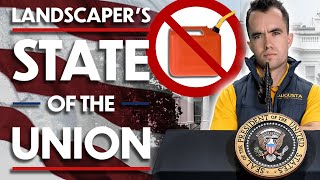
Mike Andes breaks down what's hitting the landscaping industry: inflation squeezing margins, used truck prices doubling, and California and New York pushing electric equipment bans. He warns that battery-powered mowers aren't ready for commercial work yet and expects consolidation as smaller operators get priced out.
Chapters
Are the robots going to take over? I don't know what they were on. Like. I know, I know. Hey, cannabis is legal down in California, so maybe that's what they were doing when they came up with that statistic. I just don't buy it.
Hey, everyone, this is Mike Andes, and today I'm giving a stage State of the Union on the landscaping industry. We're going to be talking about inflation, how you can't find trucks that are half decent price. Right now we're going to talk about electric mowers and the mandates. They're coming down from the government. The fourth thing we're talking about is robot mowers and if we need to keep our eye on them. So first things first. Inflation.
Well, over the past couple years, inflation has dramatically gone up. And if you don't know what inflation is, it's basically the fact that things go up in price over time. Well, typically that's around 1 to 2% a year over the past couple decades. But the past couple years, we're now above 5% annual rate of inflation. Now, I want you to keep in mind the fact that that 5% takes into account a whole bunch of CPI data, which is consumer price index, from a whole bunch of different categories of the economy. Keep in mind that fuel trucks, equipment and labor have gone up even more than that. So you need to make sure that you raised your prices by at least 10%, not because you're greedy or you want more money, simply because the cost of doing business is going up. And if you are not raising your prices, you. You are losing your profits to the simple fact that as time goes on, the cost of things go up. Now, I truly believe that by 2023, the inflation craziness that we're going through will subside somewhat because people are so are purchasing so much inventory right now. I'm looking at the amount of warehouses that are completely filled with stock right now because people are hoarding and they're ordering massive amounts of stock because of the supply chain shortage, because of the chip shortage. There's a massive amount of inventory, a lot of these businesses. And I think we're going to have some deflationary pressures late 22, 2022 and early 2023. However, that could all change if we continue to have problems with getting these chips and these semiconductors to the different factories. But for now, inflation is high and that's going to continue for the next several months. And you better make sure your prices have been increased to make sure you are not losing your profits. To inflation.
The second thing we're gonna talk about is the fact that you cannot find a half decent pickup truck for anything right now. Literally before 2020, we never spent more than $9,000 on any given truck. Besides one, which was a dump truck, never spent more than $9,000. We'd find great deals secondhand. We'd go up to Canada and be able to find vehicles up there because we're close to the border. But. But we could always find a great deal on a secondhand truck. Well, guess what, that same truck, that was eight, $9,000. Good luck trying to find it for 14 or $15,000. Right now. Literally the price of used trucks has gone up 50 to 100% in most places within our markets. So what does that mean? That means I'm going to not go buy more trucks as frequently. I'm going to try to get maybe two people inside of a vehicle before I go buy a second truck to get one. One solo operator, one solo employee in each truck. So if you are currently growing your business and you have five vehicles, in my opinion, you don't need to go buy a truck for every employee right now. Wait for the prices to come down. Now, I originally thought this was going to happen like in January, February, March, but because of all the chip shortages that really spiked recently, I think this is going to be a pretty good trend going into late 2022 that we still have these inflated used car prices. There's just such a massive lack of inventory at used car dealerships, new car dealerships, as well as rental car facilities that sold off all their inventory at the beginning of the pandemic. So again, all of this comes back to supply chain shortages. I truly believe that all of the inventory is gonna be coming back online. The supply chain lags about 12 to 24 months, depending on the type of product you're talking about. And so when everyone went to the pandemic in 2020 and they cut all their forecasts, they closed down the factories. We're just now starting to feel the effects of that. So therefore now everyone's going to hyper, like make more stuff, get the factories, pump and build new factories. That's going to hit the supply chain in another year or so, end of 2022. And I feel like we're going to have that subside. So when that happens, I feel like you'll have some better deals on purchasing trucks. But for the time being, I would try, if at all possible, to try to keep two people in a vehicle instead of just using one person. If you're growing and expanding now, if you have some money and you're just gonna bite the bullet and just take it in the teeth, cause you don't wanna wait an extra year or two years before you keep growing, that's fine. But used trucks are gonna be hard to find the first half of 2022.
All right. The state of the union is the fact that electric mowers are literally being politicized. The fact that California is now banning the sale of any small tractor and lawn mowing equipment after 2024. So I want to be clear, that's over three years from now to where you can't buy that equipment. So I think some people are overreacting a little bit here because they're all like, oh my goodness, we gotta go battery. It's like, wait, hold on a second. You still have over three years before that's actually going to be where you cannot purchase that type of gas powered trimmer, hedger blower, push mower until that time. So we've still got three years. And in my opinion that is not going to be something that sweeps the nation in the next 12 to 24 months. I think most the country is not going to be banning these lawn mowers and push mowers, et cetera for now. I think that what's crazy is the fact that California specifically is doing this now. It's in New York where we also have an Augusta lawn care location. I know firsthand the fact that they are already incentivizing electric equipment and they actually waive registration fees if you can prove that you've purchased a certain amount of hand, gas, power or non gas powered equipment. So electric blowers and hand tools. And so I really like hand tools, I really think hand tools, electric is fantastic. But I just do not see the mower side of things when it comes to electricity being economically feasible to actually make money in this industry. I feel like the battery paired hand tools, trimmers, etc. Great, love them. I think they could actually be used commercially and have a lot of advantages to them. When it comes to the battery powered mowers, they're just way too expensive. They do not make economic sense Right now if you're gonna pay 20 to $30,000 for the type of mower that is going to be otherwise 7 to 8 or $9,000 if it's gas powered, we're literally paying a 3 to 4x premium to get battery powered. And we don't know what these battery powered zero turns are going to be like in Five years. We don't have a track record. Most batteries don't like that much vibration. I'm a little bit concerned about that. And furthermore, I really think the fact that battery technology is evolving so quickly, if people jump on board right now, they're going to pay a premium price for technology that's literally going to be obsolete in three to five years. So in my opinion, if I was in California right now, I would not be jumping on the electric mower bandwagon. I'd be testing it, I'd be seeing how I could use it, how it's going to impact my business, but I would not be buying it at a premium price right now. If you even wait 24 months, the price of battery powered equipment will come down, the performance will go up, and furthermore, we're gonna be able to see what all the guinea pigs, how their equipment works, how it breaks down, and how we can maintain that equipment over time. I think it's crazy that California specifically is doing this because their electrical grid is under such pressure right now and because they're trying to go green and really greenwashing, in my opinion, making this a political matter, they're really going to put themselves in a bad spot. The cost of these mowers is so high. What is that going to do? That cost is going to be passed down the customer. So why are people freaking out that it's so expensive? Live in California or. Well, the fact of the matter is that there's now government passing laws that are forcing us as business owners to raise our prices. You cannot complain about high cost of living and the high cost of services and labor when those type of laws are being enforced. I think it's crazy. I think they should be going the complete opposite direction. But that's just one person's opinion. I don't think it's going to be spreading for at least three to five years before most of us even have to start thinking about it. I just don't think it's a bad idea to start testing it now, seeing how it might work, thinking about what might mean for the future. But I'm not going to pay a 3x premium for a product and for a technology that could very well be obsolete in 24 to 36 months.
Little fun fact, an article I saw from California's government, they said that running a gas powered backpack blower or was the equivalent of riding and driving a 2016 Toyota Camry for 1100 miles. I don't know what they were on. I know, hey, cannabis is legal down in California. So maybe that's what they were doing when they came up with that statistic. But I'm sorry, I just don't buy it when it comes to the oil, the rubber on the tires that are being tread for 1100 miles. It's just crazy what's coming coming out of the government right now. And I think it's crazy that it's becoming a political matter when this is going to actually impact a lot of landscapers, their businesses, their employees, and it's going to raise the cost of living even more in a state where it's already too high.
Now, the fourth thing is other robots going to take over. Are we not going to be able to mow lawns and do our job as landscapers because the robots are going to take over again? I think people are really, really jump in the gun on this one. I think we're a good five to ten years away from robots being playing a real meaningful part in the lawn care and landscaping industry. I was recently at GIE and almost all the robotic mowers that were not the ones that are really small and you leave one mower per lawn outside of those, all of them are mostly in prototype. It's not like you can hop on and drive them or like, you know, just use it right now, go buy five of these. There was no prices attached to them. A lot of them are prototype. It's at least five to 10 years before it's actually gonna play a part in our businesses. And it's much more on the lines of 10 years before it's actually economically feasible. Because when these prototypes come out, they're gonna be 10, probably 5 to 10 times more expensive than a regular mower. And I'm sorry, but, like, if you're gonna use the little mowers that go around and kind of zigzaggy, and you can't have the way you have to plant the line around the entire perimeter. It's just a pain. Then you gotta have contracts for the customer because now you're investing into their property. I think that's a long ways away in terms of price. That price has got to come way down or GPS has to get really good so we don't have to put the line around the perimeter of the entire lawn. And then with those little mowers, you got problems like getting through fences and gates and theft. And even though those things have been somewhat thought out and figured out, I still think it's a big barrier to entry. And especially for us as commercial landscapers, I'm sorry, I can't buy an $1,800 piece of equipment for 500 lawns. Like, literally by the time I recoup my cost, that piece of equipment will be completely obsolete. So the rate of innovation in this industry and in this technological sphere of landscaping and robotics is extremely fast. So for me to buy a piece of equipment with a three year return, it takes me three years to recoup my investment and then start making a return. In three years, that technology is going to be obsolete. There's going to be much better stuff out there. So I don't want to jump on board with the highest price with this product that I am going to literally barely get my money back before it's completely obsolete. So for those smaller units, you know, the Husqvarna's, the Hondas, the Steels, they're making those little robots that go back and forth. I think GPS has got to get better as well as the cost has got to go dramatically down. Otherwise we're going to be really stuck with larger units. Now, these larger units are great. You know where they do the perimeter, you do the perimeter on them, then they fill in all the gaps. And they have safety features to stop if there's a kid in front of them or some sort of an obstacle. Those are fantastic. But the cost of those are gonna be absolutely astronomical. Yes, they have lidar and radar and they use videos to be able to figure out a lot of things around them. But you have to be watching it and it's taking your time. It needs to be completely autonomous and it needs to be 48 inches or bigger, or potentially even just a push more. But it needs to be quick enough to stay up with the person who's line trimming and blowing things off, which is you're usually right around the same amount of time, if not needs to be faster than the person that is line trimming and blowing things off. But again, the cost of this technology cannot be $50,000. It can't be $40,000, it can't be $30,000. It needs to be comparable to what's currently on the market. So until those pieces of equipment are under $20,000, in my opinion, it's not going to actually move the needle for us as commercial landscapers. And I think that is at least 10 years away from now.
So all of that might seem doom and gloom from inflation. You gotta raise your prices and we got no trucks that you can't buy and the government's coming down on us. But at the end of the day. I still think this is a fantastic time to get into the landscape industry. We have a lot of technology that's coming in and in my opinion is a fantastic thing because it's going to allow us to eventually perform the most mundane tasks like mowing at the lowest price possible. Right now that cost is extremely high. The barrier to entry is way too high for that initial upfront cost of buying those mowers. But whether it be battery powered equipment, whether it be robotics, I'm extremely excited about the future of this industry. I'm also excited by the fact that by having higher truck prices, it also makes us get more creative about how do we use labor, how do we make sure we have more efficient labors, and how do we have things like pay for performance to make sure that we are paying our employees more than the current going rate in our market, but it's being done efficiently and how do we raise our price and stay competitive and know our numbers? And I really feel like the next 12 months might be a thinning time in the landscaping industry when it comes to the amount of number of contractors in the market. Why? Because in 2020, a lot of people lost their jobs. And what do they do? They became a chuck in a truck. They grabbed their, their mower, their blower, their weed whacker, threw it in the back of their truck and started mowing lawns. Well, now with the labor market being so, so hot and so many different industries being willing to pay so much, a lot of those people are gonna go find jobs this winter. They're gonna go find jobs in the original industries that they lost their job like a year and a half ago. Well, last year this time, hey, things were still kind of up in the air. We had Delta, we had the election going on. Well, now this coming, going this winter after this growing season, I think we're gonna lose a lot of those people and they're gonna be somewhat discouraged by the rising cost of fuel. They can't find any helpers. I feel like this is a great time to get in use systems corre and that is going to be the advantage for landscapers that take care of these four big issues over the next couple years. And I think the overarching theme is a lot of people are overreacting. They're overreacting way too soon. And they're going to buy equipment that is way too highly priced when they have three years to figure out the electric thing in California and then probably five to 10 years in most states in the country. So that's it for today. That's the state of the unit in the landscaping industry. We're going to be going even deeper on some of these topics as well as how these things are going to affect marketing at Landscape Summit 2022 to be January 13th, 14th and 15th as a Thursday, Friday, Saturday. So book it. Get the calendar. With inflation comes the fact that it's hard to find flights right now and the cost of things go up as you wait. So just book the tickets. Now it's 299. We didn't even raise the price two years ago is still 299. But the cost of, you know, everything went up. Food, the cost of the venue went up, the cost of getting speakers has gone up. But guess what, the price has stayed the same. So book it. The day before we change our mind, inflation takes over. I'm Mike Andes. Thanks so much for watching and we'll see you tomorrow.
Okay, done.









