the lawn care industry is about to CHANGE MASSIVELY; don't fall behind
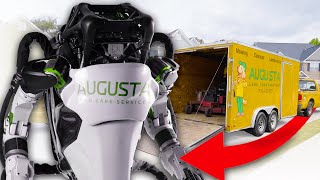
Mike Andes (founder, Augusta Lawn Care) presents a 15-year projection for the lawn care and landscaping industry, arguing the sector is bullish due to aging baby-boomer demand but will undergo major structural change. He identifies five converging trends: (1) robotics will automate high-labor, hazardous services first (mowing, chemical treatments) once costs fall and add-on units exist; (2) chronic labor shortages and rising wages will accelerate automation and increase churn, making pay-for-performance systems (P4Psoftware) important; (3) the highly fragmented $105B U.S. market (≈600,000 small businesses) will consolidate, with private equity and large players likely to capture double-digit market shares; (4) software (CRMs, payments, estimating, automation) will drive big efficiency gains and be essential to survival; (5) electrification of handheld and then larger equipment will accelerate as battery costs fall, potentially flipping market share quickly when purchase prices and performance cross over. He closes with a call to adapt and resources (P4Psoftware, mikeandes.com).
Chapters
You're going to be wiped out. You've got to get on the train because it's going to be.
Hey, everyone, my name is Mike Andes. I'm the founder of Augusta Lawn Care. We have almost 100 locations around North America. And today I'm talking to you about what the future of the lawn care and landscaping industry is going to be. And I'm going to project 15 years into the future and tell you what I see in this industry. So whether you're just getting started, you're thinking about starting a lawn care business, or you've been in the industry for quite some time, I feel like this is important information if, if you want to stay in business, be relevant and run a really profitable business over the next couple decades. Obviously, if you watch my content, you know that I'm very bullish on the lawn care landscaping industry over the next couple decades, mostly due to the fact that the wealth of our country is held by baby boomers. And baby boomers are now coming to the age and in the age bracket where they physically cannot do the work that they need to be done, that needs to be done on their property in terms of trimming bushes, mowing their lawn, doing their landscaping. And so I'm very, very bullish on this industry as a whole and that there's a great opportunity. I also feel like there's a massive shift that's about to come over the next couple decades. And today I'm gonna go over the five different things I see coming down the pipe for the lawn care and landscape industry and something you should be thinking about and educating yourself about in all of these areas. The first one is robotics. And again, some of these are not like, gonna be surprising. And I'm not here to say like, you know, to predict anything necessarily as much as just say, this is the changes that are gonna happen and these are the things you wanna be aware of and if you want to stay relevant. So robotics. I do not believe that trimming, bushes, edging and the like will ever be fully automated by robots. What will be automated first and in the next 15 years is going to be mowing and treatments. Those are services that are two, two fold. One, high intensity of labor. Two, they are also very high profit margin for the treatment side. And three, they can also be potentially hazardous and dangerous. Both chemicals as well as blades turning very quick. So whenever you combine high labor cost, high margin for treatments, and then a high potential of danger in terms of chemicals or injury, massive opportunity for technology in the form of robotics to take over now the biggest obstacle to robotics taking over is going to be the cost, the cost of those robotics. The thing is right now the infrastructure and the technology is already in place. But no one is going to spend hundreds of thousands of dollars in order to get a few mowers. It's just not going to happen. The cost of that machinery, the cost of that equip needs to come down substantially. And furthermore, the mass adoption of this will happen when it will be a unit that can go, can plop onto an existing mower and it's going to be like an add on. That's where the adoption will take off the fastest. But again, whether it be lidar or videos and pictures that are used, or any sort of radar around the mower, for example, it's going to be a while before the cost of that technology actually works. Well for the mowing side of things, treatment side of things I actually think is going to be the first step for robotics. And there's already plenty of companies in both of these sectors that are figuring that out. But mowing and treatments, in 15 years, robotics will absolutely be taking it over. And you're like, well, what do I do if I'm mowing lawns? You're going to be just fine because you still got to edge the property. You got to blow off all the sidewalks and the walkways, trim the bushes, install the mulch. And those things are not going to be done by a robot. There's just no time that a robot is going to be able to trim a bush and know exactly every single bush in the property and have everything down. Like there's just, that's not happening for decades, like way off. All of us will be dead by the time robots show up at your property unmanned and are trimming all the bushes, hauling away debris, throwing it in the back of a dump truck. That's happening way down the road. So right now, the lowest hanging fruit that's going to happen the next 15 years is going to be mowing and treatments. And again, I said why those are going to happen. But the reason it's going to take 10 to 15 years is going to be because the cost of that equipment needs to come down. The technology is already there. There's multiple already have that. This works just fine. In what I see the opportunity for mowing is going to be that this machine comes off of a trailer and you mow the lawn one time and buy it manually, but it programs into that mower exactly what it should be doing and exactly the area. And using GPS Coordinates, knows where to avoid and what to go around, and then every time thereafter can be pushed a button and it goes and does its thing. I feel like that's some of the most efficient route of doing it on a residential property. On commercial, there's already really good applications for this because there's so much open air. If you're going back and forth, mowing is not a problem. It's going to be around residential things, smaller properties, more curves, more turns. That's where the market is going to be a little bit longer adoption before robotics can actually use for mowing. And so down the road though, when that happens, you push the button, the mower can start doing stripes and do the property, and then the operator would then be able to edge, blow and do all the fine tuning of that property again. This is 15 years down the road, but it's not going to be 40 and it's definitely not going to be in two or three. So if you think robotics are going to take over your business, I do not believe that. Even if you're in mowing, even if you're in treatments, because there's going to be parts of the service that still require human interaction. And that's the part you can still differentiate yourself from every other competitor. All right. The second thing that is going to be absolutely a big theme in this industry and is no surprise to us because we feel it, it gets worse every single year. And that is the labor issues that we are going to have over the next couple decades. Not so much because of low unemployment, but more a matter of the fact that entry level employees would rather take a pay cut and not work outside, not work in the heat, not work in the elements. And furthermore, it's becoming harder and harder to hire, like the H2B program and immigrants. And as immigration becomes difficult, more and more difficult, and the politics behind that, it's gonna become more and more difficult to find. People that want to work outside, are willing to work 30, 40, 50 hours in the blazing heat, in the cold, in the rain. It's gonna become harder and harder and harder. This is not a news flash to anyone. And I truly believe that that's why robotics will eventually become so prevalent and will have to take away a lot of the very manual labor tasks like mowing and doing anything that's laborious is because it's gonna be impossible to find labor. So the cost of that labor is gonna go up, have to start paying people more. And therefore that's when robotics will actually start making more and more sense from the standpoint of it doesn't call out, it doesn't get sick, it doesn't get overheated. Well, typically robotics don't. So that is when robotics will become even more cost accepted, is when the cost of labor continues to go up and up and up because we have to keep raising the wages just to get anyone that wants to do this kind of work. Long hair and landscaping is not easy work. It's difficult physically. And that's not going to be the generation that's upcoming that wants to go out, work hard outside and get sweaty. They'd rather work at home. They'd rather do TikTok videos and watch YouTube videos and do more creative work. Which is not to say that those are bad things. But most people are not looking forward to doing a labor type position out in the blazing heat or in the elements. This is going to become more of an issue again. Robotics will solve this in the long run, in the short term and for the work that still need to be done that robotics can't do. That's why pay for performance is so important. That's why we built p4psoftware.com that's why you can get this book on Amazon called P4P. Why hourly is a failing formula to incentivize your employees, even though it is a very difficult job to be able to incentivize them, be efficient, learn skills and make more money themselves. And in the short term, then get those skills and move on and do something else in their career. Because the labor issues is going to put more pressure. It's going to be more and more difficult to keep people for five, 10, 15 years. You're going to have to create a business that allows someone to jump on board and within a matter of days are profitable because they're only gonna last six, seven, eight months because of the labor shortages, because of the labor issues with people not wanting to work outside. You're gonna have to make the business profitable. When you have a high churn in this industry. The third thing that's gonna become extremely prevalent in this industry is we're gonna go from a fragmented marketplace. Fragmented. And it's gonna become much, much more congealed. There's gonna be a lot of consolidation in the lawn care industry. Consolidation. I probably will spell this wrong. Consolidation. And we've already seen this in several different places. And what I mean by that is right now the lawn care industry is very fragmented. Even the biggest players literally have less than a 2% market share. So last year, 2021 the lawn care and landscaping industry made up about $105 billion. That's a B $105 billion of revenue. The market share across the whole board. In the United States now one of the largest companies, TruGreen, even after their acquisition of Scotts, did $1.4 billion in revenue. So they had less than 2%, less than 1 1/2% of market share. Like BrightView, if I remember correctly, $700 million in revenue. So less than 1% of the market. And those are like the two biggest players. So if you take out like the top, you know, four or five people, four or five biggest players in the market is literally still like 5% of the market. So very, very fragmented. There's like 600,000 lawn care and landscaping businesses that make up the other 95% of the market. So very, very fragmented. And so this is a huge opportunity. And markets like this don't exist very much right now. The Internet has mostly changed the name of the game in most industries where you don't have this much fragmentation. So home services and labor based work, in my opinion is the next frontier for the Internet to take over and create massive consolidation. And so you've already seen this like kkr, they're one of the largest private equity firms in the world and they have like just over half a billion, sorry, half a trillion dollars, almost half a trillion dollars in assets under management AUM. And so they own a ton of stuff. They own brightview, They're a massive player. Brightview, they recently bought out several different large competitors in the residential space for lawn care. And I guarantee they have their eyes fixed all over the stuff I'm talking about today as an opportunity to consolidate this industry. And so I do believe in the next 15 years there's going to be a player that takes 10% of the market share and there's going to be a couple of those players. I believe that in 15 years will have 10 plus percent of this market. And this will be because of the fact that labor will become such an issue. The other thing I'm going to talk about become such an issue. And the people who will have the money to get robotics, develop software, develop these solutions, they are the ones that will take big chunks of the market because a lot of venture capital, a lot of private equity is going to go into this industry. I can just guarantee it. It's already happening. And they're going to solve these issues that are very expensive and they're, and they're gold. They're not stupid. The reason they're going to do this is for a return on their investment. And their return on investment is getting 10% of the market share. You get 10% of $105 billion industry, that's $10 billion in revenue a year. That's a pretty great company. And so right now we have a company that's public like Brightview, that has 700 million a year in revenue and they have less than 1% of the market share. Massive opportunity. So you're going to see a lot of consolidation, people getting bought out in this industry over the next 15 years. And in 15 years, my prediction is that there'll be at least one, probably two players that will have 10 + percent of the market. I don't know, for some people that's scary, but I also feel like there's a lot of opportunities in that. I made a video about this the same way. When Amazon took over, a lot of people went out of business, but there was other retailers that adopted things they did and made very healthy businesses doing things that Amazon could not do. And a big, massive, multi billion dollar company is not going to be able to do certain services, they're not gonna be able to have a certain level of service on certain parts of the business that you can take advantage of. So to think that this is like a massively bad thing is simply a scarcity mindset. That usually means, you know you're gonna fail to adapt. Cause you can adapt to this and still make a lot of money. Think every Shopify retailer, every Shopify website out there is riding the coattails of Amazon and they do do very well, a lot of Shopify millionaires. So the fourth thing that I think is going to happen over the next 15 years is software. And software is going to lead to massive efficiencies.
Across our industry. And right now, software for most of us and over the past five to 10 years, the push has been accept credit cards. It's going to be like get a CRM, get customers data in into a database and be able to send them emails and get everything organized on a CRM. That's fine. That's like old news. In 15 years, if you do not have a CRM, if you are not having credit cards on file, if you are not having it, you will literally be obliterated. You will not exist. You might have been able to get past it for now with Excel or potentially doing like spreadsheets or even in your notebook. I've seen it. Trust me, that will not work. In 15 years you will be put out of business because you will be inefficient compared to people who have adopted technology and have innovated in form of software. So this is literally where I eat and breathe most of my day, is this game, okay? And so I know where this industry is going when it comes to software. Software will be the thing that leads to massive efficiencies. And then combined with robotics is what's going to lead to number three, which is the fragmentation, becoming consolidation and larger players in this industry will invest a lot of money into software and robotics. So you say, well, oh man, we're gonna get wiped out. No, that's not why I'm making this video. The matter of the fact is that you've got to stay on the cutting edge of software. What's happening in this industry, what are we doing in the form of Labor? Things like P4Psoftware.com will be absolutely prevalent in the next 10 to 15 years. It will be standard. Okay? So things like that, that's one piece of it. Then you have other forms of software in terms of estimating and trying to make your estimates from square footage and doing it virtually. And then you can take so many different elements of software. That's gonna solve so many problems in this industry.
The next 10 to 15 years gonna be crazy. When it comes to software, it's gonna completely overturn this industry. And if people have not got a CRM right now, if they're not taking credit cards, they don't have automations, you're gonna be wiped out. You've gotta get on the train because it's, it's gonna be like, I know what's coming down the pipe for software and you've gotta get on, you've gotta educate yourself, you gotta realize that software changes 10 times faster than the size of your mower or what type of weed line trimmer stuff you're gonna use or what blower is coming out, that is like, so like old news compared to what's happening in software. That can change overnight, that within a matter of year can completely upturn and change an industry. So they focus on this, realize that there's software that's coming out that's gonna change this industry for good. And p4psoftware.com is just this tip of the iceberg of what's gonna happen in this industry when it comes to software. Alright? The last one is probably the least shocking to anyone and that is electric, okay? And right now a lot of people are feeling that electric is gonna be pushed by the government. And I feel like this is true, there's gonna be more legislation pushing people towards electric, especially on blowers, because they're so loud and people get annoyed by them. In neighborhoods, there's certain laws and ordinances against gas powered equipment, especially blowers. However, what I feel is going to actually make this extremely mass market and where all of us are using it is when it makes sense financially to use a piece of electric equipment over gas powered equipment. And so handheld is already very close, if not better, in terms of buying the batteries, getting the chargers, having multiple batteries, or getting the backpack ones and like there's some hassle. But right now handheld is great. It's lighter for electric and all the rest of it. But what's going to really change when it comes to mowers, when it comes to zero turns, when it comes to larger equipment, is going to be the fact that the cost comes down. No one argues the fact that it, it's better for the environment, that it is faster. Like the torque on an electric mower is fantastic. The wear and tear, the maintenance is less, less cost per hour once it's up and running because you're not burning fuel. And as fuel costs go up and they continue to go up, electric is going to become more and more appealing. But if I'm going to have to spend $30,000 or $20,000 for a mower that would otherwise be 8 or $9,000 if I bought gas powered, that's not going to, that's not going to go mass market. Not everyone's going to buy one. But I promise you, when there's a $12,000 electric mower that will outperform an eight, $9,000 mower, that's when it's going to become very interesting. That's when more people are going to adopt it. When it becomes the price of an electric mower is less than the cost of a fuel, a gas powered mower. You might as well just like count on this happening and as everyone will switch to electricity. And that's going to happen as the cost of battery technology gets better and better. One of the main reasons why I listen to Tesla so much right now in relation to this, what we're talking about now in this industry is the fact that they are on the cutting edge of battery technology and they are constantly, constantly improving that battery technology. In the past when it came to computing power, there was what's called Moore's Law, which is like every year the computer computing power doubles, right? So every single year we just like double how fast we're able to compute things. Like back in the day, a massive computer that filled the entire room is now contained in the size of your pocket in a cell phone, like your computer in your phone. And the processing power is greater than what they use to put someone on the moon. It's crazy. And so when we apply that same law and logic to batteries, that is going to be the technology, technological bottleneck to making this happen. When the cost of batteries and the technology of batteries improves the point where the cost of the electric equipment is less than the cost of the gas powered equipment, that's when we'll have mass adoption. That's when it'll take over and it'll just become standard. And I believe this is going to happen in a matter of about three years.
And I don't mean like it's in three years from now. I mean that probably in five years it's going to become more and more popular, slowly but surely. But in a matter of about three years, I think it'll go from like 5% of the market to 80% of the market. Because what's going to happen in those three years is we're going to hit that time when the cost of electric powered equipment is cheaper than gas powered. And you don't need to run math out into the future to figure that out. It'll literally be like $9,000 for this gas powered mower, $8,000 for this electric mower. When that happens, talk about how fast that switch will be in this industry, because there's very few reasons why you'd rather have gas over electric if the costs of the initial purchase are equivalent. And so I truly believe that it's going to be still five, eight years from now when electric is very popular. But in that period of time, there's going to be a couple years where all of a sudden you see it everywhere and you literally see what's happening right now with vehicles. GM and Ford basically say, like, hey, by 2020, by 2030, we're not making any gas powered electric, gas powered combustion vehicles. We're doing all electric. Watch that happen in about three to five years for Exmark and Echo and Toro and Gravely and all these companies will do the exact same thing. But it's going to take the cost of batteries coming down because a lot of these companies are not big enough like Tesla, to lose millions of dollars and billions of dollars on loss leaders and production at the scale at which is required to get the cost of these batteries down. So that's a lot to talk about, you know, if you follow me throughout this entire video, you are probably very deep into the weeds of building your lawn care business. You're very deep into what's going on. And so I'll try to make these videos occasionally in terms of why I think it's coming up. But in 15 years, these are my predictions, this will absolutely happen. I have no doubt about it. I try to stay on the cutting edge of what's happening. And trust me, software and robotics right now is like my number one thing in 15 years where I want to be the leader in. And I truly believe that staying pertinent and staying ahead of the game in all these different areas is what allow you to not just survive the number three, which is the fragmentation, consolidation, it will allow you to thrive and actually grow and become extremely successful. And so I hope that as the number of landscapers goes from 600,000 to, in my opinion, to 200,000 or less over the next 10 to 15 years, that you are in the winning side of that equation. And I truly hope that my channel speaks to you and those individuals that would do that and change and evolve and grow with technology, with the times, and make their businesses better. So thank you so much for your time. Go to mikeandys.com if you want other resources to grow your business. Also, check this video out here where I talk about the one marketing tactic that you need to know in order to grow your business. It's not super fancy, it's not super complicated, but this one thing will completely change your lawn care business.









