The Service Funnel: LESS Headache, MORE Profit in Your Landscape Business!
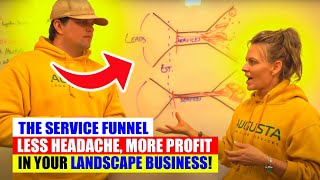
Lee and Liz of Augusta Lawn Care explain how narrowing your service menu cuts headaches and boosts profit. An estimator acts as a filter, turning down jobs that don't fit your core services. Fewer offerings mean faster crew training, fewer mistakes, and less owner dependence.
Chapters
Hey everybody, I'm Lee with Augusta Lawn Care, Whatcom County. This is Liz, you probably already met her. I am the office manager here at the local Whatcom County Augusta. And Liz is the operations manager and facilitator of communication. So today what we wanted to show you is an idea that kind of Mike and I had put together. Liz is here to offer questions and other insights of her five plus years being in an office manager and operations manager role. And this was something Mike and I were spitballing a couple weeks ago. And essentially it's a double sided funnel that accounts for the degree for air. So one thing that we preach here at Augusta is simplifying our services. So I want to label these funnels first and we'll go through what simplifying your services will do for your company. So this funnel here, right, this open end, if we're moving from left to right, this is going to be your leads. So we'll just label that here. So your leads come in all through this funnel. That's however you market. That's, you know, Facebook, that's Google, that's cold calling, that's door hangers, whatever it may be. This is your leads. So this is going to be a company with, that accepts a lot of those leads. And this is going to be a company that has more simplified services. So we're still going to get the same amount of leads. So I'll just do this purple there. So that's also leads. And then here, somewhere along this area is going to be your estimator and your estimator, essentially the old analogy that Mike and I use is called throttling. The estimator throttles how that business comes into your company. If it's a picky client, if it's something you don't want to do, if it's someone you don't want to work with or they, you know, complain about other services or that the job's never the way they want it. Your estimator kind of throttles that here. So he's a little bit farther down the funnel. We'll accept anyone's email, anyone's number, we want them in our database, we want to send them emails, we want to send them newsletters. So this is the estimator and he's right here.
So you're saying he's like in the position of power to say we definitely don't want this person or this would be a great client.
Exactly, exactly. So and if you're training your estimator on a simplified service model like we are. He already knows that we only offer, say that amount of services. So this middle area is your services offered. So.
And then here.
So much smaller. So that's your services offered, right? So you get to this point, you get all your leads go in, your estimator goes out, meets with them, does a drive by, whatever it may be. Then it goes into the funnel where this line, and I'll do this one in red, so you can see a little bit cleaner. This is where the job gets accepted, right? So this company accepts a lot of different jobs, right? They do hardscaping, they do irrigation, they do tree trimming, they do pruning, they do hyper specialized flowers and plantings, things like that. They have. Whoops. They have a larger amount of services that are offered here. We have a company that has more simplified services. Maybe it's just mowing, maybe it's just simple trimming, and maybe it's some very, very basic hardscaping. So this is the point where those jobs get accepted. Now, as those jobs funnel through, what may happen is the exit point, which is the degree for air. So the reason that these are both also the same degree is because, like Mike likes to say, it's just humanity, right? There's human error, there's preferences, there's things that people like, don't like, right? So these are technically still gonna be the same. However, if you were to put, say we get 100 leads here and 100 leads here, and we put, say we convert 50%, so we put 50 balls into this funnel, and we put 50 balls into this funnel,. Those 50 balls are gonna come out in all these directions because the middle is so much wider. Now if you had 50 balls coming out of this one, it's tighter. And they're all going to be going this way, right?
Are these all mows and projects and.
That would be everything? Yep, everything you offer. So your degree for air becomes greater because you're accepting more jobs that you aren't necessarily used to, right? You have projects that you don't do all the time. Maybe you do hardscape work and you do irrigation and someone asks for a fountain. Well, you could use your hardscaping ability, you could use your irrigation ability to install a fountain, but you don't really know how to install a fountain, right? That's where you're increasing your degree for air. Where in this model, a simplified service model, the estimator would catch that right here and say, hey, Mr. Smith, I love the idea of a fountain in your backyard. We can install a nice Retaining wall around it. We can mow your lawn, make your property look nice year round, but we're not gonna do the fountain. And that's where the estimator cuts it off. Makes that skinnier. And it's simplified services. Now, the big picture idea here, that really needs to be clear is what happens over here. And Liz, you can speak to this. What happens over here when these balls start shooting out the sides, is that gonna be the daily crew member's responsibility to save this customer over here or this customer over here, or is that gonna be the owner or the manager's responsibilities?
Us in the office, we're the first contact for all of this. And this becomes the customer angry, this becomes the frustration of the guys. This becomes a waste of product, this becomes accidents, this becomes destroying people's property. Now, we said we'd build a fence, but we're not really good at fences. And now we hit a water line. Oh, we were supposed to call the city. Well, we're not used to doing that. Oh, we forgot to do that. So now we have the city, the owner, their neighbor, everybody on our backs. And if we did something that everybody was comfortable doing every single day and wrapped up with walkthroughs and everything. Wonderful. Just happy things, good reviews.
Yeah, exactly. And that's where we as managers and owners of our landscape companies, this is where most of our headache comes from. Right? Our headache doesn't come from leads. We love leads. We love getting people into our databases. We want to be sending out emails, newsletters, whatever it may be. You know, our headache doesn't really come through the estimation process. It can, though, if you are offering services that you don't know how to bid for. That's why if you simplify the services, the estimator has confidence and has the ability to bid those jobs and make sure they're done correctly. Another thing I'd like to point out that Liz touched on, you know, these people out here, your everyday crew, who knows this amount of services, right, right there in the middle, they're not going to know how to solve these problems. They have no idea. They haven't dealt with it before. They haven't installed that, they haven't used that machinery before. However, here, if we're doing only these services, 90% of our crew can solve a problem that happens in that small area of degree for error.
So you're saying then you're not dependent on one guy who, oh, no, we can't get this job because so and so doesn't do it right. And what if they're sick?
Exactly. Exactly. So these little things that always fall on the owner, if you simplify your services and you train your crew to know how to do these services, become masters of those few services, you offer that degree for error, smaller, and it also allows them to take more ownership and gives them the ability to solve those problems. Right. Whereas an owner, these problems out here, no one knows how to solve except for you. Right. You've been doing it for 10, 15, 20 years, whatever it may be. But if you have a guy who's been with you for two years, he can solve most of these problems here. He can solve a mowing issue, he can solve a small crack in a paver job. Right. He can solve those very basic, simple things if you simplify your services.
Question, though. When the estimator comes to somebody's house and he looks at the property and it's a job that we could make $30,000 on, and that seems like, oh, my word, that's going to be a lot of different things. And they want a paver patio with a kind of paver we've never installed and takes special training. But all the rest of the job is really simple, like just massive amounts of mulch and rock. And the estimator's like, oh, my word, we could do all of. Except the wall. And so how would he present to the customer? Like, I want this job, but I don't want the wall.
Right. So, yeah.
Would it give distress to the customer, or would it actually cement their confidence in you?
Right. That's ultimately about transparency. Right. You want. If you want to raise the professionalism in your business and the industry as a whole, you want to be transparent with the client. When you say, we offer all of this up here, there's sometimes an element of trust that's lost. Right. Not everyone's a master of everything. Know what you're a master at, Right. So for Liz's specific example, what I would say in that situation, I would say, hey, Mr. Jones, it was great to meet you. I'm really excited about giving you this bid. However, we don't feel confident. Here's where I'm drawing that line in front of the funnel. I don't feel confident installing that specific type of retaining wall block. We've never installed it before, and we don't have the expertise to do it. However, the other. Right. I'm drawing that line. The other 80% of your work, the mulch, the lawn repair, the soil, we would love to bid that and get that taken care of. For you. So what I'm going to do is I'm going to offer you those services. Those services, the mulch, the soil, the lawn repair, whatever it may be. And then I'll give you a referral for another company we work with that does great retaining walls. We've worked with them in the past. And then we'll monitor them while we're on site.
And then do you. Do you comfort the customer, telling them we work well with them and we will schedule with them what parts need to go in where exactly.
Yeah. And then. And then we take it off the custom. So you still want to have that authority with the customer to let them know that you are the professional.
Right.
And by being honest and open, you're actually presenting yourself as more professional instead of just saying, oh, I can do that. Oh, we know how to do that. Oh, yeah, we're the best at that. When really, a lot of times you aren't. Right. It's being transparent with the client and letting them know, we will blow you out of the water on 80% of this job. But that last 20%, we're going to ask that you contact another guy that we've worked with before. If you like his bid, we'll get the job done together and make sure it is 100% to your satisfaction.
And for most people, they're going to go, wow, I've never seen competitors work this well together because most of the time they will have gotten a bid from somebody else and they'll go, oh, Augusta does this really bad. I have to come and fix Augusta's work all the time. And then you come on and you have nothing negative to say about any company, even if they're not a good company. You're just saying what we offer, everything that's good. And they're like, wow, they are so. They are a united front to all of the community. I have one more question. So most people in our industry are just starting out. They're all gung ho for the big jobs, especially if they've had training in the area. And you love hardscape and you love walls and you love paver patios, but you really don't have guys that have a lot of skill for that. And, you know, you kind of need to cut them out, but that's what kind of fuels your passion. That's what you love to do. It is very hard then for the estimator to. I don't mean this derogatory, but to dumb it down enough for the crew to do. And so can you speak to that and your own struggles with that. Like, it's so tempting when you're there because you're like, I know I could do this wall, but that's not your position anymore.
Right. Yeah. To speak to that. I kind of grew up in Augusta in the last three years, where we were doing kind of a rapid expansion, right? We were selling turf job, we were selling retaining walls, we were selling Boulder walls.
We just figured it out.
Anything we did, myself, Mike and other project managers, we put our heads together and we'd figure it out. And it was hard to reduce that service. But you really have to think about the bigger picture, right? It comes back to these jobs that come out here and that make you lose sleep at night, make your relationships with your family, your friends, your co workers, your employees feel fracture, right? It's those jobs that are the ones that usually cause you more pain than they're worth. And at the end of the day, sometimes emotional, physical, spiritual, whatever that comfort may be that you have in life is worth more than that $30,000. But when you think about the material costs and the possibility of going over on product or going over budget on hours, or the city getting involved for permitting, whatever it may be, all those problems are just not worth it, right? So for us, it was. It was hard for me personally to move to the simplified services model, having done it now for almost a full year. We pretty much all of 2020 have really dumbed down our services to where anyone who gets hired here within two to three weeks is profitable for the company, and that's the ultimate thing. And then for Liz and I, no more headaches, right? We have one or two big jobs a year. We break them up. We only say yes to things we know we're going to do good at, and then we move forward, right?
So that's wonderful. If you have any questions, let us know.









