The Skills That Get You to $1M Won’t Get You to $10M
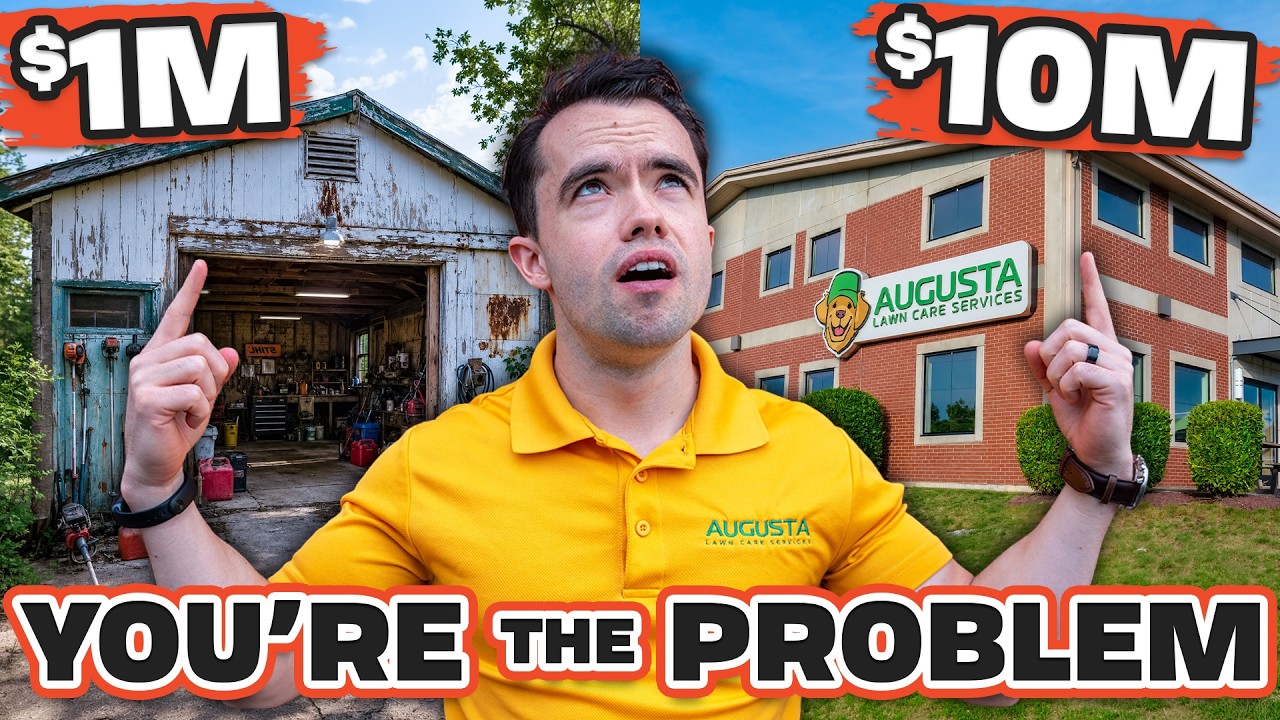
In this presentation Mike Andes explains that building a home‑service business to $1 million in revenue requires mastering only two core competencies: sales and management. He argues that early‑stage growth is a demand problem – you must find a single, repeatable customer‑acquisition channel (door hangers, road‑side signs, Facebook groups, etc.), measure its inputs and outputs, and double‑down on it until you can no longer fulfill the work yourself. At that point you must become an effective manager, handling hiring, training, quality control, compensation, and culture to support 6‑8 technicians and sustain a million‑dollar operation. Once past $1 million, the challenge shifts from demand to supply and the required skill set changes dramatically. Scaling to $10 million hinges on leadership and high‑quality decision‑making rather than pure sales or day‑to‑day management. Andes describes leadership as a non‑linear, soft‑skill discipline that involves personal health, emotional self‑control, vision‑casting, and the ability to empower others to solve problems. He illustrates how poor leadership (e.g., bluntness, reactive behavior) creates churn at mid‑level management and stalls growth. To develop these soft skills, Andes promotes the Home Service Boardroom community, which runs 30‑day challenges focused on nutrition, exercise, mindset, and relationship health, arguing that personal discipline is a prerequisite for leading large teams. The talk concludes with a call to owners of million‑plus businesses to join the Boardroom to accelerate their path to $10 million.
Chapters
If you want to build a million-dollar business in home services, there's really only 2 skills you need. They're very different than 2 other skills you'll need if you want to try to build to $10 million in annual revenue. I'm going to go over what those 4 skills are and the only things you got to focus on to build a 7 and 8-figure business. So when it comes to growing from $0 to $1 million, you only need 2 things. Some people are going to say you need websites, you need SEO, you need uniforms, you need wrapped trucks. But ultimately, there's 2 skills that you need, and that is sales and management. Now, if you're only trying to get from zero to say $200,000 in annual revenue, you actually only need sales. And that is go find customers, knock on doors, go to neighborhoods like this, do door hangers, talk to people on Facebook groups or Nextdoor, and just get your first 20, 30, 50 customers. You can do that getting to $200,000. Well, if you want to get to $1 million, almost always in home services, you're going to have to hire some employees. And most of your skill in getting those employees to be efficient and profitable for your business is going to come down to whether or not you're a good manager. That is training them, hiring, firing, having good team meetings, having good one-on-one meetings, making sure that there's a high quality standard when your crew goes out and does the job. Just the same way that when you did the job, it was also high quality. So getting from zero to a million is sales. Go get customers. I don't care if you're gonna knock on doors, if you don't have any money. I used to, back in North Carolina when I started a location from scratch, I started on a really small budget and I would stand next to the road with a sign. But about one every hour I would get a customer would drive in and they'd want a quote. And about 2 out of 3 would accept. And all that sign says was, do you want mowing? If you want a quote, I'll give you a quote in 2 minutes. And so the only thing that was required to get those first 20, 30 customers was the ability to sell. And I don't care how you do it. Everyone gets wrapped up in the tactics and whatnot. What about door hangers? What about knocking on doors? Should I go on Facebook groups? Should I run Facebook ads? Should I run Google ads? Do I need a website? And every single market is so different. I have talked to business owners that do $10, $20, $50 million in annual revenue that will swear by a certain tactic. I'll talk to someone else just a market or two over and they say that doesn't work. And so don't get too hung up on the tactics of sales and what works because it's so different based upon the service, based upon your brand, how long you've been in business. how many reviews you have, your online presence. It also depends a lot on your pricing, depends a lot on what your website looks like, your trucks. There's so many elements in addition to just the fact that we are seasonal in most home services and very region-specific. So what works for you might not work for someone else just a couple hours away. And so be very careful thinking about sales through the lens of tactics or hacks. You're gonna have to go out there, You gotta figure out what works in your market and then just double down on it. You don't need to get 5 different sales channels, you just need to find one. If you can hold a sign next to the road and get 1 lead every hour and close 2 out of 3 of them, that means every 3 hours you're gonna get 2 new customers. Meaning if you, on average, if I can hold a sign next to the road for a day, I'm gonna get a couple customers. And that's how you're able to get started. Sales. And as you start to get enough of those sales, you get enough customers, you get enough revenue, enough leads coming in the door every day, you can no longer do all the work. You can't, you can't hold the sign next to the road forever because you gotta go do the work yourself and actually earn the revenue. You gotta fulfill on the jobs that you've sold. But eventually, if so many of those jobs, you either A, don't have enough time to do the jobs, or B, have no more time to go out and do sales. Because you're so busy just getting the work done and fulfilling on the promises that you've made to the leads that came in. And that's when you have to become a good manager. What your job placement looks like, posting, what your compensation level is going to be, how are you going to train new employees, how are you going to make sure that the quality of the work that they do is going to be up to your standards and the customer standards. Make sure that they're not making damage cases, not making a bunch of mistakes, but rather they're going to present your brand in a positive light by doing good quality work. And then there's always going to be bad apples. There's going to be employees that you hire that'll try to sour the culture of the business. They'll complain. They will try to take customers away from you. They'll try to sue you. They'll try and make things up that never happened, and it'll be hurtful to For you. But the skill of management is the thing that gets you from $200,000 to $1 million. And if we can get sales, figure out a way, just one way to get customers, a channel that we know works, where we actually know how much inputs equal an output. Inputs being actions, outputs being a customer. If I know how many hours I need to stand on the side of a road with a sign to get one mowing customer, I have the inputs and I know what the output is. A customer. Once you know that math, that's all you need in home services. You don't need to go figure out 5 different ways. Everyone gets so wrapped up with like podcasts and books, videos they watch on YouTube, and they get distracted with 5 different ways of getting customers. So they never get good at one. Versus just like, can I figure out what the inputs for this sales channel is? How many door hangers do I have to put out? How many doors do I need to knock on? How many Facebook comments do I have to respond to in local Facebook groups? How many yard signs do I have to put out to get one output, one customer? And once I know that math, I should just execute on it and make it better and better and better. How can I optimize when I put my door hangers out? How can I optimize what the design of my door hanger looks like? Can I put instant quotes on my door hangers? Can I use QR codes? Can I cross out the price and do a lower price to be able to add some level of scarcity or price urgency to the offer. These are all things that you optimize slowly over the course of time, and instead of paying $200 cost per lead, over the course of years you optimize it to where it's only $30 or $40 cost per lead. But that's because you focused on one channel, and that's sales. Now, management is a very different experience, and for a lot of people, that's where they think that you should just go and be solo. You should be a solo operator forever, Because it's so hard to find good employees. And I agree, it's the hardest part about home services. And until the robots come along and take everyone's job and can do it really at a high quality level, which by the way, Optimus is not coming to save us anytime soon. Until that happens, human labor and managing it is going to be the skill that is required to go from $200,000 to $1 million. So figure out sales channel. We're doubling down on it. We're executing on the inputs that we know lead to a customer. We do that over and over and over again until this point where we can no longer fulfill on all of the work and we gotta go hire someone. And it'll simply come down to whether or not you can manage that person effectively. Can you motivate them? Can you make sure that they do a high-quality standard of work? Can you make sure you compensate them to where they reach their goals, making more money, when the business reaches its goals, which is high-quality service, selling more to existing customers, making sure customers are happy? If you can figure out to be a good manager, you'll build a million-dollar business. Now, that is usually 6 to 8 technicians depending on your home service industry, but usually 6 to 8 technicians, you can by yourself build a million-dollar business, especially if over the course of a few years you optimize your pricing, you raise your prices, you can build a million-dollar business. Now, the question becomes, what happens after that? If I'm in a smaller market or if I don't want to— I can't get a big shop space in my area, maybe I'm going to put a general manager over those 6 to 8 technicians and I'm going to go start another location 30 or 40 minutes away. Maybe because my market is small, maybe because the nearest town is 30, 40 minutes away. I don't want that drive time because of traffic and the way that the traffic patterns are set up. Maybe it's simply because you have a great employee that you want to promote and they do a great job of taking over all the operations. You've systematized everything. Everything's dialed in. Super profitable location. You're like, I just want to go do another one of these. Great. Or you decide, I'm going to take this one location. I'm in a massive market. I can scale this thing much larger. I want to be able to stay in operations with my team and be the leader at the location. Great. Let's scale one location. Okay, now we're going past $1 million in revenue. And the skill that is almost always required is 2 things. That is the ability to lead, leadership, and the ability to make great decisions. Because as a solo operator, as someone with 4, 5, 6 technicians, most of the wins that you have incurred are because you found customers, sales, and you led your team. Now there's going to be other managers involved. There's a mid-level management team that starts to be involved, whether you are scaling at one location and doing operations managers, office assistants, operations assistants, mechanics, and you start to scale at one location. Or if you're doing multiple locations where now you have general managers, you have people, other people hiring other individuals. Now when someone joins the team, you don't even know their name. There's a technician with your brand out doing work for your customers and you don't know their name. That's going to happen once you start getting 20, 30, 40, 50, 60 employees. You're getting past $1 million in annual revenue and you're scaling to 10. Million dollars in annual revenue. And your ability to sell, your ability to be a great manager, is the thing that got you to a million. And many times is the reason why you can't get to $10 million. Because look at this view over the houses. There's Mount Baker in the background. But a lot of times I see really, really strong salespeople, really, really strong managers. That is actually the thing that keeps them from being great leaders and from making great decisions. Because they take so much pride in selling, they spend all their time on obsessing about sales instead of becoming a better leader. And instead of focusing on making a few really solid decisions for the business, making their marketing calendar, optimizing their upsell process, creating systems and procedures for the business, instead of doing that, At a $4 or $5 million business, they're out there training with their team. They're out being a great manager, but that's not what's required to get them to $10 million. So they beat their head up against $2 million, $3 million. They have a lot of churn at the mid-level manager position. They can never get their operations people to stay long. They can never get any general managers to stay long. They struggle with churn at the technician level, but mostly at the mid-level manager. Level because they haven't learned the skill of leadership. And the challenging part about the skill of leadership is it's not linear. It's not something that I can give you a checklist of things that you need to do. And it can take a lot longer than learning a skill or tactic around Facebook ads, Google ads. And in the past, when you're trying to learn sales, you have to do one thing really well. Leadership is you've got to do like 100 things well. And it starts to become where things are thrown at you where you don't have the previous experience or the know-how, and you've got to come up with things on the fly. And that's a skill that as a leader you'll have to develop. So how do you become a better leader? Well, this is actually why we started the school community called Home Service Boardroom, because it's such a soft skill. It's not checklist-based. And a lot of times it actually has to do with doing hard work on yourself. As a person, becoming the leader that others want to follow, becoming the leader that A-players want to work for. And that's hard. And that can mean doing things that are uncomfortable, like whether it be your diet, your exercise, whether it be the way that you communicate. You're like, I'm just a blunt person, that's just how I am. Great, that'll probably get you to $1 million. You will be able to do that over and over again. If you start a new business tomorrow, Probably get to $1 million, and then you hit up against $2 or $3 million because you don't have the skill of leadership. And you think being blunt is just a characteristic that you're not gonna change. In reality, being blunt is the thing keeping you from growing the business, keeping you from attracting and retaining great talent. And again, you as a great manager or salesperson could be the very thing that's preventing you from being a great leader and making good decisions for a $3, $4, $5 million business, and if that happens, you'll stall there and you won't ever get to $10 million. This is why inside the Home Service Boardroom, the very first month, we actually do a challenge, 30-day challenge, where all we do is we track what we eat and we track every single workout, and we work out 7 days a week. Why? Because if you can't control the 24 inches between your table and your mouth, you can't control this, how do you expect your team Every single day to show up and control their emotions, control their desires, what they would rather do, the things that feel good to them, the thing that feels easy to them. And so becoming the leader that others want to follow, not just anyone else, by the way, great employees, great team members, great managers want to follow. You will have to become the leader they want to follow and that can cast a vision on the business and that people believe you you're gonna execute on it. That takes leadership and it takes really good decision-making. And you will make, every single decision you make, there's a high probability of making a mistake. But how you deal with that is more reflective of how you are as a leader. So when you make a mistake, do you get mad? Do you blow up? Do you say that it's other people's problem? You cast blame. Or do you take ownership? You stay in control even though it might be not your fault, You take ownership, you figure out what you can do to control it, because if you are in control of your business and you stay in ownership of your emotions, your team will do the same thing. And a lot of times you see a business that is floundering or has a lot of churn at the leadership level, and they're just mimicking the behaviors they're seeing in their leader. And so if their leader blows up and gets mad, if their leader quits on people fast. If their leader is explosive and reactive to everything in the business, the mid-level managers will be the same way. And so a lot of times, if you see deficiencies in your mid-level managers, it's actually we as leaders have to make changes ourselves. And that's hard. It's not something that you learn over the weekend like you did when it came to running your Facebook ads or doing your door hangers better. That was a skill. That was something that you could quickly pick up and In a weekend. And I do believe that leadership and decision-making is a skill, but it can take a lot longer to figure out. It can take a lot longer of trial and error, figure out what works for your style. There is no right and wrong way to lead. There are leaders like Elon Musk that'll come into a place and blow the place up and fire half the leadership. And there's other leaders that would never do that. They would lead more with their heart and empathy. They would take longer to make decisions. But they would foster the current leadership instead of just nuking everyone. There's no right or wrong. There are successful instances and examples of both ways of leading. And becoming that person though, the one that has a strong moral compass and leadership compass that other people can look at and know that this person will act in accordance to these values every single time, that's hard. It's not something that is easy to acquire. And so this is why we have the boardroom and we talk about things that like your marriage. I have seen so many people, their business be affected negatively because nothing to do with their marketing or their sales, their management experience. They build a $2, $3 million business and it's struggling, it's stalling, and they hate their business. Why? Because their marriage is messed up. Their health is messed up. Their— the body, the chemicals in their body and the nutrients, like, are out of whack. They, they get emotional and reactive because their blood sugar is spiking 2 or 3 times a day. They have lulls of energy, especially in the evening when they should be spending time with their family after a day's worth of work. They get annoyed, they get anxious, they get frustrated, they get tired, and now their family resents The business they built that they think is taking all their energy, time, and attention away from the family. And that's why you started the business, was for the family. And now in their mind, like, what in the world? Now they spend all that energy and time at work and then they come to us and they have none of that. And so now they start resenting the business and they want you to spend less time working on it. They want you to spend discretionary effort, weekends, evenings. They hate when you have to pull out your laptop and work a little extra or pull out your phone when there's a fire in the business. Because they don't see the business as serving you. They see you as serving the business. And when that sort of fragmentation and friction is in a family, in a relationship, in someone's physical body, causes mental stress, causes pressure. When that's happening, how in the world are we going to make good decisions? How are you going to make good decisions in business or when it comes to acquiring talent? If we are so unstable in our mind, if we're so unstable as leaders. And I was talking to Jonathan Potocnik recently on the podcast, and we kind of broke down what we talked about, these 4 things: sales, management, getting to $1 million, and then decision-making and leadership, getting to $10 million. And it's almost like this: getting to $1 million, it's all a demand issue. I gotta get more customers. It's all about getting more demand. Now the other side of the equation is supply. That is technicians, that is managers, that is infrastructure, that is more trucks, employees, all the— that is all supply. And so going from zero to a million, it's all about getting more leads. It's all about demand. That's the problem. Most of us, it's just getting more leads. After a million, it has nothing to do with that. And the person that was so good at getting leads a lot of times bat their head up against, just constantly run their head up against this problem and they can't keep scaling is because it has nothing to do with getting more leads. And that skill that has served you in the past no longer is the thing that's going to get you to the next level. You're going to have to become a better leader. You're going to have to make better decisions. You're going to have to allocate time, attention, energy, and resources towards your team making decisions instead of just you. And you're no longer going to be the person that saves the day or has the brilliant ideas. You're going to be the person that facilitates others to come up with ideas and facilitates them finding problems, finding solutions, and executing instead of you being the one that does that every single time. So I recently had a lot of people ask why we started the Boardroom and why it's only for million-plus business owners, because it's a very different skill set that is required than going from zero to a million. So if you have over $1 million in revenue, feel free to apply. You just go to skool.com/boardroom, and every single month we have a a challenge for 30 days that is going to allow you to become a better leader over the course of time. But there's just no way, I believe, if someone cannot force their body to exercise and work out, discipline themselves around the food they eat, be able to have systems and procedures in their relationship that foster success, if you can't do those things, how in the world are we gonna expect to lead 50, 60, 100 people to a $10 million organization? And that's the things we focus on. So, appreciate you all, hope that helped. Thanks, Mike.









