The ULTIMATE Mowing and Lawn Care Equipment Setup!
Mike Andes walks through a lawn-care operation and explains how to match equipment to jobs. Use smaller mowers and skip the trailer for tight urban properties to cut costs per hour. Pay workers based on performance and share profits to keep them around.
Chapters
Today we're going to make some money mowing lawns, running a landscape business. Here's all the information. This client has their home for sale. It's on a very steep hill. It's hard to actually access it with the trailer. You're going to see in just a moment. We're mowing and weeding this property, and we're actually spraying for them as well as part of the weeding service. There's the turf. Square footage. You can see it's really small. There's just a little bit in the front lawn and then a little bit of backyard lawn under 1500 square feet.
Foreign.
It's Mike andes here@landscapebusinesscourse.com and today we are mowing lawns. And the next job we're about to do is the very top of this hill. Unfortunately, there's nowhere to turn around with a big trailer. This, again, is why you might think about doing trailerless setup. Is this thing in front of us. There's no turnaround, and all the driveways are blocked with cars. So we're either gonna have to walk up with the push mower or drive this massive monstrosity up and back it back down. So we're gonna drive up and see what happens.
No trailer brakes. Here we go.
See, usually I turn around in here.
And they're both blocked. Oh, there is space up here. Let's. Good choice. Either this person is selling their house or publicly puts their phone number next to the road.
Okay, so this one, we are mowing the lawn. It's a small front and backyard. It's gonna be a push mow. Property cleanup is gonna be includes two front garden beds on either side of the driveway and gravel under the back deck. Pull large weeds, spot spray areas of heavy weed growth, remove leaves and debris. Okay, so on this one, we got 30 minutes for the MOW, 15 minutes for the bed maintenance. And let's start now.
You knew I wasn't going to let you down. We're going to do some voiceover as usual and learn how to make some money mowing lawns, doing landscaping. Today we're gonna be talking about the trailer. Why we try to get away from the enclosed trailers and some of the downsides. But again, as I've always said, you gotta match your equipment setup to the type of property that you have. I really recommend, if you're just getting started or you're small, start with the smaller lawns. Cause you don't have to get as big a truck. You don't have to get a half ton or three quarter ton or a full ton pickup to, to haul a massive trailer around. You can even get like a Ford Ranger or a Colorado. It's not even a half ton pickup. That smaller truck allows you to have a smaller mower, which has less liability, less maintenance, and less cost for maintenance, like a hydro oil filter and hydro oil change. And the belts on a big zero turn cost a lot more than this little machine here, this $1,200 Honda commercial. Yes, it's gonna limit you in terms of how many lawns you can do potentially in your market. But in my mind, you've got to look at the cost per hour of overhead to operate a specific setup. With a tiny mower, small equipment, your cost per hour of maintenance, your cost per hour of fuel, your cost per hour of overhead dramatically decreases. So if I'm going to get a bigger mower for me, I want to make sure that 40% of my lawns actually need the equipment. So that way, asset utilization, what that means is like I'm actually using the asset. It's not just sitting there doing nothing. That's dead money. And if I'm doing a capital expenditure in the form of a truck, a trailer, equipment, I want to make sure I'm actually using it and it's making me money. That's how I can maximize the ROI on that purchase. So when you look at different setups in your lawn care business, as you grow, you potentially might have a setup that has a big zero turn and is doing all the perimeter, like the outside county properties of your route, and then have a smaller setup that has less overhead, less equipment, less need for skilled laborers, et cetera, that can do the, maybe downtown, the smaller lawns like this one that are smaller square footage because at the end of the day, you've got to look at what that mower is actually going to cost you per hour, what that setup is going to cost you. For example, if we break down just the cost per hour of a zero turn setup, if it's $8,000 for the acquisition cost and you run it for 15,000 hours, that means $5.33 per hour is really going toward just purchasing the equipment, let alone, you know, let's say like $4 per hour for fuel, a dollar per hour for insurance, couple dollars per hour for maintenance.
All right, so we're at this property, and part of our mowing service and weekly service here is pulling weeds. So this property just recently got bark mulch. So this is what we call medium brown bark, has a little bit Chunkier of the bark kind of chunks in there. However, this is a great upsell for your mowing customers. Even though we focus on recurring services and basic services, when you get a mowing client, the goal is to upsell them as many services as possible so you increase their lifetime value. So, for example, if we mow this lawn and we charge them, I think it's $50 for this service today or $60 for this service today. If I do that, say 30 times in the year, that's going to be what, $1,800? 860 times 30. Like, yeah, $1,800. But if I can get one mult install, I might get another 1500 dollars from this client. And they went from $1,800 a month or $1,800 a year all the way to over $3,000 in terms of value of the client without having to go get more customers. So upselling and getting more lifetime value and annual value from each customer is imperative to growing the business. If you're wondering what you need to get started in terms of equipment, you don't need a trailer, you don't need a bunch of mowers. You literally need a bucket and some gloves and you can pull weeds. That's really all you need. And honestly, you don't even need those things, so there's no excuses why you can't get started.
Pulling weeds is definitely where we get the most of our call back. So being thorough with that's really important. It's almost honestly the hardest thing to train new hires on in being really efficient as well as just really maniacal about getting every single weed. Most of our callbacks, most of our complaints are from missed weeding, so we really have had to buckle down on it. Especially with P4P pay for performance, where our team is trying to go as quickly as possible. They can't cut the corners when it comes to weeding. Speaking of cutting corners, we have what we call profit sharing program for our frontline staff we've implemented this past couple years, and it's really, really worked wonders for our team culture as well as the ability for the team to make more money and earn that money through their hard work and being efficient out in the field. So even this past week at the local shop, the frontline employees, guys out in the mowing crews and landscape crews, they made $651 for this past quarterly profit sharing. And if you're going to do profit sharing, in my mind, you have to have what's called open book management, which Means you share the numbers and you actually share where the business is making money, revenues and profits and losses each month, staying in touch with them and actually being transparent with all the numbers of the business. You can't like hide what your hourly rate is or how much you're making on a job because otherwise they're just not going to trust you. When you come up with a profit sharing number, they're just going to think you literally pulled it out of the thin air and are making stuff up. And they're going to wonder why it goes up and why it goes down. You want to give them as much context as possible. In my opinion, if you want an employee to think like an owner, they need two things. They need the information like an owner that comes in the form of open book management and them seeing the numbers. And then they need to be compensated like an owner. This comes in the form of pay for performance where they get more money, the harder they work and the more efficiently they actually produce. So a lot of times people are worried about, well, what happens if I'm making a bunch of money on open book management? They're see, I make all this money. Then you got to make sure you give them upward ability to make the same amount of money as you.
All right, so this house is for sale. I can tell. There's a key box on the front door. I want to talk about real quickly. When it comes to your lawnmowing customers, there's only a couple different type of customers you can get. Number one is the customer that is for the very first time getting service. Usually these people get service at the beginning of the year. They're like, you know what, don't want to get the mower out of the front out of the garage. It's not working. I'm just going to hire someone that's the first customer. Next customer is the disgruntled customer, the person who is unsatisfied with their existing provider and is looking for somebody else. That's the second one. The third one is when people move. You know, it's always been said that when there's always a few times in people's lives where they spend money irrationally. One is when they die, one is when they get married, one is when they have a kid. Only one in my mind is when they sell their house. So there's a reason why we were able to sell them this mulch installation and why they're obviously getting weeding and spraying and all the rest of it because they're selling their house. So Again, opportunity. If you're in this kind of real estate market right now, where everything is buying and selling and really quickly, people, if you want to optimize the value of their property, it's a great way to upsell them on a property cleanup. Installing mulch, getting their beds cleaned out and their bushes trimmed. Money in the bank.
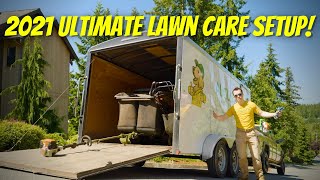
Couple drawbacks about the enclosed trailers. We love them for one reason. These bad boys on the side. It's like a massive moving billboard. You got Max, our mascot on the side, you got 14ft of absolute billboard. Massive lettering. Etc. Things we don't like about it though is partly just the construction. For example, look at this fender. It's been hit by something because it sticks out and has now been. You can actually see they've actually had to fix this and put some silicone in here to prevent any sort of water getting through these tires. They're the tandem axles. We go through like one set a year at least just because they're tandem and they'll wear a lot faster. You got brakes on here, you got grease points on these tire, obviously, but this sheet metal, it's like the thinnest stuff ever given to mankind. And it gets dented, it gets scratched, especially if it's white like this. But again, I wouldn't even paint it due to the fact that, you know, screws come out. It gets dented, you gotta fix it. Now you're patching a color. So I love this, I love the billboard. But there's things that we just, you know, there's just a lot of wear and tear. For example, these cables here on the side, these are the draw cables for the back gate. Helps, you know, it has a coil up here for tension to be able to lift this gate up a lot easier. However, if you have a zero turn coming in and out of this every day, this one's gone. And literally this happens like three times a year. All it takes is someone backing up the zero turn. We have the bagger on it so it sticks out like 12 inches on this side. So as you can see, we hit it and now it's almost beyond repair. So this is again why we switched to trailerless setups. We get the ramp rack, there's a Moen go systems dot com. You can check those out. This is why we're trying to move that direction. Cuz the construction of these just not built for a thousand pounds. Zero turn coming in and out of here 50 times a day. You got the back, this, the boards here on the door itself. The ramp Itself already starting to buckle again just under the weight you got, you got to grease these fittings and, and just overall it's just not built for this stuff. Yes, you could buy a $10,000 one or upgrade. Like for example, what we did is we've doubled the plywood in the flooring here because we have so much moisture and grass and all the rest of it. The flooring of this would actually over time start to buckle and kind of depress under the weight of everything or the weight of the mower was. So we actually put a double thing of plywood. But again it's just lots of maintenance and again contributes to the fact while we're moving the trailers and you can get a zero turn in a trail list, you just can't bag clippings. And that's why we have to have this trailer to haul this thing around so we can keep the bed of the truck open for collecting clippings. I'm going to go ahead and spray some weeds now.
It's kind of like driving a Tesla and then trying to go back to a Toyota or a Honda. Once you've seen one of the battery powered backpack sprayers, you just feel stupid using this handle to pump the thing. We were down in Georgia at one of our locations and Jesse, one of the employees down there was using oh my goodness, seat now you want some help? Not only did I feel stupid, I look stupid. All right, there we go. He was using one of the battery powered ones. They look legit. None of this garbage going on all day. By the way, Danny, on our last video someone called us Sally's and said we should go back to our office. Job jobs. So we've been relegated to the office.
Everyone always asks, well how do you grow your business, how do you get more customers? All the rest of it. One of the best things I recommend is get getting a website made for your business. Most customers right now are coming from our online presence. Most of our leads do not come through phone call. They actually come through online request forms, people emailing, et cetera. And in my mind what happened in 2020 with the pandemic and people staying at home. It forced our target demographic, that 50 and up year old market to actually start using technology. They're actually on Facebook now. They watch you YouTube videos, they might even be on Instagram. So the fact of the matter is that our target market that perhaps in the past didn't have an email, didn't want to be on social media. What happened in 2020 is accelerated the social media and online acceptance of that into our older demographic of customers that we are going after. What that means is we need to be at where our customer eyeballs are at, and if they're on Facebook, we need to be there. So. So if you're going to run ads in all those online platforms like Nextdoor and Facebook and YouTube and Google, for example, you need to make sure that you can actually link them to a good looking website. Yes, you can make a.









