The ultimate showdown: College vs. Entrepreneurship - Episode 085
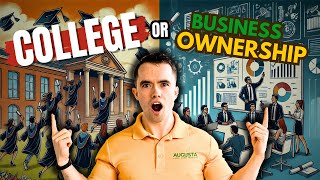
A recorded conversation (Lee and Mike Andes) exploring whether to pursue a college degree or entrepreneurship. They react to a viral tweet (Brianna Wu) questioning academic usefulness, compare data on degree-holding entrepreneurs (64% with 4‑year degrees; 11% with master’s+), business failure rates (roughly 10–25% year one, ~60–70% by five years), college completion (61% for 4‑year degrees in the U.S.), and income comparisons (class of 2024 starting salary projected ~68k; 2023 median recent-grad income ~60k; humanities ~50k, computer science ~75k, engineering ~76k). ZipRecruiter data cited an average small-business owner income of $127,000 (with 21% earning < $50k); PayScale cited average home business owner ~$70,781. The hosts emphasize risk-profile, the non-guarantee of a degree, the discipline value of completing school, the glamorization of entrepreneurship, and practical advice: prioritize metrics before starting, use community/coaching, manage pride by deflecting praise, and use simple tools (Trello, six-week sprints) to focus execution.
Questions this video answers
December 5, 2024
Over 2 million views within 24 hours
64% (with 11% holding a master's or beyond)
Year-one failure typically 10–25%; about 60–70% fail within five years
61% completion rate in the U.S. for four-year degrees
Chapters
Welcome back. Another episode, C Suite Unfiltered with Mike Andes. It is December and you are fired up about beating the competition.
Oh, yeah.
Do you know what I'm referring to my story yesterday? Yeah. You've been going hard on public posts as well as posts inside of Augusta about. This is the time of year where most people, not just business owners, most people kind of rest on their laurels. They take a break, it's the holidays, they're done for the year. They can regroup in the new year. And you've basically said that over the next six weeks, from December 1st to mid January, you can double the impact of your competitors. What is your thought process behind that? Why have you been pushing that so aggressively?
Dude? Because it comes Thanksgiving, everyone literally takes a five week vacation. It's ridiculous.
Yeah.
So he's like, how do I get ahead of my competition? Well, just work for the next five weeks and if you double down, you'll be 10 weeks ahead of your competition come January 1st.
Yeah.
So, yeah, it's easy to fall into that though, because a lot of people, you travel, you have a bunch of food, you're usually kind of like comatose. You have a bunch of sleeping. That happens on the weekend. Then you, then you do shopping. So you get in like the mode of like Christmas gifts, all that sort of thing. Well, then Christmas is still four weeks away. It's like all of a sudden you just checked out for four weeks and your, your brain is on public events and gift giving, which is great, let's go. But then, then you hit New Year's and everyone's like, well, you know, it's the New Year, we're going to do some New Year's resolutions, going to take a couple days, warm things up. So literally it's till the 10th of January, people literally going to Kobatos. And so just know, just throttle it if you want to get ahead right now.
Yeah, yeah, I, I agree with that. I, I, this is probably the first time in years because, you know, I felt motivated, I felt called out. It's probably the first time in years. The Friday after Thanksgiving, I was like, no, I'm like, I'm actually going to work because most people aren't. And my, my wife, the producer of the pod, is like, do you have to? I was like, well, hey, if, if, you know, people want to have calls with me the Friday after Thanksgiving, I'm gonna take them. So it was good. It honestly did feel good because I'm like, oh, yeah, no one's probably working right now. But I'm just going to do it because it's going to get me one step ahead of someone else.
Let's go.
It's good motivation. All right.
And to that point, I think you sold an executive model that day.
Yes. Yes, we did. Yeah. So that's exciting. Yes. If you're interested, Augusta, we have the executive model. You can start multiple locations for a massive discount up front. So very exciting. All right, well, I wanted to get into a topic here that is not maybe going to apply to all of the audience, but probably something that people would love to hear your thoughts on more at length. I know you have done some videos about this in the past. You've talked about it at conferences. But it is the age old question of entrepreneurship versus a college degree. And this was spurred on by a tweet that I saw and I'm going to read this verbatim now. I did not look into this person. I do not know what their background is. They were just giving their take. Right. That is the point of the Internet. You can give your take to the masses and if it catches fire, you're going to go viral. And this went viral, had over 2 million views within 24 hours. And this is what at Brianna Wu said. She said, my hottest take is that I don't think a massive number of people in academia are that smart, which is why they are unemployable elsewhere. I think they become very pedantic people that learn a ritualistic way of communicating. That sounds smart, but if you really examine it, all it does is inflate weak ideas. They become so focused on minor details, they're unable to connect to any larger narrative. Everything about their lives becomes missing. The forest for the trees. Your reaction to this tweet from Brianna Wu.
So I was on a podcast the other day getting interviewed, and I spent a long time diving into this because they wanted to talk about my past with going to college so young. So they asked me something along those lines and kind of what came to me was, it's kind of like this. If you go and you see a guy that can lift 300, 300 pounds, that does not make him a great MMA fighter or a great fighter or boxer in general, like you could like.
It does not correlate exactly. However, if I took that 300, that person that could lift 300 pounds, and I put them next to someone that has never gone to the gym, I would probably put my bet, if I was a betting person, I would put it on the person that could lift to 300 pounds just as like an odds perspective, it's not to say it's 100%, but from an odds perspective they have done the hard work to lift 300 pounds, they might have a better chance of success in the ring with someone else to beat them up. And so I think the school is the same way. Like the piece of paper means absolutely nothing. It does not mean you're a good fighter. It does not mean you're good in business, does not mean you're going to be successful. However, it has proven that for four years you can do something completely useless but stay disciplined enough to stay stick with it. And that's a skill that is, is required, that is beneficial. And so I don't think the piece of paper does anything, but it does give validation to the fact that someone had the discipline to stick with something that they literally cannot draw conclusions as to how this is going to help them in real life. But they stuck with it. And for four years or eight years or whatever it is. And so I think that's the, the, the merit of, of an education in my brain.
Yeah. So I did pull lots of data on this, not related to the tweet by any means, but just to the topic of kind of college versus entrepreneurship. Data I saw from Recruiter was that 64% of small business owners in the US do have a four year degree. So that was kind of an interesting metric. And of that 64%, 11% actually have a master's or beyond degree. So it does like the overall majority of entrepreneurs do have a four year degree.
Maybe that's, maybe that's the 64% that fail.
Yeah.
Fair enough. Yeah. And then that does kind of correlate with obviously some of the statistics of opening a business. So I pulled some of that data as well, which I know you're very familiar familiar with, but lots of different ranges. The failure rate for year one entrepreneurs is typically the ranges I saw is anywhere between 10 to 25% and over the course of five years it is a staggering 60 to 70% will fail.
Yeah, yeah, there's your 60 to 70%. We have statistical averages. Let's go correlation.
Which is super funny because if you look at the college completion rate, so college completion rate for a four year degree is 61% now in the U.S. so it's actually increased over the years, which I thought was surprising. And if you, you just look.
Cost policy goes up. Yeah, that makes sense. I didn't even think about that correlation there. Do you think that's, do you think there's a correlation there.
The sunk cost fallacy.
Yeah.
If you're spending, if you're spending $25,000 a year versus $5,000 a year, the likelihood of you finishing your degree is probably a little bit higher, I would say.
Yeah. Does that then correlate with the likelihood of wanting student loan forgiveness.
Which side.
Of the aisle you're on?
Yeah. And then it's just. And then here, here we are. This is what has divided America. But then I was like, okay, let's look at what you can take home. Like what, what can you actually make based on doing higher ed? Getting a bachelor's degree versus starting your own business. Now it is hard to find data on first year entrepreneurs like what they're going to make in their first year. But this is. Yeah, I mean it's basically zero. I knew you'd, you would basically make that comment. But this is for someone that has gotten a four year degree. So the average starting salary for the class of 2024 is projected.
Let me. Oh, oh, I heard your first 60 something thousand.
Okay, yeah, 68,000. Okay. So the medium income for recent graduates with a bachelor's degree, this IS data from 2023 was right around 60,000. So it's a little bit less than what they're projecting for the class of 2024. Now a little bit of a breakdown here. I'll let you guess these breakdown between computer science degrees versus humanities versus engineering.
It's going to be like 45 to 50 for humanities.
Okay.
And then engineering is probably high 90s, early six figures. And then computer science is going to be 120 to 140.
So actually you're high on those two humanities. You're right on. It's about 50,000. Now these are probably entry level jobs and it's looking at all computer sciences.
Okay.
Okay.
Yeah.
Well it's average salary. So most of them are probably going to get entry level. Right. Even if they are do have an engineering or computer science degree so they.
Can go work at McDonald's. Yep.
Yeah, that's true. All computer science averages is 75,000 and engineering is 76,000. So there are about $25,000. $25,000 more per year than someone with a humanities degree.
And sometimes they do more damage if they're brand new out of school than anything. So I do not recommend hiring them as engineers.
Yeah, yeah. Now what do you think that. This is data from ZipRecruiter for small business owners across the U.S. this is data from last year nationwide. What do you think the average salary take home is for small business owners in the United States.
Oh, I saw this before. I think it's, I want to say 52.
Oh, see this is, this, this is from ZipRecruiter. This is a big study that they did. Now what they classify as small businesses I did not, I did not find in the article. I apologize for not finding the exact data point on how they're classifying a small business, but it is 127,000 a year.
It's a lie. It's a lie.
Absolutely.
Yeah, That's a mess. No, not true.
And that's what I thought. So I, I want to see if I, you know, if, if want to kill some time for me, I can try to see what they define as a small business owner. Now they do say that 21% of small business owners make less than $50,000 a year and that the average, so the average 20, this is like 29%, 19% and 21%. So what would that be?
40 something.
Pay scale, for example, has the average home business owner at 70,781 per year. So like I think this is going to be all over the place. Place.
Right. So the bulk of their research here says that 60%, the overwhelming majority, 60% of small business owners make between 82,000 and 130,000 a year.
Okay. Yeah, good luck.
I mean that's, yeah, it's from ZipRecruiter.
60%, 60% fail. I. E less than zero. Or like they can't even make ends meet. Trust me, the average is way lower unless you're taking people that are making millions. And that's extrapolating out the average. But if you look at the mean, I bet it's less than 30 or 40 grand. Like the, like the 50th percentile I would imagine is 30 to 40 grand.
Even less. Like, yeah, I'm telling you, like there are people that lose hundreds of thousands of dollars. Like that is a negative, kind of brings the average down.
So well, here's the, the top paid small business owner. So this, this is obviously getting into more technical fields. But the top paying from this article is like an orthodontist or a dentist practice because they do own their practice. So that is technically a small business. And their annual salary for orthodontic orthodontists or dentists is 130 or excuse me, 309,000.
That makes sense.
Yeah. So it is taking in like more technical fields of small business ownership. Obviously we're not looking at, you know, like Blue collar or lawn care. But I thought that data seemed skewed as well. And then you throw in the data of, well, 60 to 70% are going to fail in their first five years, which means you just have to get through those first five years to even basically dream of this kind of take home pay.
Yep. Who is that Easy? Everyone would do it.
Yeah. So then, then the question becomes, is it risk management? Right. Do you get the four year degree in say engineering, something that you can make that 70k right out of the gate, 75k right out of the gate, or do you want to sacrifice, as you like to say, for five years to potentially get that pale of 100, 120, 130 a year? What are your thoughts on that?
Yeah, it's a good like assessment based on your risk profile because yes, the more, the less risky thing is to do what you just said. That being said, if you spent five years in, in the industry that you're trying to pursue and didn't have to go into student loans and that would potentially set you back for several more years, all of a sudden we're 7, 8, 9 years of industry experience. Like 10 years ago I was just starting Augusta, so if I was, I would just be getting out of medical school otherwise.
Right. Well, you're the anomaly, you're the outlier in this case. But do you think that for most, for the average person, what should they do if they're on the fence? Someone's on the fence and they have a great opportunity to start a small business or say they have a four year degree and they could go into that field. What would your advice be to them?
Well, I have a hard time thinking if this is a decision for an entrepreneur, that they are an entrepreneur, they should probably be an intrapreneur, like get the degree and be a great number two or three or an exec or start an early startup. That's probably the move this person would make because if you're even considering this, you probably don't have the risk profile of like let's go all in on anything. So it's not, it doesn't even become a conversation. And so yeah.
Do you think entrepreneurship to dive into that deeper? Do you think entrepreneurship is truly like a calling or. I know you've said this in the past, you know, I don't know if you've, you've met it facetiously or actually is like, so you're kind of messed up in the head if you're an entrepreneur, especially if you're like a Serial entrepreneur. I've heard you make that comment before, like you're kind of messed up in the head. Do you think that that's true? It's like this calling, this feeling that can't be tamed or pushed aside. Like you have to do this thing, you have to build this business. And that if people don't feel that maybe they shouldn't start a business, I.
Think there's more sure fire ways of getting rich. Like your goal is trying to get rich, then I don't think it's necessarily the best path and like the least risky way of doing it. And so I would only do it if you must. Like if you cannot not have ownership, then, then go for it. But like I would say in general there are far better ways to be able to mitigate risk. Have a good paying job, put your bet on a company that you think is going to grow, and then have a good paycheck. Instead of ups and downs in your income, things that wipe you out, massive amounts of risk in terms of something bad happens, like data loss, cybersecurity.
Key man risk, insurance fraud, like there's so many things that can wipe you out. Like that hovers over your head all the time. So if you have proclivity towards de risking your life, like I would just not address it. Like for example, Steve Ballmer, all right, arguably did a poor job as a CEO at Microsoft, but he is now, I think in the top five richest people in the world and maybe top 10. Now he's actually richer. He's, he has more money now than Bill Gates.
That's crazy.
Think about that for a second.
Yeah, yeah, he was, he was an.
Employee and there's a lot of people like that. But no one talks about them because everyone wants to talk about the founders. But like the lesson, the less.
Glamorous way of doing this is getting with a company that you believe in for the long term that you can have a good paycheck with. If you're trying to down, you know, protect your downside and then put all your effort and energy and entrepreneurial tendencies towards that, that's the less risky way. Now if you're like, well I want control, then go start your own business. Just realize you're risking like 60% of people will fail versus like there's a high likelihood that you will get paid your next paycheck if you're an employee. And I don't think there's any good or bad about either. Which way? What do you want out of, of life and which one's going to be less downside. The downside to me if I was like, you must show up at this time. You can only work this many hours, you cannot work at night, et cetera. Like, I would feel com. Like a lot of issues with that. But then I also have to deal with the more risks, like, which one do you want? Do you want constraints or do you want risk?
Yeah. Now, do you think that becoming an entrepreneur, and I'll give you a story here, do you think that some people are drawn to it strictly because it's. It's the sexy thing to do? It's the cool thing to do. Because the story that I have, it's very interesting. My wife and I were getting breakfast last week with some of our friends from college. Hadn't seen them in years. They got married, have a kid, we're married, have a kid. It was like, yeah, we're similar life and, you know, we haven't seen you in years. Let's get breakfast, right? So we get breakfast and they're asking me about my job and what I do and they're, you know. And then it kind of went down the rabbit hole of entrepreneurship. And I was like, yeah, I don't really know, like, maybe one day I'll own a business. I think just through osmosis and the people I'm around. Being around you and all the owners inside of Augusta, I'm like, yeah, like I could see us owning a business, like, that's definitely on the horizon, but I haven't really thought about it much. And they were like almost taken back. They were like, wow, you do that. Like you would just open your own business. And this isn't to like make them look bad or make me feel good by any means. It's just an example that it felt like sexy in that moment that they were like, wow, look at Lee, like he's gonna open his own business. And I was like, oh, this isn't even like a half baked idea. I'm just making conversation. And I think that more than likely I'll own a business at some point, but I don't know what it's going to look like or anything. But the reaction to that was like they, they were just so enthralled by the idea. Do you think that that really kind of forces people to take that step that maybe they shouldn't?
Ideologies like that have killed many people throughout history. Yeah, so many different ways. Whether you look at politics or religion or whatever, like those sort of ideologies, like in like finances for people that are like, like, it becomes sexy and glamorous and like, usually if that's the case, I would run away from it. And so I realized this going, even going into Copilot, I knew how difficult building software was. And JP recently put a really good video out yesterday about building software. And like, that was what I knew going into it.
How difficult it was going to be. I didn't have like the rose colored glasses, and that's why I said I didn't want to start a CRM. However, it's still just as hard and difficult and painful. And like yesterday, I think it was. Dustin in the Mastermind asked about, like, what we're doing in the future with the company and like, well, could anyone copy this? I'm like, yes, someone could copy this, but I don't think they're gonna do this, this, and this all at the same time. But ultimately, it's like.
The chasm between good and great is, is vast. I keep saying it, but, like, you can start a good little business, but the difference between that and what everyone's looking to as great is like magnitudes of effort, different magnitudes of time, energy, capital, talent required to get there. And so we all glamorized, like the literally 0.01% of entrepreneurs. And we can like, list off, list them all off. And it's like, yeah, there's. Okay, there's a hundred of them. Great. And that is. That is a fragment of the millions that start every year, small businesses. And so I think to keep that in perspective is important.
Yeah. So what's the balance that needs to be struck? Because we have a core value at Augusta, that we are emotional about our brand, and you can elaborate on that, but on a surface level, that is a core value. We're emotional about our brand. I think that's a good thing. I embrace that. But what you're also saying is that as entrepreneurs, you can't chase that feeling of glamour or ideologies that you hold. It needs to be, without saying it, you need to start a business kind of based on the numbers, based on the business principles, but you also should be emotional about it. What's the balance that needs to be struck there?
Well, I think in this case, we assume that you've already decided to join the brand prior to becoming emotional about it. So I think the decision as to whether or not someone should be a business owner or start their own thing should not be emotional. It usually is, but it shouldn't be. The likelihood of success will be increased if we looked at the numbers and the metrics and actually dug into stuff before jumping in. But then once, like, inside of Augusta Nation, when we talk about being emotional at our brand, what we think a lot about is, like, the uniform on the back of a military person, you going on the other side of the world, seeing someone that you've never met before. You have different ideologies, different political backgrounds, different age. You've never met this person your whole life, and you're willing to take a bullet for them. And if they're getting shot at, you're willing to stand up in front of it. That's emotional. Like, there's absolutely no logical way that you're gonna trust people with your life or put your life in danger without having some sort of ideology around. In this case, a brand of the United States or a country or the military, etc. And there's a common brotherhood. And, like, the Marines, and, like, these are brands, and so they are emotional. And that's. That's really where that ideology comes from, from us. It's like. But the decision to join should not be emotional. And that's why you and I, when it comes to, like, the sales side for Augusta, it's like, if someone's hyped up, we're probably not going to let them in because, like, they're not approaching this with the numbers. They haven't talked. We require them to talk to other owners. Read through the ftd. Now, like, we. Even the past couple of years, we've really honed in on this because we've seen people join and they're excited, but that emotion eventually wears off once the magnitude of the effort required to go from good to great actually hits them. And so, you know, I don't think emotional is good to get in in any business, but then once you're in and you have a community, having emotion is important to be able to support each other. And that's really what the brand is all about for Augusta Nation.
And do you think that the community and coaching and those things that we really subscribe to at Augusta are also a check to the negative emotions? Would you say that that's true?
I think if you're going to be emotional about your brand, you're going to have downside effects of that. The same way that in the military, there, there's definitely issues and problems, and people have HR problems, and there's spits and spats, and they argue with each other and they get mad at each other, but when live Fire starts happening, we're all on the same team and the brotherhood and the community that's built there is when is really tested. And so yes, when you're emotional about anything, there will be downsides of that. It's the same way in a relationship if you're going to have emotion with an individual, there's going to be downsides, there's going to be blow ups, there's going to be confrontation or disagreements. However, it's like when fire starts. We are on the same team, we will protect each other's back. And so.
Yeah, emotion is a double edged sword.
Yeah, I like that. I don't really have any follow ups to that. I just wanted to kind of go down the, the rabbit hole of entrepreneurship. Who should start, who should not. And with that kind of jumping all the way back to that original tweet, you know, I can't really make a good segue here, but do you think that people in academia are smarter than the average entrepreneur or would you put your money on entrepreneurs being smarter than the average person in academia?
How do you define smart?
I don't know. Well, IQ test, let's go very generic with it.
Oh, then iq, they would win.
Academia.
Yeah.
What about. I'm trying to think of other measurable categories. That's success, money success.
Because that's a tweet. Right. Like people in academia aren't that smart. And I know that you have said on your channel like, hey, it might be worth going the entrepreneurial route than getting a four year degree. So it really comes down to what are you kind of optimizing for? What are you trying to get out of life? Do you want that four year degree to get into a technical field and be more of an entrepreneur or do you want to pave your own path? Now jumping to kind of a different subject on entrepreneurship because this is something I've been struggling about. And I guess a little bit of a teaser for you for my blue collar summit talk is I'm going to say some salacious takes, I'm going to have some hot takes. And one of them is saying that you can't work for someone else is the worst reason to become an entrepreneur. Do you agree?
Yeah, 100%. Because when you, when you have a visit, you work for everyone else.
Yeah. And, and who's going to want to work with you? If you're the guy that can't work for someone else, who's going to want to work for you? That's where my brain I was like, okay, so if you're the person who says I can't work for someone else. Fine. You don't take direction well. Whatever. I think you need to grow up. But on the flip side of that coin is, then why would anybody want to work for you? Like, if you can't be a team player when someone's above you, hierarchically speaking, like, why would they want to be under you?
Yeah, No, I agree 100%.
And it's funny. I found a survey while looking up data for entrepreneurship. This is another one. I think it was from ZipRecruiter, maybe something else. But they said 20% of entrepreneurs say one of their main reasons for starting a business is because they need to be their own business boss.
Yeah, well, the bottom line is, like, the same way that a boss would, like, potentially tell you you need to do something, and you have to comply. The. The question is like, okay, so you're not wanting to work with anyone, work for anyone else. Great. So whatever gets you out of bed. When you get the message in the morning and you see it on your phone, whatever gets you out of bed, you're like, I need to react to this. You're working for them. So if an employee calls out and you're like, oh, snap, I need to get to the office earlier, you're working for them. If a vendor stops sending you supplies or materials and you freak out and have to go find someone else, and you immediately have to stop what you're doing and go do it, you're working for them. And that. That. That. That is not a downside. That's just like you are going to. And the bigger the business, the more dependencies you're gonna have on other people. And if you're trying to avoid that, you should just be a solopreneur. And even in that case, I'd say you're still working for other people because you have clients. And if those clients react, you're gonna, oh, I gotta. I gotta adjust. I gotta change. So you're always working for someone.
Yeah, I. I agree with that.
So really live on your little island then. Go for it.
Yeah, yeah, yeah. It's just. It' think that a lot of entrepreneurship, and once again, not as a business owner. So take this with a grain of salt. Do you think that there is maybe too much pride involved with business ownership?
Oh, yeah, 100%. There's most. There's too much pride in just about every way of life, dude.
Well, yes, but, like, how do you. How do you, as an entrepreneur, check that? Like, what are the. What are the checks for that? Like, checks and balances of, like, not being too proud of yourself.
So that. That should be the goal. So what's that look like, practically speaking? Like, as an entrepreneur? Let's say I'm a successful entrepreneur, and you just met me for the first time at blue collar summit, and I got lots of money in the bank, and I'm just, you know, I have a team under me. It's successful. Like, how do I keep my pride in check? Like, if I am objectively successful, I have money in the bank. I got a good house, I can provide for my family. I got a team that, you know, I can pay well. What's the check for me to not be prideful in that.
Deflect all comments back to the person giving them. Okay, so that would be, like, how great you are or whatever. It's just like, okay, great. That's fantastic. Thank you. I absorb it, but then I'm deflected back. I'm not going to start rambling about, you know, how great I am. Like, I was literally with someone last week, like, from a financial business perspective, like, not on the charts. All they did was talk about themselves. And so, like, this is where I was talking with someone else, and I was like, look, I've met more people that are proud, that have nothing than people who have a lot and are willing to talk about everyone but themselves.
And so it's a very fast way to gauge this. If I give a compliment to someone and immediately they start talking about their successes, I'm like, okay, all right. I know where you're at. That's fine. I'm not taking away from you. This is something I had to check for myself because especially going through college early, etcetera, like, it's easy for people to get impressed with that. And so it's easy to start letting that get to your head or get proudful. It's like, okay, if someone gives me a compliment, I'm gonna deflect it and then somehow turn around back to them. So, for example, if they give me a compliment about the business, I say, yeah, it's great. I really appreciate. It's awesome. And I try to get back on them. And so I would, you know, I'm giving away my secrets. But it is a matter of, like, I can gauge this relatively quick by giving someone a compliment, see what they do with it. Like, I put the T, the ball up, put the T there and be like, okay, do you want to hit it or not? And it's a good test. And so, yeah, anyways, so what would.
You say because you. You were kind of complimenting me by saying, I sold that executive model on that Friday after Thanksgiving. So how would you grade my reaction?
You absorbed it well, and then you deflected it back to the company because.
Perfect.
If anyone wants to. Wants to buy one, then.
That'S what I was trying to do. So I'm glad I passed the Mike Andes wax on, wax off. If you can take this rock from my.
The bottom line is, if you've absorbed all of the praise, it means that whenever hate comes along, which it inevitably will, you will also have to absorb it, and that will cripple you. And so.
The ebbs and flows of success and failure will come. And whether or not you're able to get through the storm of failure will depend on whether or not you absorb it. So if you can deflect the praise, you'll also defect the failures. And the people that like will mock you. They'll say horrible things about you. You'll deflect that. If that's become the mode of operation.
This would be, I guess, kind of. It can be my not financial advice, unless you have any other thoughts on this topic. But we could potentially wrap it up there. This would be my advice to people. I found that I had a hard time probably, there probably were elements of pride, of talking about myself. But I think it's also, it's human nature. Like, you're gonna talk about yourself. You're the main character of your story. You're gonna talk about yourself, your spouse, your kids, what you're doing on the weekend. Human nature. But one thing that I started to do, to avoid doing that, especially as a manager and having to manage a team, because you want to show those employees that you care about them and you want to hear about their lives, is instead of in a conversation replying with statements, just reply with questions. Just start replying with questions. And guess what? People do not realize that you are replying with questions. Why? Because they want to talk about themselves. And I experienced this. So it was such a slap in the face when we went to Jocko Willink's muster event and they offered one on one coaching sessions with some of their team members. And I sat down with one of their team members to get some advice on my position and supporting you and supporting the vision of Augusta. And I looked, I asked him if I could record it. I've listened to the recording many times. He barely made any statements until the last minute of our conversation. It was a 15 minute sit down, one on one. And for the first 14 minutes he just peppered me with questions. In the moment, I never felt like he was hitting me with questions. And then in the last minute he was like, okay, now I have enough information to give you actionable feedback and actionable statements. It like, it was such a slap in the face. I felt like such an idiot. But that's my tip to anyone is like just ask people questions. They won't realize that you're just responding with questions.
Yeah, no, I agree. I'm trying to, I'm trying to get better at this. The challenging part for me is like, so for example, I had like I stacked interviews yesterday. So I did five podcast interviews. It's difficult to go from everyone asking you questions and you're supposed to give a response and like that is the format of a podcast. You can't like return the podcast back there. So that's a great question. So what do you think about advertising? Like, you can't do that. You have to come up with an answer on the fly. And so it's difficult sometimes. Like, turn that off and like, okay, like I'm now in with my internal team. I'm with owners out of a Gusa Nation. I'm talking to members of COPA is a very different way of communication and it can come across very, very proud if you take that same like I'm being interviewed and take and apply it to a regular conversation. And so yeah, yeah, that's why not financial advice?
If you struggle with talking about yourself too much or not feeling like you're. You're offering enough to your team or those around you, just start asking questions. So do you have any not financial advice for the people?
Take it away, dude.
No, that was mine. That's my non financial advice.
Oh, that was yours. Okay, so I'll just go back to Trello actually. I'm going to take a bit of that video out, I think from the Mastermind and put it up on Home Service Millionaires. So subscribe to Home Service Millionaire if you haven't. It's coming out I think next week. I'm just taking that little clip out about Trello. Trello is really a free tool. It's from Atlassian, which is mostly around code. We use it a ton for Jira and other products that they have for coding and tech stuff, project management. But you can use a really simple Kanban, simple templates from Trello. It's free just to stay organized and make sure that you're not biting off more than you can chew. And more importantly, you stay focused on two or three things over the course of a sprint. And there's a book, I always forget the name of it, but Jason Freed wrote it. It's really for coding and technology and something we implemented and are working on. Copilot and the software engineers. But having six week sprints with two weeks gaps in between and then really having a process in terms of what are we going to work on next, what are we going to commit to and then treating them like deadlines over the course of those six weeks. And it's kind of like the theme I've been talking about recently and that if I make one, two, maybe three positive changes for Augusta, for Copilot, et cetera in a quarter.
Will win like also seem extremely fast to members. If once a month, once every two months, I'm releasing something, I am improving something, I'm making change and it's well executed on instead of trying to fight a hundred fires at the same time. And so entrepreneurship and operations is mostly just fighting fires. But then like, what are the one or two major things I'm changing in the business? And so if you struggle with prioritization, I'd recommend using Trello because then I just have like this long list of to do's and then I have the chopping block and I got to get through the chopping block to actually get on a sprint. And then you start weeding it down in terms. Okay, these are the ten things. Well, I only get two to three. I have to choose which one of the top ones priority and then I execute only on those. And then that's when you have like, oh, I have a down hour. I have a meeting canceled. Great. I know exactly what I'm working on, so that'd be my recommendation.
Perfect. I love it. Well, fantastic. Thanks everybody for listening like and subscribe.
Let's go.









