This $1M+ Snow Business Got CUT IN HALF!
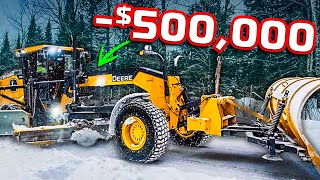
Aaron's Toronto snow-removal business hit $1M in 2022, then tanked in 2023 after equipment debt and insurance costs spiraled. He's weighing whether to exit snow services entirely, downsize, or refocus on cheaper residential work that actually makes money.
Chapters
No sense in having a million dollar business if you spend 950 to get there. There was a lot of debt, like a lot. Skid steer loader, two tractors. We're talking four or five hundred thousand.
I know one thing for certain, and that is if we make this business more profitable, you'll have a lot of options to choose from.
When you're trying to figure things out, you learn a lot of hard lessons and a lot of times lessons cost money. You don't know if you're gonna make it. Some days you don't know if it's all worth it. Like, should I quit? Should I hang it up? Michelle and I split. I was not a happy person to be around.
So, you know, where do we go from here?
Today we're in Toronto, Canada, visiting Aaron from the grounds.
Guys, how's it going, man?
This is a great place you got here, man.
Show me around a little bit.
So it's a thousand square feet out here. It's not huge, but it does what we needed to do before two years ago. This stuff was outside. Like all of our stuff was outside. And you know, diesel equipment, as you may or may not know, can have a hard time in the wintertime if it's sitting outside. So it was nice to bring this stuff inside.
This is the office.
Our. Our own little personal touch. Yeah, it's cool on things. I do want to have a nice place to work at. I did for many years, just used to work out of my house and that's okay until you get obviously to a certain point and then, yeah, you kind of need a little bit more. I love coming here to work. I really do love this environment. Like right now, you know, we're south facing, you get the sun coming in here. It's nice. I like it. I enjoy it.
You've been doing it like 15 years, right?
I've been in it for 15 years as a franchisee. We're coming up on our sixth year. So I had the silly idea of franchising my business, which is laughable because there was no business to franchise. Didn't know the first thing about franchising. Literally just did things by the seat of my pants, as bad as that might sound. So I actually called them, really just siphoned information. We were on the phone for about an hour and a half. And the first half of that call was me just writing down all the. He was giving me all the answers to my questions and I loved it. I'm seeing how much money and how much work it would take for me to franchise my business, which again, there was no business to franchise. And I just really started to buy into what they were bringing to the table as far as the systems and the software and the structure that I was totally lacking. So all the things that they were bringing to the table just started to resonate with me from when I came into franchise here at the Ground Skies. I started in May of 2018 and that five or six years like you come to now. Like I definitely a lot smarter following your content for a year or two now. So I love what you do. And we have our franchise business coach that really helps us too. Right. So I needed all of that because I was literally, let's just wing it and figure it out. Which probably not ideal and I certainly wouldn't recommend it.
Before that you were working at a casino?
Yes. My background is 13 years.
Wow. Was it like security? What were you doing there?
No. Table games started when I was 22 and I left in 2012 and I had started my business in 2010. The 13 year career that I had in in the casino industry was really all I knew and I enjoyed what I did at the casino. But I remember one day, I know I was supervising a dead roulette table. I remember sitting there and the roulette table was dead and the wheels going around. No one's playing. There's nothing going on. And that's when I just started doing the math. I'm like, now how long have I worked here and how much money have I made? And I start kind of doing those calculations and I'm like, I still have like 32 years before retirement's even possible. And I just started thinking like, I can't be here for 32 years. I want more. I want something else. So in my last year at the casino business, I dropped down from a supervisory position to a part time dealer position just to start focusing on my truck and a truck experience.
Yeah. Why lawn care?
It's such a funny question because I've had friends ask me that. Yeah. And the answer is pretty silly. I chose landscaping simply because I don't have a college education or didn't have any real passions, no real skills. So it was something that I could start with my limited credentials. I knew that it was something that I could start with. No skills, no nothing. Like I have no trades, no nothing.
Give me kind of the breakdown, say 2017, kind of what that looked like.
Prior to 2023, we had six years in a row that were best year ever, dating back to my last year. As I'll call myself a chuck in a truck. In 2017, I had no employees, two subs and we did 180,000 with no employees. I was ecstatic. Over the moon. I ended up landing three dealerships in a row, which sent us from I think it was 120,000 to 180,000. Then I'm coming into the business that was part of the big learning curve for me because, like, I felt like a real jerk when I first came into this. And they're asking me, well, how's your P and L? I didn't know what P and L meant. I had to stumble. I'm like, oh, profit and loss. And they're like, yeah. And I'm like, well, I've never done one. And then they were like, how do you know how much to charge? And it's like.
50 bucks for that long. And I literally, what they call, rolled in an existing business of 100,000. So I came into this brand with 100,000 in existing business. And then in year one, I think we went to 350. Then we went to 550. Seven fifty, a million thirty. So you can see those kind of increases, which was great. 2022, we did a little over a million in revenue, lost a couple big municipal contracts. So I knew we were coming into 20, 23.
Down. But I mean, I know I've heard you say it a million times, like, growth sucks cash. And it did. Like these investments were huge. There's no sense in having a million dollar business if you spend 950 to get there. Like to me, that's not a great business. Not very sustainable, I think. I think I had two trucks and no machines. I was like, there's a heavy investment company. So it was this, this. It was two tractors to the tune of $257,000. And the payment on that equipment was five grand a month. And I was freaking out. So there was a ton of debt. I was still paying the skid steer. Now you've got skid steer loader, two tractors. So still had two trucks, both had payments. So I mean there was a lot of debt, like a lot. We're talking four or five hundred thousand.
As Aaron has grown his business year over year, he has had to acquire more and more debt. In this case, he was able to leverage the loans that he took and grow the business. However, every single time you take on debt, you're increasing the risk to the business. A bad job, unexpected cost, or even just a lack of work could send the business spiraling.
Once Insurance found out what kind of contracts we were getting into. Our insurance just ballooned. We used to pay 7,500 a year. Then it went to like 30,000 a year. Then from there it went to $90,000.
We're paying $90,000 per year for insurance. That's almost 20% of his annual revenue.
There's the trajectory of how we went. And then of course, tail end of 2022, I knew that we were losing a couple of those contracts. So we actually dropped about 500,000 in revenue. We struggled this summer. This year we pretty much just needed a two man crew. Two, three employees, struggled, had eight, nine people come and go for that. Ended up finishing the season myself, me and my wife. Which brings me back, you know, 15 years ago when her and I first started 2022, we ended with just over a million. 2023, we ended at six. You know, you don't, you don't know if you're gonna make it. Some days you don't know if it's all worth it. Like, should I quit? Should I hang it up? Should I just go back to my job and not worry about any of that? You do have those, those struggles and some don't make it. Michelle and I split because I was not a happy person to be around. And she wasn't working at the time. She had quit her job to come with me. I was like, oh, everything's gonna be great. You know, that got so stressful. And I was so stressed. Like we were apart for four months, so. So we made the decision to try to save the relationship. It was, you know what? I'm not a happy person to be around because of what's happening in business. She wasn't happy because she wasn't working. So the two together just was real bad. So we agreed that she'd go live at the one apartment that I had. So we were four months apart. And I knew that was either going to save the relationship or it was going to let us know, like, hey, we actually like being apart. So you go your way, I'll go my way. As I've been doing this for 15 years and really hardcore for say the last five or six. It's not about the top line anymore. I mean, it is, but it's now more important for me figuring out that bottom line, how can I do less but be more profitable? And snow. It's a requirement here, right? We need it. It has to happen. But I don't enjoy it now as I'm getting a little older. I would really like to start focusing and channeling on things that I enjoy versus things that I have to. So now I'm asking myself, I'm gonna be 47 in two months. Here I am doing things that I don't enjoy.
There's certainly something to be said about doing the hard work despite not enjoying it. Whether or not you enjoy it doesn't make a difference. The fact that the work still needs to get done. But for Aaron, he's been doing this for 15 years now, and he's proven to himself and all of us that he's able to do the work even if he doesn't enjoy it. So the advice that I give Aaron might not be the same advice I'd give to someone that was in year one, two, or three when I just tell them, look, you got to get comfortable being uncomfortable.
How do I take a step back but still provide for others? And what does that look like? Does it mean that I get out all together and go a subcontractor route? I don't know. Maybe. Does it mean we get out of snow altogether? Because again, if I have to spend 80, 90, 100,000 in insurance, that's a lot of revenue just to pay for that. If I get out of snow altogether, that's going to drop to probably 20 grand.
You want to go in the office maybe, and we'll take a look at some of the numbers and kind of look at what the restructuring might look like.
So October is a big month for you because that's when you sell all your snow contracts, I imagine.
Yes, and that's if I'm going to restructure and if we are going to get out of snow, then what does that look like, and how do we recover that? Because it would be a big. A big drop. We came down 400,000 in revenue, probably 300,000 in snow. So our business essentially came down 40% year, yet our insurance came down 10 or 20,000. So it's not real relative.
It's really based on the service you have, the equipment you have. That's what they're looking at.
And just the type of snow that we do, the type of clients that we have, you know, you throw in any municipality, your insurance is not going to be on the low side because they know if there's damage of any kind. Like for us, for example, York Reach Police. Okay, well, if you have a problem there and you hit cars, you're not just taking out my little Ford Focus.
You're.
You're taking out cruisers. Right. So there's a lot more we used to do gas stations as well. I noticed a big jump when we said we started doing gas stations. The admin buildings, like they're very, very high profile counselors and mayors. That's where they go to do their business. A lot of foot traffic. As soon as you mention anything snow related with liability, it's almost like that's a reason that they're just going to give you Whatever price problem too for us is like if you go and call for insurance on your car, you can probably get 20 prices today. Whereas we use a broker. We go to 23 companies every single year. And every single year it comes down to the final couple weeks to know whether I even get insurance or not. Because of 23 companies, we'll get maybe two or three numbers. Maybe the year it went from 30,000 to 90,000, we had one number.
And you're stuck.
So when that came in, it was like the massive increase in the insurance. Your thing was like that. Just scale this. And that's when he went 6, 7, 8, all the way up to million plus.
I think it was around the 7 or 800,000 mark is when that jump happened. That was really difficult.
I guess my concern with trying to cut the snow right now with it being two thirds of the revenue is really just can the other one third, even if we grow it, sustain the fixed cost that we have.
Yes. So and thank you for mentioning because I was going to mention that that's what I experienced with that huge insurance jump was okay, well all our costs are the same. And now that just ballooned. And then when we dropped in revenue at the time, we still had all the overhead expenses. Yet in the last one to two years, I've managed to get rid of about six or seven thousand per month in payments. So like all of that equipment was paid off, the skid steer was paid off. This past summer we paid off two trucks. In the last five or six years, we're. We're talking four or five hundred thousand we've paid off. So it was a struggle and I would do things maybe a little differently.
That sucked every penny.
It did.
It's like the loader, for example. What's the payment still remaining on that one that's paid off. Oh, that's awesome.
That the two tractors, the skid steer and two trucks are now all paid off.
With the equipment and trucks paid off, Aaron is in a unique position to sell some of his assets to facilitate moving away from snow plowing and transition into more simple services. This transition will allow him to build A more sustainable business without him having to be so involved in the daily operations.
If our future involves no snow, yes. There's about $250,000 worth of equipment that I don't need. If we stay in the snow game, you gotta have them.
What part of the snow do you not like? Because my thought is if you're paying off all this equipment, I'm assuming this year, some of them like you finish the payments, etc. Is it going to become more profitable going forward now, or is it more matter of, like, quality of life? Like, this is something I just don't enjoy doing.
It's both. It would certainly be more profitable now with things being paid off for sure. But, I mean, that's how we sustained that $400,000 drop that had to happen. Otherwise, if I still had seven or eight thousand dollars a month in payments, I don't know that we. We'd be here right now. Right.
But there's really not the desire to go back to the million plus with the big contracts.
No, not really. It just started wearing on me. I guess the time that I worked really started getting more difficult as I got older. I know my wife and I, we've always wanted to be somewhere warm in the winter, so that's definitely motivating as well. Yeah, just a better quality of life at the same time. Still striving for that next level.
Your prices for simple services must be really good in terms of you're making good profit.
I think so.
Because just based upon the numbers of you being able to pay that much debt off in the course of five years, I think your pricing based on just knowing that stuff is probably pretty good for your mowing and it would be fine to be able to still be closed for a few months.
Something else that I could mention, I reached out to a gentleman who started his own mobile detailing. Saw his ad on Facebook or whatever. So we got together, did a couple of our trucks. I like him. And then I asked him what he did in the wintertime. He's like, well, I. I have to shut down. I said, well, would you be interested in. In sharing space here? Like, well, you know, what does that look like? How much? So I gave him a price and he really liked it. So it would heavily offset my costs. Here could work for him. We could share shop space there. Again, especially if we get out of winter. That truck's not there, that loader's not there. He has space to work. I love coming here to work. I really do love this environment here. It's Nice. I like it. I enjoy it. I don't need it. And, you know, there's 30,000 a year that I probably don't have to spend if I wasn't doing snow.
Can I write on the whiteboard real quick? I just wanted to say thank you so much to everyone watching the videos.
All these turnarounds that we go out and fly to, and all that's covered.
Is completely free to the owners. And that's made possible by everyone supporting what we're trying to do. And if you'd like to support us, down in the description, there's links to all the different products and services that I sell. Trying to help you grow your business, because that's really what makes it all financially possible for us to go to these trips.
So thank you so much.
Every person that watches, subscribes, and supports the channel. Let's say we pull the band aid off, our insurance is gonna go from, what, six, seven grand a month to two or three, you think?
If we're not doing snow at all, I'd be very surprised if it's 25,000 or above that.
So probably 5,000 in savings just from insurance per month.
Yeah.
Then we rent some of this out to somebody else or move away from it entirely. Let's just call that an extra savings of $1,000 in rent. Then we got the fact that, like, maintenance on these big pieces of equipment, all of that is probably, I would say, at least a grand or two.
Grand a month this year, for sure. Like, we knew that this year we went full service. Tires, the machine was five years old. We never changed the tires before.
Just say a thousand bucks. So this is where it's like, okay, we're literally going to save $7,000 in straight overhead every single month. The fact of the matter is, to cover this $7,000 in overhead at 20% margin, we need to be creating $35,000 a month in revenue just to cover this. And so if I have a decrease of 35,000amonth in revenue, I don't really care if you, as long as I can kick this out. Either I grow by 35,000 and pay this, or I don't pay this, and I just go reduce my size of business. When we look at this, this is like, basically the cut we're looking at. Can we go down from 600,000 to, you know, 200, 250,000? When we look at the drop and.
Call this a nice little benefit, We've never really pushed anything. We do not do a lot of marketing. Nothing. Like I Think it was a bit of a mistake. We were really just commercial and municipal focused. And I think I was a little naive and maybe a little overconfident. Our coaches do kind of push what they call the low hanging fruit, which is the residential. And it is, it is. The majority of our requests is residential, simple residential services.
There are many benefits to joining a franchise, in my opinion. One of the major ones is having more eyes on your business and getting a community around you of business owners that are all using the same systems.
And for the first, I'd say three years, I pretty much turned them all away. If I show you our leads just from say, April till June, we have lots. I could push that big time. That's why I do think that we can go to 2 or 300,000 because we didn't push before at all.
The simple services, like, makes a lot of sense because if you got leads literally sitting there or like they're coming in, pull pretty organically. If we can actually push that and actually have a strategy around acquiring them. I think that's the part where we don't know what your customer acquisition cost is because we've never actually tried to go out and advertise. I can tell you, oh, you do.
On the low end, it was $55 per customer. On the high end, it was 85.
So in that regard, it's a matter of like, okay, we literally have a couple hundred thousand dollars of equipment that could be liquidated at the same time. We cut all our fixed expenses, and then we spend a fraction of that going towards the marketing. And let's just say $100 to be safe. That's literally $10,000 you would spend to get 100 customers. 100 customers at 200 bucks a month. There's your 20 grand a month.
In order to turn the business around, make it more profitable and increase its quality of life, Aaron needs to simplify services, cut out snow, and really make the simple services of mowing, property cleanups and little projects very, very profitable.
When I know that, okay, we have a bunch of leads for mowing. We know what our customer cost is, is under $100. And then we just look at the math of what the revenue per one of those customers is. I have a good feeling. If you were able to actually sell the equipment, let's say it's 200 grand. We spend 50 grand of that on marketing, advertising, and potentially having to get some more equipment for the mowing side. That other 150 grand is going to literally be your cushion for the next two years. If you took this $5,000 in insurance that you're paying right now and put that towards marketing, lawn, landscape, simple service stuff, I think within a year, you. You are at this size of business, no problem. And if you kept spending that kind of money on marketing, you would easily be able to scale back to a million. And I know that you have the management experience to be able to handle that size.
As I'm sitting there contemplating things, these are all things that go in my mind. Well, if I. If I have this kind of capital, I mean, When I started five, six years ago, I literally had 40 grand to get it off the ground. It was that or crash and burn. And it worked. So, I mean, now with the experience that I have, the knowledge that I do have now and capital like that, to me, it's like, there's no way that we won't make this work.
And now you're going to take a vacation in the middle of winter instead of worrying about all this stuff.
And that's what I want.
Go ahead. If you need to take some.
It's Michelle. Let me just see.
Hey, babe.
That was just Michelle telling me she got her job. She was with me when I had nothing. Like, I remember our first couple dates. I had a car that had 500,000km on it. I had to stop and get gas. My door wouldn't open, so I had to get her to get out so that I could get out and get gas. Someone that sticks with you through stuff like that, like the struggles in business, the car that I had, that says a lot. So I think even though we don't agree on a lot of things, we both definitely agree on being somewhere else for the winter, 100%. So now if I can figure out how to do that, even for a month or two in the winter time, just break it up. That'll just make our relationship even stronger. Like, we used to be landlords. And this is something that I should tell you because I know that you're involved in real estate, too, but that is also. Also another motivator for me is I need to build this thing back up to a substantial point because I do want to get back into real estate, and this has to be the vehicle for me to get there. Like, I don't have, you know, family money or anything like that because. Because our coaches and I love our coaches. Our coaches are great. I've learned a ton because I knew nothing. But when our coaches talk about 10, 15, 20 growth, I'm really just rolling my eyes because that, that doesn't do anything for me. I need those 2, 300,000 jumps. I do.
If that's the goal on the North Star, this is like the first unlock from just a time perspective to make that happen. Then we figure out the financial part of it. I haven't even like asked about pricing for summer services. I know you're profitable on that. You have not one time mentioned the.
Day I make so much money on.
Snow plowing and rolling it in. Because that's not what's important to you. The part that's important to you is getting away from like the golden handcuffs to the snow plowing so you can go do the stuff you want.
Absolutely.
So it's okay if at the end of 2024 you sell the loader, you sell it and you do go into that savings, a bit of 20, 30, 40 grand that you lose during that winter time. But now you don't have this. You paid off the other truck. Your fixed expenses are so low you'll be able to get through with 40, 50 grand come into spring the following year. And now you're really going for it because you figured out what works in 2024 in terms of advertising. Probably have yourself a crew leader or manager. That's why I think 2025 is going to be the year you go to a million. That's when you'll crush it.
So now I just want to take it to a step further. I am thinking of more than one location. Think it would maybe come down to one the numbers to an individual. But at what point do you think it would make sense for me? Is it 25, 26, 27? Because I am an opportunist. Like I do want to grow. I do have a, you know, a large goal, if and when it happens, of 10 million in business. How do I, how do I get there? What is the. That look like?
The new shiny object syndrome is alive and well with most entrepreneurs. Trying to do real estate and trying to do all these other businesses isn't going to actually make him more successful right now.
I know one thing for certain and that is if we make this business more profitable, you'll have a lot of options to choose from. Right now we don't. We're tied to these pieces of equipment, we're tied to these service, we're tied to these contracts. That's why it's like the only thing that really matters is this location and like making this one profit because as soon as you do that, it just unlocks. You have so many options and yes.
It's been 15 years.
And what happens? You get burned. Like, okay, maybe it's just the wrong industry, or I should do something else, or like, it's my location or whatever. Just figure that one thing out. Because when you do that, then you move on the next thing, and then all of a sudden, the dominoes start falling, and then you all of a sudden do wake up with a $10 million business or a big real estate portfolio. But that doesn't happen by trying to focus on all those things at the same time.
Think of all your energy and attention as a light bulb that lights up an entire room. But really, when it comes to business, focusing all that energy on one thing, like a laser, has much more impact and typically leads to making a lot more money. In fact, watch this video here where I spoke with the owner of Mr. Sudsy, a soft wash company where he had the exact same issue and was trying to split his attention in a hundred different ways.
It gets a little bit crazy.









