✅This LANDSCAPER Made $300K Trading Stocks! 📈 [how he did it]
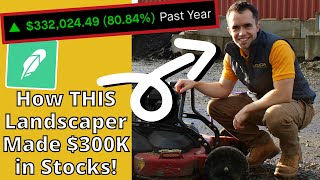
Mike Andes (a landscaper and founder of Augusta Lawn Care) presents a YouTube walkthrough of his Robinhood account and explains how he made about $332,193 in gains over the past 12 months—roughly $200k of which occurred in the most recent six weeks. The transcript chunk shows: his portfolio hit about $669k before dipping to ~$538k; about 3% of his portfolio is in crypto (Bitcoin/Ethereum); he bought a small amount of Dogecoin (~$3,000 at ~$0.30); he uses disciplined investing principles (diversification, long-term belief, only ~20% of portfolio used for swing trading); he trimmed ~15–20% (~$150k) in late April to take profits and later used cash to buy the dip, netting ~ $80k from a swing trade. The clip includes on-screen order lists and holdings (many tickers named) as evidence.
Hey, everyone. I'm Mike Andes. I'm a landscaper. And today I'm going to show you how I made over $300,000 in stock market gains in the past 12 months. And in past six weeks, 200,000 of that actually came. Before we get into the show, though, a big thank you, today's sponsor, which is Gusto, if you have employees and do want to do automatic payment directly into their account when you do payroll, check it out today for 90 days. Try it out completely free. Go to gusto.com.
Now. This is not clickbait. This is not me trying to get you to click on this video. I'm going to walk you step by step, show you exactly what I invested in, show you the numbers, and actually show you Robinhood, the app where I made the money and how I did it. So let's get learned. This is not going to be a video with mowing. It's not going to be anything to do with landscaping. But I want to prove a point, and that is this. If you feel like you're stuck in the world of landscaping, maybe you're just an employee right now and you're just getting started. You just started pushing mowers last week and you're maybe you work for Augusta Lawn Care, the company that I started, and maybe you're working and just got started. There's absolutely a way to grow your financial education and grow your financial wherewithal and grow wealth for you, your family, and for your future. So let's go ahead and jump right into it because I know you came here to actually see the numbers and not just the headline. So let's open up the Robinhood app. So I'm going to open up my phone here and I'm going to show you exactly what I've been investing in and what, what the gains have been. So over the past 12 months, as you can see here on the side, I'm going to pop it up here. The total gains have been $332,193. Right now, it's 1008pm so the reason it's still moving is because Bitcoin and Ethereum and my other cryptos, they do trade 24. 7 less than 3%. About 3% of my portfolio is in Bitcoin and in Ethereum and cryptocurrencies in general. So it's not very much. I've only recently got into it on the big dip. But let's really go through this. So this is the one year chart, but let's go ahead and look at some of these ups and downs. And this is the part that I feel like so many of us getting started. Why we lose money in the stock market and why we think it's just gambling is because people, when they're hearing about how great the stock market is and how much money people are making, that's when they start to invest. And then when things are going bad and it's on the news that the Dow is crashing and the Dow lost a thousand points and everything is going away and all this fear is in the marketplace and there's inflation, all the rest of it, that's when they sell. So I want to talk about being a disciplined investor and what I did in the past 12 months that hopefully you can learn from. So what's really difficult though is having discipline. When for example, here our total portfolio value is 669,000 and just a couple weeks later it was down to 538,000. Literally lost $120,000 in portfolio value. And yet you gotta stay in the market. I still remember when I made, when I first started really getting dedicated to the investments and in my stock portfolio I had like $70,000 worth of total gains that I ever made and that went all the way down to 20 and I almost pulled out 100% of my money and said, you know what, forget this, I'm not gonna do this. This is just bad for my well being. I'm gonna lose sleep over this. And at the end of the day I had to come to the grips of the fact that I'm not going to invest any money, that if I lost it all that I would lose Sleepover. So that's really the moment when I was like, look, I'm gonna stay in the market. I know these are the companies I believe in, but I'm not going to invest money that I'm going to lose Sleepover if I lost. But I want you. The reason I'm showing this is because I want you to look at the long term mindset it requires and the belief in the companies that you invest in. So April 26th, 27th, right in here, the portfolio value is like.
691. Okay, well, literally a week or two later in May 13th, it's 544,000. So we literally went down again $150,000 in portfolio value in literally a couple weeks. That takes some real guts to stay in the market. So how do you do that? Couple things. Number one, you've got to have long term belief in the companies that you're investing in. I have not invested a single dollar in GameStop in. What's the other one? AMC, any of the meme stocks. None of them whatsoever. And the reason I haven't is take that back. I did have some investments in Rocket Mortgage. It spiked up to about $37 per share. And I sold because I realized, hey, this is the mean game. And fortunately I sold the right time because it crashed literally the next day down, back down 20. It's gone. And it's been fluctuating around there for now. But besides that, because I invested in Rocket far before it became a mean stock. But when it went that high, I sold. But I didn't use amc. I wasn't even in Tesla until the re in the past few months when it dived. I did not write it up from a lot of people. Look at my portfolio of the past year. Like, oh, there must have been a stock that just rode to the moon. No, I never any point had any one stock that was worth More than 20% of my portfolio and that was Amazon for a short period of time and even Amazon now is about 10%. So I have a pretty diversified portfolio. And Tesla I only recently got into. And there hasn't been any stocks that I've tripled my money on. Haven't had it yet. All right, so long term, belief in mindset in the companies that you're investing in. Disciplined trading. When everyone is saying, buy, buy, buy. This is the best time. The stock market's doing really well and everyone's like, get in, get in. That is the time to sell. Cause that is when hogs get slaughtered. When everyone's getting in, that's when I usually get out. I'm going to show you kind of what I do with my portfolio to kind of make it where I do take this money out. Because I need this money to be able to keep running my business and keep growing. We have Augusta Long here, the franchise with 40 locations. It loses money every single month. I need to be able to pay for that. And the $2.4 million headquarters that we're trying to build in the next year and a half is going to be funded by this. So how do I do that? I've got to actually be able to take money off the top. So how I'm doing that is I'm usually swing trading about 20% of my portfolio. What swing trading is when I. When it's really high, you try to sell it. When it's low, you try to pick it back up. And that swing you can make some difference. You can make some money on that. So I'm gonna talk about that and actually how I use it to fund the businesses. Cause we haven't had to take out debt, we haven't had to take out a bunch of equity. Even though the business still loses money and is growing very quickly, we've been able to keep the equity and not go into a bunch of debt by using this strategy in the stock market that I've been trying to be disciplined on. It's not easy. It is not easy to, to be buying Tesla and buying AMD and buying Enphase when they've crashed 30, 40, 50% in the past two weeks. And every single news pundit is saying that everything is going to zero. This technology, it's gone too high, it's overvalued all the rest of it. You've gotta be disciplined and you've gotta ask yourself, will this company be around in five years? Do I believe it will be a higher value in five years? If the answer is yes, and you don't have any short term obligation to sell those stocks, why would I not be buying? Okay, so I want to show you though, in the past six weeks. So from May 13, let's see here, 544,000 was the portfolio value. Literally. Now, six weeks later, we have $199,000 worth of gains. So about $200,000 worth of gains in the past six weeks. If I actually zero in on that, it was a little bit lower than that number there. So it's a little. Actually over $200,000 in gains in the past six weeks. How do you do that? You invest and you put your money in when everyone is saying it's going to zero. When everything is bad and ugly and there's fear in the market, there's fear of inflation and things are completely oversold. And companies that you believe in, you know, the fundamentals are there. You know they're gonna be growing massively in the next five to 10 years. You believe that the future is moving towards them. Why would I not invest in those companies when they're on sale for 30, 40, 50% off? Literally the reason you buy stocks is when they're cheap. It's like when you go into a store and you're going looking for a sale, you're like, hey, I want to get the highest price. The thing that you've marked up and you're getting a really good margin on, I want to buy those. No, you're looking for the discounts. So why is it when it comes to stocks, we always buy when it's the most expensive and we sell when everyone's afraid and everything's on discount. It's the opposite. It's complete reverse psychology. But it's not easy. It's not easy as an investor to be doing that. Alright, now I want to actually dive in and show you the orders because anyone can take this and photoshop it and make it look pretty. Now I'm going to show you the actual orders that I've had over the past 30 days to actually prove that this is exactly what I did. So I want to first show you that over the past little while. And keep in mind, recently bitcoin has dropped over the past six weeks or so. Bitcoin, Ethereum. And I actually bought a little bit of Dogecoin, just a few thousand, but I bought a little bit of Dogecoin, like halved in value. And then you got to have a little bit of fun in life. You got to have a little bit of fun. I bought a little bit of Dogecoin at I think around $0.20, $0.21. No, take it back. $0.30. $0.30 for Dogecoin, but literally like $3,000. So like less than half percent of the portfolio. But I want to show you the orders because I want you to see what I do. I don't buy massive chunks. I trickle into the market and then I find a time when I feel like things are overvalued or things are getting to the point where I can take some profits and I do. So. Okay, so let's look at the past couple weeks. So last couple weeks, look, if you look at the buys, those are all Ethereum and bitcoin. Okay, so taking those buys away though, let's look at, look at the past couple weeks. June 17. Look at all these cells. Twilio, Neo Lemonade, Ghvi, Piton, Shift Technologies, Redfin, Expi, Pins, P Palantir, Tilio, Salesforce, Envy. All of these are sale, sell, sell, sell, sell, sell, sell. Literally, if you look at that page right there, that's probably like 50, $60,000 worth of selling. All right, now let's go back to the chart and see where that was at. So that was right about here. Okay, so you can see I was about $706,000 in portfolio value and I started selling about 10% of my portfolio. All right, so that was a big sell. I kind of like, you know what time to sell. Just take a little bit off the plate. Take, take a little bit off the table and let's go ahead and sell. But now let me show you when I was buying. Okay? So let's now go back. Obviously there's some Bitcoin, ethereum, stuff like that in there, but let's look here. All right, June 3rd, buying Tesla. All right, we're buying Shift. Now we're going back May 24, buying shift. Buying Ethereum, Bitcoin, when they crashed a whole bunch on that day. Buying Alibaba when it crashed. Buying coin, buying Twilio, buying Tesla. Buy, buy, buy. More Alibaba, more Pinterest, more Enphase. You can see kind of the company, Etsy, Tesla. You know, we keep buying and buying. Why? This was the dip, okay? This was the hardest period of time. Like right in here, the 12th and the 13th when I was doing all this buying. Right. Now let's go back to the chart and see what was happening. This is where we were at the worst period of time when everything was falling apart. You cannot go on CNBC without seeing that the world was falling, the sky was falling, everything was bad. Tesla was a horrible company. All the rest of it. But it's very hard when you hear that, all that negativity to be doing this. Buying the dip. Gotta buy the dip, baby. Amazon, Expi, Lemonade, Palantir, Expi. This is all in the worst trough of that market. Okay? We keep going. And if we keep going all the way back to. You can see I was trickling in. I'm not ever buying 15, 20 thousand dollars of a stock. I know it's winners. I know the company I believe in for the long term, and it's very disciplined. If it's going down and it's dropped below 20%, I'm buying. If it keeps going down, I keep trickling in. I never go all in because it could keep going down. But great. I get a deep, I'm happy. Like, you kind of got to force yourself to be happy, but you're like, great. Things are going even deeper on sale. I'm gonna keep going in. And you know, again, if you believe in the company long term, that's what you can do. The problem is when you're doing in a meme stock or in some stock that just like random that you heard about to just keep pouring money into something that's going down without having fundamental analysis of why you know that stock is gonna come up and why it's undervalued. When you look at PE ratio and when you look at the actual ratios that matter when it comes to pitch stock pick stock Picking stocks here. Buying, buying. All of this is buying. Not a single sale for like six weeks here. Twilio, Expi. Pton. I got into Peloton finally after it went way up to like 170, 180, sold off. It was way overvalued. Then it came all the way back down, though. Hey, I'm going to buy it at 80, $90 a share. Of course it's 50% off. And I believe in Peloton. Peloton just bought one of the manufacturers of the gym equipment that I use at my gym. And. And Peloton's a massive competitor to my gym. You don't think I want a little piece of that action? Every single one of these companies, I understand what they do, I understand what they sell. And the companies in the past that I have bought that I don't understand, I don't understand their fundamental analysis, I don't understand their leadership team, I don't understand their profit and loss statement. I haven't looked at their financials. Those are the only companies and there's two of them that I have lost money on in the stocks market. And I. Every single time I get into it, you know what, I'm just gonna do it like this looks good. I don't want to miss out on this. This is gonna be revolutionary. And those are the companies I did not look at. The financials that I do not believe in for the 20, 30 year. Long term, those are ones I missed out on. But all of this buying, buying, buying, buying. Apple, all of these companies, Pinterest, this is going back May 4th. Now all buy lemonade, Etsy, Ghvi, Palantir, Micron, Facebook. Bought a bunch of Facebook back in here, all the way back, until you finally start seeing me doing some selling price action on, let's see here, April 26, right here, this is the last time I was selling. Okay? So right here you can see I sold off a little bit of everything. Kind of what I usually do is I do like a 10 or 15 or 20% trim of just all my portfolio. All right here, this is the 26th. Even if you go all the way back to the 23rd. Look at all the selling action all on the 26th there, right? Sold. Even Tesla, which I believed in a bunch. But like all selling all the way back to the 23rd here. Okay, now let's go back to what was happening on April 2023, or, sorry, 26th, right there. It was at the little peak there, right when I got to the point, you know what let's take some profits, because I know what happens. This is. I said four or five months ago, if you go back into February, March and April, you heard me say, I believe over the next four to six months, we're going to have a very choppy market. And look what happened. We had ups and downs, ups and downs. So I'm not going to ride no diamond hand things when I believe it's going to be going up and down because of fears of inflation. I said that March, April and May were going to be crazy in the stock market because of the fear of inflation. And I think it's going to be transitory. Well, look what's happening, all right. It's going up now. And the reason for that is because the fear of inflation and going, you know, massive inflation is going away and we're seeing the market respond. But what I also knew is that I still held my thesis on April 26, that we're going to have a choppy market. I'm not going to die in hand. This stuff I'm going to take, I think about took about 15 to 20% of my portfolio off the table on that day right there, April 26th, April 27th, I sold. Why? Because I took that same money. I sold about $150,000 worth of stocks on those few days there, the 26th, 27th. Did I know it could have very well kept going up and then I'd be a fool, right? No. I knew that that was what I needed to do. Take the money out where I felt comfortable and wait for the next dip because I was very confident that it was, we're gonna have a choppy market. What happened over the next couple months, that's when I spent all that money on May 10 to May 16. Right in that trough is where I was spending all the money that you saw there. Discipline, investing, buying. When everyone hates the stock, when everyone is saying you shouldn't buy it, when it's way down in price, that's when you buy. And when everyone's getting in and when it's going up 10% one day and then 15% another 20% the next day, that's the time to sell. Take a little bit off the table in this one swing trade that I did from April 26 till today. So what is that? April, May, June, two months in the past two months with that, two weeks of absolute fear and agony of dropping off, and then the recent rebound. In the past six weeks, I profited about $80,000 with the swing trade by putting a whole bunch of money in and then taking the money out, about $80,000. Now, is that time in market? Yes. Is that what you should be doing? Not with your entire portfolio, but with 20% of it. I use it as a way to actually move in and to put money back into the market. If this keeps going up, I'm going to leave it. And you say, well, that's crazy. You sold on the 17th right here, and it's gone up since then. You're right, it has. But guess what? If it ever goes back way down, it has a massive 20, 30% for sale. I'm going to have the cash to go shopping. So you have to be disciplined. So all of this to say, if you're doing landscaping right now, if you've held with me this long, I really would recommend a few things. Number one is get involved in the stock market investing, most importantly, investing in yourself, and then secondarily investing in assets like stocks, bonds, real estate. And it doesn't have to be a stock. If you enjoy real estate that you're passionate about real estate, go for that. In the past 12 months, I've also purchased eight other real estate units doing the same thing. But it all comes back to this, and that is educating yourself. I could not have struck when the iron was hot in April and April, May of 2020, when everything was crashing and everyone was afraid. That's when I went all in. That's when I knew fundamentally the stock market was gonna come back. When the Fed stepped in, that's when I went all in. But I could only do that because I had educated myself for years. Literally six, seven years of really in depth study. Online courses, podcasts. You know, people talk about online courses and, you know, books and audible books and like, oh, it's so like, you know, airy fairy, whatever. Guess what? That six and seven years of preparation. Listen to audiobooks while I was mowing, you know, out there mowing. 11, 12, 13 years old. Mowing lawns 18 years old. Start Augusta mowing lawns 12, 11, 14 hours a day. Sometimes. Mowing lawns in your ears was not music in my ears, was either sermons or it was literally listening to audiobooks, podcasts, and online courses about real estate and the stock market. And I didn't really capitalize on that until the past couple years. But this is the biggest takeaway. Number one, you don't need a million dollars. You don't have to have a million dollars to get started in the stock market. I invested 101,000, 2,000, 3,000 over the past five years. It wasn't until I felt like I was so educated and knew what was going on. I had tracked companies for a long enough period of time to really go all in one. Last year, in spring of 2020, when everything crashed, that's when I was able to get in on the companies that I saw as a bargain. That's when I jumped in. But I could not have done that confidently. I could not have taken all my savings and dumped it into the stock market, into real estate, at a time when there was so much uncertainty. If I had not been educating myself, if I hadn't been putting a little bit of money into the stock market to actually educate myself. Cause I find time and time again, people will not do the work of educating themselves on stocks and real estate until they actually own that asset class. So go buy yourself a little bit of Amazon, go buy yourself a little bit of Apple, and just start to look at their financial reports, listen to their quarterly reports. Yeah, they're boring. Yeah, you got to listen for an hour or two hours. But you're mowing a lawn, you're getting valuable information about market trends, what's happening geopolitically, what's happening in the economy on a macro level, what's happening with inflation, what's happening with supply chains. These are all things that might seem foreign to you. But if you're mowing, if you're doing landscaping right now, if you're in any job where you can plug in your headset and work and make 15, 16 bucks an hour while listening and educating yourself, it's incredible. You can literally get a college education without paying tuition and make money at your job while you're doing it. And I just cannot overemphasize. You've got to take the time to learn, never stop learning. And if you have busy work, like mowing lawns, and that is a great opportunity to start learning, and it might be five, six years of doing that, stacking money aside, $100 a week, $100 a pay period. Maybe it's $50 each week. I'm going to put that aside. And maybe it doesn't mean you're going to go spend it now, doesn't mean you have to go buy real estate now with $50. Doesn't mean you have to go even get stocks right now. But put that money aside. You know that that money is ready to be invested. So the next question is, what should I buy now? And there's a reason why I put this at the end of the video, because everyone wants to know you, you know. What are you buying now? Well, I'm gonna show you here on the Robinhood app what I am currently invested in. Alright, so I'm just gonna scroll through here so that if you wanna pause the video, you can actually screenshot what I'm invested in. It kinda goes from the top, which is highest conviction to lowest conviction at the bottom. But you can see the companies that I really believe in and some of them are doing well. Some of them I still feel have plenty of room to run. These are companies that I feel like for the long run I can believe in these. The two stocks that I mentioned that lost money are these two at the bottom, Splunk and Sunrun. Those two companies right here, Splunk, you can see here, I've lost 15% and run Sunrun, I have lost 13% and it was uglier. Look at here, it was uglier a month ago. So those are the two companies that I purchased without listening to their annual reports, without looking through their financial statements and without looking at their leadership team and understanding really what they do in the marketplace and their competition. All these other companies I'm up on and I believe in for the long term and I'm really not going to sell them or like go away from them. Something crazy happens. But this is what I've been buying. And so if you're asking me right now, what would you buy now, like as of, what is it June 2025, 26th, what would I be buying now? Well, let's open up my apps here. I would probably be buying things like Etsy, Amazon, Tesla, Enphase, Apple, Expi, which happens to be a local company. So I might be a little bit biased because it's the one public company in Bellingham, Facebook, Google, these are all great companies to invest in. There's still plenty of room to run. But that being said, the past six weeks have been very good for all of these companies. They're all up 20, 30%. So maybe this isn't the time to invest. Maybe you start stacking money aside, educating yourself so that when the next big dip does come, you know which companies you believe in. You, you know which companies are on sale and you get to go shopping. All right, so my next strategy is.
As the past couple months, industrials, cyclicals, oil stocks, these other, they've gotten really hot. Caterpillar, Boeing, all these other industrial stocks and commodity driven stocks have gotten very expensive. They've gone up because of the fear of inflation. Now the past couple weeks they've Been getting taper off because the fear of inflation is starting to slip away that we're not gonna have 10, 15% runaway infl. That's why these growth stocks that I invest in more in terms of technology, have been taking off. That being said, now I'm gonna go a little bit more conservative. I'm gonna buy into companies if and when these cyclical stocks go back down, which they will because they're right now, they're priced to perfection. They've gone up so much in the past two to three months, they literally priced for perfection if they go down. And there's a rotation of institutional money from the industrials and the cyclical stocks and restaurants and airlines and all these companies that have were beat down and have come roaring back and are now priced to perfection with a bunch of debt underneath their belt. If they actually start coming back down, I might move some of my money, probably 15 to 20% of my portfolio out of growth stocks and into the industrials to balance out my portfolio as we start to ride the waves of what's going to be some pretty crazy economic data over the next 12 months. That's my strategy. And at the end of the day, all of this is being said. Not to brag, not to gloat, not to say, look how much money I made. That is not the intention. I have been very, very disciplined in the past nine months to share every single month how much money my companies do. And a big piece of why we can lose money every single month at the franchise without taking debt or outside equity is exactly what I showed you today. And if you're wanting to take your business to the next level, if your business has now grown to the point where it's predictable profits, realize I did not start investing heavily in the stock market until having multiple businesses, multiple streams of income with other investments that I was very, very safe. I did not start my lawn care business and then the next year start investing in the stock market. No. I started my lawn care business when I was 11 years old. And for the next 10, 12 years I was educating, learning, paying for like people bash online courses. I know there's a lot of bad ones out there and I know I sell an online course, but I have learned so much from good online courses. I believe in them. They're a whole lot cheaper. Even the bad one is cheaper than a college education in many regards. If I went out of state tuition, I'm gonna spend 20, $30,000 on a piece of paper when I could spend $1,000 and get 2030 really good audible books. I could look for free, listen to podcasts. I could, I could get an online course. I could learn from someone who's done this, that has a track record, that knows the stock market can teach me option trading, which if you saw me scrolling through there, yes, I do a little bit of options when things really, really go down. I bought options on Pinterest, Enphase and Etsy and those have done really, really well for me over the past six weeks. So bottom line, make sure you educate yourself. If you're in the phase right now where you don't have the money to spend and, and buy stocks or buy real estate, that's fine. Educate yourself, learn, be disciplined about how you're going to invest your money. And that might be five years from now when another opportunity comes around, you'll be ready to cash in on the education and the discipline that comes with financial education. This is why literally in 2022, next year, midway through the year, we're going to be launching a program for our Gusta Long Hair franchisees to start learning about stock market. The stock market start learning about the real estate start learning about bonds and other economic factors that go into investing because as their business grows and as your business grows, you can diversify into other industries. You can diversify into other asset classes like stocks and real estate that can really grow your wealth and doesn't require all the blood, sweat and tears of running a business does. It's down the road and you should not be doing it in years one, two or three of running your business. Those are the years you invest back into the business and make sure it becomes a solid financial pillar that allows you to go into stock market and real estate. I'm Mike Andes, landscapebusinesscourse.com I hope that was helpful. Comment below. If you're investing in the stock market and what your favorite picks are, we'll see you next. Video.









