TOUR: Build a Podcast Home Studio!
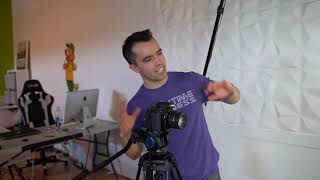
A first-person tour by Mike Andes of his combined podcast and franchisee training studio. He describes the physical layout (former Curves space, ~1,800 sq ft), set design (green stools, 3D wall tiles, Augusta backdrop), audio/video equipment (Shure SM7B mics, DSLR camera, Zoom H4n Pro recorder, ring light, 8TB Seagate drive, DJI drone), acoustics challenges (high ceilings, hard surfaces, nearby train and weight room noise), and operational workflow for recording, editing, and franchisee training.
Chapters
Hey, everyone, it's Mike Andes here. I wanted to show you a little bit around the studio here. This also serves as the franchisee training area. So when people come for franchisee training, this is where we sit. We have the big projector there and we walk through service autopilot, how to do estimates, all the systems and things that we've talked about on the podcast. That's where it all is shown and that's where you sit. So I'd love to have you come sit in this chair, but let's take you a little bit around the tour of the place. This used to be an old Curves space. The Curves used to be a women's gym. I think there's still a few of them around, but they're not doing very well. And so they went out of business here. And so that's kind of the setup. There's about 1,800 square feet in here. This is the bean bag. Got this for my birthday. It's yellow and it matches the Augusta logo as well as our artwork up there. Got a rug down bottom and then snow leather chair to sit around and hang out. People come in here, drop by the office, drop by the studio, can talk there. Josh hangs out here and does video editing on that couch as well.
Over here is where a lot of the action happen, happens in terms of the video recording. So all the podcasts are recorded right here. And this is the setup. So we've got these green bar stools, which I really like. Kind of adding a kind of a minimalistic modern touch to the set of having the grass plants, the white glass tables, and then everything in the background. These are really kind of cool. These are 3D wall. Well, I don't know what they're called, but they're squares and basically just paste into the wall and you can paint them kinda that three dimensional thing, but they're actually just squares. I think they're 24 inches by 24 inch. No, 18 by 18. And then you just put a whole bunch of them up. So we covered the whole wall when we first got here. When we first got here, this whole place was painted like this ugly baby blue. And so we had to do the walls all white and then all along there, the green wall. But here we got. We used these shure mics. I think they're called SMB. I forget the name of these. Oh yeah, SM7B. That's the microphones we use our. This other one here is if we ever have a guest. We do a lot of training with the office Staff. And so Liz or Lonnie are here. We'll do training using these guys underneath us. The worst thing about this whole studio, you're probably hearing it right now is the audio. And so the reason for that is cause because it was a curved space, there's hardwood up above. We have high ceilings, but it is all hard. And then we got walls. And so the sound just acoustics in here are horrible. I was thinking about trying to, like, soundproof this thing. It's not gonna happen. It's so expensive. And we have a train that goes right by us outside the front doors. And so that's what you hear sometimes in the background of the podcast. These mics cut out a lot of it. But literally the weight room for Anytime Fitness is right through that wall. And there's occasions you hear bangs and crashes and people laughing and stuff like that. So not really the best for a podcast studio, but we make do. We got light boxes all around here. So usually it's a pretty distribution for when you're watching the podcast on YouTube or on Facebook. And so we got 1, 2, 3 here, got 1 in the back here. Against our backdrop, which is our gusta backdrop, we take pictures of the franchisees in front of this when they come here for franchisee training. But you can see a lot of people wonder, like, how this all works is that there's this beam in the back here. That's what the big TV is on, and that is what is usually being shown to you as a viewer. This is kind of tight. Where's the power cord? It's all on this beam here. It's all metal. This is where the TV sits so that you can see whatever we're talking about on the screen. But then that also kind of hides this stand here. That's why we put it here is so that way, kind of from the perspective of the camera, you can't see this, but this is where the photo kind of booth is for the franchisees. Now, what we did is we got these cords, the XLR cords from the microphones. We ran them underneath.
Table here, and they come out underneath the mat. And then we tape them and they're going back to where we actually record the audio in the back. But here we got the camera. This is a really, you know, kind of entry level dslr. That's the camera you're getting. So if you want to swing around Josh and get like the whole angle, this is probably what you're used to seeing on the podcast on the training videos from this angle is this camera right here. And that's what you're going to be seeing. You know, most podcasts and things like that, we used to have the secondary camera which is set up over here. But for the sake of quickly editing videos, right now we're just using one angle. So that's where that's coming from here.
Then those audio wires are coming all the way back to the back table here where we are actually recording it. And we use just the zoom. H4N Pro is what they're called. And the reason it has all this fluffy stuff on top is because you can actually record audio directly from here like a microphone and have it directional and things. And we've used it in the past, actually used it to record some audio out in the field. And this is just a wind jam, so that wind doesn't get to the microphone. But it's really cool because it records all of your audio files directly to an SD card. So you can throw this in here, record right directly to the SD card. Makes MP3 files and WAV files, and then you can throw it on a desktop. It's really easy to edit as well as this is just really hardy. Like you can put with the, with the screw there, you can put it right directly onto a mount as well as it's like just out in the field with dirt, things like that. Great. But what's nice, it has two channels. So it's really all we need for the podcast. Like if we got a soundboard, it'd be kind of overkill for the fact that we have usually just one microphone, maybe two. But you do have two inputs here. If you ever did want to have that second microphone, we just basically take the second microphone, plug it in and we're good to go. We can also do a live audio recording, which we used for the recording of zero. Turn the audio book, which can go directly into the computer and we actually see the waveform of the audio as we're recording it in the back here I got my old, old laptop, this Mac here, this MacBook. It's a 17 inch MacBook. You can't actually get these very frequently anymore. For a while they didn't sell them. They only had the 15 inch. This is from 2009, my first laptop ever. And it still works. I rarely use it cause it's a little bit slow now these days, but it still works. And I use it for really, if I'm just wanting a trackpad, I don't know how I use it. It's really not needed very much. Anymore, but it's still here. It's my first laptop ever and I just have one stickers to make it look carbon fiber. This is where this computer here, this Mac is used for the recording of the podcast as well as showing what's up on the screen in the recording studio. So being able to see, you know, have the logo up there that's all projected from this computer here and then goes up on the screen. So sometimes you'll see a slideshow up there as well. And that's all being done from this computer back here. We also use Audition, Adobe Audition to actually edit the audio files, put them up on the podcast. This is kind of a podcast computer here in the back here. We got a workstation here. Then the future Josh or someone else will probably end up using. But for now I use this for our what I call the 12 week year. It's a book I just read. It was referred by one of our employees at Augusta and he had listened to the book and then he told me I should read it. So what I do is every single week for the next 12 weeks I have my goal and it's something that I want to get done in that week. So for example, this was last week is launch Mount Vernon Alc. That's a lawn care company owned location. So got that finished. This is actually this week which is sell one franchise. Create step by step system for franchise sales. I just did some more systematized. We actually sold two franchises yesterday. One in Victoria B.C. and one in South Carolina in Columbia. So that was really cool.
So I have that on these like vinyl, in case some people are wondering, just on these vinyl boards. That way I can do dry erase and I just take these little stickers and put them in the corners. But I have 12 of those. And the idea behind that is instead of looking at your tracking your goals based on each year and 12 months, looking at each 12 week series and really looking at, you know, what is my plans, what's my goal for the next 12 weeks instead of months trying to get everything you'd get done in a month into one week. All right, so a lot of this random stuff here is where I send out a lot of the books. If you've gotten books from me, this is where they come from. I do sign them with my own Sharpie and the storage of a lot of the equipment in terms of headphones for when I'm doing webinars, I got over here. It's kind of a cool deal. This little ring light, I put it right onto this gorillapod. So again, it's similar to the Zoom H4N Pro. It just has a connect adapter here that screws onto here. And then I use this for webinar lighting. So instead of. I usually don't have a lot of time to set up on webinars and things. So if the lighting isn't that great, I can set this up and then I got this right here. I can turn it on and I can adjust the. Here. This is probably gonna mess you up, but I can adjust the level of brightness really easily. I can also change the type of light, whatever it's called. What is knits? I don't know what it's called. Anyways, the. Just the coloration of it. So that's really good. Really useful for when I'm doing a webinar because sometimes webinar lighting isn't great and usually I'm doing the webinar here or I'm doing it over there and it's not great lighting. So I try to use this thing to help out with that. This is the kind of where a lot of the operation happens from video production standpoint, mostly due to the fact that it's a newer computer, so it has a better processing speed. And I upgraded it because it just was taking, you know, 20, 30 minutes to edit a video, whereas now I can do it in about five minutes. All of our footage currently is put on this eight terabyte hard drive Seagate. And that is going to have all the audio and video from Business Boot Camp, podcast, Landscape, Business course, all the training videos on Dashboard for the Augusta franchisees. So really all videos on that eight terabytes is a lot of space and we don't really record anything over 1080p, so we don't do 4K. So it's sufficient and unusual. Probably lasts about a year of storage. All right, I'll go through some random stuff now. Now stuff I use and like. So these are some really cool studio headphones I got off of Amazon. They're similar to Bose, except they're 60 or no, $70 maybe. I think it was really, really like these. I couldn't bring myself to spend $400 on headphones, but I definitely needed wireless headphones with noise cancellation on an airplane. So really, really love these. I only use them on airplanes. I do not use them for working out because I don't want to get these all messed up. But really liking these and for the price. What are they called? Cowan. Yeah, it's.
Got those off of Amazon and then Here we also got the book for local leaders, which we just wrote. This is the most recent book we wrote for local businesses and local business owners to kind of spread the message about Augusta Lawn Care. What else we got here? We got some equipment. We got like a drone here. This is the DJI.
Drone here. I'm covering up my phone number in case it ever crashes. But that we use that to get a lot of footage for landscaping jobs. And this, this spring, will be using that quite a bit to get some footage for the franchisees to use in their marketing as well. So that's really useful. Battery pack charger there, video case here with all sorts of goodies, shotgun mics, remote control stuff. That's about it. So over here, this is, like I said, this is where the projector is for the franchisees. It does have a controller. Here you go, up and down.
Very high tech. Not really, but that's where we can share, go a lot over service autopilot with the franchisees and discuss a lot of the systems that we use for Augusta Lawn Care. So just wanted to show you guys around. Hopefully you enjoyed that. Have a good one. Peace.









