TOUR of Enclosed Trailer Setup At Augusta Lawn Care
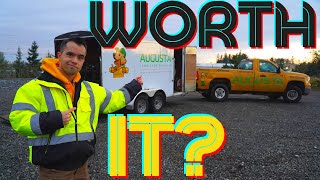
A walkthrough by Mike Andes of an Augusta Lawn Care enclosed trailer (ET4) showing gear layout, simple organization strategies, specific equipment (mowers, trimmers, sprayer, seed/fuel storage), maintenance issues (ramp cables, tires, sheet metal wear), and a recommendation to shift to a trailerless setup the next year to reduce complexity and maintenance.
Questions this video answers
50% rye, 50% fescue.
ET4 (enclosed trailer 4).
7 by 14 (7 ft wide).
Gravely Pro-Turn 48 (48-inch mower).
Switching 100% to a trailerless setup.
Chapters
Good morning everyone. It's Mike Annis here with landscape business course. And I wanted to show you this morning our trailered setup. Last week we showed you our trailer list set up with the trailer with the ramp rack. Today we're going to be showing you the trailered setup because so many of you been asking us to show inside of our trailers and next year we won't have any trailers. So I figured before we get rid of them all this winter, as we head into the, you know, headed here now into November, we wanted to show you what they look like before you get rid of them all in case you do have to use trailers and so stick around for the rest of the video. At the end I'm going to give kind of my synopsis on whether I would buy trailered setups again with the enclosed trailers or open trailers, etc. So let's go ahead and show you around and hopefully get some good ideas. I guess never really showed this before because I can't think. It's kind of boring, but hopefully it's useful for all of you. So inside of here the biggest thing for us is just keeping it really, really simple. So I know some people will like to have a whole ton of tools and equipment just like everything that they could possibly think of in their trailers. We don't have that. And it does require in the mornings for the guys to get a few things from the shop. However, it just keeps it very, very tidy. If you have a lot of different employees using the same trailer, like they're switching them out, stuff will get mixed around a lot. If you have more and more tools, you get more and more disorganization. So up front here you can see it's pretty open. You have a lot of space. We don't have like racks. We haven't built a whole lot in here. But I'll kind of walk you through what we do have. So we got a blower here. Handle's broken, but they'll get that fixed. And we just kind of. We don't have like a rack for this one. It just sits inside of a two by four that's screwed. Two by fours are screwed into the flooring. And that's just because usually the last thing that they're using on the job is the blower and just easier for them to open the door real quick and throw it inside here instead of trying to then step inside and. And put it on a rack. So just trying to think about ease of use. The reason we did that is because we used to Have a rack up on the wall, but the blower never end up on it because throughout the day the last thing they're using is the blower. They'd open this up and throw it here on the ground and it'd roll around. So we put it there, it locks in place kinda with the two by fours and that's sufficient. But we do have the sprayer, spot sprayer up on the wall. We don't do a whole ton of spraying. This is gonna be used for like tiny little weeds inside of beds or if they're weeding a big area that's open in a bed that has a whole bunch and they just knock it down and spray it. We have this Here, it's labeled ET4 is the trailer that you're currently in, enclosed trailer 4. And so that's why a lot of the stuff you'll see here has, you know, ET4 written on it. It's what's labeled on the, on the trailer up front here we have soil and then we have seed in these five gallon buckets. And so that's just if they make a mistake on a lawn, if they make a rut of any sort, we just use the general seed. That's a 50% rye, 50% fescue. That's kind of common in our area in the Pacific Northwest. We have that in all of our trailers just in case they do make a rut with the zero turn up here we do have the racks. These racks are from trailerracks.com and again they're all labeled. You'll see ET4 here at the back. They're labeled the number of the trimmer. The newer ones, we started actually putting the date on the trimmers. That way we knew exactly what day they were new. Because usually after three, four years it's better just to get these replaced, honestly than trying to get deal with them taking 20 pools in the morning just in terms of efficiency. So usually after four or five, five years we're retiring these definitely. Even if they're doing decent because they. By the time it gets cold here in the Northwest, it's wet and cold in November. Taking 20, 30 pools to get these things started can be annoying. So we usually switch them out after every, you know, four or five years. But for now we have them up on the racks. We have two per trailer at least. And then they can have a third one if they want to. If they know there's something on their a route that is going to take a lot of weed whacking, they can put A third trimmer on here. But we have a.
Straight bar here with the trimmer attachment. And then we also have the one with the straight head edger attachment. So this is the combi system up top. And then this one does not have the attachment at all. It's just the straight trimmer rack. So over here we just have some basic tools, hand tools that they're going to use throughout the day. Most commonly we got the soft rake, the hula hoe, a shovel. We also have some ties here. If they do bring other equipment here, they can tie it down if needs be. Here they have like the most common little tiny tools that they might use if something breaks. So inside of here is like pliers, needle nose pliers, screwdriver, stuff like that that they might run into if something breaks that they can fix out in the field. So especially the steel tools that open the encasements for the steel heads as well as the attachments, all that's in here. That way if something happens throughout the day they don't have to come back to the shop or take it to the repair place. They can just fix themselves. Over here we do have the fuel. Again we lock it in place just using two by fours. There is things that you can put on the wall for these. But again we found that a lot of times they just end up on the floor otherwise. And so we ended up putting them here. Same thing with spray concentrate. We have castor on spreader there that we can use for weed preventer which you don't use a whole lot. Here is the zero turn. This is the Gravely Pro turn 148. This is 148 or sorry 48 inch zero turn mower. And we do have to have the bag on the side so it adds about 6 to 8 inches on the side in terms of getting the size that we want into the trailer. This one's pretty dirty. We haven't cleaned it this week, but usually every few weeks we clean the mowers and we can get a 52 inch. So our other trailers do have 52 inch mowers that are gravely as well in there. And we do have to have the side disk, you know, the side bagging unit though. So it does add extra space. We can get like a 65 inch inside of these trailers. These are 7 by 14 trailers. So 714ft long, 7ft wide. So let's hop 2 by eights, I think 2 by eights or 2 by tens in order to secure all the racks. And here we do have space if we wanted to add more, we have some. What are these called? Shears, Things like that we'll put up on the side of the. Of the wall here. We could add more if we wanted to, but we just try to keep it as minimal as possible, keep it really simple and tidy. The more tools and stuff we found that we put in here, the more and more disorganized they got. So let's hop around back, show you just kind of behind here on the trailer. So obviously you got the ramp. And this is something. Another reason why we're not huge fans of the ramps. And that is these cords get broken all the time. So there's this one here, but then this one here is broken. And this literally happens twice a year usually. And it has to do with the fact that when you have a zero turn with that bagging unit on the side, it's pretty wide and you only have a couple inches on both sides when you're trying to get inside this ramp. So this is broken and we had to replace those usually twice a year. And so again, we're getting rid of these trailers. So that's why this has not been replaced. In the back here, you can see the bagging unit for the gravely zero turn in the back here. And everyone's responsible to clean these out at the end of each day. Again, this will usually be pressure washed and cleaned a little better every few weeks. But it is. Everyone's responsible. We haven't really specifically cleaned this one out a whole lot. Everyone's responsible to clean this out at the end of every single day that they mow on P4P. We can take money out of someone's paycheck if they have not been clean, if they leave these full of bit clippings or. This whole place is a mess and the equipment's everywhere. It's part of P4P is taking care of the equipment and setting up the next crew for success. So this is pretty common in terms of like, we haven't specifically cleaned this one out, but that is the zero turn. Some of this is. There's deferred maintenance on this zero turn because we aren't planning on using these for a very long time. Next year, like I said, we'll be switching 100% to the trailerless setup. I'll talk about why in just a minute. In the back here, we do have the. The wire, the trimmer wire on a piece here. Also from trailer ramp or trailerracks.com Again, this is the back area. You can see the 2 by 10, there is more space to hook more things up on the wall if needs be. We have a 21 inch mower here and then we have a 2x4 in the back there just to brace it so it doesn't roll around a whole bunch or hit this in the back of the, of the ramp, which we found a lot of times when this door is closed, if there's not a 2x4 there, this can roll around and really start to mess up the controls. So we have the two by fours in place. So that way it's all locked in place and it can't go anywhere. So that's pretty good there as well. So kind of the final synopsis on it all is that, you know, we're not going to use these in the future. We're going to use the trailerless setups where we don't have to have the ramps, we don't have to have the massive. Like you can see how long this whole truck and trailer setup is. By the time you add 14ft for the trailer, 4ft in between that and then, you know, maybe another 15, 16ft for the truck, you're looking at almost 40ft. Trying to move around a small neighborhood, it's very, very difficult. And whereas with the trailerless setup, you just don't have those problems and you don't have to deal with the massive mower breaking things as well as. Let's look at the trailer here. You can see these tires here that are less than a year old. On the outside they're almost bald, and on the inside they're not, but on the outside they are. And you find a lot of times with these trailers, they wear unevenly and, and you got trailer brakes on this thing. You have to have trailer brake controller inside of the truck. And so by the time you add up all the maintenance of the cost of the, you know, every single year going through a set of tires, the brakes, you know, cords breaking, this sheet metal is like paper thin. And so even if we look at the front of this trailer, it's only a couple years old, you'll see dents, nicks, you know, rocks from the road get knocked up. And so it's just very difficult to keep this thing looking good, especially when they're white like this. If they're yellow like some of our franchisees have invested in and actually painted them yellow, they look a little bit better long term, they don't look as dirty. But we're definitely getting rid of these and switching to trailer setups, which you should watch the Video I made last week showing exactly how that should be done. And it really reduces the amount of time and effort goes into training your crew because they don't have to worry about backing up trailers, figuring out how not to jackknife all the other stuff that goes into using a trailer, including just using the trailer brakes. So hopefully that was helpful. If you do use trailers, they're definitely useful for storage. And so if you don't have a place to put your equipment, you don't have a place that you can store the equipment that's inside of this trailer outside the elements, then maybe this is a good option for you. Especially if you're just a one man show and you don't have to train employees on how to drive them. Definitely might be a good option for you. But definitely keep in mind that if you're going to have lots of employees, if you're going to really scale out, you're going to have to teach every single person how to drive a trailer. The organization of it, the maintenance, the wear and tear, it just, you know, you have to have a bigger truck. Like this is a 2,500 truck instead of like last week we looked at a 1500 truck. That was half the cost. So little things like that kind of add up when it comes to the trailers. So we're moving to more of a trailer, less setup. And so make sure you watch that video. But I hope that was helpful if you do have trailers. In terms of organization, keeping it simple is the biggest thing. Just to make sure that you have the tools you need. But there's not so many that it just, it becomes absolute chaos. I've seen so many enclosed trailers where there's racks and there is shelving in there and just stuff is thrown in and eventually just becomes absolute hodgepodge and mess. And when you need a tool, it's there. You just don't know where it's at. So make sure you keep it organized. Thanks so much everyone. Mike Andy's landscape business course. We'll see you next time.
Sam.









