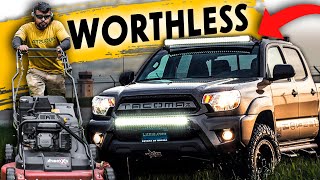
Mike Andes argues that spending on trucks and flashy equipment is not a real investment in a small business because such purchases only shift cash into depreciating assets on the balance sheet and do not create additional revenue or profit on the profit-and-loss statement. He contrasts book value (assets like trucks/equipment) with enterprise value derived from profits (price-to-earnings multiples), and recommends investing in activities that increase customer value and profits (e.g., answering phones/virtual assistants, marketing/customer acquisition) rather than cosmetic upgrades (LED light bars, lift kits, rims). He gives numeric examples to show how redirecting $5,000 from vehicle upgrades to revenue-generating activities can create larger profit and enterprise-value gains.
Questions this video answers
Mike Andes
September 16, 2022
Chapters
Today I'm going to be sharing with you the logic and the numbers behind why trucks and equipment is a bad investment for your business and how it has absolutely no impact on whether or not you're creating any value for the customer and the actual value of the business if you were to sell it. Let's jump into it. So some basic premises we got to go over first. First of all, what is a balance sheet? Okay, balance sheet. Over here we're going to have a profit and loss statement or P and L. Alright? These are basic elements. You can learn more about this@mbaforantrepreneurs.com and in the links below. But on a balance sheet you have something called assets. Okay? These are going to be your trucks, your equipment, et cetera. And we're going to get back to that. You also have your liabilities. And ultimately on a balance sheet, these things must equal, and that's why you call it a balance sheet. The assets have to equal the liabilities. And some people are like, oh no, that's impossible. Well, if you get a loan, your liabilities go up. Guess what else goes up? Your assets. Because you get more cash from the loan. When you buy an asset in the form of a truck or equipment. Here's what happens under our asset column. We had, let's say $10,000 worth of cash. Well, I'm going to go buy $5,000 worth of a truck. So what happens here? Well, I'm going to have a negative $5,000 worth of cash on the balance sheet, but I'm going to have a positive $5,000 in the form of a truck. Okay? So literally nothing happens. The assets column stays exactly the same. Now if you get a loan again, your liabilities will just go up, your cash will go up and then the same exact thing will happen. But nothing really moves the needle at the end of the day. Your assets, the assets that you buy, your trucks, your equipment, your office supplies, your computers and all that is not a business. Those are tools to create value for your customers. And they do not need a light bar and flashy shiny rims and a 6 inch lift on the truck in order to produce value for the customer. I promise you, customers will not pay $1 more for the cost of their lawn getting cut or their house getting clean. They will not pay $1 more for a 6 inch lift on your truck or for a LED light bar on the top of your truck or to upgrade the type of film on your paint. That is not going to move the needle for the customer. And the reason I care about the customer is because the customer is what makes the business and the profit and loss statement is what actually produces value. Because over here we do have value. The assets of the business equal the book value. This is literally. If you were to sell everything in your business, what would you be able to sell all your trucks, your equipment, your assets for is the book value. And this is literally what most small businesses end up selling their companies for. Because they don't have any other value outside of just the book value. They sell their trucks and their equipment and that's it. Because their brand doesn't have any value. They have no systems in place, nothing in addition to the book value. Now I promise you, instead of spending an extra $2,000 on a custom tint job on your windows of your truck or on a flashy brand new whatever, on a piece of equipment that is going to offer no value to the customer, I promise you, the customer would rather you spend that money on something that's going to produce value to them. For example, I have seen many people upgrade their truck by 5, $10,000 by putting suspension and lift kits and roll bars and the flashy shiny thing in the front of the truck, a grill thing, I don't know what it's called. Whatever it is, they spend thousands of dollars on that. And yet that business owner will not want to spend 100, 200, $300 a week on a virtual assistant. Someone to answer the phone. But guess what? Customers will pay more money if you answer your phone and they will not pay more money if you get an LED light bar on your truck. Alright, now the reason I'm talking about this is you've got to ask yourself what is a good investment? Is buying a brand new truck or upgrading the truck by $5,000 going to be a good investment? No, I can confidently say it's not going to be a good investment. Why? Because you're simply moving the cash into the value of the truck. There is no additional book value and there is nothing changed on the profit and loss statement. You create no additional revenue. So why in the world would you call this an investment in your business? It's not. It doesn't help the book value and it doesn't produce any profit loss for the company. It's ridiculous. So let's jump into what a profit and loss statement and where you actually create real value for a customer. On a profit and loss statement you have your revenue or income revenue at the top, minus your expenses. And that is going to equal something which is Sometimes foreign to people in the small business world, and that is profit. This number right here is what you create a business on when you look at the stock exchange. What is everything based upon? Price to earnings, ratio, price to earnings or profit? People care about profits because that's where value is created in addition to book value. So if I have $10,000 worth of book value, but I also create $5,000 worth of profit at an earnings multiple of just say, let's just say three. Now all of a sudden that $5,000 of profit times three in terms of valuation. Now I've created $15,000 worth worth of value. And this is what business creation is. When you think about creation, it's taking nothing and turning it into something. This is turning something and turning it into something. Oh, and by the way, this truck, that roll bar, that LED light bar, depreciates very, very, very quickly. So it's going down in value. It depreciates. But all of that to say that is not creating a business, that's not investing in your business, investing in your business is how do I improve the profits? And so if buying more truck, buying another piece of equipment, increasing the tint on your windows and upgrading the rims on your truck, if those things do not create value for the customer, that's gonna allow you to create more revenue and increase profits. That is not an investment, that is a sales pitch. And that is you buying it as someone on social media that's bragging or showing off their equipment and their trucks. And it does not produce more value for the customer. The reason that Amazon and these massive companies become massive is they obsess over what makes the customer happy. And what is the customer willing to pay for? Are they willing to pay for shiny new equipment and flashy new computers and new cell phones for everybody? And we're going to upgrade everything to be able to have a wireless key fob system for our truck. Your customers are not willing to pay for an air horn on your truck. It might help your ego, but it ain't going to produce any more revenue. It's not going to produce any more profit because your customers are not willing to pay for it. So when you talk about investing in your business, ask yourself, are we simply shuffling numbers on the asset column and on the balance sheet, are we maybe getting some loans, that is some liabilities, taking that cash and turning it into assets? Just a transaction, the balance sheet therefore moving book value, are we actually producing real value for the business creation? The enterprise value of the business is based on this number can you produce profit? Can you maximize profit? How do you maximize profit? You reduce expenses or you increase revenue. So if buying more trucks and buying more equipment and upgrading all those things that's new and flashy and putting whatever in your trucks, if it's not going to increase your revenue, I.e. your customers are willing to pay for, or B it's going to decrease your expenses. Sorry, an LED light bar does not count. Flashy rims does not count. Now taking that $5,000 on that flashy new LED light bar and brand new rims and putting that towards getting a truck that's maybe five years newer and is going to last you longer, that's going to reduce your expenses, that is Increase your profits, that is you've created real value in your business. So stop thinking and convincing yourself and buying into lie in the notion of marketers that are telling you that you're investing in your business. When you buy trucks and equipment, you are not. You are simply getting the tools required so that you can build a real business. Producing revenue, buying customers with customer acquisition costs, spending money on marketing, advertising. Much better investment than spending $5,000 on upgrading your trucks and equipment. Why? Because that $5,000 could turn into $50,000 worth of revenue. At 20% margin, that's $10,000. I just turned $5,000 into $10,000 worth of profit. Why? Because I took this $5,000 I otherwise would have spent on something that was depreciating and next year would be only worth $2,000 in my assets column and I turned it into something that now that $10,000 worth of profit could literally be worth 30, $40,000 worth of enterprise value and business creation. That is investing in your business, creating customers, making them happy, and maximizing profit. I'm Mike Andes. Check out the links out in the description below and we'll see you tomorrow.