🇺🇸 VETERAN Grows Property Restoration Company Past $250,000 in Annual Revenue | ZERO TURN
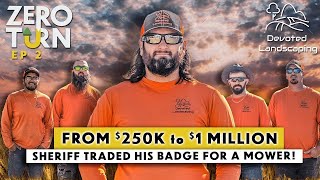
A Zero Turn episode interviewing Andrew, founder of Devoted Landscaping, about building a landscaping and property-restoration business after military service. The video covers his origin (high-school mowing → Marines → sheriff’s office → full-time business), core services (commercial/residential maintenance, installs, property restoration), shop/equipment, hiring and team roles (crew leader Noah), estimating multi-stage cleanup/install jobs, marketing channels (word-of-mouth, social media, Google, door hangers), operational routines (Google Calendar, morning meetings, rotating maintenance weeks), pricing practices (minimum show fee), community work (Project Evergreen), and growth targets (staff and revenue goals).
Questions this video answers
$55 show fee.
Five full‑time employees and three part‑time workers.
Roughly 0.5 acre up to 1.5–2 acres (hill-country, larger yards).
About four months.
Goal: 10 full‑time staff by end of next season; revenue plan: ~$500K next year, then ~$1M the following year (four‑year mark).
Chapters
Hey, everybody. Welcome to another episode of Zero Turn. We're down here in Texas showing off landscapers and lawn care providers telling their stories and what makes them special. If you're interested in joining on a future episode, check out the link down below. And you could be next on Zero Turn.
Welcome to Zero Turn. Today we're here with Andrew, owner and founder of Devoted Landscaping. He went from working the land to protecting it. Now he's back in the country making a difference, one lawn at a time. Let's talk to Andrew about how he grew his company past $250,000 in revenue. Andrew, it's great having you on the show.
Hey, thank you for having me.
Do you want to tell us a little bit how it was getting started where you first came with the idea to get started with Devoted Landscaping?
Yeah. So kind of like other people, you know, in high school, I was mowing yards, and I actually had another business. It was called Big A's Lawn Care that I started for a couple of.
Years outside of high school.
But I always had a passion to serve in the military, so I wind up closing that down and joined the Marine Corps. And then after getting out of the Marine Corps, I started working the sheriff's office. After working there a couple of years, I kind of started getting into some of my old contacts and started doing lawn maintenance on the side, working with people in other companies. And after about a year or two, actually, my supervisor kind of brought to my attention, said, hey, you're, you know, you're really passionate about this and seems like you really got a niche for it. You know, have you ever thought about doing this full time and, you know, really taking off with it? And he really got me thinking, you know, and I was like, that is something that, you know, I started with years ago. But, you know, I didn't really consider it. And just with everything that was going on, I started to really think about it, did a lot of soul searching, and realized, yeah, this is what I want to do full time, and I want to go all in. And that's how I got started.
That's sweet. Well, what was your setup originally? Did you start with maintenance? Did you go right into property cleaning?
So, yes, for the most time, especially.
When I was working the sheriff's office.
Doing it on the side, I was just mowing yards, Mowing, doing a little bit of cleanup, leaf removal, stuff like that, small bed maintenance, but for the most part, just maintenance. Low overhead, just kind of do what I could do by myself and do it nights and weekends.
What services do you guys focus in.
So we provide commercial and residential landscaping services. So install maintenance and property restoration.
That's great. And so you said property restoration. What does that mean? Can you kind of paint us a picture of what you would pitch to your clients for property restoration?
Yeah.
So property restoration, a lot of times we get clients who say, hey, this property. Property has been abandoned for two or three years. Or maybe it's a management company that they had a tenant and they just destroyed the property. Basically, the short answer is restoring a property to its original beauty and trying to make it look even better than that. So overgrown, just trash in the place, you know, plants and trees that are dead going in there and doing a complete cleanup and restoring the property to make it look beautiful and make the clients, you know, proud of their property.
So this is kind of where we do oil changes, service equipment and stuff like that.
Nothing fancy, just somewhere to work on the trucks and mowers, change out blades. Right now everything's kind of in here because we're still doing maintenance, but for the most part we're doing mostly installs and projects and stuff like that. So I'm on the standoff mowers here. Just some of our general stuff. Generators, push mowers, some more, zero turns. It's kind of a mess, but essentially.
We keep chainsaws and weed eaters over here.
The backpack blowers are usually all in the trailers and trucks, but they're all in here because we've been playing musical vehicles and trailers on job sites and then kind of just graveyard with, you know, equipment parts that aren't in use. And then more hand tools, nothing fancy.
It does a job.
Right now, you know, working on getting the Connex box, which will give us some more space, kind of double our size. Plus have that lean too, so we can have one of the trucks set up for the trailerless setup. This is basically the shop right here.
So you guys have zero turns. What's the average size of yours property?
I would say between half an acre to one and a half, two acres. So we do some large scale properties. We do have some of the cookie cutter subdivisions, you know, and properties there. But we have a lot of hill country properties, what I call it. So bigger, bigger yards, you know, where guys, you know, a two man crew will go out and they'll be out on property for three or four hours. We do have some of the smaller ones that, you know, you can get with the push mowers. Not as many subdivision yards. More hill country. Yeah, Large, you know, acreage property.
With the property restoration. Do you have to use any special tools or is it kind of clear cut landscaping here?
Yeah, for the most part it's clear cut. So a lot of chainsaws, mowers, blowers.
A lot of hand tools, pruning, you know, overgrown vines, pulling flower beds, shrubs, everything that's dead, pulling it out and clean up. A lot of leaf cleanup. So, you know, use a lot of tarps to bag stuff. But basic hand hand tools and you know, regular stuff that you use everyday kind of landscape work.
Hey, did you know that they have parrots down here in Texas? Did you also know that you have less than a month to get your tickets for landscape Summit? You can get them for January 13th, 14th and 15th at landscapebusinesscourse.com conference. We'll see you.
So now that you've grown and you've gone full time, what is your role in the company?
So I am advertising management, motivator, scheduler. You kind of name it, I do it. I still go out and work with the crews. I'm not the type to just sit back and, you know, stay in the office. So I'm out on the day to day operations doing everything from helping with maintenance and scheduling to actually going out to the jobs, running a crew. Right now we have a maintenance crew and install crew. Next year we're kind of transitioning into where we have two maintenance crews and one install crew. So I do have a crew leader who's doing a great job on the maintenance side. He'll take over that and then the second maintenance crew and then I'll focus more on the install and management of the company.
Yeah, we, we do get a lot of projects from our clients and our maintenance. But honestly, a lot of word of mouth is how we get a good amount and then people just see stuff. I've actually, it's kind of crazy when somebody reaches out like through Facebook or Instagram, you know, like, hey, somebody shared a call.
DM you?
Yes. Yeah, they just DM and say, hey, I live in this area, blah, blah, blah. Do you do this or can you do this? And we'll, you know, if it's something that I know we can do, then, you know, we'll set up an appointment and go give them an estimate and take a look at everything. If it's something that I'm unsure of, I always tell people I'll go out there and take a look. If I don't know that we can do it, I know somebody who does, you know, put you in contract so here in the hill country, it's really nice. The community of landscapers is really a network. It's not like competitors. Oh, that's so. You know, I've had a couple of landscapers that helped me get started and gave me a lot of advice and, you know, hey, this is. This is good. This is what you need to look at. And, you know, kind of just steer me in the right directions. And if it's something that I can't handle, I reach out to them and vice versa.
Where can they find you?
So devoted landscaping.com, you can Google devoted landscaping, usually one of the top five that'll pop up, and then Instagram and Facebook, you know, backslash devoted landscaping, so you'll be able to see us. So that's a task in itself. Keeping up with all that, all the platforms on that.
No. Like, what was the process of getting your website designed? I checked it out. It's a beautiful website. Did you hire it up?
Yes. So I actually had one of my old co workers, his wife is a.
Internet guru, social media guru. She said, you know, you got to have a website, and I want to help you out with that.
I said, okay.
And Charlie, she actually helped me with my logo as well, because she said, you got to, you know, once you get going, you got to have a brand. You know, you got to make it to where people know the company, not just you. I said, I agree 100%. So she helped me with the website, and then I had another friend, Debbie, help finish out. So kind of a collaboration of two friends helping put it together. I wanted to incorporate the hills, you know, the trees. We try to do a design with the river. Just a lot of bodies of water in the area. So I wanted to incorporate that, but just in the design. It didn't flow as well as the one we have now. But once we got, you know, through a few different designs, we kind of found that one. I was like, all right, this is it. That's the one. So if it wasn't. Wasn't for their help, it probably looked.
Like stick figures drawings.
You know, that's funny.
So when you went from part time to full time, how long was it till you felt the need to find an employee?
I'd say it was about four months. And I actually had somebody that I had a cleanup job. One of my buddies said, hey, I know this guy who just lost his job. He could probably help you out a little bit and at least knock out this job. So I got him. He helped me that day, and I Was like, man, you're pretty awesome. You know, if you, if you want to work some more, let me know. And he goes, well, actually, yeah, I mean, I'm, I'm a diesel mechanic, but you know, I would, you know, until I find a full time job doing that again, I don't mind helping you. And originally I thought he was going to help me maybe, you know, another couple times. So he wound up working with me probably for about four, four and a half months before he got on the job. So pretty much all of the summer he'd helped me, you know, about two or three days out of the week. And that made a big difference.
So what was your process for your final employee after him?
So after him it was kind of the same time frame right now, the end of November, beginning of December. I started picking up more work, more referrals coming in and I wasn't able to do it by myself. So I had a guy who had actually worked with me a little bit before and you know, he said, hey, you know, I'm kind of slowing down because he was doing a little bit of this, a little bit of that. And I said, well, do you want to come and help me out again? And he's like, yeah, I'll help you out. So after a couple of days of him working with me, you know, I told him, I said, hey, man, I think this thing's really going to take off. I think next year is really going to be a starting point of something great. And you know, I'd really like to have you come on board full time. I can, I can guarantee you by spring, you know, we'll be full time. But I'm confident that in the months of January, February, I can at least have you on as part time if you're willing to come on board. And he's like, you know what, let's do this. And that's actually my maintenance crew leader, Noah, who's been with me, you know, since the get go. And the company would not be where it is without his help.
We're here with Noah Pierce from Devoe Landscaping. He's a maintenance crew leader. He's been working with them from the start. So let's hear what he has to say. How's it going, Noah? Good. Nice to meet you. How long have you been working with Andrew?
I started in January.
Nice. And do you have a lot of experience with lawn care and landscaping?
I had my own business going on. I was working as a one man show.
Nice, nice.
And yeah, doing the same thing, thing, working for friends. And I lived in Bernie, Texas for a while and there was a lot of business there. And then my wife and I moved to San Marcos and I met Andrew and he was begging me to come on full time. I pulled the trigger and did it. Yeah, yeah. Been with him since January.
That's great. So what's your role in the company?
I'm a maintenance crew leader and so we maintain commercial and residential properties.
What's the biggest difference between trying to maintain a commercial property over like a residential.
I wouldn't say it's a little more detailed, but it's a bigger, usually a bigger scale. There's not a whole lot of difference, honestly.
So are you in charge of like the hiring new employees, firing new, old employees? Andrew and I both are nice.
Yeah, we do interviews together and yeah, I can fire as well.
So what's your aspirations as you move forward with the company?
Honestly, I didn't know that I wanted to stay in landscaping. And as we've been going, I just kind of got inspired about it. I love being outside. The projects that we're doing are fun, especially when managing a crew. As we grow as a company, the plan is to be in charge of several crews. We've got a two year plan and we hope to have four or five crews going out. I'll be overseeing that.
So that's where we're headed now.
So do you think that he was really a pillar in starting to build that culture?
Absolutely. He is 100% devoted to the company. When we bring on new guys, he, you know, has a good talk with them, lets them know, you know, what we're all about. I feel like he's fully invested in the company and I've told him as the company continues to grow, he's going to grow with him, with us. And I honestly, that couldn't be half of the things we've done this year I could not have done without his help.
Did you find any trouble finding new employees this last year with the labor crisis or anything?
It has been insane. I've had everything from no calls, no shows, to guys who show up and decide they're gonna leave. I've had one guy quit within two hours. I've had one guy quit Within 45 minutes. I've had a guy work a full day that said he did concrete. We did tree trimming for one day and he said, this is not for me.
I've had a lot of people that.
I think reached out just to try to get an interview, just to maybe continue unemployment benefits because they never showed up. So it has been a roller coaster of a year trying to get people.
So what size is your team now?
So right now we have five full.
Time guys and then I have three part time guys and the three that are part time. It'd be great if they come on full time. The reason they're part time is because they all have full time jobs. So they come on and work. Some of them will work two or three days a week. Some of them work once every week.
So one of them works at the sheriff's office.
So he has rotating schedule. And then another one works for the county and then another one does landscaping as well. So he's a buddy from high school and, you know, he kind of helps me when he can, which is typically two to three days a week.
Honestly, we get a lot of stuff by word of mouth. And then this year's been a lot on Google and some from next door and Facebook. So last year, at the beginning of the year, I made 2,000 door hangers.
Oh, wow.
And I would say we put out about 150, 180 of them. The rest I still have because it just kept getting busier and busier. We didn't even get the opportunity to put.
Didn't even get door hangers out.
Yeah, so we did.
One day we just went. I just went up and down the streets in a subdivision in San Marcos and.
That was it. There was that one subdivision and then everything just started taking off.
Hope you're enjoying the episode so far. If you want your business to take off just like Andrew's, check out lawncaremedia.com we got flyers, postcards, yard signs, and instant quote door hangers. Check us out today. Let's get back into it.
Like, what's your process for keeping connected with your team with all these, like, changes around and rescheduling and stuff like that?
Yeah. So right now it's pretty easy with Noah being my crew leader, obviously went. You know, he just called. I mean, he calls me throughout the day. Kind of shifted to where now clients can reach out to him directly. When it comes to maintenance things, the Gmail, the Google Calendar, that's the one.
Way we do that.
He has access to that. Usually for like the maintenance schedule we do is once we have the calendar set for the whole week, for the most part we have rotating weeks. So we have like what we call like a yellow week and a green week and those rotate out here. We do a lot of bi weekly, but for the most part, we know the schedules and we don't do what are called drop ins. We don't require contracts for our residential customers. But once we get somebody on the schedule, we stick for the most part to that day. We try to do our best to stick to that day. Other, you know, sometimes you run into weather delays or, you know, things that are out of our control. But we do as best as we can with getting that, you know, sticking to that schedule that we make. And then every morning we get together. Usually on like Mondays, we'll try to get together and kind of have like team meeting, kind of lay out what's going to go on during the week, during the season. I feel like sometimes there's like, it's so busy that, you know, like we got two crews going. You know, it's kind of like high by kind of thing.
You know, everybody's loading up in the morning, doing what's got to be done.
And then, and then taking on.
So is this for these people right here?
No, this is its own new property.
Oh, wow. Yeah.
Basically what we did is there was an old mobile home that was right there, obviously where y' all were parked. There used to be a shed and then another building back here between these two trees, which is that pile over there. So we've already hauled off one 25 yard dumpster. Probably gonna bring in another two yard, two dumpsters to haul that off. But this pad right here is where the home's gonna go. And basically what we're doing is cleaning it up. So that way it's all nice and, and clean.
Yep.
See there's been a lot of cutting already over there. All that's going to get chipped today along with that pile. Once that's finished up, then everything's chipped and then we'll go through another phase.
Of cutting everything down and cleaning it up.
So, so what goes into estimating a project like this? I mean that's, that's a multi stage sort of deal that you out there.
Yeah. So basically the way we break it down, try to have systems in place with. Okay, how many guys are we going to have out on the job site? How many days they're going to dig out there, how many trucks as far as equipment? You know, today we don't have the skid steer out here, but the skid.
Steer'S been out here.
And you know, of course the chipper's out here today. So pretty much that's basically when I go in and do an estimate. I go out and meet with the client, kind of give an idea what the scope of work is go over everything with them again and then say, okay, what's the highest priority? So like this project in particular being done in stages, the first thing was to basically clear out that area. So we had a prep site. Pretty soon there's gonna be a septic system that's put in over there. So about a month and a half ago, where the truck and all the guys are at, you couldn't even see that it was. There was an old pole barn there with a couple of rattlesnakes and some other things just stored up. So we went in there and cleared all that. This is about 2 acres. By the time we're done, you'll be able to see all of it and all be cleaned up. You know, the big trees will be cleaned up and then all the sucker growth will be cleared out. So that way they have a nice yard. Basically going back to how we did the estimate is get the scope of work and then break down what needs to be done first to last and then basically section it off by, okay, how many days are you going to take? How many guys is it going to take, what kind of equipment? And then trying to factor in kind of the unseen. Is it really going to take three days? Is it most likely going to take three and a half, four days? And then playing along with the weather and other contractors.
So we talked with Noah a little bit. You guys have a two year plan going forward. So what does it look like for devoted landscaping going into 2022, 2023.
So 2022 we'll be having two maintenance crews and an install crew. Right now, like I said, I have the five full time guys and three part time guys. My goal is by the end of this season, next year to have 10 full time guys. So that looks like two maintenance crews, one install crew going into the next year will be our four year mark and we're looking at doing a million of that year. So kind of breaking it down into phases, you know, half a million next year and then following year, a million. Wow. I believe with the growth and the area, with our systems in place, we can continue to do that.
And grow.
House is right here. The driveway is going to come in where we're parked. It's going to circle around these trees and kind of circle back through, obviously the old pad and that porch will be all gone. And then this will just be nice scenic view of nice green grass.
So where do you draw the line? How do you figure out if something is too much for you guys to do or it's too little. You won't make enough profit on it.
Well, this year has kind of been expanding because I consider this to be a little bit more of like, it's a landscape cleanup, but also kind of some site prep, which, honestly, since we got the skips here, it's kind of weird. We just kind of got started getting more inquiries about, hey, can you clean out this lot? And we've done lot cleanups before. Last year we had like an acre and a half piece of property that we cleared out. I have a lot of experience with heavy equipment, but not all the guys do. So it's kind of like, okay, what can we do that we know how to safely do and effectively do and can also estimate it, but really, it is a learning curve. We do have a minimum for, like, maintenance as far as a basic mow. So if somebody's wanting, you know, mow, trim and blow, that's our basic package of lawn mowing. A minimum is $55 show fee. If it's less than that, we just won't show up. And the reason being is because it's just we've realized that not profitable as far as a small project. You know, 250 is what we are, is a baseline project. But for the most part, we don't really even have issues with that. As you can see on that other property. You know, we do have bigger properties that we maintain, you know, half an acre, acre and a half, two acres. We do have smaller ones, but those.
Are pretty standard when they're in a subdivision.
You know, 55, 75, you know, maybe 80, $85. Just kind of cut, trim and blow and go from there. Trying to learn, learning a lot from Mike, you know, always watching videos and trying to read as much. I definitely haven't figured it all out. I'm still learning. We still have those jobs where I go and I'm like, oh, man, I didn't even see that. I tell people that we're going to be profitable or we're going to learn. You know, it's one of those things.
So as you start to grow and start to expand, you're already saying that you're like an octopus. You have your hands on and everything. How is it training your crew, especially now that you're picking up more hardscaping jobs?
My biggest thing is making sure that the guys that are, that are trained are doing what they're trained to do. If somebody doesn't know what they're doing, the goal is to train them to get to that Point. And stepping into hardscapes is something that we're just barely easing into. It's kind of one of those things, crawl, walk, run. Because you definitely learn more as you're going. And kind of like I was talking earlier about the, you know, having a network of other contractors to kind of help, like, hey, you know, this company focuses primarily in concrete. We can help with this and this and this. Okay, let's bring them in and learn how to utilize those assets, you know, because I am trying to step away from that octopus role, you know, and Mike talks about the jackrabbits. That's really what I'm trying to do. Noah has definitely helped me get to that point to where, okay, now I pretty much got to where the maintenance. I can focus on handing it to him and he's, you know, in control of that. I can focus more on the installs and managing the business aspect of the company.
So I saw on your website that you work with Project Evergreen. Do you want to tell us a little bit about that?
Yeah.
So Project Evergreen is a. They're a non profit organization. Basically what they do is they put service providers, whether it be, you know, just lawn maintenance, landscaping, anything in kind of the green industry. They put you in contact with families who have a spouse that's deployed. So the family's not having to focus on taking care of their property while their spouse is deployed.
We do that.
So basically what they do is they reach out to. They either have the person themselves reach out or they'll send us a list and say, hey, here are some families within a certain area that you give them and the whole time that their loved one is deployed, you're taking care of their landscapes, their maintenance. So that might be something as simple as just the basic, basic mow or, you know, taking care of the shrubs and flower beds, their trees, just making it to where it's.
It's one less thing that they have to worry about, you know, while, yeah, you know, they're, you know, other ones not there.
And it's all, you know, complimentary services provided to them.
So it's nothing that, you know, it's.
Not even a discount.
It's. It's 100% provided by us.
Yeah.
So as you start to expand your business, you are picking up another person that you're trying to be in like a leadership role. How has that played on your business? What are your goals for expanding as the next year rolls around?
So one, it's really pushed me to learn how to delegate more because as the company Grows. I can't control everything. I can't be on every job site and then also communicating with my customers and then realizing that, hey, it's not just myself or Noah. It's, you know, now we have another guy that's part of the team that's, you know, gonna be somebody that's showing up and, you know, running a crew. So definitely planning ahead and not so much as, okay, we have this week planned out, but like we have this month planned out and where are all the guys gonna go? And you know, when we run into rain delays. Like actually one of Mike's episodes this past week kind of talked about the rain delays and stuff and I was like, oh, this is totally what we're doing right now. You know, we just need to fine tune it. Today's a perfect example, you know, because of the rain, you know, the sod farms can't cut. So we're shifting around, doing this job, doing another job, and then we're going to go lay sod on Friday. So definitely having more guys and more crew leaders, it really is pushing me to grow more in the leadership role of learning how to delegate and also planning ahead.
You have your wife, two kids.
Two kids.
So how does that weigh on you as a business owner?
So it weighs a lot. You know, one, they, they depend on me. So it's trying to find that balance of being able to provide for them and, you know, provide a good quality way of life and also being able.
To spend time with them. Which being a business owner, I mean.
You know, it's not uncommon that I'm working on estimates or doing paperwork at 10, 11 o' clock at night. Kind of getting into that role now where it's like, okay, we need a part time going into full time office.
Manager to kind of help delegate some.
Of that a little bit more. But you know, especially these first couple years, my wife's been extremely helpful with helping me with the kids, going through receipts and running. She's, you know, a lot better with computer programs than I am. So, you know, a big, big help on that end. But it's, it's definitely a juggle trying to find the balance, you know, and then having a newborn, he wants to, to spend, you know, all of his.
Time with me right now.
And it's like, okay, you know, try.
To spend time with him in the.
Mornings, try to spend time with him in the evenings.
And my daughter as well, yeah, you.
Know, she's a little bit under. She, she understands a little bit more that, you know, dad's going to work. Dad's, you know, got a bunch of.
Of things he's trying to do with the little guy. You know, he's just.
He just wants. Yeah, he just wants to hang out.
You want to be home with him, too?
Always. That's.
That's the biggest thing, you know.
And you. You've talked to me a little bit about it, but you're trying to build a place where your team can grow and flourish and stuff like that. What does that look like from a business owner's perspective?
So as the company grows, I want to be able to provide. Not just a job. I want to be able to provide a career for people. So, you know, we're not real far from Austin. The Austin Fire department is known for having.
Thousands of people who apply for a position there when they open. So they might have a few slots, and they literally have a over a thousand people that apply because they have great benefits, great pay.
You know, it's just a great place.
To work, and that's kind of what I want for devoted landscaping. You know, when we post an ad on, you know, whether it be an indeed or Facebook, and say, hey, you know, we're hiring for three or four positions, maybe we have hundreds of people that apply, I want people to know that it's a great place to work. You know, we train well, we pay well, we have benefits. This year, we started with paid time off. My goal is to have full medical, you know, medical, dental, vision, as well as, you know, opportunities for the guys to actually partake in profit sharing. You know, Mike always talks about the P4P.
That's something as we continue to grow.
Looking into that, But I want it to not just benefit me and my.
Family, but everybody that's a part of the team.
Everybody. Thanks for watching another episode of Zero Turn. Make sure to hit that like and subscribe button to support future episodes.









