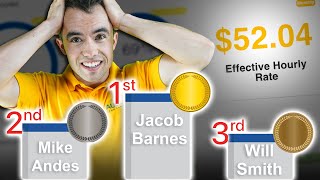
Mike Andes (YouTube, May 10, 2022) discusses using P4P (pay-for-performance) software to display employees' efficiency and dollars-per-hour on a live leaderboard. He argues this transparency, combined with a flat base pay plus percentage-of-revenue bonuses and penalties for negligence, creates a meritocracy, reduces subjective grievances about wages, and motivates lower performers to learn from top performers. The video defends P4P against concerns about safety and quality by explaining built-in penalties for callbacks and damages; it ends with a CTA to p4psoftware.com for training.
Chapters
So I want to ask you the question, do you think it's good to have a competitive environment in your business where employees see how much everyone else makes and they're able to see who is the most efficient?
Now@p4psoftware.com you can actually allow your employees to see exactly how much money people are making in the business and who is the most efficient. Now, it doesn't exactly share with everyone how much dollars they make in a paycheck, but it does share the per hour efficiency of each employ. We're actually making some changes right now where you'll actually show the dollars per hour earned by each employee as they are working throughout the week, live every single day. Now the question is, how is this ethical? Is this right? And why are you doing this? So the first thing is you have to remember that they're not paid by the hour. Otherwise it'd be a really boring chart. It'd be a really boring leaderboard of who makes the most money in the company. And that is what leads most the time in my opinion, to cultural rifts and issues in the business is because people start to compare their hourly wage with other people and they start realizing that I work harder, I work longer hours, I put in more effort and I'm making less money than so and so. How is that fair? How is it fair that I show up to work early, that I research at night how to become more efficient and become better at my job? I work all day long and yet my manager, who is making $8 more per hour than me, sits in the truck all day long on their cell phone, drives around in an air conditioned vehicle, takes two hour personal lunches and personal calls throughout the day. And I'm just working so hard all day long. In my opinion this has led this dollar per hour mentality, has led everyone to believe that you should never talk about money and you should never have employees know how much everyone else is making. However, if you had a system by which people were paid more when they worked harder and when they worked more efficiently, that would be a pure meritocracy. A meritocracy is where merit is rewarded, not how long someone's been with you, not whether or not they're friends with the boss, not if they are older or not if they just work hard when the boss is around. Those are the reasons why most of the time people make more money and get raises in service based businesses been around for a long time, they have the most experience. Experience doesn't pay the bills experience. It should should result in higher efficiency, more productivity, more output for the business. And if it's not, then it's waste. And so in my opinion, if you're going to share the numbers with your employees and everyone's going to know how efficient everyone is in the business, you, you need to make sure you are running a pay for performance model whereby the employees are paid a percentage of the revenue that they make for the business. Now this leaderboard, it's a great way to create this camaraderie and this competitive spirit in the business around who is the most efficient, who is being the most profitable. And a lot of times people are like, well, if you do that, people are just going to run and they're going to mess up and they're going to have injuries all the time. And that's the kind of mentality that people and excuses that people come with up with as to why you should stay on hourly wages instead of switching to pay for performance. However, an employee that goes really fast and makes a bunch of callbacks, damages a lot of things while they're out working, is actually going to make less money on P4P because they have to go back and fix those mistakes. And all their performance dollars are on the table when it comes to damage cases because of negligence. If they break things, if they send a rock through someone's window, if they drive over a piece of equipment and break it, or all of that is going to come out of their bonus, their performance dollars at the end of the paycheck. So they're not going to make more money if they go really, really fast. There has to be a certain quality standard that is achieved in order for them to actually make more money on P4P. But back to the main question, and that is, should people know how efficient everyone else is and what they're making per hour? Now we do allow this and we allow literally on a leaderboard in the next couple of weeks they're going to be able to see how much dollars per hour everyone in the business is making. Now it doesn't mean that they're making more money because if they work half as amount of time, it doesn't mean they made more money, but it definitely allows everyone to know how efficient all of their team members are. And now is this healthy? Is this something that we should do in our business? And I believe you should, because if you don't give information, if there is ever an area of the business that you don't talk about and you shun the appearance of it and you just don't even talk, oh, we don't talk about money, we don't talk about wages. Your employees are going to assume they are going to think about how much money you make, they're going to think about how much their boss makes, they're going to think about their manager makes, how much is their coworker making. And that's why we have a flat base pay for all of our employees on P4P. Not based upon experience or if you have a little more time with the company, you make more. It's like, look, everyone's at the same base pay. Anything above that is going to be based upon performance. That way when we do share the numbers and we will do see how much everyone is making, it's strictly based upon who works the hardest, who works the smartest, who is the most efficient, that's the person making the money. And furthermore allows the lower performers to understand and realize that there is opportunity to make more money on P4P and it allows them to see who they should potentially learn from and talk to when it comes to them wanting to increase their paycheck and increase their productivity and increase their efficiency. And that's really what P4P software.com is all about. You can go there, it's completely free. For the training, just go p4psoftware.com training. You can literally book a call with a CPA from our team that's going to walk you through and answer your questions about pay for for performance. It's a great system and I truly believe that sharing your numbers with your team, having a leaderboard, having a scoreboard, it's like playing a game. And when you look at the game of business, you have to realize that people want a scoreboard. They want to be a look at something and see how they're doing, what their performance. Where do I rank against everybody else? Because if you don't give these numbers, if you don't give clear, crystal clear metrics as to who is doing well, who is getting paid, they're going to come up with their own metrics. And a lot of times these metrics are who drives the nicest truck, who gets the nicest perks, who did the boss get coffee for the other day, who slacks off most of the job. That's like the pecking order of the company when it should be based on how much revenue, what productivity do you bring to this business? Ultimately that's what pays the bills when it comes to a small business that is service based. If you want more information about pay for performance or P4P. Check this video out here. It's very in depth and answers all the questions and the fine details that you might be having with when it comes to using this model instead of dollars per hour, which in our opinion is a failing formula for this industry.